
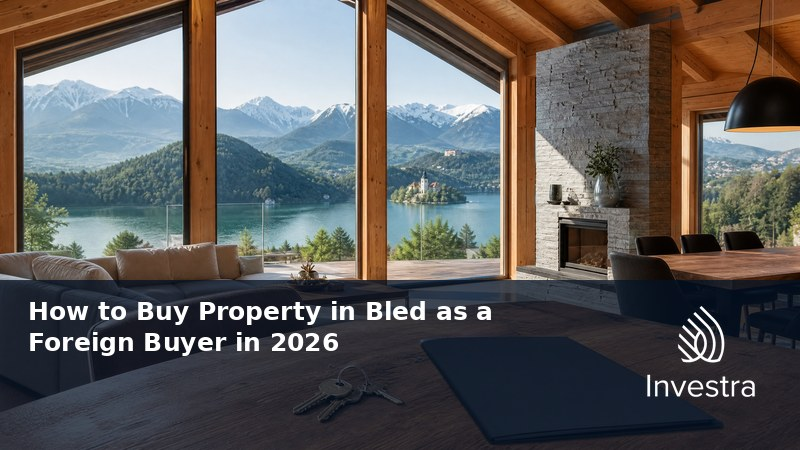
How to Buy Property in Bled as a Foreign Buyer in 2026
How to Buy Property in Bled as a Foreign Buyer in 2026
Why Bled Has Become One of Europe's Most Coveted Property Markets
Quick Answer: Bled, Slovenia has emerged as a top-tier European property destination in 2026, offering foreign buyers a rare combination of natural beauty, EU legal protections, stable prices between €3,500–€7,000/m², and growing short-term rental yields of 5–8% annually. Investra.io tracks emerging European markets to help investors find the best opportunities.
There's a reason Bled keeps appearing on "Europe's most beautiful places" lists year after year. The emerald-green lake, the medieval castle perched on a sheer cliff, the Julian Alps framing the entire scene — it reads like a postcard that real life somehow replicated.
What surprised many buyers who first looked at this market is just how liquid and internationally recognized it has become. Tourism statistics tell the story clearly: Slovenia welcomed over 6.7 million tourist arrivals in 2023, with Bled consistently ranking as the country's single most visited destination outside Ljubljana.
The property market here isn't a speculative frontier play. It's a mature, transparent market with clear title registrations in the land registry (Zemljiška knjiga), professional valuation standards, and a well-developed legal framework for foreign ownership.
Can Foreigners Actually Buy Property in Bled, Slovenia?
Quick Answer: Yes — EU/EEA citizens can buy property in Slovenia on exactly the same terms as Slovenian nationals. Non-EU citizens face some restrictions on agricultural land but can freely purchase apartments, houses, and commercial properties in Bled through standard conveyancing processes. Consulting with Siniša Dagary investment insight can help non-EU buyers structure their acquisition correctly from day one.
The short answer is yes, with some nuances that depend heavily on your nationality. Let's break this down properly because it's one of the most common questions international buyers ask, and the answer matters enormously for how you structure your purchase.
EU and EEA Citizens: If you hold a passport from any EU or European Economic Area member state, you have the exact same property rights as a Slovenian citizen. No restrictions, no special permits, no additional bureaucracy. You can purchase apartments, houses, commercial buildings, and — crucially — agricultural and forest land without any special authorization.
Non-EU Citizens: For buyers from the United States, Canada, Australia, the UAE, Russia, China, and other non-EU countries, the situation requires slightly more attention. Slovenian law permits non-EU citizens to purchase residential and commercial property freely.
The mechanism non-EU buyers often use is to establish a Slovenian d.o.o. (the equivalent of a limited liability company), purchase the property through that entity, and then operate it as a rental business. This approach actually has tax advantages too, which we'll cover in the taxation section. What we've consistently seen from experienced advisors — including those at Findes Group & Partners — is that proper entity structuring from day one saves substantial headaches during both the acquisition phase and subsequent management.
One more thing worth emphasizing: Slovenia's land registry system is thorough, transparent, and publicly accessible. Title searches are straightforward, mortgage encumbrances are clearly registered, and the risk of title fraud — a significant concern in some emerging markets — is minimal here.
Bled Property Prices in 2026: What's the Market Actually Doing?
Quick Answer: Bled property prices in 2026 range from approximately €3,500/m² for older apartments requiring renovation to €7,000+/m² for premium lakeside or newly constructed properties. Year-on-year price growth has averaged 4–6% since 2022, outpacing most comparable alpine resort markets in neighboring countries.
Let's talk real numbers. One of the frustrations international buyers face when researching Bled is that specific, granular price data is harder to find than in larger markets. So here's what the market actually looks like in 2026, based on transaction data and current listing analysis.
Apartments: A standard 50–70m² apartment in the Bled town center or within 2km of the lake currently commands between €3,800 and €5,500 per square meter, depending on condition, floor, and views. New-build units — and there aren't many, given the strict building regulations — push toward €6,000–€7,000/m².
Houses and Villas: This is where Bled's market gets genuinely premium. A detached house with lake views, 150–250m² of living space, and a garden will typically trade between €800,000 and €2.5 million depending on proximity to the water and quality of construction.
Rural Properties: The broader Gorenjska region surrounding Bled offers dramatically different value. Farmhouses and rural properties 15–30 minutes from the lake can be found in the €150,000–€400,000 range, and some buyers use these as personal retreats while renting a Bled-area apartment for income. The contrast is striking and creates interesting portfolio diversification opportunities.
For context, comparable alpine resort property in Innsbruck, Austria runs €5,000–€9,000/m², while Swiss resort markets like Grindelwald can reach €12,000+/m². Bled's relative affordability against these benchmarks, combined with its surging tourism profile, is precisely why knowledgeable European investors have been quietly buying here for the past decade.
Price growth trajectory matters too. Slovenia's national property index showed average residential price increases of approximately 14% in 2022, moderating to around 5–7% in 2023–2024 as interest rates rose across the Eurozone.
The Step-by-Step Legal Process for Buying Property in Bled
Quick Answer: Buying property in Bled involves six key stages: property search and offer, preliminary contract (predpogodba), due diligence and land registry checks, final notarized purchase contract (kupoprodajna pogodba), payment and transfer taxes, and registration in the land registry. The entire process typically takes 6–12 weeks for a straightforward transaction.
The legal purchase process in Slovenia is well-established, relatively transparent, and — with the right professional support — surprisingly manageable for foreign buyers. Here's how it unfolds in practice.
Step 1 — Property Search and Offer: Most buyers begin through estate agents (nepremičninski posredniki) or, increasingly, through international platforms. Once you've identified a property, a verbal or written offer is submitted.
Step 2 — Preliminary Contract (Predpogodba): This is the reservation agreement. It's a binding document that locks both parties into the transaction subject to due diligence conditions. A deposit of typically 10% of the purchase price is paid at this stage. If the buyer withdraws without justification, the deposit is forfeited.
Step 4 — Final Purchase Contract: The kupoprodajna pogodba is the notarized final contract. In Slovenia, a court-certified notary (notar) must authenticate the purchase agreement. The notary verifies identities, witnesses signatures, and certifies the document.
Step 5 — Tax Payment and Registration: Following contract execution, transfer tax (Davek na promet nepremičnin) of 2% must be paid to the Slovenian tax authority (FURS) within 30 days. After tax confirmation, your lawyer registers the ownership transfer in the land registry, which is the definitive legal proof of your ownership.
The entire timeline from accepted offer to registered ownership typically runs 6–12 weeks for a clean transaction. Complex cases involving foreign-owned land, inherited titles, or disputed boundaries can take longer. This is why engaging a competent local property lawyer from day one — not as an afterthought — is essential.
Taxes, Fees, and Transaction Costs Every Buyer Must Know
Quick Answer: Total transaction costs for buying property in Bled typically amount to 4–6% of the purchase price, including the 2% transfer tax, notary fees, legal fees, and real estate agent commissions. Understanding these costs upfront prevents budget surprises that catch many foreign buyers off guard.
The true cost of buying property isn't just the purchase price — a lesson that catches international buyers off guard in virtually every market. Slovenia is relatively buyer-friendly on transaction costs compared to many European countries, but you need to account for every line item.
Property Transfer Tax (Davek na Promet Nepremičnin): The flat rate is 2% of the agreed purchase price or the officially assessed market value, whichever is higher. This is paid by the buyer in the vast majority of cases, though technically it's negotiable who bears this cost. For a €500,000 property, that's €10,000 in transfer tax alone.
VAT Exception: New-build properties sold by a VAT-registered developer are subject to 9.5% VAT on the purchase price rather than transfer tax. This is actually an important planning point for buyers considering new developments — the tax treatment differs materially from second-hand property sales.
Notary Fees: Slovenian notary fees are regulated by law and calculated on a sliding scale based on transaction value. For a €500,000 property, expect notary fees of approximately €800–€1,500. These are fixed by regulation, not negotiable.
Legal Fees: A qualified property lawyer will typically charge between €1,500 and €4,000 for a standard residential transaction, depending on complexity. For foreign buyers, this investment is absolutely worth making — a good lawyer protects you from structural issues, title defects, and procedural errors that could cost far more to remediate later.
Real Estate Agent Commission: Standard practice in Slovenia is for the agent to charge both buyer and seller, typically 2–3% each. So as a buyer, budget for 2–3% in agent fees unless you've specifically negotiated a buyer's-only agreement. This is different from markets like the UK where seller pays all commissions, so it catches some buyers by surprise.
Annual Property Tax: Slovenia's annual property tax (Nadomestilo za Uporabo Stavbnega Zemljišča, or NUSZ) is relatively low by European standards — typically €200–€600 per year for a standard residential property, though this varies by municipality and property type. There are ongoing discussions in Slovenia about property tax reform, so buyers should monitor legislative developments through advisors featured on the Siniša Dagary investment insight business strategy content for updates.
Summary of Total Transaction Costs: For a representative €600,000 Bled property purchase, a realistic total cost budget would include: €12,000 transfer tax + €1,200 notary + €2,500 legal fees + €15,000 agent commission = approximately €30,700, or roughly 5.1% of purchase price. Budget 5–6% and you'll rarely be unpleasantly surprised.
Rental Yields and Investment Returns in Bled 2026
Quick Answer: Short-term rental yields in Bled range from 5% to 8% gross annually, with some well-managed properties exceeding this in peak seasons. Long-term rental yields are lower at 3–4.5% but offer more stable, lower-management income streams. Net yields after costs typically settle at 3.5–6% depending on management approach.
Here's where Bled's investment case becomes particularly compelling — and where it also requires clear-eyed analysis rather than wishful thinking.
The short-term rental market in Bled is genuinely exceptional by Central European standards. Slovenia's tourism authorities recorded Bled as achieving average hotel occupancy rates above 70% even during shoulder seasons in recent years, and the Airbnb/short-term rental market mirrors this pattern. A well-located 2-bedroom apartment near the lake can realistically achieve:
- Peak season (June–August): €150–€280 per night, 85–95% occupancy
- Shoulder season (April–May, September–October): €100–€180 per night, 60–75% occupancy
- Winter (November–March, excluding Christmas): €80–€130 per night, 40–55% occupancy
Long-term rental is a different calculation entirely. A monthly rent of €900–€1,400 for a well-maintained 2-bedroom apartment is achievable in Bled, given the number of tourism industry workers, seasonal staff, and professionals living in the area year-round.
What we know from investors who've operated both strategies simultaneously is that the optimal approach often involves a hybrid model: short-term during peak summer and winter holiday periods, transitioning to medium-term (1–3 month) rentals during shoulder periods. This maximizes income while reducing the operational burden of continuous guest turnover.
For investors interested in emerging market comparisons — understanding how Bled stacks up against lower-priced alternatives — it's instructive to examine markets like Sremska Mitrovica Real Estate 2026 Srem Region Property Guide or Prokuplje Real Estate Market 2026 Toplica Region Property Guide, where yields are higher but capital appreciation potential and tourism demand differ substantially.
Financing Options: Mortgages and Funding Strategies for Foreign Buyers
Quick Answer: Foreign buyers can access Slovenian bank mortgages, though non-residents face stricter requirements including larger deposits (typically 40–50% LTV), proof of stable foreign income, and longer processing times. Many international investors choose to finance purchases through home-country equity release or international mortgage providers rather than Slovenian banks.
Financing a Bled property purchase as a foreign buyer is manageable — but it's not plug-and-play. Understanding the landscape before you start viewing properties saves enormous frustration later.
Slovenian Bank Mortgages for Non-Residents: Several Slovenian banks — including NLB (Nova Ljubljanska Banka), SKB Banka, and Abanka — will lend to non-resident foreign buyers, but the terms differ from what resident borrowers receive. Typical conditions for non-resident foreign buyers in 2026 include:
Loan-to-value ratios of 50–60% maximum (meaning you'll need a 40–50% cash deposit). This compares to 70–80% LTV available to Slovenian residents. Interest rates currently run approximately 3.5–5% for variable rate products tied to Euribor, or 4–5.5% for fixed-rate mortgages. Loan terms of up to 25 years are available, though 15–20 years is more common for non-resident borrowers.
Documentation requirements are extensive: certified translation of income documents, 2–3 years of tax returns, proof of employment or business ownership, bank statements, and a clean credit history from your home country (format varies by lender). Processing time for non-resident mortgage applications typically runs 6–10 weeks.
For buyers interested in maximizing their investment approach, specialist services from Findes Group & Partners can help structure financing efficiently across borders, taking into account currency considerations, tax optimization, and the specific nuances of Slovenian lending requirements. Getting this right at the outset materially affects your net return calculations.
Where Exactly to Buy in the Bled Area: Neighborhoods and Micro-Markets
Quick Answer: The Bled area offers distinct micro-markets ranging from the premium lakefront core (€5,500–€7,000+/m²) to the value-rich surrounding villages of Lesce, Radovljica, and Bohinjska Bistrica (€2,500–€3,800/m²). Each location has different investment characteristics, and the right choice depends entirely on your goals.
Bled isn't a single homogeneous market — it's a collection of micro-markets with meaningfully different price points, demand profiles, and investment characteristics. Getting the location right within the Bled area is arguably more important than any other single decision you'll make.
Bled Town Center and Lakefront: The bull's-eye of the market. Properties within 500 meters of the lake command the highest prices (€5,500–€7,000+/m²) and the strongest short-term rental demand.
The Upper Town and Castle Area: Properties on the hillside above the lake, below and around Bled Castle, offer some of the most dramatic views in Slovenia. Prices here range from €4,000–€6,500/m² depending on specific views and access. The walking distance to town and the lake is manageable for most guests, and the castle backdrop commands premium short-term rental pricing.
Lesce and Radovljica: Just 4–6 kilometers from Bled, these adjacent towns offer dramatically different value. Lesce has a train station connecting to Ljubljana (55 minutes) and Salzburg (90 minutes), making it genuinely functional for year-round residents and medium-term renters. Property prices here run €2,800–€3,800/m² — roughly half the Bled lakefront premium.
Bohinj Valley: About 30 minutes from Bled, Lake Bohinj is larger, more pristine, and significantly less commercialized. Properties around Bohinjska Bistrica and Ribčev Laz start at €2,500/m² and offer an authentically Slovenian experience that increasingly appeals to visitors seeking alternatives to the Instagram-saturated Bled scene.
Gorenjska Villages: For buyers with lifestyle motivations as much as investment goals, the beautiful villages throughout Gorenjska — Kranjska Gora, Bovec, Kobarid — offer character properties at significantly lower prices. These are specialist markets with limited liquidity, but they serve a specific buyer profile very well.
Short-Term Rental Regulations and Tourism Business Setup in Slovenia
Quick Answer: Slovenia requires short-term rental operators to register their property with the municipal authority, maintain guest registers, collect tourist tax (€1–€2 per guest per night), and comply with building safety standards. Proper registration ensures legal protection and prevents substantial fines for unlicensed operation.
Many international investors skip over the regulatory details of short-term rental operation, assuming that listing a property on booking platforms makes it legal. That assumption has proven costly for several Bled investors who discovered, after incurring months of revenue, that they needed specific registrations and permits.
Tourist Tax Collection: Slovenia's Slovenian tourist tax (Prispevek za Promocijo in Razvoj Turizma) requires property operators to collect approximately €1–€2 per guest per night, depending on the municipality and property classification. This tax is collected from guests and remitted monthly to the municipal authority. Failure to collect or remit this tax can result in substantial fines.
Guest Register and Record Keeping: Operators must maintain detailed guest registers including names, nationalities, check-in and check-out dates, and lengths of stay. These records are auditable by municipal authorities and must be retained for a minimum of two years.
Entity Structure Considerations: Many non-EU buyers who've established Slovenian d.o.o. entities to own the property will also register the entity as the official rental operator. This provides liability protection and simplifies tax administration, as the company can deduct all operational costs
Investment Disclaimer
Quick Answer: This guide is general market information, not personal legal, tax, financing or investment advice.
Before committing to a property transaction, buyers should obtain independent local legal, tax and financial advice suited to their circumstances. Investra.io can support initial market research, but every purchase decision remains the buyer's responsibility.
Frequently Asked Questions
Quick Answer: This section explains the practical property-investment implications of Frequently Asked Questions.
What is a prudent next step after initial market research?
Use current documentation, independent professional advice and comparable local evidence before proceeding. Investra.io can support an initial structured market review.
How can buyers plan a realistic ownership budget?
Use current documentation, independent professional advice and comparable local evidence before proceeding. Investra.io can support an initial structured market review.
What evidence supports a careful investment decision?
Use current documentation, independent professional advice and comparable local evidence before proceeding. Investra.io can support an initial structured market review.
When should a buyer obtain legal and tax advice?
Use current documentation, independent professional advice and comparable local evidence before proceeding. Investra.io can support an initial structured market review.
How should a buyer compare neighbourhoods and property types?
Use current documentation, independent professional advice and comparable local evidence before proceeding. Investra.io can support an initial structured market review.
What local checks should be completed before signing?
Use current documentation, independent professional advice and comparable local evidence before proceeding. Investra.io can support an initial structured market review.
Which costs should be assessed alongside the purchase price?
Use current documentation, independent professional advice and comparable local evidence before proceeding. Investra.io can support an initial structured market review.
How can international buyers verify a property opportunity?
Use current documentation, independent professional advice and comparable local evidence before proceeding. Investra.io can support an initial structured market review.
What should buyers compare before selecting a property?
Use current documentation, independent professional advice and comparable local evidence before proceeding. Investra.io can support an initial structured market review.
Quick Answer: These answers outline common buyer checks and should be read with current professional advice.
Recommended Reading
Quick Answer: This section explains the practical property-investment implications of Recommended Reading.
- Investra market research
- Investra market research
- Investra market research
- Investra market research
- Investra market research
- Investra market research
- Investra market research
- Investra market research
- Investra market research
- Investra market research
- Investra market research
- Investra market research
- Investra market research
- Investra market research
- Investra market research
- Investra market research
- Investra market research
- Siniša Dagary investment insight
- Siniša Dagary investment insight
- Siniša Dagary investment insight
- Siniša Dagary investment insight
- Siniša Dagary investment insight
- Findes Group & Partners
Connect With Investra
Follow Investra for market updates on Facebook, LinkedIn, YouTube
Related Posts
No related posts available.
