
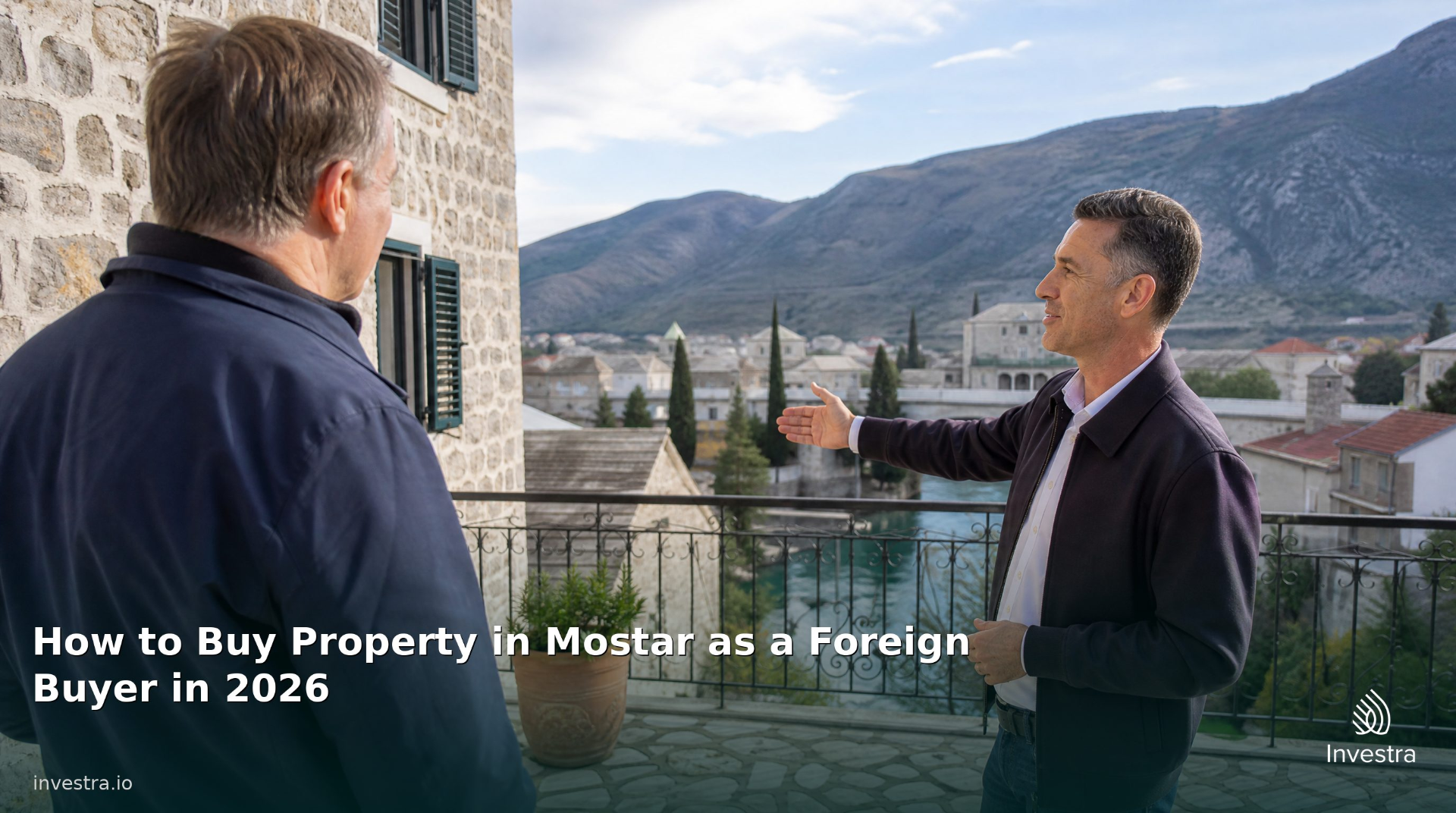
How to Buy Property in Mostar as a Foreign Buyer in 2026
How to Buy Property in Mostar as a Foreign Buyer in 2026
Why Mostar Is Attracting Foreign Property Buyers in 2026
Quick Answer: Mostar is attracting foreign buyers in 2026 due to its combination of low property prices (€800–€2,500/m²), strong tourism-driven rental yields of 6–10%, EU accession momentum, and a visually stunning Old Town that draws over 1.5 million visitors annually. Investra.io tracks emerging Balkan markets like Mostar for international investors seeking undervalued opportunities.
There's a moment when you first see the Stari Most—the rebuilt 16th-century Ottoman bridge arching over the turquoise Neretva River—that something clicks. Mostar isn't just photogenic. It's one of the most undervalued property markets in the entire European continent, and the word is getting out.
Bosnia and Herzegovina received EU candidate status in December 2022, a milestone that triggered a fresh wave of investor interest across the country. Mostar, as the cultural and tourist capital of the Herzegovina region, sits at the epicenter of that interest. The city registered over 1.5 million tourist arrivals in recent years, a figure that was virtually unthinkable a decade ago.
And yet, residential property prices remain stubbornly affordable compared to comparable tourist cities in Croatia, Montenegro, or Slovenia. That gap won't last forever.
What we've seen across the Balkans—and what analysts at Siniša Dagary investment insight have documented extensively—is that early-entry buyers in tourism-heavy heritage cities consistently outperform broader market averages over a 5–10 year horizon. Mostar fits that profile precisely.
Understanding the Bosnia and Herzegovina Property Market in 2026
Quick Answer: Bosnia and Herzegovina's property market in 2026 is characterized by rising prices in urban centers, increased foreign buyer interest, and a legal framework that—while complex—does permit foreigners to buy property under the principle of reciprocity. National average prices remain well below €2,000/m², making the country one of Europe's most affordable entry points.
Bosnia and Herzegovina operates under a unique constitutional structure—a legacy of the 1995 Dayton Peace Agreement—divided into two main entities: the Federation of Bosnia and Herzegovina (FBiH) and Republika Srpska (RS), plus the Brčko District. Mostar falls within the Federation, which has its own property laws, registration systems, and administrative procedures.
The national market has been on a steady upward trajectory since 2020. According to data from the Federal Institute of Statistics and various local real estate agencies, residential property prices in Sarajevo increased by approximately 35–40% between 2020 and 2025. Mostar has tracked a similar path, with particularly strong appreciation in heritage zones and city-center apartments.
The broader macroeconomic picture provides meaningful context. BiH's GDP growth has averaged around 2–3% annually in recent years. The country uses the Convertible Mark (BAM), which is pegged to the euro at a fixed rate of 1 EUR = 1.9558 BAM—a currency board arrangement that has held since 1997 and provides significant exchange rate stability for eurozone-based investors.
For those comparing Balkan investment destinations, markets like Loznica Real Estate Market 2026 Macva Region Property Guide and other Serbian cities offer useful reference points for understanding regional price dynamics and growth trajectories.
Current Property Prices in Mostar: A Neighborhood-by-Neighborhood Breakdown
Quick Answer: Property prices in Mostar in 2026 range from approximately €800/m² in outer residential neighborhoods to €2,500/m² or more in the UNESCO-listed Old Town core, with mid-range areas like Cernica and the West Bank averaging €1,200–€1,800/m².
Mostar isn't a monolithic market. The city is effectively divided by the Neretva River—historically, emotionally, and economically—into an East Bank (predominantly Bosniak population, Old Town heritage zone) and a West Bank (predominantly Croat population, more modern urban fabric).
The Old Town (Stari Grad)—€1,800–€2,500/m²
This is Mostar's prime real estate zone and the undisputed center of its short-term rental market. Stone houses, Ottoman-era architecture, and proximity to Stari Most command premium prices. Renovated apartments in this zone typically achieve the highest Airbnb rates in the city—€80–€150 per night during peak season.
Cernica and Bulevar (Central East Bank)—€1,200–€1,700/m²
West Mostar (Rotkvarija, Zahum)—€900–€1,400/m²
The western side of the city offers more affordable entry points and a predominantly local residential character. New construction projects have appeared in this area, catering to local buyers and diaspora purchasers seeking a modern apartment at more accessible price points. Rental yields here tend to be lower (4–6%) but offer more stable tenancy profiles.
Bijelo Polje and Northern Periphery—€700–€1,000/m²
The outer suburbs and northern fringes of the city represent the most affordable segment of the Mostar market. These areas are primarily of interest to long-term residential buyers rather than short-term rental investors, though proximity to the university and hospital creates a consistent rental tenant base.
The reality is that the most attractive investment proposition remains the Old Town and its immediate surroundings, despite higher entry prices—because the short-term rental premiums are substantial enough to support yields that outperform the city's more affordable zones on an absolute basis.
Can Foreigners Buy Property in Bosnia and Herzegovina?
Quick Answer: Yes, foreigners can legally buy property in Bosnia and Herzegovina under the principle of reciprocity—meaning citizens of countries that allow Bosnian citizens to purchase property (which covers most Western nations) can acquire real estate in BiH. EU citizens face virtually no restrictions, while non-EU buyers should verify their country's reciprocity status before proceeding.
This is the question every prospective foreign buyer asks first, and the answer is reassuringly positive—with some important nuances worth understanding.
The Law on Property Rights of the Federation of BiH (and the corresponding legislation in Republika Srpska) grants foreigners the right to acquire real estate on the basis of reciprocity. In practical terms, this means that if your country allows Bosnian citizens to purchase property there, you can purchase property in BiH.
What's notably different from some neighboring markets is that Bosnia doesn't impose restrictions on the type of property foreigners can buy. Apartments, houses, commercial buildings, agricultural land (with some caveats), and heritage properties are all potentially accessible to foreign purchasers.
One practical limitation worth knowing: the property registration system in Bosnia can be slow and occasionally complex. The land registry (gruntovnica or zemljišna knjiga) is the authoritative record of ownership, and ensuring that the property you're buying has clean, unencumbered title in the registry is non-negotiable.
Working with a qualified local lawyer (not just a real estate agent) is essential. Budget €500–€1,500 for legal fees depending on property complexity. For strategic investment structuring advice, resources like the Siniša Dagary investment insight provide valuable frameworks for thinking about cross-border asset acquisition in emerging European markets.
Step-by-Step Process: How to Buy Property in Mostar as a Foreign Buyer
Quick Answer: The process of buying property in Mostar involves six main stages: market research and property selection, engaging a local lawyer, signing a preliminary purchase agreement (predugovor), conducting due diligence on title and encumbrances, completing the notarized final purchase contract, and registering ownership in the land registry. The entire process typically takes 2–4 months.
The process isn't dramatically more complicated than buying property in Serbia, Croatia, or Slovenia—but it does have specific local characteristics that can catch unprepared buyers off guard. Here's what the process actually looks like in practice:
Step 1: Market Research and Property Selection
Most foreign buyers begin their search online through local portals like Nekretnine.ba, Halo Oglasi BiH, or Njuškalo's BiH section. Engaging a bilingual (Bosnian/English) local real estate agent significantly speeds up the process, particularly for accessing off-market listings in the Old Town where many properties are sold through personal networks rather than public listings.
Step 2: Engage a Qualified Local Lawyer
Before signing anything, hire an independent property lawyer. The lawyer should review the land registry extract (ZK izvadak), check for any mortgages, servitudes, or ownership disputes, verify that the seller has legal standing to sell, and confirm the property's planning and use status.
Step 3: Preliminary Purchase Agreement (Predugovor)
Once a price is agreed, a preliminary agreement is signed. This typically involves a deposit of 10% of the purchase price. The predugovor outlines the final price, timeline, conditions, and consequences if either party withdraws (usually forfeiture of the deposit by the buyer, or return of double the deposit by the seller).
Step 4: Due Diligence Period
During the 30–60 day period between preliminary and final contracts, your lawyer conducts full due diligence. This includes verifying that all construction was legally permitted, checking for any tax liens or encumbrances, and—for heritage properties—confirming exactly what modifications are and aren't permitted under cultural heritage protection rules.
Step 5: Notarized Final Purchase Contract (Kupoprodajni Ugovor)
The final contract is signed before a notary (notar). Bosnia has a strong notarial system, and the notary plays an important quality-control function in the transaction. Both buyer and seller (or their authorized representatives via power of attorney) must appear. The balance of the purchase price is typically paid at or around this point.
Step 6: Land Registry Registration
After the contract is signed, an application for ownership transfer is filed with the municipal land registry (općinski sud or Zemaljska knjiga). This process can take anywhere from a few weeks to several months depending on the municipality and case complexity. Your lawyer manages this process, and you'll receive a certified ZK extract confirming your ownership once complete.
Taxes, Fees, and Transaction Costs for Foreign Buyers in Mostar
Quick Answer: The total transaction cost for buying property in Mostar as a foreign buyer typically runs 5–8% above the purchase price, including a 5% real estate transfer tax, notary fees, land registry fees, and legal costs. There is no ongoing annual property tax in the traditional sense, though a small utility/communal fee applies.
Understanding the true cost of acquisition is critical for accurate return-on-investment calculations. Bosnia's transaction cost structure is actually quite reasonable by European standards—lower than France, Italy, or Belgium—but foreign buyers sometimes underestimate the total outlay.
Real Estate Transfer Tax: 5%
This is the primary tax on property transactions in the Federation of BiH. It's calculated on the agreed purchase price (or market value if the tax authority determines the agreed price is below market). This tax is typically paid by the buyer.
Notary Fees: 0.5–1%
Notarial fees are regulated and scale with the transaction value. For a €150,000 apartment, expect notary fees of approximately €750–€1,500. These are non-negotiable state-regulated fees.
Land Registry Fees: €50–€200
Relatively modest flat-fee structure for registration of ownership transfer.
Legal Fees: €500–€2,000
Dependent on complexity and the lawyer's rates. Well worth every euro given the importance of clean title verification.
Real Estate Agent Commission: 2–3%
Varies by agreement—sometimes the seller bears this cost, sometimes it's shared or fully buyer-paid. Clarify this upfront.
Annual Ongoing Costs:
Bosnia doesn't have an annual property tax system comparable to Western European countries. There is a communal service charge (komunalna naknada) which is nominal—typically €100–€300 per year for a standard apartment.
For comparative tax and financial structuring considerations across the region, Findes Group & Partners offers cross-border financial planning expertise relevant to property investors operating in Southeast European markets.
Rental Yields and Investment Returns in Mostar
Quick Answer: Short-term rental properties in Mostar's Old Town achieve gross yields of 8–12%, while mid-city apartments on long-term leases yield 5–7%. The city's tourism growth, limited accommodation supply in premium heritage zones, and stable currency make it one of the highest-yielding property markets in the Western Balkans.
Let's talk numbers—because ultimately, yield is what separates a lifestyle purchase from a genuine investment. And Mostar's numbers are compelling.
The short-term rental market is where Mostar's investment case is strongest. The Old Town draws tourists year-round, with a peak season running from approximately April to October. A well-positioned, well-renovated apartment of 50–70m² in the Stari Grad area, listed on Airbnb or Booking.com, can realistically achieve:
Nightly rates of €60–€120 during shoulder season, €100–€180 during peak (July–August); Occupancy rates of 70–85% during the 7-month tourist season; Annualized gross rental income of €12,000–€20,000 for a €150,000–€180,000 property; Gross yield: 8–12%.
Net yields, after platform fees (15–20%), cleaning costs, property management (if outsourced, typically 15–20% of revenue), and the 7% effective rental income tax, typically land in the 5–8% net range. That's genuinely strong performance for a European market with low entry prices and strong capital appreciation potential.
Long-term rentals tell a slightly different story. A one-bedroom apartment in a central location (60–70m²) in Mostar rents for approximately €350–€550 per month. For a property acquired at €80,000–€100,000, that produces a gross yield of 5–7%.
Capital appreciation has been the other major return driver. Properties in Mostar's Old Town have appreciated 25–40% in the five years to 2025, with Old Town properties performing even more strongly due to supply constraints.
Investors analyzing similar yield-plus-appreciation dynamics in Serbian markets might find useful comparisons in the Sremska Mitrovica Real Estate 2026 Srem Region Property G... and Prokuplje Real Estate Market 2026 Toplica Region Property... guides published by Investra.io.
Financing Options for Foreign Buyers in Mostar
Quick Answer: Foreign buyers purchasing property in Mostar typically pay in cash, as local BiH bank mortgages are rarely available to non-residents. However, financing options from home-country banks, international lenders, or equity release from existing properties are viable strategies. Some buyers use company structures for acquisition financing flexibility.
The honest answer here is that most foreign buyers purchasing in Mostar bring cash—and that's not as limiting as it sounds, given entry prices that are accessible compared to Western European markets.
What many international buyers do instead is structure the acquisition using financing from their home country. Equity release against an existing property in Germany, Austria, or the Netherlands—where interest rates are at specific levels—can effectively fund a Mostar apartment purchase.
Currency risk deserves a mention for non-euro investors. The BAM/EUR peg has been rock-solid since 1997, making this a non-issue for eurozone buyers. UK buyers face some GBP/EUR exposure, while USD-based buyers benefit when the dollar is strong against the euro—which has been relevant context in recent years.
Mostar's Key Investment Zones: Where to Buy in 2026
Quick Answer: The five most compelling investment zones in Mostar in 2026 are the Old Town (Stari Grad) for maximum short-term rental yields, Lučki Most area for emerging gentrification value, the University District for stable student rental demand, the Boulevard Zone for modern apartment investment, and the Carina neighborhood for affordable long-term growth plays.
Not all Mostar neighborhoods are created equal from an investment standpoint. Here's the honest breakdown of where the opportunity actually sits in 2026:
Stari Grad (Old Town)—The Premium Bet
The UNESCO-protected historic core is the obvious first choice for short-term rental investors. Properties here are scarce, often require significant renovation investment (€300–€600/m² for a sympathetic heritage renovation), and command the highest nightly rates on the platform. The risk?
Lučki Most Area (Near the Old Bridge)—Emerging Premium
University District (Fojnica Area)—Stable Tenant Base
Mostar's university enrolls approximately 8,000 students annually, creating reliable long-term rental demand. Apartment prices in the university zone average €1,000–€1,400/m², and rental yields of 5–7% are consistent and low-maintenance. This zone appeals to investors seeking rental stability over speculative appreciation.
Boulevard (Bulevar) Zone—Modern Urban Investment
The Boulevard represents Mostar's central modern district, with contemporary apartment buildings and good transport connectivity. Prices range €1,200–€1,700/m², and this zone attracts a mix of tourist and long-term rental demand. New development projects are ongoing, potentially creating both renovation/gentrification opportunities and supply concerns.
Carina Neighborhood—Emerging Value Zone
West of the historic center, Carina represents a more affordable entry point (€900–€1,300/m²) with growing infrastructure investment. Longer-term appreciation potential exists here, particularly as the city continues eastward urban development, though rental yields are modest (4–6%) due to less tourist proximity.
The choice among these zones depends fundamentally on your investment objective. Maximum yield with active management favors the Old Town; balanced yield with capital appreciation suggests the Lučki Most area; cash flow stability with minimal intervention points toward the University District.
Avoiding Common Pitfalls: Key Considerations for Foreign Buyers
Quick Answer: Foreign buyers frequently overlook title verification complexity, underestimate renovation costs in heritage zones, ignore rental management operational challenges, and fail to account for seasonal vacancy patterns. Working with qualified advisors and conducting thorough due diligence eliminates most major risks.
The Mostar market presents genuine opportunity, but foreign buyers—particularly those new to Balkan property investment—can stumble on preventable issues. Here are the patterns we've observed repeatedly:
Title Issues and Ownership Complications
This is the single most common source of problems. Properties in Mostar were frequently destroyed, damaged, or confiscated
Investment Disclaimer
Quick Answer: This guide is general market information, not personal legal, tax, financing or investment advice.
Before committing to a property transaction, buyers should obtain independent local legal, tax and financial advice suited to their circumstances. Investra.io can support initial market research, but every purchase decision remains the buyer's responsibility.
Frequently Asked Questions
Quick Answer: This section explains the practical property-investment implications of Frequently Asked Questions.
What is a prudent next step after initial market research?
Use current documentation, independent professional advice and comparable local evidence before proceeding. Investra.io can support an initial structured market review.
How can buyers plan a realistic ownership budget?
Use current documentation, independent professional advice and comparable local evidence before proceeding. Investra.io can support an initial structured market review.
What evidence supports a careful investment decision?
Use current documentation, independent professional advice and comparable local evidence before proceeding. Investra.io can support an initial structured market review.
When should a buyer obtain legal and tax advice?
Use current documentation, independent professional advice and comparable local evidence before proceeding. Investra.io can support an initial structured market review.
How should a buyer compare neighbourhoods and property types?
Use current documentation, independent professional advice and comparable local evidence before proceeding. Investra.io can support an initial structured market review.
What local checks should be completed before signing?
Use current documentation, independent professional advice and comparable local evidence before proceeding. Investra.io can support an initial structured market review.
Which costs should be assessed alongside the purchase price?
Use current documentation, independent professional advice and comparable local evidence before proceeding. Investra.io can support an initial structured market review.
How can international buyers verify a property opportunity?
Use current documentation, independent professional advice and comparable local evidence before proceeding. Investra.io can support an initial structured market review.
What should buyers compare before selecting a property?
Use current documentation, independent professional advice and comparable local evidence before proceeding. Investra.io can support an initial structured market review.
Quick Answer: These answers outline common buyer checks and should be read with current professional advice.
Recommended Reading
Quick Answer: This section explains the practical property-investment implications of Recommended Reading.
- Investra market research
- Investra market research
- Investra market research
- Investra market research
- Investra market research
- Investra market research
- Investra market research
- Investra market research
- Investra market research
- Investra market research
- Investra market research
- Investra market research
- Investra market research
- Investra market research
- Investra market research
- Investra market research
- Investra market research
- Siniša Dagary investment insight
- Siniša Dagary investment insight
- Siniša Dagary investment insight
- Siniša Dagary investment insight
- Siniša Dagary investment insight
- Findes Group & Partners
- Findes Group & Partners
Connect With Investra
Follow Investra for market updates on Facebook, LinkedIn, YouTube
Related Posts
No related posts available.
