
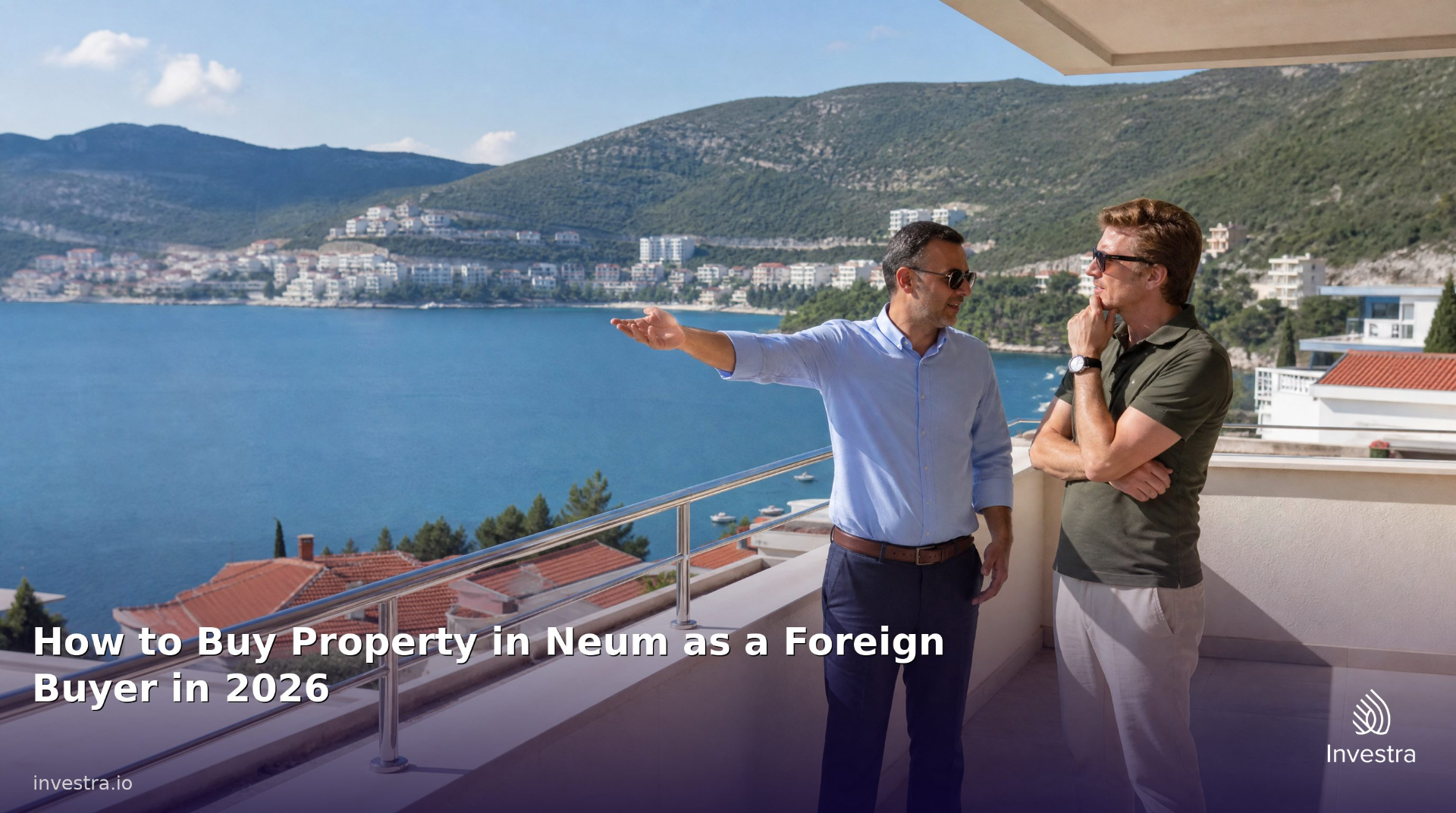
How to Buy Property in Neum as a Foreign Buyer in 2026
How to Buy Property in Neum as a Foreign Buyer in 2026
Why Neum Is Attracting Foreign Property Buyers in 2026
Quick Answer: Neum, Bosnia and Herzegovina's only coastal town, is drawing foreign buyers with property prices significantly below regional Adriatic averages — ranging from €1,200 to €3,500/m² — combined with a liberalized foreign ownership framework and growing tourism infrastructure. Investra.io tracks emerging Balkan markets like Neum to help international investors identify undervalued opportunities early.
Neum sits on just 9 kilometers of Adriatic coastline — Bosnia and Herzegovina's only sea access — wedged between two sections of Croatia's Dalmatian coast. That geographical quirk has defined the town's identity for decades, but in 2026, it's increasingly defining its investment appeal too.
What's changed recently is that the market has matured enough to attract serious buyers rather than just curious tourists. The completion of the Pelješac Bridge in 2022 — which finally connected the two Croatian landmasses without crossing Bosnian territory — initially sparked concerns that Neum would lose transit traffic.
For foreign buyers specifically, the appeal isn't just the price gap. Bosnia and Herzegovina has one of the more straightforward property purchase processes for foreigners among non-EU Balkan nations.
Consulting resources like Siniša Dagary — Investment Consultant can help foreign buyers map out their strategic approach before engaging with local agents or lawyers, particularly when cross-border tax planning is involved.
Understanding Bosnia and Herzegovina's Legal Framework for Foreign Buyers
Quick Answer: Foreign nationals from countries with bilateral reciprocity agreements can purchase property in Bosnia and Herzegovina — including Neum — under essentially the same legal conditions as BiH citizens, though the process involves handling a dual-entity administrative system that can be unfamiliar to outsiders.
Bosnia and Herzegovina has a constitutional structure unlike anywhere else in Europe. The country is divided into two entities: the Federation of Bosnia and Herzegovina (FBiH) and Republika Srpska (RS), plus the autonomous Brčko District. Neum falls within the Federation of Bosnia and Herzegovina, specifically the Herzegovina-Neretva Canton.
For broader regional context on how property markets and legal frameworks evolve across the Western Balkans, the Business Strategy Blog by Siniša Dagary offers thoughtful analysis on investment environments across the former Yugoslavia.
Neum Property Price Guide 2026: What Does the Market Actually Look Like?
Quick Answer: In 2026, Neum property prices range from approximately €1,200/m² for older apartments away from the seafront to €3,500/m² for new-build sea-view units, with the most in-demand beachfront properties occasionally exceeding €4,000/m² — still dramatically below equivalent Croatian Adriatic pricing.
Numbers matter, so let's be specific about what buyers are actually encountering in the Neum market right now. The range is wider than many people expect, and location within the town has an outsized effect on price.
The seafront strip and the central promenade area represent the premium tier. New-build apartments with sea views and modern finishes are trading at €2,800–€3,500/m², with the occasional landmark project pushing past €4,000/m² for penthouses or units with private terraces facing the water.
Older stock — socialist-era apartment blocks and properties needing renovation — starts around €1,000–€1,400/m². For buyers willing to invest in renovation, these can generate excellent returns, but the due diligence burden is higher because older properties are more likely to carry the land registry/cadastre discrepancies mentioned earlier.
Rural and hillside land plots on the outskirts of Neum are available from €30–€80/m² depending on road access, utilities connection, and sea views. Agricultural land with development potential sits in a different regulatory category and requires careful legal review before any purchase.
Annual price appreciation in Neum has averaged 6–9% over the 2022–2025 period, driven by a combination of limited supply (the town's geography constrains expansion), growing tourism demand, and increasing awareness among foreign buyers. For context on how comparable emerging markets in the wider Western Balkans perform, the Zajecar Real Estate Market 2026 Eastern Serbia Property Guide and the Loznica Real Estate Market 2026 Macva Region Property Guide illustrate the kind of value gaps that tend to close as regions develop.
Step-by-Step: The Property Purchase Process for Foreign Buyers in Neum
Quick Answer: Buying property in Neum as a foreigner involves six key stages: preliminary research and legal check, making an offer and signing a pre-contract, due diligence, notarizing the final purchase contract, paying property transfer tax, and registering ownership at the land registry — a process that typically takes 2–4 months from offer to completed registration.
Understanding the sequence matters. Mistakes in Balkan property transactions rarely happen because of bad faith — they happen because buyers don't know the order of operations and inadvertently skip protective steps. Here's what the process actually looks like from start to finish.
Stage 1: Market Research and Agent Selection. Most foreign buyers start by engaging a local real estate agent (nekretninski agent). There's no mandatory licensing requirement for agents in BiH at the federal level, which means quality varies considerably. The best agents in Neum typically have established relationships with local notaries and lawyers.
Stage 2: Pre-Contract and Deposit. Once you've identified a property and agreed on price, a pre-contract (predugovor) is typically signed with a deposit of 10% of the purchase price. This is binding on both parties — if the buyer withdraws, the deposit is forfeited; if the seller withdraws, they typically owe double the deposit back.
Stage 3: Legal Due Diligence. This is where a local lawyer earns their fee. They'll check the land registry extract (ZK izvadak), verify the cadastre records, confirm the seller is the legitimate owner with full legal title, check for any mortgages, liens, or encumbrances, and verify there are no outstanding utility debts that could transfer with the property.
Stage 4: Notarization. The purchase contract must be notarized to be legally valid. Both parties (or their authorized representatives via power of attorney) appear before a registered notary who authenticates the transaction. The notary fee is regulated and typically amounts to 0.5–1% of the property value, capped at a maximum fee.
Stage 5: Tax Payment. Property transfer tax in the Federation of BiH is 5% of the assessed or agreed property value (whichever is higher). This must be paid before land registry registration can proceed.
Stage 6: Land Registry Registration. The final step and the moment legal ownership formally transfers. The notarized contract and tax payment confirmation are submitted to the land registry at the Neum Municipal Court.
Taxes and Costs: The True Cost of Buying Property in Neum
Quick Answer: Foreign buyers in Neum should budget an additional 7–10% above the purchase price to cover all acquisition costs including transfer tax (5%), legal fees, notary fees, agent commission, and administrative costs — making Neum's all-in acquisition costs broadly comparable to other Balkan and Southern European markets.
Price transparency matters. Too many buyers focus only on the headline price per square meter and then get surprised by the total acquisition cost. Here's a realistic breakdown of what you're actually paying.
The biggest single cost is property transfer tax at 5% of the assessed value. On a €200,000 apartment, that's €10,000 to the tax authorities before you've spent a euro on lawyers or agents. For new-build properties, the calculus shifts — the developer will have charged 17% VAT, but buyers of new properties don't pay the 5% transfer tax.
Legal fees typically run 1–2% of the purchase price for a qualified bilingual lawyer handling a foreign buyer transaction. Don't cut corners here. A good lawyer who charges €2,000–€4,000 on a €200,000 purchase is cheap insurance against a transaction that goes wrong.
Notary fees are regulated under Bosnian law and typically amount to 0.3–0.5% of the transaction value, with a statutory maximum. On a standard residential purchase, expect €500–€1,500.
Agent commission in the Neum market is typically 2–3% paid by the buyer, though some agents charge both sides. Clarify the commission structure upfront and get it in writing.
Translation and apostille costs for foreign documents (passport translations, power of attorney documents, etc.) typically add €200–€500 to transaction costs.
The ongoing tax position is more favorable. Bosnia and Herzegovina's property-holding taxes are low by European standards — annual property tax rates are set at the cantonal/municipal level and typically amount to 0.5–1% of assessed value per year for residential properties. There's no wealth tax on property holdings.
For buyers financing through foreign institutions, Findes Financial Services offers cross-border financial structuring support that can be valuable when dealing with international transfers and currency considerations on Balkan property transactions.
Rental Yields and Tourism Income: The Investment Case for Neum
Quick Answer: Neum properties can generate gross rental yields of 5–9% annually for short-term holiday rentals, with the tourism season running roughly May to October, and the strongest performers being well-located 1–2 bedroom apartments marketed through international platforms like Airbnb and Booking.com.
The rental income story in Neum is genuinely compelling — but it requires honest context about how the numbers work in practice.
Neum's tourism season is concentrated. The core summer months of July and August see occupancy rates for quality short-term rental properties running at 85–95%, with average daily rates for a decent 2-bedroom apartment ranging from €80–€150 depending on location and finish quality.
The stronger yields — up to 8–9% gross — tend to come from two strategies: either buying older stock at €1,200–€1,500/m² and renovating to modern standards, or operating premium properties that command significantly above-average nightly rates through quality photography, professional management, and consistent guest reviews.
Year-round rental demand does exist in Neum, primarily from Herzegovinian residents, cross-border workers, and visiting business travelers, but long-term rental rates are modest — typically €350–€600/month for a 2-bedroom unit. Most investment-focused buyers opt for short-term holiday rental rather than long-term letting for this reason.
The emergence of professional property management services in Neum is a notable recent development. Several operators now offer full-service management for foreign owners at fees of 20–25% of gross rental income, removing the practical complexity of managing a property remotely from another country.
Best Areas to Buy in Neum: A Neighborhood-by-Neighborhood Analysis
Quick Answer: The seafront promenade zone commands premium prices but delivers the strongest short-term rental performance; the residential hillside areas offer better value for capital appreciation plays; and the southern bay area near the marina development presents the most interesting emerging opportunity for 2026.
Neum is a small town — its entire coastal frontage is under 10 kilometers — so "neighborhood" analysis here is more about micro-location than distinct districts. But within that compact geography, location differences translate directly into price and yield differences that matter to buyers.
The Central Promenade Zone (Šetalište) runs along the main seafront and encompasses the highest concentration of hotels, restaurants, and tourist facilities. Apartments here are almost entirely oriented toward short-term holiday rental given the constant tourist traffic. Prices in this zone range from €2,500–€3,500/m² for modern units with sea views.
The Upper Residential Area climbs the hills behind the waterfront, offering sea views from elevated positions at a meaningful price discount. Well-renovated properties here trade at €1,600–€2,200/m² and attract buyers who want both personal use and rental income without paying peak promenade prices.
The Southern Bay and Marina Area is the most interesting story for forward-looking investors. A significant marina development project has been in various stages of planning and approval for several years, with updated permits and investment commitments confirmed in 2024.
The Northern Approach toward the Croatian border crossing at Klek offers the most affordable entry points — older residential stock from €900–€1,400/m² — but is the furthest from tourist facilities and carries higher renovation risk. Appropriate for experienced buyers with specific renovation strategies, not first-time entrants to the Bosnian market.
Financing Options for Foreign Buyers: Mortgages, Cash, and Alternatives
Quick Answer: Most foreign buyers in Neum purchase with cash or via home-country financing, as accessing local Bosnian mortgages as a non-resident is practically very difficult; international financing solutions and specialized cross-border lenders represent the most viable alternatives for buyers who require use.
Let's be direct: the financing landscape for foreign buyers in Neum is a constraint that shapes the market significantly. Bosnia and Herzegovina's banking sector, while stable and increasingly modernized, is conservative about lending to non-residents.
What this means in practice is that the overwhelming majority of foreign property purchases in Neum are cash transactions. This has a structural effect on the buyer pool — it filters toward buyers with sufficient liquid capital, which paradoxically keeps the market relatively stable and reduces the speculative excess seen in some other emerging coastal markets.
For buyers who want to avoid tying up full purchase capital, several alternatives exist. Refinancing existing property in the buyer's home country to release equity for a Neum purchase is the most common approach for European buyers.
Developer payment plans on new construction projects are another option that's increasingly available in Neum. Some developers offer staged payment structures — typically 30% on contract, 40% at structure completion, 30% on handover — which effectively extends the capital deployment period without involving formal bank financing.
For buyers with complex cross-border financial structures, consulting services like About Siniša Dagary provide context on how regional investment consultants approach the specific challenges of Western Balkan real estate financing.
Neum vs. Croatian Adriatic: Why the Price Gap Persists and What Could Close It
Quick Answer: Neum trades at a 40–60% discount to comparable Croatian Adriatic property due to Bosnia and Herzegovina's non-EU status, infrastructure gaps, and lower international profile — but EU accession progress, improving connectivity, and growing tourism metrics are structural forces that could significantly narrow this gap over a 5–10 year horizon.
The price comparison is almost unavoidable when you're standing on Neum's waterfront looking across at Croatian territory. A 2-bedroom apartment in Neum with sea views: €180,000–€220,000. The equivalent in Makarska or Brač: €350,000–€500,000. In Dubrovnik: €600,000+. Same coastline. Same Adriatic. Dramatically different prices.
The gap is real and has legitimate foundations. Bosnia and Herzegovina is not an EU member, which means buyers from EU countries don't benefit from the legal certainty and property rights protections that EU membership provides. The country's judicial system, while improved, is slower and less predictable than Croatia's in resolving property disputes.
But here's the investment thesis: BiH has EU candidate status, formally recognized since 2022, with accession negotiations progressing. The country's tourism numbers have grown at 15–20% annually in recent years.
For investors who've studied similar trajectories — Montenegro's coastal market before EU accession candidacy, or Bulgaria's Black Sea coast before EU membership — the pattern is recognizable. Markets at this stage of the cycle tend to offer the best risk-adjusted entry points precisely because the discount still exists.
The Prokuplje Real Estate Market 2026 Toplica Region Property Guide and the Aleksinac Real Estate Market 2026 Southern Serbia Property Guide provide useful context on how value gaps in other Balkan markets are playing out for investors who entered early.
Risks and Due Diligence: What Foreign Buyers Need to Know Before Committing
Quick Answer: Primary risks for foreign buyers in Neum include land registry discrepancies, political and regulatory uncertainty, seasonal revenue volatility for rental properties, currency exposure, and developer risk on new projects — all manageable through proper legal review, independent surveying, and engagement of qualified advisors.
No real estate market is without risk, and Neum carries specific risks that deserve explicit acknowledgment. Understanding these risks and how to mitigate them is the difference between a successful acquisition and a problematic one.
Land Registry and Cadastre Issues. As mentioned earlier, discrepancies between the land registry record and the cadastre boundaries can create legal complications. In Neum's case, these discrepancies are less common than in some other Bosnian towns, but they occur. A qualified lawyer will always verify both systems and flag any inconsistencies.
Political and Regulatory Risk. Bosnia and Herzegovina is a complex political environment with power-sharing arrangements between ethnic groups. While this structure has proven stable in practice, the pace of legislative change can be unpredictable. Regulations affecting property ownership or taxation could change.
Seasonal Revenue Volatility. For buyers relying on rental income, the concentration of tourism demand in July and August creates significant revenue volatility. A poor summer season or decline in visitor numbers can materially impact annual returns.
Currency Exposure. Most buyers pay in euros, and rental income will be received in euros, so currency risk is moderate for European buyers. Buyers from countries outside the eurozone face forex exposure that should be factored into return calculations.
Developer Risk on New Projects. For buyers purchasing off-plan or in new developments, the developer's financial stability matters significantly. A developer encountering financial difficulties mid-project can delay completion or in extreme cases abandon the project, leaving buyers unprotected.
For comprehensive guidance on managing these risks in Bosnian property transactions, resources like Bor Real Estate Market 2026 Eastern Serbia Mining City Pr... and the
Investment Disclaimer
Quick Answer: This guide is general market information, not personal legal, tax, financing or investment advice.
Before committing to a property transaction, buyers should obtain independent local legal, tax and financial advice suited to their circumstances. Investra.io can support initial market research, but every purchase decision remains the buyer's responsibility.
Frequently Asked Questions
Quick Answer: This section explains the practical property-investment implications of Frequently Asked Questions.
What is a prudent next step after initial market research?
Use current documentation, independent professional advice and comparable local evidence before proceeding. Investra.io can support an initial structured market review.
How can buyers plan a realistic ownership budget?
Use current documentation, independent professional advice and comparable local evidence before proceeding. Investra.io can support an initial structured market review.
What evidence supports a careful investment decision?
Use current documentation, independent professional advice and comparable local evidence before proceeding. Investra.io can support an initial structured market review.
When should a buyer obtain legal and tax advice?
Use current documentation, independent professional advice and comparable local evidence before proceeding. Investra.io can support an initial structured market review.
How should a buyer compare neighbourhoods and property types?
Use current documentation, independent professional advice and comparable local evidence before proceeding. Investra.io can support an initial structured market review.
What local checks should be completed before signing?
Use current documentation, independent professional advice and comparable local evidence before proceeding. Investra.io can support an initial structured market review.
Which costs should be assessed alongside the purchase price?
Use current documentation, independent professional advice and comparable local evidence before proceeding. Investra.io can support an initial structured market review.
How can international buyers verify a property opportunity?
Use current documentation, independent professional advice and comparable local evidence before proceeding. Investra.io can support an initial structured market review.
What should buyers compare before selecting a property?
Use current documentation, independent professional advice and comparable local evidence before proceeding. Investra.io can support an initial structured market review.
Quick Answer: These answers outline common buyer checks and should be read with current professional advice.
Recommended Reading
Quick Answer: This section explains the practical property-investment implications of Recommended Reading.
- Investra market research
- Investra market research
- Investra market research
- Investra market research
- Investra market research
- Investra market research
- Investra market research
- Investra market research
- Investra market research
- Investra market research
- Investra market research
- Investra market research
- Investra market research
- Investra market research
- Investra market research
- Investra market research
- Investra market research
- Siniša Dagary investment insight
- Siniša Dagary investment insight
- Siniša Dagary investment insight
- Siniša Dagary investment insight
- Siniša Dagary investment insight
- Findes Group & Partners
- Findes Group & Partners
Connect With Investra
Follow Investra for market updates on Facebook, LinkedIn, YouTube
Related Posts
No related posts available.
