
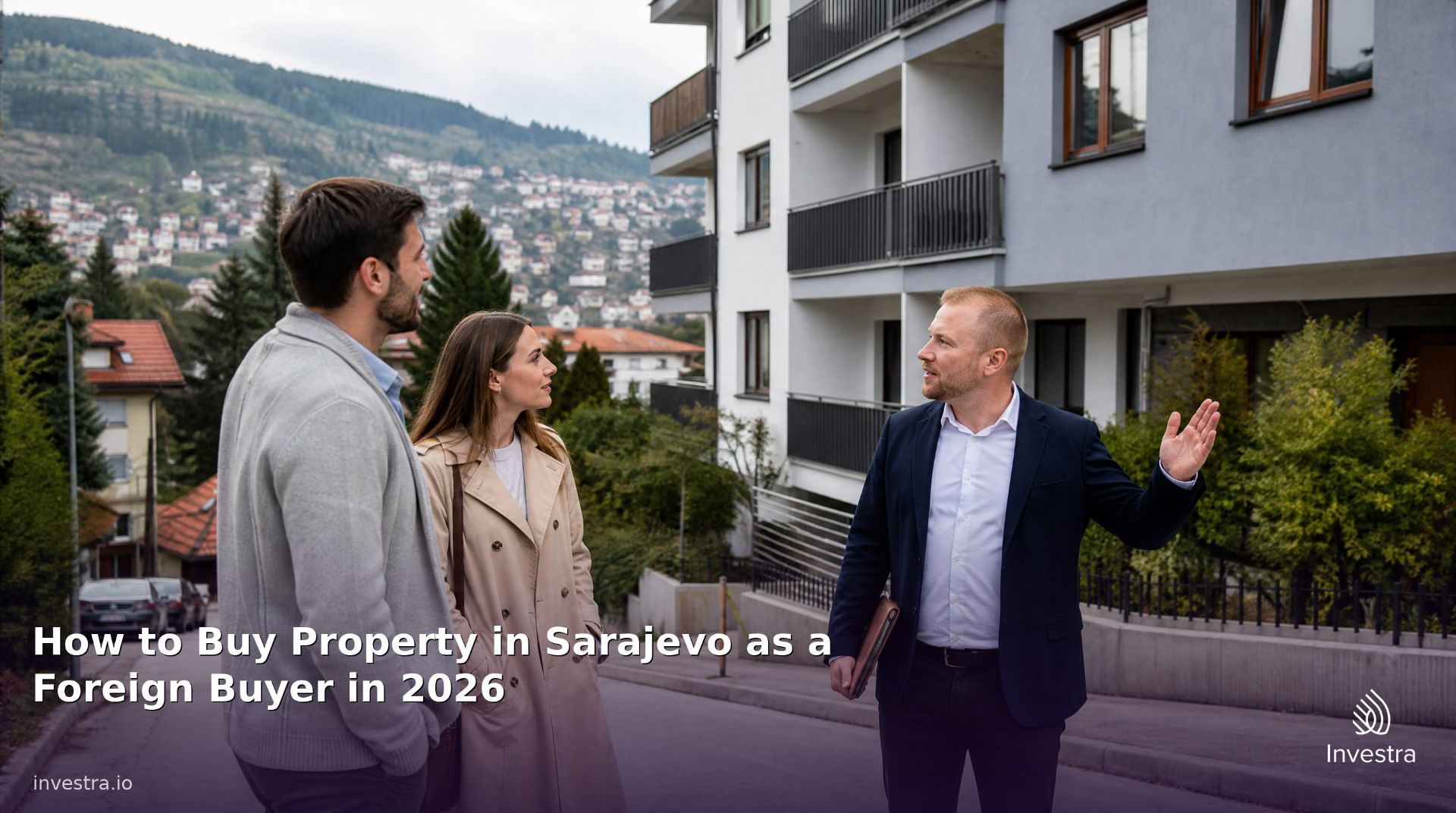
How to Buy Property in Sarajevo as a Foreign Buyer in 2026
How to Buy Property in Sarajevo as a Foreign Buyer in 2026
Why Sarajevo Is Attracting Foreign Property Buyers in 2026
Quick Answer: Sarajevo is attracting foreign buyers in 2026 due to its low property prices (€1,200–€2,800/m²), strong tourism growth, EU candidacy momentum, and rental yields of 5–8% — making it one of the most compelling emerging market opportunities in Southeast Europe. Investra market research tracks emerging Balkan markets including Bosnia and Herzegovina for global investors.
What makes 2026 particularly significant? Bosnia and Herzegovina formally received EU candidate status, a milestone that historically triggers multi-year property price appreciation cycles across the Western Balkans. We've seen this exact pattern play out in Serbia, North Macedonia, and Albania — and now Sarajevo is positioned at that same inflection point.
The tourism story is equally compelling. Sarajevo attracted over 600,000 overnight visitors in 2023, a figure that's been growing at roughly 12% annually. The city's unique blend of Ottoman, Austro-Hungarian, and Yugoslav architecture creates an authenticity that's impossible to manufacture — and that's precisely what modern travelers pay premium rates to experience.
The reality is that Sarajevo remains dramatically underpriced compared to regional peers. Zagreb, Belgrade, and Ljubljana are all trading at 2–3x Sarajevo's price per square meter for comparable properties. That gap won't hold indefinitely. For foreign buyers willing to understand the legal landscape and move decisively, the window of entry at current valuations is open — but it isn't infinite.
Understanding Bosnia and Herzegovina's Legal Framework for Foreign Buyers
Quick Answer: Foreign nationals can legally purchase property in Bosnia and Herzegovina under the principle of reciprocity — meaning citizens of countries that allow Bosnians to buy property can do so in BiH. EU citizens, UK nationals, Americans, and most Western buyers face no significant barriers to ownership.
The legal basis for foreign ownership rests on reciprocity agreements. Under Bosnian law, foreign citizens may purchase real property if their home country extends equivalent rights to Bosnian citizens.
Agricultural land remains the primary restriction. Foreign nationals — and even foreign legal entities — cannot purchase agricultural land in Bosnia and Herzegovina. This restriction is consistent with EU accession frameworks and mirrors restrictions seen in other candidate countries during their pre-accession phases.
One structural complexity worth understanding: properties in Sarajevo Canton fall under FBiH jurisdiction, meaning the relevant registries, courts, and administrative bodies are Federation-level institutions. This is important when selecting a lawyer and when understanding which property registry (zemljišna knjiga or cadastre) holds the definitive record of ownership. A qualified local attorney familiar with Sarajevo specifically — not just Bosnian law generally — is an essential part of any transaction team. Consulting resources like Siniša Dagary investment insight can help foreign buyers understand cross-border investment structures before committing to a specific market.
Property Prices in Sarajevo 2026: What Foreign Buyers Are Actually Paying
Quick Answer: Property prices in Sarajevo range from approximately €1,200/m² in outer residential areas to €2,800/m² in premium central locations in 2026, with the historic Baščaršija neighborhood and the modern Marijin Dvor district commanding the highest prices.
Let's talk numbers — because this is where Sarajevo's investment case becomes viscerally clear. The city's property market is segmented in ways that matter significantly to investors, and understanding where value sits versus where hype lives is essential to making good decisions.
The historic core — the area around Baščaršija, the old bazaar district, and the Ottoman-era streets extending toward the Miljacka River — commands the highest prices. Renovated apartments here typically trade at €2,200–€2,800/m², with particularly well-positioned units near the old city center occasionally breaking €3,000/m² for exceptional properties.
The Marijin Dvor and Centar municipality — Sarajevo's modern business and diplomatic quarter — is where you'll find newer construction at €1,800–€2,500/m². This district has seen significant new development activity, with several mixed-use projects completing between 2023 and 2025.
Moving outward, neighborhoods like Ilidža, Vogošća, and Hadžići offer properties starting from €900–€1,400/m². These areas are primarily residential and attract local buyers, though Ilidža specifically — with its thermal spa heritage and improving transit connections — is seeing growing interest from foreign buyers seeking value-oriented long-term holds.
New construction across Sarajevo carries a premium of approximately 15–25% over comparable existing stock, reflecting higher build quality, energy efficiency standards, and modern amenities. For buyers planning to rent to Western tourists or business travelers, that premium typically pays back quickly through higher achievable daily rates.
Step-by-Step: The Property Purchase Process in Sarajevo
Quick Answer: Buying property in Sarajevo as a foreigner involves eight key stages: property search and due diligence, preliminary agreement, legal title verification, signing of the purchase contract before a notary, registration at the land registry, tax payment, and final handover — a process typically completed in 60–90 days.
The purchase process in Sarajevo is fairly standard by regional standards, but there are specific procedural requirements that catch foreign buyers off guard if they aren't prepared. Here's how a typical transaction actually unfolds.
Step 2 — Preliminary Agreement (Predugovor): Once due diligence is satisfactory, a preliminary purchase agreement is typically signed, accompanied by a deposit of 10% of the purchase price. This deposit is legally binding — if the buyer withdraws without cause, it's forfeited; if the seller withdraws, they typically return double the deposit.
Step 3 — Final Purchase Contract: The main sale and purchase agreement (Kupoprodajni ugovor) must be executed before a notary (notar) to be legally valid. The notary verifies the identities of all parties, confirms the legal basis for the transaction, and ensures all conditions are met. As a foreign buyer, you'll need a valid passport and may need an officially certified translation of certain documents.
Step 4 — Tax Registration and Payment: Property transfer tax in BiH's Federation entity is 5% of the assessed value. This must be paid within prescribed deadlines to avoid penalties. Your notary or lawyer will typically manage this process.
Step 5 — Land Registry Registration: Final registration of ownership at the land registry (Gruntovnica) is the step that legally completes the transfer. Registration timelines vary — typically 2–6 weeks in Sarajevo — and this is when the property legally becomes yours.
Throughout this process, working with a reputable local attorney who specializes in real estate transactions is not optional — it's essential. Budget approximately €1,500–€3,000 in legal fees for a standard residential transaction, depending on complexity and property value.
Taxes and Transaction Costs: The Full Picture
Quick Answer: Total transaction costs for buying property in Sarajevo typically range from 6–9% of the purchase price, including 5% property transfer tax, notary fees (0.1–0.3%), legal fees, and agent commissions — making Bosnia one of the more cost-effective markets in the Western Balkans for foreign buyers.
One of the aspects that makes Sarajevo genuinely attractive from a cost-of-entry perspective is the relatively lean transaction cost structure. At 6–9% all-in, it compares favorably to markets like Slovenia or Croatia, where total acquisition costs routinely reach 10–14%. Let's break down exactly what you're paying.
Property Transfer Tax (Porez na promet nekretnina): The headline figure is 5% of the assessed value in the Federation entity, where Sarajevo is located. This is typically calculated on the market value as assessed by the tax authority, which in most cases aligns closely with the actual purchase price.
Notary Fees: Typically 0.1–0.3% of the transaction value, subject to minimum and maximum fee schedules set by the Notary Chamber. For a €150,000 apartment, expect notary fees in the range of €300–€600.
Legal Fees: As noted, budget €1,500–€3,000 for a qualified real estate attorney's services from due diligence through registration. For complex transactions or commercial properties, fees will be higher.
Real Estate Agent Commission: Standard agency commissions in Sarajevo range from 2–3% of the purchase price, typically paid by the buyer (though some agents split the commission between buyer and seller). Not all sellers use agents, particularly in the secondary market.
Land Registry Registration Fees: Relatively modest — typically €100–€300 depending on the transaction value and property type.
On the ongoing tax side, Bosnia's property ownership is not particularly burdensome. There's no annual wealth tax on real property, and property holding costs beyond routine maintenance and utility expenses are limited. Rental income is subject to personal income tax at the flat rate of 10% in the Federation entity — one of the lowest rates in Europe, which directly boosts net rental yield calculations. For investors comparing multiple Balkan markets, this flat 10% income tax rate is a meaningful competitive advantage. Reviewing resources on comparable regional markets — such as the Loznica Real Estate Market 2026 Macva Region Property Guide or the Sremska Mitrovica Real Estate 2026 Srem Region Property Guide — can provide useful context for tax comparison across the region.
Rental Yields and ROI: What Sarajevo Actually Delivers for Investors
Quick Answer: Gross rental yields in Sarajevo range from 5–8% for long-term residential rentals and can reach 9–12% for well-managed short-term rentals in tourist-heavy central areas — significantly above Western European averages of 2–4%.
The yield story in Sarajevo deserves careful examination because there's a meaningful difference between what the market's two dominant rental strategies deliver. Getting this distinction right is the difference between an investment that performs and one that merely holds value.
Long-term residential rentals — the classic "buy and let" model targeting local professionals, expats, and students — yield approximately 5–7% gross in central Sarajevo neighborhoods. A well-located 60m² apartment purchased for €120,000–€140,000 in the Centar municipality can generate monthly rents of €600–€850, translating to gross annual yields of around 6–7.2%.
Short-term rentals, concentrated in the old city and central tourist areas, are where the numbers get genuinely exciting — but also where management complexity increases. A centrally located studio or one-bedroom apartment achieving 65–75% annual occupancy at €80–€120 average daily rate generates gross annual revenue of €18,000–€32,000.
Capital appreciation has been the third leg of Sarajevo's return story. The city has delivered 6–10% annual price appreciation in prime areas over the 2021–2025 period, a trend supported by limited new supply in the historic core, growing tourism infrastructure investment, and EU accession momentum.
For investors who prefer to diversify across the Western Balkans rather than concentrate in a single market, it's worth exploring other emerging yield stories profiled by Investra.io's Southern Serbia property guide for Aleksinac or comparing with the Prokuplje Real Estate Market 2026 Toplica Region Property Guide.
The Best Neighborhoods in Sarajevo for Foreign Property Investment
Quick Answer: The top neighborhoods for foreign investment in Sarajevo are Stari Grad (old city, tourism/short-term rentals), Centar/Marijin Dvor (business district, long-term professionals), and Novo Sarajevo (value growth, young professional demand) — each serving a different investment thesis and risk profile.
Sarajevo's geography is unusual — the city stretches along the Miljacka River valley in a narrow east-west corridor, which means neighborhoods have distinct characters that don't follow the typical "city center premium radiating outward" model you'd find in most European capitals. Location choice here requires more nuance.
Stari Grad (Old Town): This is Sarajevo's tourism engine and the heart of its short-term rental market. The neighborhood contains the Baščaršija bazaar, the historic mosques and cathedrals, and the warren of cobblestone streets that make Sarajevo architecturally unique. Properties here trade at €2,200–€2,800/m² for renovated stock and require significant renovation investment for older units.
Centar Municipality / Marijin Dvor: This is where the modern city's commercial and diplomatic heart beats. International organizations, embassies, law firms, and corporate offices concentrate here, creating steady demand for quality long-term rentals.
Novo Sarajevo: The city's post-war modernization is most visible here, with a mix of older Yugoslav-era apartment blocks being gradually replaced or renovated, and newer developments targeting middle-class buyers. Entry prices of €1,300–€1,900/m² offer better capital appreciation potential as the neighborhood undergoes gentrification pressure from central Sarajevo's rising prices.
Ilidža: The western suburb with thermal spa facilities, green spaces, and excellent tram connections to the city center is increasingly on international buyers' radar as a lifestyle-investment hybrid. Properties at €900–€1,300/m² offer the best entry price in the metro area with reasonable long-term appreciation expectations tied to infrastructure improvements.
Financing Options for Foreign Buyers in Bosnia and Herzegovina
Quick Answer: Foreign buyers purchasing property in Sarajevo typically use cash purchases or financing from their home country, as obtaining a Bosnian mortgage as a non-resident is extremely challenging. Local bank mortgage rates for residents currently range from 4.5–7%, but access is restricted for foreigners without established Bosnian income or residency.
This is one of the less glamorous but critically important aspects of Sarajevo property investment that doesn't get enough attention in typical investment guides. The financing landscape for foreign buyers is genuinely limited, and planning around it is essential.
The practical reality for foreign buyers is that cash purchases dominate this market. This actually creates negotiating advantages — sellers in Sarajevo respond well to all-cash buyers who can close quickly, and discounts of 3–8% below asking price are achievable in many cases for buyers who can demonstrate financial readiness.
For buyers who need financing, the most viable route is typically home equity release or refinancing against a property in their home country, with the BiH purchase made as a cash transaction. Specialist international mortgage brokers, and financial services firms like Findes Group & Partners, can help structure cross-border financing arrangements that allow investors to access the Sarajevo market without being restricted by local lending limitations.
Practical Challenges and Risk Factors Foreign Buyers Must Understand
Quick Answer: Key risks for foreign buyers in Sarajevo include property title irregularities from post-war restitution processes, administrative complexity from the dual-entity legal structure, currency risk (BAM is pegged to EUR), limited mortgage access, and occasional bureaucratic delays in registry processes — all manageable with proper legal counsel.
Honest risk assessment is what separates smart investors from optimistic ones, and Sarajevo has a specific set of challenges that deserve straightforward discussion rather than soft-pedaling.
The most significant practical risk is title irregularity. Bosnia's post-war property restitution processes — combined with the Yugoslav-era system where apartments were "socially owned" rather than privately held — created a legacy of complex ownership situations that weren't fully resolved until the 2000s and early 2010s.
Administrative complexity is the second practical challenge. Bosnia's dual-entity structure means that what appears to be a single national real estate market is actually administered through parallel systems. Sarajevo Canton's administrative processes are generally functional but can be slow, and the bureaucratic requirements for foreign buyers add additional steps.
Currency risk is structurally minimal — the Bosnian Convertible Mark (BAM/KM) is legally pegged to the Euro at a fixed rate of 1.95583 BAM per EUR, a peg maintained since 1997 under a currency board arrangement. This peg provides genuine currency stability for EUR-based investors and is highly unlikely to change given EU accession trajectory.
Property management and tenant enforcement are operational considerations that require experienced local partners. Sarajevo's rental market is growing but remains less formalized than Western European markets — having a qualified property manager familiar with local tenant law and enforcement mechanisms is substantially more important here than in mature markets. Consulting Siniša Dagary investment insight on structural considerations can help international investors make informed decisions about operational risk management.
Due Diligence Essentials: What to Check Before Committing Capital
Quick Answer: Essential due diligence items include full title verification at the land registry, building condition assessment by qualified engineer, utility infrastructure check, neighborhood trend analysis, and verification of local zoning and planning regulations — non-negotiable steps before contract execution.
The difference between a successful Sarajevo property investment and a troubled one often comes down to diligence completeness in the pre-contract phase. Here's the checklist that protects foreign buyers.
Title and Ownership Verification: Obtain the complete property extract from the land registry including all historical ownership transfers. Verify that the seller's name matches the registered owner. Check for any registered mortgages, liens, easements, restrictions on use, or pending litigation affecting the property. A clear title report from a qualified Sarajevo real estate attorney is essential.
Building and Structural Assessment: Have an independent engineer or qualified surveyor inspect the property, particularly for apartments in older buildings. Communist-era construction, while often solid, sometimes has issues with moisture, structural cracks, or insufficient earthquake reinforcement. Thermal efficiency becomes increasingly important for long-term rental competitiveness.
Utility Infrastructure and Approvals: Verify that water, sewage, electricity, and heating systems are properly connected and registered. In Sarajevo, some properties have informal utility connections that should be formalized through the building's main infrastructure accounts. Confirm all building permits and certificates of completion exist for any modifications or additions.
Neighborhood and Market Trends: Spend time in the neighborhood at different times of day and week. Talk to local residents, business owners, and other property owners. Review local development plans and infrastructure projects that might
Investment Disclaimer
Quick Answer: This guide is general market information, not personal legal, tax, financing or investment advice.
Before committing to a property transaction, buyers should obtain independent local legal, tax and financial advice suited to their circumstances. Investra.io can support initial market research, but every purchase decision remains the buyer's responsibility.
Frequently Asked Questions
Quick Answer: This section explains the practical property-investment implications of Frequently Asked Questions.
What is a prudent next step after initial market research?
Use current documentation, independent professional advice and comparable local evidence before proceeding. Investra.io can support an initial structured market review.
How can buyers plan a realistic ownership budget?
Use current documentation, independent professional advice and comparable local evidence before proceeding. Investra.io can support an initial structured market review.
What evidence supports a careful investment decision?
Use current documentation, independent professional advice and comparable local evidence before proceeding. Investra.io can support an initial structured market review.
When should a buyer obtain legal and tax advice?
Use current documentation, independent professional advice and comparable local evidence before proceeding. Investra.io can support an initial structured market review.
How should a buyer compare neighbourhoods and property types?
Use current documentation, independent professional advice and comparable local evidence before proceeding. Investra.io can support an initial structured market review.
What local checks should be completed before signing?
Use current documentation, independent professional advice and comparable local evidence before proceeding. Investra.io can support an initial structured market review.
Which costs should be assessed alongside the purchase price?
Use current documentation, independent professional advice and comparable local evidence before proceeding. Investra.io can support an initial structured market review.
How can international buyers verify a property opportunity?
Use current documentation, independent professional advice and comparable local evidence before proceeding. Investra.io can support an initial structured market review.
What should buyers compare before selecting a property?
Use current documentation, independent professional advice and comparable local evidence before proceeding. Investra.io can support an initial structured market review.
Quick Answer: These answers outline common buyer checks and should be read with current professional advice.
Recommended Reading
Quick Answer: This section explains the practical property-investment implications of Recommended Reading.
- Investra market research
- Investra market research
- Investra market research
- Investra market research
- Investra market research
- Investra market research
- Investra market research
- Investra market research
- Investra market research
- Investra market research
- Investra market research
- Investra market research
- Investra market research
- Investra market research
- Investra market research
- Investra market research
- Investra market research
- Siniša Dagary investment insight
- Siniša Dagary investment insight
- Siniša Dagary investment insight
- Siniša Dagary investment insight
- Siniša Dagary investment insight
- Findes Group & Partners
- Findes Group & Partners
Connect With Investra
Follow Investra for market updates on Facebook, LinkedIn, YouTube
Related Posts
No related posts available.
