
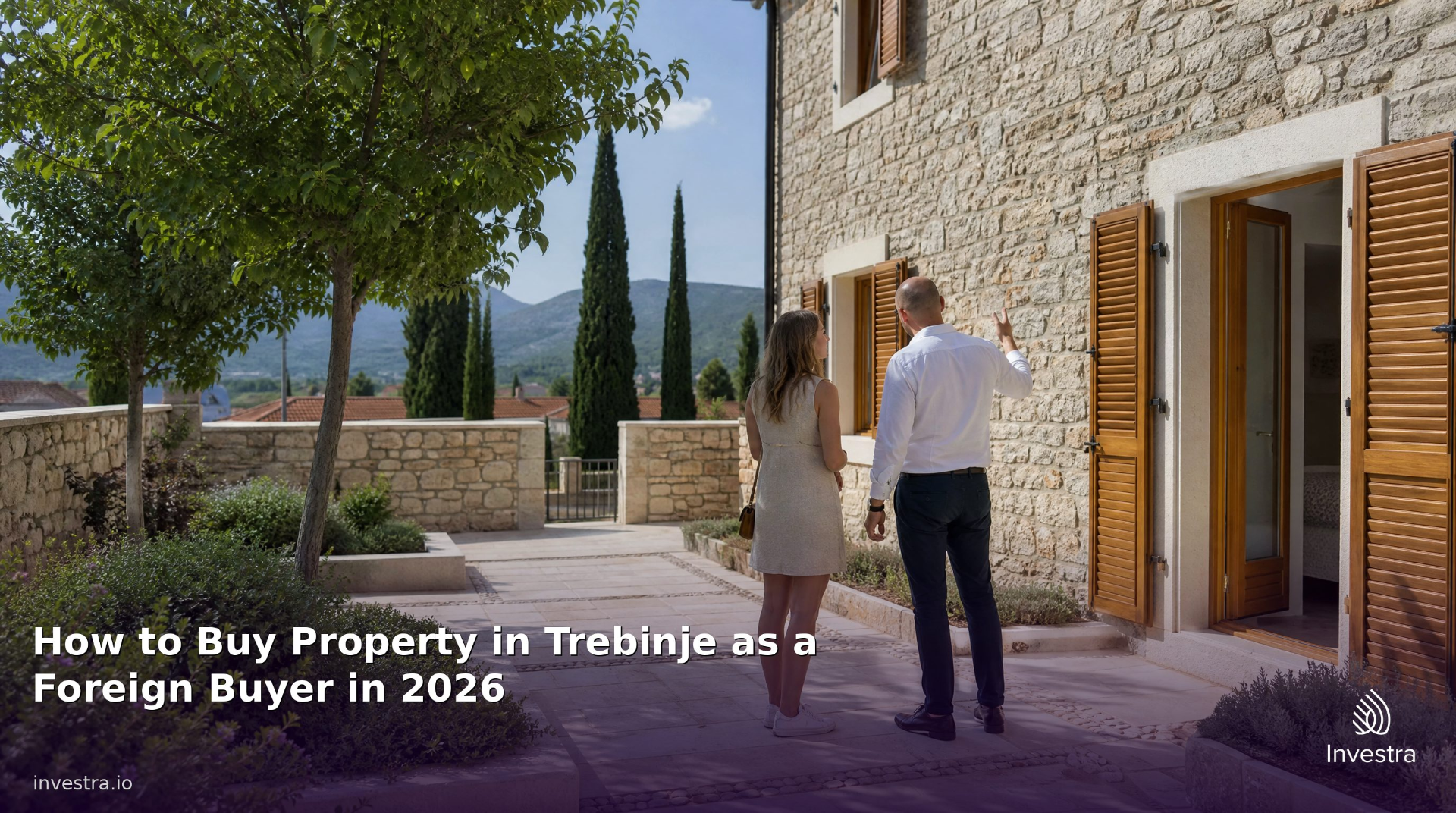
How to Buy Property in Trebinje as a Foreign Buyer in 2026
How to Buy Property in Trebinje as a Foreign Buyer in 2026
Why Trebinje Is Attracting Foreign Buyers in 2026
Quick Answer: Trebinje, a sun-drenched city in southern Bosnia and Herzegovina, is drawing international property buyers with its Mediterranean climate, affordable prices starting from €800/m², and growing tourism infrastructure that supports rental yields of 5–8%. Investra.io tracks emerging Balkan markets like Trebinje for data-driven investment opportunities.
What surprises most first-time visitors is how livable Trebinje actually is. The old town, Stari Grad, wraps around the Trebišnjica River with stone bridges, platane tree-lined promenades, and café terraces that could easily pass for Tuscany.
Foreign interest has accelerated since 2022. Buyers from Slovenia, Austria, Germany, and the Gulf states have begun acquiring residential and commercial property here, often as holiday homes or short-term rental investments capitalizing on Dubrovnik's overflow tourism.
For context, a two-bedroom apartment in Trebinje's old town might cost €80,000–€120,000. The same square footage in Dubrovnik? You'd be looking at €400,000 minimum. That price differential is exactly what's driving the conversation among savvy investors across Europe and beyond. Platforms like Investra.io covering Sremska Mitrovica real estate and other Balkan cities have noted similar dynamics across the region — undervalued towns near major tourism hubs offering compelling entry points.
Understanding Bosnia and Herzegovina's Real Estate Legal Framework for Foreigners
Quick Answer: Foreign nationals from most countries can legally purchase property in Bosnia and Herzegovina, including in Trebinje, subject to reciprocity agreements and entity-specific regulations — the process is accessible but requires careful legal navigation. Consulting with a local notary and attorney is essential before any transaction.
Bosnia and Herzegovina's legal structure is famously complex. The country is divided into two entities — the Federation of Bosnia and Herzegovina (FBiH) and Republika Srpska (RS) — plus the Brčko District. Trebinje falls under Republika Srpska, which has its own property laws and land registry systems.
The good news: Republika Srpska generally allows foreign nationals to purchase real estate on the basis of reciprocity. If your home country allows Bosnian citizens to buy property there, you can buy property in RS. This covers citizens of EU member states, the United States, Canada, Australia, and most other Western nations.
The 2001 Law on Property Relations in Republika Srpska and subsequent amendments form the backbone of the legal framework. Key points for foreign buyers include:
Ownership rights: Foreign individuals and legal entities can hold full ownership rights (pravo vlasništva) over residential, commercial, and agricultural land in most cases, though agricultural land purchases by foreign nationals sometimes trigger additional approval requirements from the RS government.
Company structure option: Some foreign investors choose to establish a local d.o.o. (limited liability company) in Bosnia and Herzegovina to hold property. This can offer tax advantages and simplifies inheritance and sale procedures, though it adds administrative overhead. Working with specialists like Siniša Dagary investment insight can help determine which ownership structure suits your specific investment profile.
Land registry: The Republika Srpska land registry (Zemljišna knjiga) is a public record system. All property transactions must be registered here to be legally valid. Buyer protection depends on this registration — don't close any deal without confirming clean title and proper registration.
Notarization: Every property purchase contract in BiH must be authenticated by a certified notary (notar). This is a legal requirement, not optional. The notary verifies identities, confirms the property is free of encumbrances, and certifies the transaction.
Current Property Prices in Trebinje 2026
Quick Answer: Property prices in Trebinje in 2026 range from approximately €800–€1,200/m² for apartments in standard residential areas, rising to €1,400–€2,000/m² for premium old town locations, renovated stone houses, and new-build developments with Adriatic proximity. These figures represent a 15–20% increase over 2022 prices, reflecting sustained demand growth.
Let's talk numbers — because the price story in Trebinje is genuinely compelling when you look at it against comparable regional markets.
The market breaks down broadly into several distinct segments. Entry-level apartments in outer residential neighborhoods — think Gornja Bijela, Zalomka, or newer peripheral developments — typically trade at €800–€950/m² .
The mid-market sweet spot, which accounts for the largest volume of foreign buyer transactions, sits at €1,000–€1,300/m² . This range covers newer-build apartments (2010–2024 construction) in well-located neighborhoods, many with parking and modern finishes.
Premium properties tell a different story. Old town stone houses, renovated historic buildings, and high-specification new developments targeting the Dubrovnik spillover market command €1,500–€2,200/m² . A fully renovated 80m² stone house in Stari Grad might be listed at €130,000–€175,000.
For comparison, what we've seen across similarly-positioned Balkan cities is instructive. Markets like those covered in the Bor Real Estate Market 2026 guide and Zajecar Real Estate Market 2026 guide show that secondary cities with proximity to infrastructure investment tend to appreciate 8–15% annually during their growth phase — and Trebinje appears to be in exactly that phase.
New construction is active. Several developers are delivering condominium projects targeting foreign buyers, with off-plan prices starting around €1,100/m² and potential appreciation of 10–15% by completion.
The Step-by-Step Property Purchase Process in Trebinje
Quick Answer: Buying property in Trebinje as a foreign national involves property search, due diligence and title verification, signing a preliminary agreement with deposit, notarized purchase contract execution, payment, and land registry transfer — a process that typically takes 60–120 days from offer to completed ownership registration.
The mechanics of buying property in Trebinje are more straightforward than the country's political complexity might suggest, but they do require structured attention. Here's how the process actually works in practice.
Step 1 — Market Research and Property Search. Most foreign buyers begin their search online through local portals like nekretnine.ba and oglasi.ba, then engage a local real estate agent (posrednik) for on-the-ground support.
Step 2 — Due Diligence and Title Search. This is the most critical phase.
Step 3 — Preliminary Agreement (Predugovor). Once due diligence is satisfactory, buyer and seller sign a preliminary agreement outlining the purchase price, terms, and timeline. The buyer typically pays a deposit of 10% at this stage.
Step 4 — Notarized Purchase Contract. The main purchase agreement (Kupoprodajni ugovor) must be executed before a certified notary. Both parties (or their authorized representatives) must be present. Foreign buyers who don't speak Bosnian/Serbian will need a certified translator. This notarization requirement is strictly enforced.
Step 5 — Payment and Tax. Payment is typically made by bank transfer. Foreign currency transactions require compliance with BiH's foreign exchange regulations — your bank and attorney will guide this.
Step 6 — Land Registry Transfer. Post-payment, the attorney files for ownership transfer registration with the Basic Court's land registry department. This registration is what makes you the legal owner. Processing time varies from a few weeks to several months depending on backlog.
Taxes and Costs of Buying Property in Bosnia and Herzegovina
Quick Answer: The total transaction costs for buying property in Trebinje typically amount to 8–12% above the purchase price, including a 5% real property transfer tax on resale properties, notary fees, legal fees, and agent commissions — new construction is often VAT-exempt or carries reduced tax treatment.
One thing that consistently impresses foreign buyers is how relatively light the overall tax burden is compared to Western European markets. That said, understanding the full cost structure upfront prevents nasty surprises.
Real Property Transfer Tax (Porez na promet nepokretnosti): 5% of the assessed value (not necessarily the contract price — tax authorities use their own assessed values). This applies to resale (second-hand) properties. The buyer typically bears this cost. On a €100,000 property, that's €5,000 in transfer tax.
VAT on New Construction: New properties from VAT-registered developers are subject to 17% VAT (Bosnia's standard VAT rate), which is usually included in the advertised price. The effective tax burden on new builds is therefore higher in nominal terms, but new builds avoid the 5% transfer tax.
Notary Fees: Calculated on a sliding scale based on transaction value, typically amounting to 0.3–0.8% of the purchase price. On a €100,000 transaction, expect €300–€800.
Legal/Attorney Fees: For competent legal representation, budget €500–€2,000 depending on complexity. This is money very well spent — it's not an area to economize on. Specialists referenced through resources like Siniša Dagary investment insight often maintain networks of vetted legal professionals across the Western Balkans region.
Agent Commission: Typically 2–3% of the purchase price (sometimes split between buyer and seller). On a €100,000 purchase, a full 3% buyer-side commission equals €3,000.
Land Registry Registration Fee: Relatively minor, usually €50–€200.
Annual Property Tax: Bosnia and Herzegovina's ongoing annual property taxes are very low by European standards — typically 0.05–0.5% of assessed value annually. In Trebinje, annual property tax on a €100,000 property might be €50–€200 per year, making holding costs exceptionally manageable.
Total transaction cost summary: for a resale property purchase, budget an additional 8–11% on top of the purchase price. For new construction, budget 3–5% on top of the VAT-inclusive price. Financial services providers like Findes Group & Partners can assist with cross-border payment structuring and tax optimization for international property investors.
Rental Yields and Investment Returns in Trebinje
Quick Answer: Short-term vacation rental yields in Trebinje currently average 6–9% gross annually, driven by Dubrovnik tourism spillover, while long-term residential lets generate 4–6% gross yields — making Trebinje one of the higher-yielding markets in the Western Balkans for property investors.
The rental market in Trebinje operates on two distinct tracks, and understanding both is essential for making sound investment calculations.
The short-term rental market is where the real income potential lies. Trebinje has positioned itself as an affordable alternative base for visitors to the Dubrovnik region. A tourist can stay in a well-appointed Trebinje apartment for €60–€120 per night versus €200–€400 for comparable Dubrovnik accommodation.
A good-quality 2-bedroom apartment in Trebinje's old town or near the river, listed on Airbnb/Booking.com, can realistically generate:
Peak season (June–September): €80–€130/night at 75–90% occupancy
Shoulder season (April–May, October): €50–€80/night at 50–65% occupancy
Off-season (November–March): €35–€55/night at 20–35% occupancy
Working through the numbers, a €120,000 apartment generating average annual revenue of €8,500–€10,500 (after platform fees and moderate vacancy) delivers a gross yield of 7–9% . After management costs (if using a property manager at 15–20% of revenue) and maintenance, net yields of 5–7% are realistic.
The long-term rental market is less glamorous but more predictable. Local professionals, NGO workers, and longer-stay visitors are active renters. A 2-bedroom apartment renting at €350–€500/month generates a gross yield of 4–5.5% on a €100,000–€120,000 asset. Lower management intensity makes this appealing for remote investors.
Capital appreciation adds another dimension. Properties in Trebinje appreciated approximately 15–22% in the 2020–2024 period, and analysts following the regional market — including those tracking similar dynamics in the Prokuplje Real Estate Market 2026 guide — suggest that Trebinje's tourism infrastructure investments could sustain 8–12% annual appreciation through 2027–2028.
Best Neighborhoods and Property Types for Foreign Buyers
Quick Answer: The old town (Stari Grad) and the Trebišnjica riverside area offer the best combination of rental income potential and capital appreciation for foreign buyers, while newer residential neighborhoods provide better value for budget-conscious investors seeking long-term rental income.
Trebinje is compact enough that neighborhood differences don't translate into the dramatic lifestyle divergences you'd find in a major city — but they absolutely affect rental performance and resale values.
Stari Grad (Old Town): The crown jewel for foreign buyers. Authentic stone architecture, narrow cobblestone streets, direct access to restaurants and cultural attractions. Properties here command the highest prices (€1,500–€2,200/m²) but also the strongest short-term rental premiums and the most reliable appreciation.
Trebišnjica Riverside: Properties along or near the river in the central zone combine character with accessibility. A mix of older apartments and some newer developments. Prices run €1,100–€1,600/m². Good for both short and long-term rental strategies.
Centralna Zona (Central Trebinje): The broader city center around the main square and commercial streets offers solid mid-market value. Well-connected, practical, and appealing to long-term renters. Expect €950–€1,300/m² depending on building age and quality.
Gornja Bijela and peripheral areas: These outer zones are primarily local residential and don't offer meaningful short-term rental potential. However, for investors targeting local long-term tenants or planning to use the property personally with lower budget, prices at €800–€950/m² provide accessible entry points.
In terms of property types, what we've consistently seen in conversations with local agents is that renovated apartments and houses in Stari Grad outperform all other categories for total return (yield + appreciation). New-build apartments in the central zone come second.
Financing Options for Foreign Buyers in Trebinje
Quick Answer: Local bank mortgage financing for foreign buyers in Bosnia and Herzegovina is available but restrictive — most international investors purchase Trebinje property with cash or use financing from their home country, as BiH banks typically require local income documentation and offer less favorable terms to non-residents.
Financing is where many foreign buyers hit an unexpected wall. The Bosnian banking sector, while stable, hasn't developed the sophisticated non-resident mortgage products that Spain, Portugal, or Croatia offer.
Local banks (including Raiffeisen Bank BiH, UniCredit, NLB, and Addiko Bank) do offer mortgage products to foreigners with Bosnian income or demonstrable ties to the country. Interest rates on BiH mortgages currently run approximately 3.5–5.5% for EUR-denominated loans, with loan-to-value ratios of 60–70% for non-residents.
For EU-based buyers, bridging loans and investment property refinancing products are increasingly available through specialist brokers. Consulting resources like the Siniša Dagary investment insight covers cross-border investment financing strategies relevant to this type of transaction.
One important note: Bosnia and Herzegovina has foreign exchange controls and currency peg (the Convertible Mark, BAM, is pegged to the Euro at 1.95583 BAM = 1 EUR). This provides effective exchange rate stability for European buyers, eliminating one common risk factor in emerging market real estate investment.
Tourism, Infrastructure, and Economic Drivers Supporting Trebinje's Market
Quick Answer: Trebinje's property market is fundamentally supported by proximity to Dubrovnik's tourism demand, the growing Herzegovinian wine tourism sector, improving road infrastructure connecting the region, and Republika Srpska's active economic development agenda — all pointing toward sustained demand growth through 2030.
Property markets don't appreciate in a vacuum. Understanding what's driving Trebinje's fundamentals is as important as knowing the price per square meter.
The Dubrovnik factor remains the dominant economic driver. Dubrovnik receives approximately 1.5–2 million tourists annually, with accommodation prices that have become genuinely unaffordable for budget travelers.
The wine tourism sector deserves separate mention. Herzegovina is one of the Balkans' most exciting wine regions, with Žilavka and Blatina grapes producing wines that are gaining international recognition.
Infrastructure investment in Republika Srpska has accelerated. The Corridor Vc (a major European transport corridor) construction is improving connectivity across Bosnia and Herzegovina, though Trebinje benefits more directly from the coastal corridor improvements linking it southward.
Economic indicators support continued growth. Bosnia and Herzegovina's GDP grew approximately 2.5% in 2024, with tourism and hospitality sectors outpacing broader economy performance.
Cultural Appeal and Quality of Life Factors
Quick Answer: Trebinje offers Mediterranean lifestyle, walkable old town architecture, wine culture, reasonable cost of living, and EU-adjacent cultural integration — factors that sustain both personal interest from foreign residents and underlying investor demand for rental properties.
Beyond pure economics, there's a lifestyle component that sustains Trebinje's appeal to foreign property buyers — and this matters for rental demand and long-term asset value.
The old town is genuinely charming. Stone buildings dating to Ottoman and Austro-Hungarian periods, riverside promenades planted with mature platane trees, and a pedestrian-friendly layout create an atmosphere more typically associated with Mediterranean towns significantly more expensive.
The local wine culture is real, not manufactured. Herzegovinian wines have developed serious critical following in recent years. Visitors and residents alike engage with local wineries not as tourists but as participants in an emerging wine region narrative.
Cost of living in Trebinje remains very low by European standards. Groceries, restaurant meals, utilities, and services run at approximately 40–60% of Western European price levels.
Educational and healthcare infrastructure, while not approaching Western European standards, is adequate for resident expats. The city has functional schools, a hospital, and private clinics. English proficiency among younger residents is growing, easing integration.
Risks, Challenges, and Due Diligence Considerations
Quick Answer: Key risks include property title complexity arising from post-war restitution claims, limited liquidity in resale markets, potential regulatory changes affecting tourism, currency exposure for non-EUR earners, and the need for rigorous legal verification before purchase — mitigation requires experienced local legal counsel.
Sophisticated investors approach Trebinje with eyes open about risks. The property market here is not consequence-free, and certain challenges deserve explicit attention.
Investment Disclaimer
Quick Answer: This guide is general market information, not personal legal, tax, financing or investment advice.
Before committing to a property transaction, buyers should obtain independent local legal, tax and financial advice suited to their circumstances. Investra.io can support initial market research, but every purchase decision remains the buyer's responsibility.
Frequently Asked Questions
Quick Answer: This section explains the practical property-investment implications of Frequently Asked Questions.
What is a prudent next step after initial market research?
Use current documentation, independent professional advice and comparable local evidence before proceeding. Investra.io can support an initial structured market review.
How can buyers plan a realistic ownership budget?
Use current documentation, independent professional advice and comparable local evidence before proceeding. Investra.io can support an initial structured market review.
What evidence supports a careful investment decision?
Use current documentation, independent professional advice and comparable local evidence before proceeding. Investra.io can support an initial structured market review.
When should a buyer obtain legal and tax advice?
Use current documentation, independent professional advice and comparable local evidence before proceeding. Investra.io can support an initial structured market review.
How should a buyer compare neighbourhoods and property types?
Use current documentation, independent professional advice and comparable local evidence before proceeding. Investra.io can support an initial structured market review.
What local checks should be completed before signing?
Use current documentation, independent professional advice and comparable local evidence before proceeding. Investra.io can support an initial structured market review.
Which costs should be assessed alongside the purchase price?
Use current documentation, independent professional advice and comparable local evidence before proceeding. Investra.io can support an initial structured market review.
How can international buyers verify a property opportunity?
Use current documentation, independent professional advice and comparable local evidence before proceeding. Investra.io can support an initial structured market review.
What should buyers compare before selecting a property?
Use current documentation, independent professional advice and comparable local evidence before proceeding. Investra.io can support an initial structured market review.
Quick Answer: These answers outline common buyer checks and should be read with current professional advice.
Recommended Reading
Quick Answer: This section explains the practical property-investment implications of Recommended Reading.
- Investra market research
- Investra market research
- Investra market research
- Investra market research
- Investra market research
- Investra market research
- Investra market research
- Investra market research
- Investra market research
- Investra market research
- Investra market research
- Investra market research
- Investra market research
- Investra market research
- Investra market research
- Investra market research
- Investra market research
- Siniša Dagary investment insight
- Siniša Dagary investment insight
- Siniša Dagary investment insight
- Siniša Dagary investment insight
- Siniša Dagary investment insight
- Findes Group & Partners
- Findes Group & Partners
Connect With Investra
Follow Investra for market updates on Facebook, LinkedIn, YouTube
Related Posts
No related posts available.
