
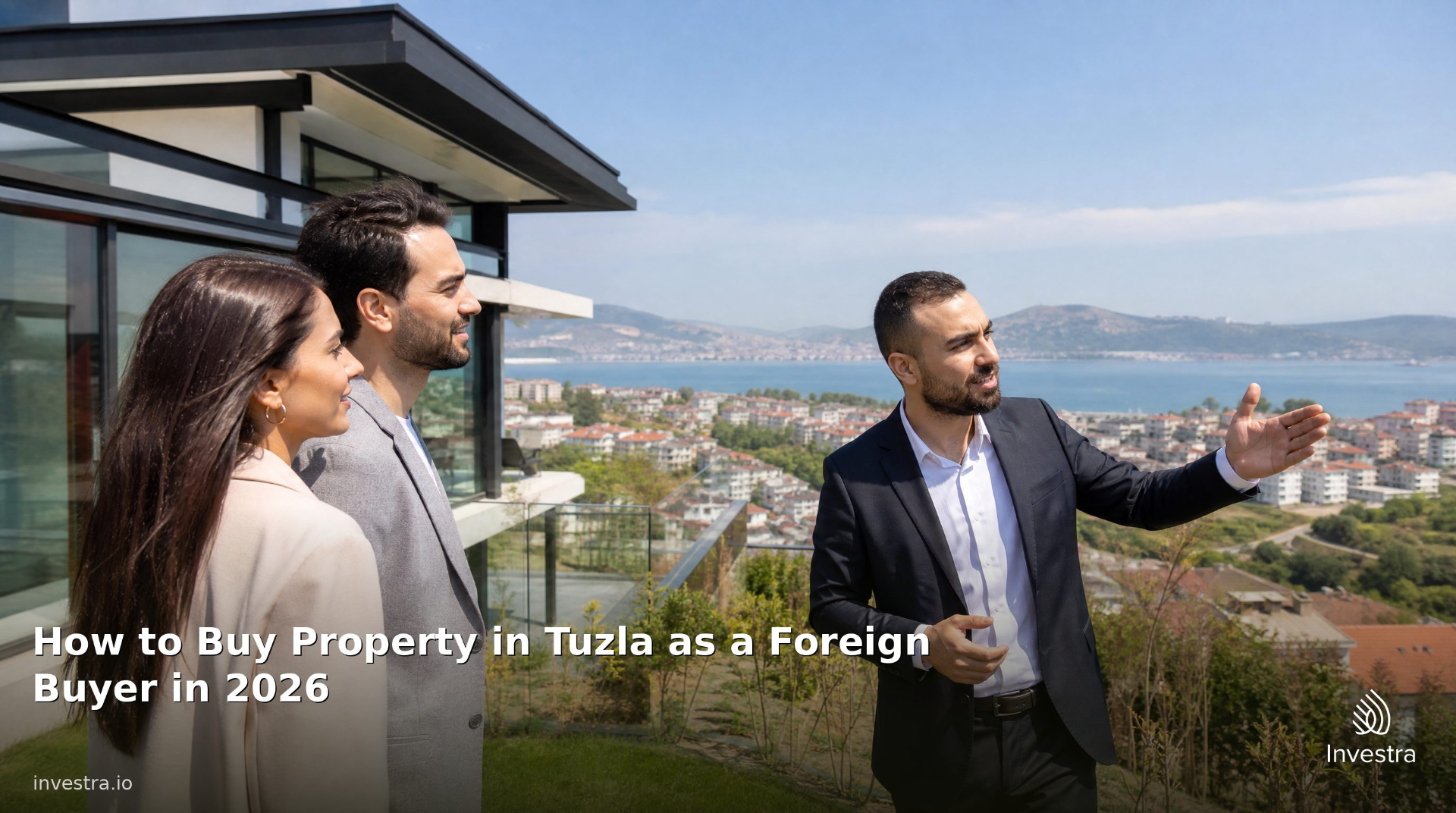
How to Buy Property in Tuzla as a Foreign Buyer in 2026
How to Buy Property in Tuzla as a Foreign Buyer in 2026
Why Tuzla Is Attracting Foreign Property Buyers in 2026
Quick Answer: Tuzla is attracting foreign buyers in 2026 due to its affordable property prices (€800–€1,500/m²), growing rental demand from students and professionals, and strong infrastructure development that positions it as one of Bosnia and Herzegovina's most accessible investment destinations. Investra.io tracks emerging Balkan markets like Tuzla for data-driven investor decisions.
There's a quiet confidence building around Tuzla that veteran Balkan property watchers have been tracking for years. Bosnia and Herzegovina's third-largest city—home to roughly 200,000 residents in the broader canton—has traditionally flown under the radar compared to Sarajevo or Mostar, and that's precisely what makes it compelling right now.
The reality that serious investors have observed in 2025 and 2026 is straightforward—price growth in capital cities has compressed yields, forcing attention toward secondary cities with genuine economic activity. Tuzla fits this profile almost perfectly. The University of Tuzla brings over 15,000 enrolled students, creating persistent rental demand that remains stable across economic cycles.
What surprises many buyers who first investigate Tuzla is the construction quality relative to price. Modern apartments in well-located neighborhoods sell at €1,100–€1,400 per square meter—a fraction of comparable quality in Ljubljana, Zagreb, or even Belgrade's premium districts. For EU and international buyers familiar with property costs at home, this creates a powerful sense of value.
For context on how Tuzla compares to regional peers, the Loznica Real Estate Market 2026 Macva Region Property Guide illustrates how similar mid-sized industrial and university cities across the Western Balkans are experiencing parallel dynamics—affordable entry points, infrastructure investment, and growing foreign buyer interest.
Understanding Bosnia and Herzegovina's Property Ownership Laws for Foreigners
Quick Answer: Foreign nationals can legally purchase property in Bosnia and Herzegovina under the principle of reciprocity, meaning citizens of countries that allow Bosnian nationals to buy property there can generally do so in BiH—this covers most EU, US, UK, and other international buyers. Working with a qualified local attorney is essential to verify eligibility and complete the legal process correctly.
The legal framework governing foreign property ownership in Bosnia and Herzegovina is somewhat unique in the region, and understanding it before committing to any purchase is non-negotiable. Bosnia operates as a decentralized state divided into two entities: the Federation of Bosnia and Herzegovina (FBiH) and Republika Srpska (RS), plus the Brčko District.
Under Bosnian law, foreign natural persons—that is, individual foreign citizens rather than corporate entities—can acquire real estate under the principle of reciprocity. In practical terms, if your home country allows Bosnian citizens to purchase property there, you can purchase property in Bosnia.
Foreign legal entities—companies incorporated abroad—follow a different path. They can acquire property in BiH if registered to conduct business in the country. This creates an interesting structure for investors seeking cleaner corporate ownership: establishing a Bosnian d.o.o. (limited liability company) and purchasing through that entity.
One structural complexity worth understanding is that property records in Bosnia are maintained through the land registry (zemljišna knjiga) and the cadastre (katastar), and historically these two systems have not always been perfectly synchronized. Discrepancies between cadastral records and land registry entries are not uncommon, particularly in older parts of Tuzla.
The Siniša Dagary investment insight page offers context on how investment consultants approach cross-border property transactions in Southeast Europe—understanding the legal architecture is always the starting point for any credible advisory process.
Tuzla Property Market Overview: Prices Per Square Meter in 2026
Quick Answer: In 2026, Tuzla property prices range from approximately €600–€900/m² for older socialist-era apartments requiring renovation, to €1,100–€1,600/m² for new-build and recently renovated residential units in prime locations, with commercial properties varying significantly based on type and location.
Let's establish the numbers, because that's ultimately what drives investment decisions. Tuzla's property market in 2026 presents a tiered pricing structure reflecting the city's diverse housing stock—ranging from communist-era concrete blocks to newly constructed residential complexes with underground parking and modern amenities.
In the city center and the Slavinovići and Pašagić neighborhoods—the most desirable residential areas for young professionals and students—new-build apartments transact at €1,200–€1,600 per square meter. One-bedroom units (45–55 m²) in these areas typically sell for €55,000–€85,000. Two-bedroom apartments (65–80 m²) range from €75,000–€120,000, depending on floor, finish quality, and building age.
Older apartments—the prefabricated panel buildings (stambeni blokovi) dominating much of Tuzla's residential landscape—trade at €600–€900 per square meter, or €30,000–€60,000 for a typical two-bedroom unit. These represent the highest-yield rental play when fully renovated, as renovation costs are relatively modest (€200–€400/m²) and rental demand from students remains consistent.
Year-over-year price growth in Tuzla has been running at approximately 4–7% annually for quality residential property, driven by steady demand, limited new supply, and modest but consistent economic growth in the canton. While this doesn't match headline numbers seen in Sarajevo's Old Town or Split's coastal districts, the consistency is arguably more attractive for risk-aware investors. Compare this dynamic to what's observed in the Zajecar Real Estate Market 2026 Eastern Serbia Property Guide, where similar mid-tier city patterns show comparable growth trajectories across the broader Balkans region.
Step-by-Step Process: How to Buy Property in Tuzla as a Foreign Buyer
Quick Answer: The Tuzla property purchase process for foreign buyers involves eight key stages: market research, attorney engagement, property identification, preliminary due diligence, pre-contract (ugovor o kupoprodaji), payment, main contract notarization, and land registry transfer—typically taking 60–120 days from offer acceptance to completed registration.
The process of actually buying property in Tuzla is more structured than many first-time buyers expect, and understanding each stage before starting saves significant time, money, and frustration. Here's how it works in practice.
Stage 1—Engage a Local Attorney: This is the first step, not the last. A bilingual real estate attorney familiar with Tuzla Canton's specific procedures should be retained before any property viewings begin. Attorney fees typically run 1–1.5% of the transaction value, and their role covers title verification, contract drafting, and registration filing.
Stage 2—Property Search and Agent Engagement: Real estate agencies (nekretnine) operate throughout Tuzla, and their commissions are typically 2–3% of purchase price, split between buyer and seller or paid by one party depending on agreement. Online portals including Nekretnine.ba and Njuškalo.ba are the primary digital listing platforms.
Stage 3—Due Diligence: Once a property is identified, your attorney conducts land registry and cadastral searches, verifies the seller's ownership, checks for encumbrances (mortgages, easements, litigation), confirms planning status, and reviews building permits for newer construction. This phase typically takes 1–2 weeks and should not be rushed.
Stage 4—Pre-Contract (Predugovor): A preliminary purchase agreement is signed between buyer and seller, with a deposit of 10–15% paid. This contract is legally binding and specifies completion timelines, price, and conditions. If the seller withdraws after signing, they typically must return double the deposit. If the buyer withdraws, the deposit is forfeited.
Stage 5—Main Contract and Notarization: The final purchase contract (ugovor o kupoprodaji) must be certified (solemnizovan) by a notary public (notar). Both parties, or their authorized representatives, must appear before the notary. Foreign buyers who cannot be present can grant a power of attorney to their Bosnian attorney to act on their behalf—a common and fully legal arrangement.
Stage 6—Payment and Transfer Tax: Full payment is made at or around notarization. Bank transfers from abroad require proper documentation to satisfy anti-money laundering regulations. The real estate transfer tax (porez na promet nekretnina) is 5% of the assessed property value, paid by the buyer within 30 days of contract signing.
Stage 7—Land Registry Registration: The notarized contract is filed with the Municipal Court's land registry department (Općinski sud). This process currently takes 30–90 days in Tuzla, though digitalization efforts are gradually improving timelines.
Taxes, Fees, and Total Transaction Costs for Foreign Buyers in Tuzla
Quick Answer: Total transaction costs for buying property in Tuzla as a foreign buyer typically add 8–12% on top of the purchase price, including the 5% real estate transfer tax, 2–3% agent commission, 1–1.5% legal fees, notary fees, and administrative registration costs.
Budgeting accurately for a Tuzla property purchase means accounting for costs well beyond the asking price. The headline figure is the real estate transfer tax—a flat 5% of the property's assessed value (procjenjena vrijednost). Importantly, the tax authority uses their own assessed value which may differ from the transaction price.
For newly constructed properties purchased directly from a developer, VAT (PDV) at 17% may apply instead of the transfer tax—this is a significant difference and needs to be clarified upfront. Developer sales of new builds are generally subject to PDV, not the 5% transfer tax, though structuring and timing can affect this.
Here's a practical cost breakdown for a €100,000 Tuzla apartment purchase:
- Real estate transfer tax (5%): €5,000
- Agent commission (2.5%): €2,500
- Legal fees (1.25%): €1,250
- Notary fees: €300–€500
- Land registry fee: €100–€200
- Total additional costs: approximately €9,150–€9,450
Ongoing annual property taxes in Bosnia are remarkably low—typically 0.1–0.5% of assessed value depending on municipality and property type. For a €100,000 apartment, annual property tax is commonly under €300. There's also a municipal utility fee (komunalna naknada) which covers basic infrastructure services, running €10–€40 per month for residential properties.
Foreign buyers should also budget for foreign exchange transfer costs if moving capital from abroad. BiH uses the Bosnian Convertible Mark (BAM/KM), pegged to the Euro at BAM 1.956 = €1 through a currency board arrangement. This fixed peg eliminates exchange rate risk between EUR and BAM, which is a significant advantage for eurozone investors.
For broader perspective on Balkan transaction costs and tax structures, the Prokuplje Real Estate Market 2026 Toplica Region Property Guide provides useful comparative context on how neighboring markets handle foreign buyer taxation.
Rental Yields and ROI: The Investment Case for Tuzla Real Estate
Quick Answer: Residential rental yields in Tuzla currently range from 5–8% gross annually, with the student rental segment offering the most consistent returns (6–8%) and long-term residential leases generating 4.5–6%, making Tuzla one of the higher-yielding urban markets in the Western Balkans for residential property investment.
The yield story in Tuzla is genuinely one of the market's strongest selling points, and it's worth unpacking in detail. Gross rental yields of 6–8% in the student-facing segments of the market are achievable—not theoretical maximums but documented transaction realities.
A renovated two-bedroom apartment (65 m²) purchased for €55,000 in a student neighborhood like Slavinovići can realistically generate €350–€450 per month in rental income when furnished and marketed effectively. That's an annual gross income of €4,200–€5,400, representing a gross yield of 7.6–9.8% on the purchase price.
For ROI projection purposes, a typical five-year hold scenario on a Tuzla investment property looks like this: purchase price €80,000, renovation €15,000, total invested capital €95,000. Annual net rental income at 6% net yield on purchase price = €4,800. Over five years: €24,000 in rental income. Conservative capital appreciation at 5% annually: property value grows to approximately €102,000.
Consulting resources like Siniša Dagary investment insight offer valuable perspectives on structuring investment strategies in emerging European markets—the approach to ROI modeling discussed there is directly applicable to Tuzla-style property investments.
Best Neighborhoods in Tuzla for Foreign Property Investment
Quick Answer: The most attractive Tuzla neighborhoods for foreign buyers in 2026 are Slavinovići and the city center for student and rental yields, Pašagić for mid-range residential investment, and the Slatina area near the salt lakes for tourism-oriented short-term rental strategies.
Tuzla isn't a large city, but it has distinct micromarkets that perform very differently depending on investment strategy. Getting the neighborhood decision right is as important as getting the price right—and this is where local knowledge genuinely matters.
The City Center (Centar) remains the prestige address for residential and commercial property alike. Old Town Tuzla has undergone genuine urban renewal over the past decade, with pedestrianized streets, renovated facades, and a cafe culture that draws both locals and visitors. Residential prices here sit at the top of the market (€1,300–€1,600/m²), and properties tend to hold value well.
Slavinovići is the area that gets the most attention from yield-focused buyers. Close to the university campus, this district has high density of student rental demand and a mix of older apartments ripe for renovation and newer purpose-built student accommodation. The price-to-rent ratio here is more favorable than the center, and vacancy rates for well-maintained furnished units are historically low.
Pašagić and Solin are established residential neighborhoods popular with families and young professionals. These areas offer a good balance of livability, connectivity, and reasonable pricing (€900–€1,200/m²).
The Pannonica and Slatina Area is arguably Tuzla's most unique geographic asset—the salt lakes formed by industrial subsidence have been transformed into a tourist attraction featuring outdoor pools, wellness facilities, and a beach complex. Properties within easy reach of this area have growing short-term rental appeal, particularly for summer visitors.
Suburban and Outskirt Areas—including Bukinje, Jala, and areas along the Tuzla-Sarajevo corridor—suit buyers interested in land banking, development projects, or larger residential compounds at low per-square-meter entry points. Land prices in these zones remain well below €50/m² in many cases, though planning and infrastructure service status must be carefully verified.
Financing Options: Can Foreign Buyers Get a Mortgage in Bosnia and Herzegovina?
Quick Answer: Foreign nationals can theoretically access mortgage financing from Bosnian banks, but in practice most foreign buyers purchase Tuzla properties with cash or through financing arranged in their home country—Bosnian mortgage conditions for non-residents are restrictive, with typically 40–50% minimum down payment requirements and interest rates of 5–8% annually.
The honest answer on mortgages for foreign buyers in BiH is: technically possible, practically challenging. Several Bosnian banks—including UniCredit Bank, Raiffeisen Bank BiH, and Intesa Sanpaolo BiH—do offer mortgage products, and foreign nationals with documented income and good credit history can apply.
Non-resident foreign buyers face maximum loan-to-value ratios of 50–60%, meaning minimum down payments of 40–50%. Interest rates on BAM/EUR-denominated mortgages currently sit in the 5–7.5% range for qualifying borrowers, reflecting both local market conditions and the additional perceived risk of non-resident lending. Loan terms typically max out at 20–25 years.
The practical reality is that a significant majority of foreign buyers in Tuzla purchase cash. The relatively accessible entry prices—with quality investments available from €50,000–€120,000—make cash purchases viable for buyers who might require substantial financing to enter, say, Munich or Amsterdam.
For investors considering a portfolio approach across multiple Balkan properties, Findes Group & Partners offers cross-border financial structuring expertise that can help identify the most efficient capital deployment strategy across different jurisdictions—a consideration that becomes increasingly relevant as portfolio size grows.
Legal Due Diligence Checklist for Buying Property in Tuzla
Quick Answer: Key due diligence items for Tuzla property purchases include: land registry title verification, cadastral status confirmation, encumbrance and lien searches, building permit validation (for post-2000 construction), urban planning status review, seller identity verification, and checking for any historical restitution claims—all of which should be completed before signing any binding contract.
Due diligence in Tuzla deserves dedicated attention because the risks of skipping steps are genuinely significant. The Bosnian property market has specific historical complexities—post-war property restitution claims, socialist-era collective ownership residues, and the land registry-cadastral discrepancy issue mentioned earlier—that don't exist in Western European markets and require local expertise to navigate.
Title Verification (Vlasništvo): The land registry (zemljišna knjiga) maintained at the Općinski sud Tuzla is the authoritative record of property ownership. Your attorney will obtain an official extract (izvod) showing all registered owners and any encumbrances. This must precisely match the cadastral records (katastar), which maintain geometric property descriptions.
Encumbrance Search: Properties may be subject to mortgages, easements (serving utilities or providing access to neighboring properties), or liens from unpaid property taxes or court judgments. A complete search across both the land registry and the Tuzla Municipal Court's records is essential. Sellers are legally obligated to disclose these, but verification is crucial.
Building Permit and Planning Compliance: For any property constructed after 2000, building permits (dozvola za gradnju) and completion certificates (rješenje o završenoj gradnji) must exist and be consistent with current use. Illegal or unpermitted construction—more common than one might expect—can create liability for
Investment Disclaimer
Quick Answer: This guide is general market information, not personal legal, tax, financing or investment advice.
Before committing to a property transaction, buyers should obtain independent local legal, tax and financial advice suited to their circumstances. Investra.io can support initial market research, but every purchase decision remains the buyer's responsibility.
Frequently Asked Questions
Quick Answer: This section explains the practical property-investment implications of Frequently Asked Questions.
What is a prudent next step after initial market research?
Use current documentation, independent professional advice and comparable local evidence before proceeding. Investra.io can support an initial structured market review.
How can buyers plan a realistic ownership budget?
Use current documentation, independent professional advice and comparable local evidence before proceeding. Investra.io can support an initial structured market review.
What evidence supports a careful investment decision?
Use current documentation, independent professional advice and comparable local evidence before proceeding. Investra.io can support an initial structured market review.
When should a buyer obtain legal and tax advice?
Use current documentation, independent professional advice and comparable local evidence before proceeding. Investra.io can support an initial structured market review.
How should a buyer compare neighbourhoods and property types?
Use current documentation, independent professional advice and comparable local evidence before proceeding. Investra.io can support an initial structured market review.
What local checks should be completed before signing?
Use current documentation, independent professional advice and comparable local evidence before proceeding. Investra.io can support an initial structured market review.
Which costs should be assessed alongside the purchase price?
Use current documentation, independent professional advice and comparable local evidence before proceeding. Investra.io can support an initial structured market review.
How can international buyers verify a property opportunity?
Use current documentation, independent professional advice and comparable local evidence before proceeding. Investra.io can support an initial structured market review.
What should buyers compare before selecting a property?
Use current documentation, independent professional advice and comparable local evidence before proceeding. Investra.io can support an initial structured market review.
Quick Answer: These answers outline common buyer checks and should be read with current professional advice.
Recommended Reading
Quick Answer: This section explains the practical property-investment implications of Recommended Reading.
- Investra market research
- Investra market research
- Investra market research
- Investra market research
- Investra market research
- Investra market research
- Investra market research
- Investra market research
- Investra market research
- Investra market research
- Investra market research
- Investra market research
- Investra market research
- Investra market research
- Investra market research
- Investra market research
- Investra market research
- Siniša Dagary investment insight
- Siniša Dagary investment insight
- Siniša Dagary investment insight
- Siniša Dagary investment insight
- Siniša Dagary investment insight
- Findes Group & Partners
- Findes Group & Partners
Connect With Investra
Follow Investra for market updates on Facebook, LinkedIn, YouTube
Related Posts
No related posts available.
