
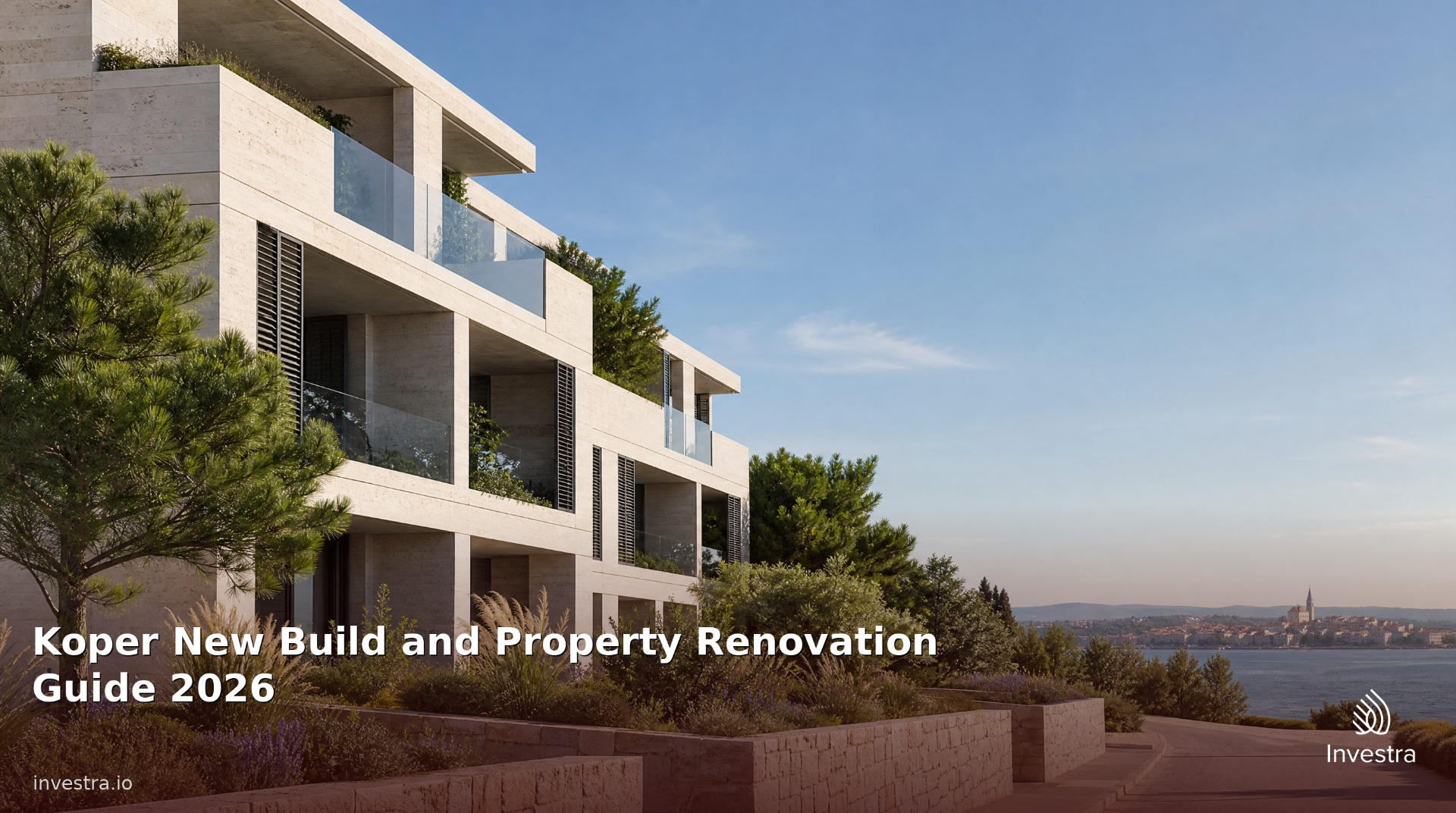
Koper New Build and Property Renovation Guide 2026
Koper New Build and Property Renovation Guide 2026
Koper's Strategic Position in the Slovenian Property Market
Quick Answer: Koper, Slovenia's only commercial port city, offers compelling new build and renovation opportunities in 2026, with new build prices ranging from €3,200 to €6,500/m² and renovation projects starting as low as €800/m² for older stock in need of modernization. Investra.io tracks these markets in real time to help investors make well-informed decisions.
Koper sits at an unusual intersection—a medieval Venetian port town that happens to be Slovenia's economic gateway to the Adriatic. It is compact, historically layered, and increasingly attractive to foreign buyers who want Mediterranean lifestyle without the inflated price tags of comparable Italian or Croatian coastal markets.
What has changed heading into 2026 is development pace. New construction projects are moving faster than at any point in the past decade. Municipal authorities have approved a series of urban regeneration zones across the Koper municipality, and construction activity along the Slovenian Riviera—the 47-kilometre coastal strip—has picked up meaningfully.
This guide breaks down everything investors, owner-occupiers, and developers need to know about building new or renovating existing property in Koper in 2026—from permitting and legal framework to real costs, material choices, contractor realities, and what kind of returns are genuinely achievable in this increasingly mature coastal market.
Understanding Koper's Property Market Fundamentals
Quick Answer: Koper's residential property market in 2026 is characterized by strong demand from both domestic buyers and EU nationals, with average prices in the city centre ranging from €3,800 to €5,500/m² and outlying areas from €2,200 to €3,400/m². Rental yields typically run between 4.5% and 6.8% gross for well-located units.
To understand why building or renovating in Koper makes sense, you must first appreciate what drives demand in this specific market. The city is home to roughly 53,000 people, but its economic footprint extends far beyond municipal boundaries. The Port of Koper is the largest dry-cargo port on the Adriatic and one of the fastest-growing container terminals in Southern Europe, handling over 27 million tonnes of cargo annually.
Layer on top of that Koper's proximity to Trieste, just 22 kilometres away, with a population ten times larger, and you quickly understand why cross-border demand is structural rather than cyclical. Many Italian professionals prefer living in Koper—lower cost of living, lower property prices, excellent road and rail connections—and commuting or working remotely.
Market data for early 2026 shows average transaction prices in Koper's historic old town sitting around €4,200–€5,500/m² for renovated apartments. New build developments in the Semedela and Bonifika neighbourhoods range from €3,200 to €4,800/m². The coastal premium applies most forcefully to properties with sea views or direct beach access, where prices can breach €6,000/m² in exceptional cases. For investors exploring comparable markets across the wider Balkans region, the Sremska Mitrovica Real Estate 2026 Srem Region Property Guide provides useful context on how mid-sized Central European cities are pricing and performing relative to their coastal counterparts.
New Build Development Zones and Active Construction Projects
Quick Answer: New residential construction in Koper is concentrated in the Semedela, Sermino, and Bertoki zones, with local planning rules governed by the Municipal Spatial Plan (OPN) and national building regulations under the GZ framework. Planning permission typically takes 3–9 months depending on project size and location sensitivity.
Slovenia's construction regulatory environment has tightened over the past five years in ways that directly affect Koper developments. The country operates under the Construction Act (Gradbeni Zakon—GZ), which introduced more streamlined permitting in theory, though in practice the coastal municipalities apply additional layers of review due to environmental and heritage sensitivity.
The key planning document for any new build project in the Koper municipality is the OPN (Občinski prostorski načrt), which defines land use zones, building height limits, setback requirements, and plot coverage ratios. The old town of Koper (Staro Mestno Jedro) is subject to the most restrictive rules—new builds are effectively prohibited in most of this zone, with only careful restoration and façade-compliant additions permitted.
The most active new build zones in 2026 include Semedela, a residential district approximately 2 kilometres west of the old town, currently seeing the highest concentration of new apartment construction. Typical new builds here are 4–6 storey blocks with underground parking, priced between €3,500 and €4,800/m². Several projects completed in 2024–2025 sold out within 12 months of launch.
Sermino represents a mixed residential and logistics-adjacent zone where developer interest has grown following port expansion plans. Land prices here are lower—around €180–€350/m² for buildable residential plots—making it more viable for mid-range development. Projects targeting port-sector professionals and longer-term rentals are performing particularly well.
Bertoki and Ankaran form the coastal stretch connecting Koper northward toward the Slovenian-Italian border. Bertoki has seen several luxury villa developments targeting Italian buyers, with finished product pricing reaching €5,000–€6,500/m² for premium sea-view units. All new builds in Slovenia must comply with the PURES 2 energy efficiency regulation, which essentially mandates near-zero-energy-building (NZEB) standards.
Renovation Opportunities in the Historic Centre
Quick Answer: Koper's old town contains hundreds of Venetian-era properties eligible for renovation, with acquisition prices for unrestored apartments ranging from €1,800 to €3,200/m² and full renovation costs adding €900–€1,800/m² depending on scope and heritage requirements. Total all-in costs for a renovated heritage apartment typically land between €3,500 and €5,500/m².
There is something genuinely special about Koper's historic centre that property developers often underestimate on first encounter. The old town is essentially an island—originally surrounded by water, now connected to the mainland by a causeway—and it retains much of its original 13th-to-16th century Venetian urban fabric.
This heritage value presents a double-edged sword. The properties are extraordinary, but they come with strict conservation obligations managed through the Institute for the Protection of Cultural Heritage of Slovenia (ZVKDS). Any renovation touching the exterior of a heritage-listed building requires cultural heritage consent (kulturnovarstveno soglasje) before a building permit is issued.
What surprised many buyers in recent years is how competitive acquisition prices remain for unrenovated old town stock. A 70–90m² apartment in need of complete renovation—think 1960s or 1970s Communist-era finishes layered over medieval bones—can still be acquired for €1,800–€2,600/m².
For investors who have explored renovation-led strategies elsewhere in the region—the logic is similar to what has been documented in the Zajecar Real Estate Market 2026 Eastern Serbia Property Guide, where older stock at low entry prices is being repositioned for modern rental markets—though Koper commands significantly higher end values given its EU coastal location.
Legal Framework for Foreign Buyers and Property Transactions
Quick Answer: EU citizens can purchase property in Slovenia on identical terms to Slovenian nationals, with no foreign ownership restrictions. Non-EU buyers face some limitations on agricultural land but can freely purchase residential and commercial properties. The transaction process typically takes 2–4 months from offer to completed title registration.
Slovenia's legal framework for foreign property buyers is among the most straightforward in Central and Eastern Europe—a direct benefit of EU membership and the country's civil law tradition rooted in Austrian legal heritage. Here is how the process actually works.
The transaction begins with a preliminary contract (predpogodba), which binds both parties and typically requires a 10% deposit. This is followed by the main sale contract (prodajna pogodba), which must be notarized by a Slovenian notary (notar). The notary verifies ownership, encumbrances, and compliance—their fee is regulated by law at approximately 0.5–1% of the transaction value, capped at specific amounts.
Land registry (Zemljiška knjiga) registration is the final step, converting contractual ownership into recorded title. This process has been significantly digitized in Slovenia and typically completes within 2–6 weeks of contract execution, though heritage properties or those with complex title histories can take longer.
For new build purchases off-plan, the legal structure differs. The developer typically issues a reservation contract followed by a construction contract, with staged payments tied to construction milestones.
Non-EU nationals from countries with bilateral agreements (the United States, United Kingdom post-Brexit under certain circumstances, and several others) can generally purchase residential property without restriction under reciprocity provisions. Chinese, Russian, and certain Middle Eastern buyers should seek specific legal advice before proceeding, as restrictions may apply in specific asset classes.
Working with an experienced investment consultant during this process is strongly recommended. Siniša Dagary — Investment Consultant brings cross-border expertise that helps international buyers structure transactions efficiently and avoid the common pitfalls that arise from unfamiliarity with Slovenian notarial and land registry procedures.
Construction Costs and Build Quality Standards
Quick Answer: New residential construction in Koper costs approximately €1,400–€2,200/m² for standard-quality builds and €2,200–€3,500/m² for high-specification projects, excluding land and professional fees. These costs reflect Slovenia's relatively high labour and material standards compared to the wider Balkan region.
Slovenia sits at an interesting cost crossroads. Labour costs are markedly higher than in Serbia, North Macedonia, or Bosnia—Slovenian construction workers earn 3–5 times more per hour than their counterparts in those countries—but still significantly lower than in Austria or Italy. This creates a genuine quality window: you can build to Northern European standards at a construction cost that is 20–35% lower than comparable projects in Western Europe.
Breaking down actual construction costs in Koper for 2026: Structural works (foundations, frame, roof) cost €450–€750/m² of gross floor area, depending on ground conditions (coastal sites can have complex geology), building height, and structural system. Reinforced concrete frame construction dominates new residential projects in Koper.
Envelope and façade work costs €200–€450/m², heavily influenced by insulation specification and NZEB compliance requirements. The thermal envelope is where developers cannot cut corners—energy certification is mandatory for all new builds and significantly affects both sale value and rental income.
Mechanical, electrical, and plumbing (MEP) costs €180–€350/m² for a complete installation including underfloor heating (now standard in quality projects), air conditioning, ventilation with heat recovery, and solar thermal or photovoltaic systems. Interior finishes range from €250–€700/m² depending heavily on specification. Mid-range finishes—engineered wood floors, tiled bathrooms, German kitchen appliances—cost around €300–€400/m².
External works and landscaping cost €50–€200/m² of plot area, depending on scope. Professional fees (architect fees typically 8–12% of construction cost for full design and supervision, structural engineer 2–4%, energy consultant 1–2%, and geodetic surveys 1–2%) must be factored into total project budgets.
Contingency budgeting is essential. Experienced developers in Koper typically hold 10–15% contingency on renovation projects and 5–10% on new builds. Coastal ground conditions—particularly the presence of fill material in some reclaimed areas—can generate unexpected structural costs.
Building Permits and Planning Process
Quick Answer: The Slovenian building permit process for new residential construction involves pre-design consultation, spatial planning compliance verification, building permit application (typically 30–90 days for straightforward projects), construction notification, and final occupancy permit. Heritage projects add ZVKDS consent requirements at multiple stages, typically extending timelines by 2–4 months.
Getting a building permit in Slovenia is not a quick process, but it is more predictable than in many regional markets. The key is understanding the sequence and engaging the right professionals at each stage.
The process starts well before any permit application—with a spatial planning information request (lokacijska informacija) from the Koper municipality, which tells you what the planning rules allow for a specific plot. This document, which costs around €50–€100 and takes 15 days to issue, is essential reading before committing to land purchase. It specifies maximum building height, permitted use, plot coverage ratio, and any special conditions.
Standard processing time is 30–60 days for uncomplicated projects, but coastal heritage projects routinely take 4–9 months. Investors should factor this into project timelines and financing structures.
Once construction commences, a construction notification (prijava začetka gradnje) must be submitted 8 days before work starts. Site supervision by a licensed supervisor (nadzornik) is mandatory throughout the build.
For those researching how permitting complexity compares in less regulated markets, the Bor Real Estate Market 2026 Eastern Serbia Mining City Property Guide illustrates how different regulatory environments affect development timelines and costs—a useful comparative lens for investors evaluating multiple markets simultaneously.
Rental Yields and Investment Returns Analysis
Quick Answer: Gross rental yields in Koper range from 4.2% to 6.8% depending on property type and location, with short-term holiday rental (Airbnb-style) strategies generating 6–9% gross in well-located units during the peak May–September season. Net yields after management costs, taxes, and vacancy allowance typically land at 3.5–5.5%.
Let us be direct about returns, because this is where many property marketing materials overstate the case. Koper is not a 10%-yield market—it never was. What it offers is stable, growing returns in a politically secure, euro-denominated, EU-regulated environment. For the right investor, that profile is more attractive than higher nominal yields in less stable markets.
Long-term residential rental yields in Koper currently average around 4.5–5.5% gross for a well-located, renovated apartment. A 65m² two-bedroom apartment in Semedela, purchased at €4,000/m² (total cost €260,000), might achieve €1,050–€1,200/month in rent, generating a gross yield of approximately 4.8–5.5%.
Short-term holiday rental changes the picture. Koper receives over 300,000 tourist overnight stays annually, and the broader Slovenian Riviera sees peak occupancy from May through September. A well-presented apartment operating as a holiday rental can achieve €800–€1,400/week in peak season and €400–€700/week in shoulder months.
Capital appreciation has been the additional driver. Koper residential prices have risen approximately 42% over the 2019–2024 period, outperforming the Slovenian national average of 34% over the same period. Forecasts for 2025–2027 suggest continued appreciation of 4–7% annually, supported by constrained supply in the historic centre and ongoing demand from Italian cross-border buyers.
Investors comparing this to opportunities in smaller Serbian regional markets like those documented in the Prokuplje Real Estate Market 2026 Toplica Region Property Guide will find that Koper offers lower entry yields but substantially higher capital security and liquidity.
Financing Options and Mortgage Structures
Quick Answer: Slovenian banks offer mortgages to EU nationals with favourable terms—LTV ratios up to 80% for primary residences and 60–70% for investment properties, with variable rates currently around 4.2–5.1% (Euribor-linked) in early 2026. Non-EU buyers face more stringent requirements and typically access finance through private lenders or developer-arranged schemes.
Slovenia's banking sector is well-capitalized and conservative by regional standards. The major domestic lenders—NLB Banka, Nova KBM, SKB Banka (owned by Société Générale), and UniCredit Slovenia—all offer residential mortgage products to EU nationals purchasing primary or investment properties. Interest rates in early 2026 reflect the ECB's rate trajectory: most variable-rate products are priced at Euribor 3M plus a margin of 1.5–2.2%, translating to all-in rates of approximately 4.2–5.1%.
For renovation projects specifically, Slovenian banks offer renovation loans (stanovanjska posojila za prenovo) with slightly different structures. These can be disbursed in tranches tied to construction progress, similar to a draw-down facility. The challenge is that heritage renovation projects often have uncertain timelines and cost outcomes, which makes banks conservative about initial valuations.
EU structural funds through the Slovenian Housing Fund (SID-SPF mechanisms) offer subsidized financing for energy renovation of residential properties. In 2025–2026, programs targeting thermal envelope upgrades and renewable energy installations provide grants of €5,000–€20,000 per dwelling unit plus subsidized loans at rates 1.5–2% below market.
For construction financing specifically, developers in Koper typically access project finance through a combination of equity (30–40%), senior bank debt (40–50%), and mezzanine or pre-sale proceeds (10–20%). Off-plan pre-sales are increasingly used as de facto financing tools—developers offer price incentives of 8–15% for buyers who commit at the foundation stage, using these deposits to fund ongoing construction.
The Business Strategy Blog by Siniša Dagary covers financing structures for cross-border property investment in considerable detail, addressing capital deployment strategies, currency hedging considerations, and tax-efficient financing for international investors.
Construction Contractors and Project Management
Quick Answer: Koper has a concentrated pool of experienced residential contractors, with the largest firms (Primorje, Kolektor, and several smaller specialists) capable of managing projects of all sizes. Contractor selection requires careful vetting of references, insurance coverage, and performance bonding. Hiring an independent site supervisor (nadzornik) is legally mandatory and costs €2,000–€5,000 per project.
The Koper construction market has matured significantly since the 2008 financial crisis eliminated weaker firms. Today, the contractor pool comprises several tiers: large regional contractors experienced in multi-unit residential development, medium-sized firms specializing in renovation and single-family builds, and specialist subcontractors for MEP, heritage conservation, and specialist finishes.
For new build projects, the main contractor
Investment Disclaimer
Quick Answer: This guide is general market information, not personal legal, tax, financing or investment advice.
Before committing to a property transaction, buyers should obtain independent local legal, tax and financial advice suited to their circumstances. Investra.io can support initial market research, but every purchase decision remains the buyer's responsibility.
Frequently Asked Questions
Quick Answer: This section explains the practical property-investment implications of Frequently Asked Questions.
What is a prudent next step after initial market research?
Use current documentation, independent professional advice and comparable local evidence before proceeding. Investra.io can support an initial structured market review.
How can buyers plan a realistic ownership budget?
Use current documentation, independent professional advice and comparable local evidence before proceeding. Investra.io can support an initial structured market review.
What evidence supports a careful investment decision?
Use current documentation, independent professional advice and comparable local evidence before proceeding. Investra.io can support an initial structured market review.
When should a buyer obtain legal and tax advice?
Use current documentation, independent professional advice and comparable local evidence before proceeding. Investra.io can support an initial structured market review.
How should a buyer compare neighbourhoods and property types?
Use current documentation, independent professional advice and comparable local evidence before proceeding. Investra.io can support an initial structured market review.
What local checks should be completed before signing?
Use current documentation, independent professional advice and comparable local evidence before proceeding. Investra.io can support an initial structured market review.
Which costs should be assessed alongside the purchase price?
Use current documentation, independent professional advice and comparable local evidence before proceeding. Investra.io can support an initial structured market review.
How can international buyers verify a property opportunity?
Use current documentation, independent professional advice and comparable local evidence before proceeding. Investra.io can support an initial structured market review.
What should buyers compare before selecting a property?
Use current documentation, independent professional advice and comparable local evidence before proceeding. Investra.io can support an initial structured market review.
Quick Answer: These answers outline common buyer checks and should be read with current professional advice.
Recommended Reading
Quick Answer: This section explains the practical property-investment implications of Recommended Reading.
- Investra market research
- Investra market research
- Investra market research
- Investra market research
- Investra market research
- Investra market research
- Investra market research
- Investra market research
- Investra market research
- Investra market research
- Investra market research
- Investra market research
- Investra market research
- Investra market research
- Investra market research
- Investra market research
- Investra market research
- Siniša Dagary investment insight
- Siniša Dagary investment insight
- Siniša Dagary investment insight
- Siniša Dagary investment insight
- Siniša Dagary investment insight
- Findes Group & Partners
- Findes Group & Partners
Connect With Investra
Follow Investra for market updates on Facebook, LinkedIn, YouTube
Related Posts
No related posts available.
