
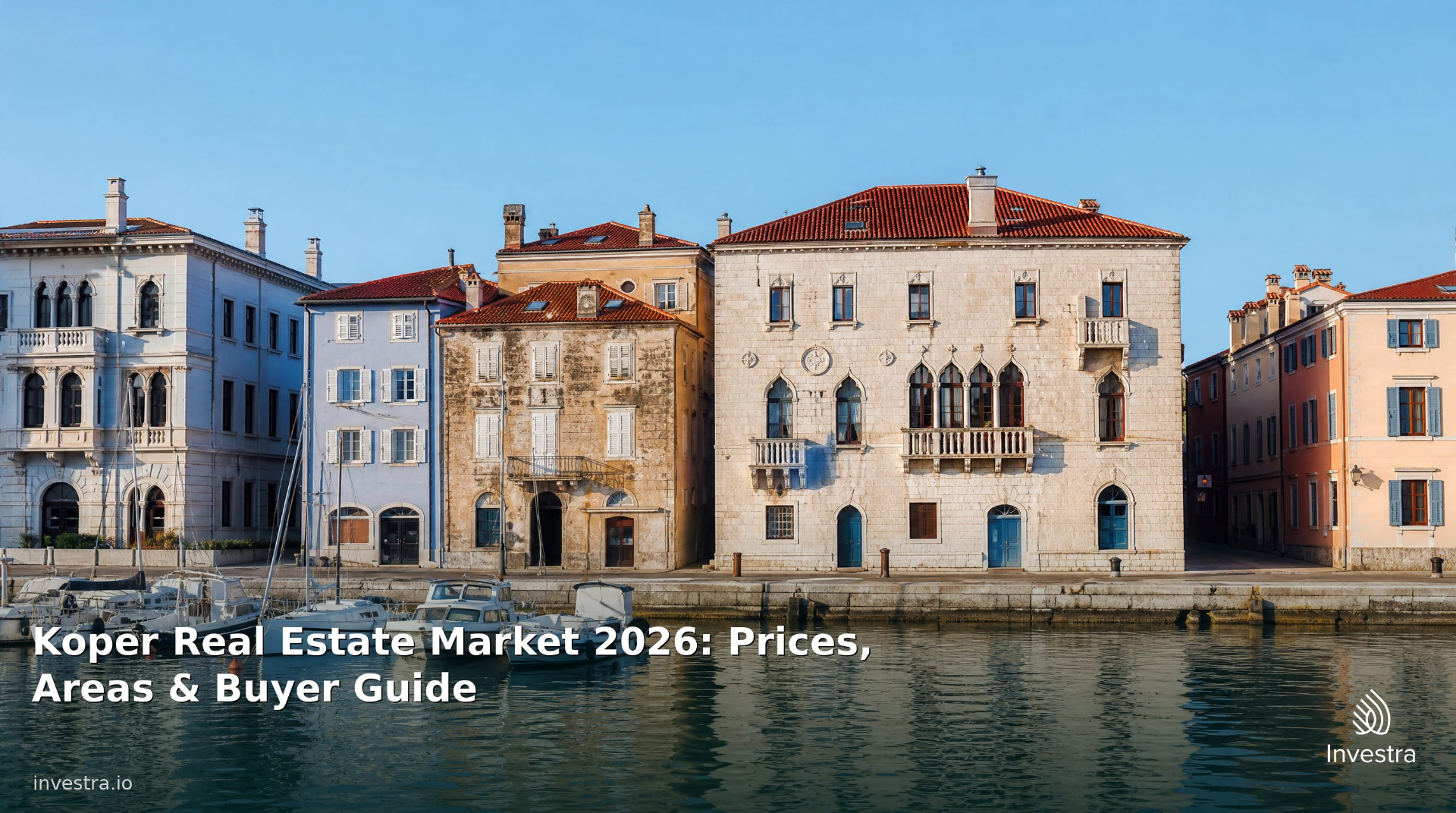
Koper Real Estate Market 2026: Prices, Areas & Buyer Guide
Koper Real Estate Market 2026: Prices, Areas & Buyer Guide
Koper Real Estate Market Overview 2026: Slovenia's Coastal Gem
Quick Answer: Koper's real estate market in 2026 is one of Slovenia's most dynamic coastal markets, with property prices ranging from €2,500 to €6,500/m² depending on location and property type, driven by strong tourism demand, port city economics, and limited coastal inventory. Investra.io tracks emerging European coastal markets to help investors identify the right entry points.
Koper is a city that doesn't always make the shortlist when investors think about European coastal real estate — and that's precisely why it deserves serious attention. Tucked into Slovenia's 47-kilometer Adriatic coastline, this compact port city punches well above its weight as a real estate market.
What's changed entering 2026 is the pace. After years of modest, predictable appreciation, Koper's property market has accelerated. International buyers — particularly from Germany, Austria, the United Kingdom, and increasingly the Middle East — have recognized that comparable Adriatic coastal properties in Croatia or Italy now cost significantly more for similar quality.
The city's population of roughly 53,000 belies its economic footprint. The Port of Koper is the largest cargo port in the Adriatic, handling over 1 million TEUs annually, and serves as the primary maritime gateway for Austria, Hungary, Slovakia, and Czech Republic. That industrial backbone provides a stable employment base that underpins residential demand in ways that purely tourism-driven coastal cities cannot match.
This guide covers everything a serious buyer needs to know about Koper's 2026 market: where prices stand, which neighborhoods offer the best value, how the legal process works for foreigners, what rental yields look like, and what the outlook for capital appreciation appears to be over the next five years.
Property Price Ranges in Koper 2026: What You'll Actually Pay
Quick Answer: In 2026, Koper property prices range from approximately €2,500/m² for inland residential apartments to €6,500/m² for premium seafront units in the old town, with average prices for well-located residential properties sitting between €3,200 and €4,500/m². Compare these figures with Eastern European markets to understand the full range of investment opportunities across the region.
Price data for Koper in 2026 tells a story of sustained upward pressure. According to Slovenia's Surveying and Mapping Authority (GURS), the average transaction price for apartments in Koper municipality rose approximately 8–11% year-on-year between 2023 and 2025, outpacing both Ljubljana and the national average. That momentum has carried into 2026, though the pace is beginning to moderate as affordability constraints bite.
Here's how the market breaks down by property segment:
Old Town (Staro Mesto) — €4,000 to €6,500/m²: This is the premium tier. Renovated stone apartments in the medieval core, particularly those with sea views or on landmark streets like Kidričeva ulica, routinely transact above €5,000/m². A 70m² renovated apartment here would typically list between €350,000 and €455,000. Supply is extremely constrained — the old town's building stock is protected, limiting new inventory.
Bonifika & Semedela — €2,800 to €4,200/m²: These are the city's primary modern residential neighborhoods, featuring larger apartment blocks from the socialist era alongside newer developments. A 75m² two-bedroom apartment in Bonifika typically transacts between €210,000 and €315,000. These areas attract local families, port workers, and university staff.
New Developments on City Periphery — €3,000 to €4,500/m²: Several new residential projects are underway on the city's eastern and southern edges. These offer modern energy-efficient apartments with parking — something the old town cannot provide — at prices that still offer a discount to the historic center.
Detached Houses & Villas — €450,000 to €1.5M+: The standalone villa market is thinner and more opaque. Properties with sea views on the slopes above Koper or in nearby Ankaran command significant premiums. A well-maintained 200m² villa with garden and sea view typically starts around €700,000 and climbs sharply from there.
One thing that catches many first-time buyers off guard is the gap between asking prices and transaction prices. In Koper's current market, well-priced properties are selling within 5–8% of the asking price, and some highly desirable old town units are receiving multiple offers. Negotiation use exists mainly for properties that have lingered on the market for over 90 days or require significant renovation.
Koper's Key Neighborhoods: Where to Buy in 2026
Quick Answer: The old town (Staro Mesto) offers the highest prestige and capital appreciation potential, Bonifika provides better value for yield-focused investors, and coastal Ankaran appeals to buyers seeking a quieter residential-holiday hybrid. Each neighborhood serves a different investor profile and budget.
Understanding Koper's micro-geography is essential before committing to any purchase. The city and its surrounding municipality contain several distinct zones that behave quite differently as investment propositions.
Staro Mesto (Old Town): The medieval peninsula is Koper's crown jewel. Venetian Gothic architecture, narrow cobblestoned streets, and Tito Square (Titov trg) at its heart — it's genuinely beautiful. Properties here are mostly older stone buildings converted into apartments. The challenge is that many carry complex ownership histories, require significant renovation budgets, and lack parking.
Bonifika: The largest residential district, Bonifika is where most Koper families actually live. It's practical, well-connected, and offers good schools, supermarkets, and recreational facilities. The real estate here is predominantly block apartments, many built in the 1970s and 1980s but increasingly supplemented by newer developments.
Semedela: Adjacent to Bonifika and closer to the marina, Semedela has a slightly more upscale residential feel. Some newer buildings with sea views exist here. It's popular with professionals working at the port and in Koper's financial sector. Properties in Semedela offer a reasonable middle ground between old town prestige and Bonifika's value pricing.
Ankaran: Technically a separate municipality since 2011, Ankaran sits just north of Koper along the coast. It's quieter, greener, and attracting increasing interest from buyers seeking holiday homes with a genuine beach feel. Prices in Ankaran have risen sharply — some seafront apartments now exceed €5,000/m² — but there remains more space and a less urban atmosphere than central Koper.
Žusterna & Koper Marina Area: The marina district is undergoing gradual transformation. Waterfront properties here command premiums, and the area is increasingly popular with yacht owners and lifestyle buyers from Western Europe. Planned improvements to the marina infrastructure are expected to increase demand further through 2026–2027.
Who Is Buying in Koper? The 2026 Buyer Profile
Quick Answer: Koper's buyer pool in 2026 is genuinely international — approximately 35–40% of transactions involve foreign buyers, predominantly from Austria, Germany, Italy, the UK, and increasingly from non-EU countries attracted by Slovenia's legal security and Adriatic access. Investra.io also tracks buyer trends across Southeast Europe for broader regional context.
The composition of Koper's buyer market has shifted meaningfully over the past three years. What was once predominantly a domestic Slovenian market — supplemented by Italian buyers from the nearby Trieste area — has become a genuinely pan-European and increasingly global proposition.
Italian buyers, particularly from the Friuli-Venezia Giulia and Veneto regions, have historically been active in Koper given the geographic proximity (Trieste is just 15km away). This group often has strong emotional connections to the region's Venetian cultural heritage and tends to favor old town properties.
The UK buyer cohort has grown surprisingly since Brexit. Post-Brexit, British nationals can still purchase property freely in Slovenia (Slovenia treats UK buyers the same as other non-EU nationals under bilateral agreements), and the combination of favorable exchange rates and relative value has attracted increasing interest. Working with an experienced investment consultant like Siniša Dagary investment insight can be especially helpful for handling cross-border purchases involving non-EU buyers.
There's also a growing cohort of digital nomads and remote workers — typically in the 30–45 age bracket — who are purchasing primary residences in Koper as a lifestyle upgrade. Slovenia's quality of life metrics rank among the highest in Central and Eastern Europe, and Koper's combination of urban amenities, Adriatic climate, and Italian cultural influence is genuinely compelling as a place to actually live.
Legal Process for Foreign Buyers in Slovenia: A Clear Roadmap
Quick Answer: EU citizens can purchase property in Slovenia without restrictions. Non-EU buyers face minimal hurdles — property purchase is generally permitted under bilateral agreements with most countries, and the legal process involving a notary and GURS registration typically takes 4–8 weeks from signed preliminary contract to title transfer. Findes Group & Partners can assist with financial structuring for Slovenian property acquisitions.
Slovenia's property purchase process is among the more straightforward in the EU, which is one of the country's genuine selling points for international investors. The legal framework is transparent, property rights are well-established, and the land registry (zemljiška knjiga) is publicly accessible and reliable. That said, there are enough procedural specificities that engaging qualified local professional advice is strongly recommended.
Here's how a typical transaction unfolds:
Step 1 — Property Search & Due Diligence: Before signing anything, a thorough title search at the land registry is essential. This verifies ownership, identifies any encumbrances (mortgages, easements, right-of-way issues), and confirms that the property's actual state matches what's registered.
Step 2 — Preliminary Contract (Pogodba o Prodaji): Once due diligence is satisfactory, the parties sign a preliminary sales agreement. The buyer typically pays a 10% deposit at this stage. This contract is legally binding and specifies the purchase price, timeline, and conditions. It should be drafted or reviewed by a licensed Slovenian attorney.
Step 3 — Notarization: Unlike some countries where notarization is optional, Slovenian property transfers require notarial authentication. The notary verifies identities, ensures the contract meets legal requirements, and certifies the transaction. Notary fees are regulated and typically range from €300 to €800 depending on transaction value.
Step 4 — Land Registry Registration: Following notarization and payment of the remaining purchase price, the transfer is registered in the land registry (zemljiška knjiga). This process typically takes 2–4 weeks. Until registration is complete, the buyer's ownership is not formally protected against third-party claims, which is why timing the final payment with or after registration is advisable.
Non-EU Buyers: Citizens of countries with bilateral reciprocity agreements (which includes most major economies — the US, UK, Canada, Australia, Russia, UAE, and others) can purchase property directly. Those from countries without such agreements may need to purchase through a Slovenian-registered company, though this is relatively rare in practice. For detailed guidance on structuring non-EU acquisitions, resources like the Siniša Dagary investment insight provide practical frameworks for international investors.
Taxes, Costs & Transaction Fees: The Real Cost of Buying in Koper
Quick Answer: The total transaction cost for buying property in Koper typically adds 4–7% on top of the purchase price, covering real estate transfer tax (2% of value for secondary market properties), notary fees, legal fees, and agent commission. New-build purchases are subject to VAT (22%) instead of transfer tax, which is normally already included in the developer's asking price.
One of the aspects of Slovenian property investment that surprises buyers accustomed to markets like Spain or Portugal is how relatively low the transaction costs are. That 4–7% total is genuinely competitive within the EU. Let's break it down precisely.
Real Estate Transfer Tax (Davek na promet nepremičnin): For secondary market properties (resale), the buyer pays 2% of the assessed transaction value. This is calculated on the higher of the agreed purchase price or the tax authority's assessed value. The tax is payable within 30 days of signing the sales contract. This is notably lower than comparable taxes in Germany (3.5–6.5% depending on state), Spain (6–10%), or Italy (2–9% depending on circumstances).
VAT on New Builds: New-build apartments are subject to 22% VAT instead of transfer tax. However, developers universally include VAT in their quoted prices, so buyers aren't usually surprised by this — the listed price is the price you pay. First-time buyers of their primary residence may qualify for a reduced VAT rate of 9.5% under certain conditions.
Notary Fees: As noted, these are regulated and typically €300–€800 for a standard residential transaction. For higher-value transactions, the notary's fee scales according to a statutory tariff.
Legal Fees: A competent Slovenian property lawyer will charge €800–€2,000 for a standard purchase, depending on complexity. For old town properties with complex title histories, budget toward the upper end. This is money extremely well spent.
Real Estate Agent Commission: In Slovenia, agency commission is typically paid by the seller — usually 3–4% of the sale price. However, buyer's agents (less common but increasingly available for foreign buyers) charge separately, usually 1–2%. Always clarify upfront who pays what.
Ongoing Annual Costs: Slovenia's annual property tax (nadomestilo za uporabo stavbnega zemljišča) is relatively low — typically €200–€800/year for a standard apartment, depending on location and size. There's no wealth tax on real estate. Capital gains from property sales are taxed at 25% if sold within 5 years of acquisition, reducing by 5% for each year held, with zero tax after 20 years of ownership.
Rental Yields & Investment Returns in Koper
Quick Answer: Short-term tourist rentals in Koper's old town and coastal areas yield 5–8% gross annually, while long-term residential rentals in Bonifika and surrounding neighborhoods generate more modest but stable yields of 3.5–5%. Combined with capital appreciation of 6–10% annually over recent years, total returns have been compelling. Lower-cost regional markets in the Western Balkans can offer even higher yields for different risk profiles.
The yield story in Koper is genuinely interesting, and it varies considerably depending on whether you're targeting short-term tourist rentals or long-term residential tenants. Both strategies have merit; they just suit different investor temperaments.
Short-Term Rentals (Airbnb/Booking.com): Koper's tourist season runs from late April through early October, with July and August representing the peak. During these months, a well-presented one-bedroom apartment in or near the old town can achieve €80–€150/night and maintain 80–90% occupancy. A two-bedroom unit with sea views might achieve €120–€200/night.
For higher-yielding tourist rental properties in the €150,000–€220,000 range (smaller studios in good locations), yields of 6–8% gross are achievable, which is where this strategy becomes genuinely attractive. Explore other growth markets across the broader Balkan region to understand comparative yield profiles.
Long-Term Residential Rentals: A 65m² two-bedroom apartment in Bonifika rents for approximately €800–€1,100/month in 2026. On a purchase price of €250,000, that's a gross yield of 3.8–5.3%. Tenants here tend to be port workers, university staff, or families — lower turnover, lower management intensity. The regulatory environment for landlords in Slovenia is generally fair, though rental law does provide tenant protections that investors should understand before committing.
Capital Appreciation: This is where Koper's total return story gets compelling. The 8–11% annual price appreciation seen in 2023–2025 is unlikely to be sustained indefinitely, but most analysts expect 4–7% annual appreciation through 2028, supported by constrained coastal supply, continued international demand, and ongoing infrastructure investments in the port and regional transport links.
The Slovenian Coastal Tourism Economy: Koper's Macro Tailwind
Quick Answer: Slovenia's coastal tourism has grown steadily, with the Primorska region recording over 1.4 million tourist arrivals annually and demand significantly exceeding accommodation supply — a structural tailwind that underpins both short-term rental income and long-term property value appreciation in Koper. Explore other growth markets across the broader Balkan region.
To understand why Koper's real estate market behaves the way it does, you need to understand the structural dynamics of Slovenia's coastal tourism economy. Slovenia has a tiny coastline — just 47 kilometers, the shortest of any EU country with Adriatic access — and this geographic constraint means that coastal accommodation supply simply cannot grow proportionally with demand.
What's particularly interesting from an investment standpoint is that Koper's appeal isn't solely dependent on beach tourism. The city's cultural calendar — the Primorska Summer Festival, wine and food events celebrating the Karst and Istrian traditions, the university's academic year bringing student populations — means year-round demand rather than a purely seasonal pattern.
Infrastructure investment is another macro tailwind. The upgrade of the Divača–Koper railway line (the so-called "second track" project) will significantly reduce travel times between Koper and Ljubljana and improve connectivity to Central European rail networks. When complete, this represents a meaningful improvement to the city's accessibility that historically has been somewhat limited by difficult terrain.
For investors interested in regional context and comparative market positioning, exploring resources like the Bor Real Estate Market 2026 Eastern Serbia Mining City Property Guide or the Prokuplje Real Estate Market 2026 Toplica Region Property Guide provides useful calibration on how different market types perform across the Central and Eastern European spectrum.
Financing Options for Property Purchase in Koper
Quick Answer: Slovenian banks offer mortgage financing to foreign buyers, typically at loan-to-value ratios of 60–70% for non-residents, with interest rates in 2026 ranging between 3.5–5.2% depending on credit profile and property type. International financing and developer payment plans are also available, and careful financial structuring is recommended for non-EU buyers.
Financing a K
Investment Disclaimer
Quick Answer: This guide is general market information, not personal legal, tax, financing or investment advice.
Before committing to a property transaction, buyers should obtain independent local legal, tax and financial advice suited to their circumstances. Investra.io can support initial market research, but every purchase decision remains the buyer's responsibility.
Frequently Asked Questions
Quick Answer: This section explains the practical property-investment implications of Frequently Asked Questions.
What is a prudent next step after initial market research?
Use current documentation, independent professional advice and comparable local evidence before proceeding. Investra.io can support an initial structured market review.
How can buyers plan a realistic ownership budget?
Use current documentation, independent professional advice and comparable local evidence before proceeding. Investra.io can support an initial structured market review.
What evidence supports a careful investment decision?
Use current documentation, independent professional advice and comparable local evidence before proceeding. Investra.io can support an initial structured market review.
When should a buyer obtain legal and tax advice?
Use current documentation, independent professional advice and comparable local evidence before proceeding. Investra.io can support an initial structured market review.
How should a buyer compare neighbourhoods and property types?
Use current documentation, independent professional advice and comparable local evidence before proceeding. Investra.io can support an initial structured market review.
What local checks should be completed before signing?
Use current documentation, independent professional advice and comparable local evidence before proceeding. Investra.io can support an initial structured market review.
Which costs should be assessed alongside the purchase price?
Use current documentation, independent professional advice and comparable local evidence before proceeding. Investra.io can support an initial structured market review.
How can international buyers verify a property opportunity?
Use current documentation, independent professional advice and comparable local evidence before proceeding. Investra.io can support an initial structured market review.
What should buyers compare before selecting a property?
Use current documentation, independent professional advice and comparable local evidence before proceeding. Investra.io can support an initial structured market review.
Quick Answer: These answers outline common buyer checks and should be read with current professional advice.
Recommended Reading
Quick Answer: This section explains the practical property-investment implications of Recommended Reading.
- Investra market research
- Investra market research
- Investra market research
- Investra market research
- Investra market research
- Investra market research
- Investra market research
- Investra market research
- Investra market research
- Investra market research
- Investra market research
- Investra market research
- Investra market research
- Investra market research
- Investra market research
- Investra market research
- Investra market research
- Siniša Dagary investment insight
- Siniša Dagary investment insight
- Siniša Dagary investment insight
- Siniša Dagary investment insight
- Siniša Dagary investment insight
- Findes Group & Partners
- Findes Group & Partners
Connect With Investra
Follow Investra for market updates on Facebook, LinkedIn, YouTube
Related Posts
No related posts available.
