
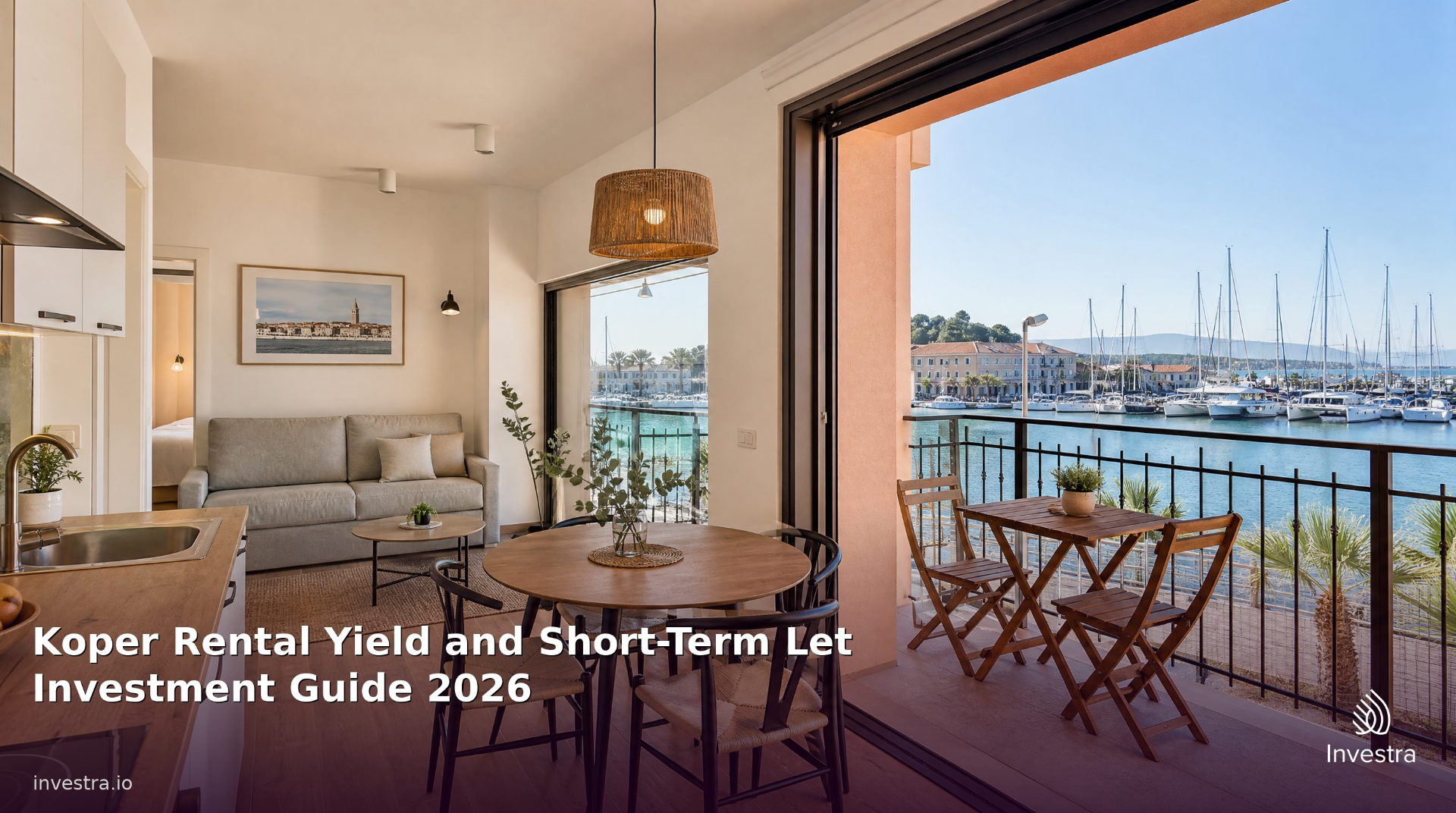
Koper Rental Yield and Short-Term Let Investment Guide 2026
Koper Rental Yield and Short-Term Let Investment Guide 2026
Why Koper Is Capturing Serious Investor Attention in 2026
Quick Answer: Koper is Slovenia's only major seaport city and offers rental yields between 4.5% and 7.8% depending on property type and location, making it one of the most compelling short-term let investment destinations on the Adriatic coast. Investra.io tracks emerging European coastal markets including Koper for global investors.
There's something quietly remarkable happening along Slovenia's 47-kilometre coastline. While most investors fixate on Croatia or Montenegro when thinking about Adriatic property, Koper — a historic Venetian port city of roughly 55,000 residents — has been delivering consistent capital appreciation and rental income for the small group of international buyers who discovered it early.
Koper sits at the northern tip of the Adriatic, part of the Slovenian Istria region. It's the country's only commercial port, a UNESCO-adjacent historic old town, and a city with genuine year-round economic activity beyond tourism. The port of Koper handles over 25 million tonnes of cargo annually and is one of the fastest-growing container terminals in Southern Europe.
What surprised many buyers entering this market in recent years is just how undervalued Koper remains relative to comparable Adriatic destinations. Italian coastal towns two hours away command double or triple the price per square metre. Croatian resort cities like Dubrovnik push €4,000–€6,000/m² for prime coastal stock.
Understanding Koper's Property Market: Prices, Zones, and Trends in 2026
Quick Answer: Koper property prices range from approximately €2,200/m² in outer residential areas to €4,500/m² in the historic old town, with average annual price growth of 5–8% recorded between 2021 and 2025. Investra.io's regional market data helps investors benchmark coastal Slovenian prices against broader European trends.
Koper's property market is relatively compact but meaningfully segmented. Understanding which zone you're buying in determines almost everything about your rental strategy, achievable yields, and resale prospects. There are essentially four distinct investment micro-markets operating simultaneously.
The Historic Old Town (Staro Mesto) sits on what was once an island, now connected to the mainland by a causeway. Stone-built Venetian-era apartments here fetch €3,200–€4,500/m² and represent the prime short-term rental inventory. These properties attract tourists, weekend visitors from Central Europe, and cultural travellers.
The Semedela and Žusterna neighbourhoods along the seafront offer more modern apartment stock at €2,600–€3,400/m². These areas are popular with both short-term tourists and longer-term residents. You'll find more recently built complexes with parking, balconies, and sea views — features that command premiums on Airbnb.
Inner Koper residential zones — areas like Markovec, Semedela inland sections, and newer suburban developments — price between €2,200–€2,800/m². These don't attract leisure tourists in meaningful numbers, but they serve the corporate and long-term rental market effectively.
The broader Koper municipality includes settlements like Škocjan, Bertoki, and Ankaran (now a separate municipality but functionally connected), where prices dip to €1,800–€2,400/m² for houses and rural properties. These are less relevant for short-term let strategies but worth knowing for buy-to-hold land banking approaches.
The overall price trajectory has been upward and reasonably consistent. Slovenian Statistical Office (SURS) data shows that residential property prices in the Coastal-Karst statistical region increased by approximately 48% in nominal terms between 2018 and 2024 — outpacing most Central European regional cities.
Rental Yield Analysis: What Investors Are Actually Earning in Koper
Quick Answer: Long-term rental yields in Koper average 3.8–5.2% gross annually, while well-optimised short-term Airbnb lets in prime locations can achieve 6.5–7.8% gross yield, with net yields after costs typically landing in the 4.5–6% range.
Yield figures are only useful when they're honest about the gap between gross and net returns — a distinction that gets glossed over in too many property investment pitches. Here's a grounded look at what Koper's rental market actually delivers.
For long-term rentals (12-month contracts), a typical 55m² apartment in the old town purchased at €200,000 will rent for €850–€1,050/month to a professional tenant. That produces a gross yield of approximately 5.1–6.3%. After factoring in property management fees (8–12% of rent), occasional vacancy, maintenance reserves, and municipal charges, net yield settles around 3.8–4.8%.
The more interesting numbers come from short-term Airbnb-style operations . The same 55m² old town apartment, professionally photographed and listed with dynamic pricing, generates average nightly rates of €85–€130 during peak season and €55–€75 in shoulder season.
What we know from operators who've been running Koper short-term lets for three or more years is that the seasonality curve is less extreme than you might expect. Unlike purely coastal resort towns, Koper's combination of port activity, university, and cultural tourism creates demand spikes that aren't confined to July and August.
For investors looking at comparable regional data before committing capital, reviewing markets like the Sremska Mitrovica real estate market or exploring Bor Real Estate Market 2026 Eastern Serbia Mining City Pr... can provide useful context about how port-adjacent and logistics-driven economies support rental demand — a dynamic that directly parallels Koper's situation.
Short-Term Let Regulations in Koper and Slovenia: What the Law Actually Says
Quick Answer: Slovenia requires short-term rental hosts to register with the tourism authority (AJPES), collect and remit tourist tax, and comply with municipal zoning rules — but there are no outright bans or licence caps in Koper as of 2026, making it more accessible than many Western European cities.
One of the first questions any serious investor asks about a short-term let market is whether the regulatory environment is stable or heading toward restriction. Koper's situation in 2026 is more permissive than most comparable European coastal cities — but that doesn't mean there are no rules, and getting the compliance framework wrong can create real financial headaches.
Slovenia's short-term rental framework operates primarily at the national level with some municipal overlays. Here's what operators need to know:
Registration with AJPES: Any property rented for tourism purposes must be registered in the Slovenian Business Register (AJPES) as a tourist accommodation facility. This is a relatively straightforward administrative process that can be completed online. Properties are categorised by type (apartment, room, etc.) and must meet minimum standards for furnishing, fire safety equipment, and hygiene.
Tourist tax collection: Hosts are obligated to collect tourist tax from guests and remit it to the municipal authority. In Koper, the rate is €1.00–€2.50 per person per night depending on accommodation category, with seasonal variations. Platforms like Airbnb now collect and remit this automatically in many Slovenian municipalities, but hosts retain legal responsibility for ensuring compliance.
Income declaration: Rental income from short-term lets must be declared to the Slovenian Financial Administration (FURS). Non-residents can opt for a flat 25% withholding tax on gross rental income, which simplifies administration considerably.
Condominium and HOA considerations: If purchasing in a building with a homeowner association (etažna lastnina), the condo rules may restrict or require approval for short-term letting. This is increasingly common in newer buildings and is something buyers must scrutinise in purchase documentation before committing.
There are no current proposals in the Koper municipality or at the national level to introduce licensing caps or strict Airbnb bans comparable to cities like Amsterdam or Barcelona. Slovenia's tourism strategy actually encourages growth in overnight stays and accommodation capacity.
The Airbnb Performance Data: Occupancy, ADR, and RevPAR in Koper
Quick Answer: Koper Airbnb properties in prime locations achieve average daily rates (ADR) of €95–€145 during peak season, with annual RevPAR (revenue per available room) figures of approximately €45–€68, translating into annual gross revenues of €16,000–€28,000 depending on property size and management quality.
The short-term rental analytics platforms (AirDNA, AllTheRooms, and AIRDNA's competitor Transparent) have built increasingly granular datasets for Slovenia's coastal markets over the past four years. The Koper picture that emerges from this data is encouraging but not without nuance.
As of late 2025, Koper had approximately 680–750 active short-term rental listings across all platforms. That's a meaningful inventory — enough to validate market demand — but not so saturated that new entrants are competing in a commodity market.
Average Daily Rate (ADR) for entire apartment listings in Koper runs approximately €88 annually, with peaks of €130–€165 for well-positioned old town properties in July and August. One-bedroom units command €70–€110/night depending on season and amenities; two-bedroom units with sea views or old town location push €110–€180/night at peak.
Occupancy rates for top-quartile performers (well-reviewed, professionally managed, dynamically priced) hit 78–85% annually. The median performer sits at 58–65%.
RevPAR — the metric that combines occupancy and rate into a single performance indicator — averages €52–€68 for top-performing Koper properties, and €35–€48 for median performers. Annual gross revenues for a well-managed one-bedroom apartment therefore land in the €16,000–€22,000 range, while high-performing two-bedroom units can generate €24,000–€32,000.
Seasonality matters. Peak season (June–September) accounts for roughly 55–60% of annual revenue. The key differentiator for top performers is how they capture shoulder season revenue — the spring travel season (April–May) driven by Italian and Austrian day-trippers and weekend visitors, and the autumn cultural travel season (October–November).
Buying Property in Koper as a Foreign Investor: The Legal Process Step by Step
Quick Answer: EU citizens can purchase property in Slovenia without restrictions. Non-EU investors face no ownership bans but must navigate additional administrative steps including approval from the Ministry of Justice; using a local notary and legal representative is essential throughout the process.
Slovenia has one of the most straightforward property purchase processes among former Yugoslav states — partly due to EU membership and partly due to a well-functioning land registry system. That said, "straightforward" doesn't mean "without complexity," and several steps genuinely require professional guidance.
Step 1 — Obtain a Slovenian tax number (davčna številka): Any foreign buyer must register with the Slovenian Financial Administration (FURS) and obtain a tax identification number before completing a purchase. This can typically be done in one to two days with passport documentation.
Step 2 — Due diligence on the property: Slovenia's land registry (Zemljiška knjiga) is publicly accessible online and relatively reliable. Investors should verify ownership, check for encumbrances (mortgages, easements, disputes), confirm the property is properly registered, and check that there are no unpaid municipal charges.
Step 3 — Pre-contract (Pogodba o Rezervaciji or Predpogodba): Buyers typically pay a deposit of 10% upon signing a reservation or preliminary contract. This deposit is generally forfeitable if the buyer withdraws without cause.
Step 4 — Notarisation: All real estate transactions in Slovenia must be notarised by a Slovenian notary (notar). The notary verifies identities, confirms the property is free of encumbrances, and oversees the signing of the final purchase agreement (Kupoprodajna pogodba). Notary fees are regulated and scale with transaction value — typically 0.3–0.5% of the purchase price.
Step 5 — Real Estate Transfer Tax (DURS): The buyer pays real estate transfer tax of 2% of the agreed purchase price (or market value if higher). This is a significant transaction cost to factor into investment calculations.
Step 6 — Land Registry Registration: Following payment, the notary submits the application for ownership registration in the Land Registry. This process takes two to six weeks under normal conditions.
Total transaction costs (including transfer tax, notary fees, legal fees, and agency commission at 2–4%) typically amount to 5–8% of purchase price — lower than many Western European markets and comparable to similar EU coastal markets. Consulting with Siniša Dagary investment insight who understand the regional European property landscape can help international buyers structure purchases efficiently and avoid common pitfalls.
Financing Property in Koper: Mortgages, Developer Finance, and Cash Strategies
Quick Answer: Slovenian banks offer mortgages to non-residents at loan-to-value ratios of 60–70%, with interest rates currently running 3.8–5.2% (variable) depending on the lender and borrower profile; cash purchases remain dominant among international investors due to faster completion and better negotiating position.
The financing landscape for Koper property purchases shifted significantly as interest rates rose across the Eurozone from 2022 onwards. Slovenia uses the euro, which means buyers are working within the ECB's monetary policy environment — the same rates affecting Frankfurt, Madrid, and Paris.
Slovenian banks including Nova KBM, NLB, and SKB offer mortgage products to qualifying foreign buyers. Non-resident EU citizens with documented income can typically access 60–70% LTV mortgages. Non-EU nationals face more scrutiny and lower LTV limits (often 50–60%).
Many international investors — particularly those approaching Koper as part of a diversified Southern European portfolio — opt for cash purchases. The advantages are real: faster completion (four to eight weeks versus three to five months with bank financing), stronger negotiating position with sellers, and elimination of currency and rate risk for non-euro investors who are converting from GBP, USD, or CHF.
The Findes Group & Partners platform specialises in cross-border financial structuring and can help investors assess the most efficient financing route for Slovenian property acquisitions, particularly when handling the EU regulatory framework as a non-Slovenian buyer.
Taxation of Rental Income in Slovenia: What Foreign Investors Pay
Quick Answer: Non-resident investors in Slovenia pay a flat 25% withholding tax on gross rental income, reduced to an effective rate of approximately 15% via the standard 40% expense deduction — one of the more investor-friendly short-term rental tax frameworks in the EU.
Tax treatment of rental income is where Slovenia genuinely differentiates itself from some of its neighbours. The framework has been designed (whether intentionally or by default) in a way that's relatively clear and not punishingly expensive for non-resident rental operators.
Here's the structure in practical terms. Non-resident individuals earning rental income from Slovenian property pay a final withholding tax of 25% on net rental income. "Net" here means the host can deduct a standardised 40% of gross income as a proxy for expenses — or deduct actual documented expenses if these exceed 40%.
Running through a worked example: an investor with €20,000 gross annual rental income applies the 40% deduction, arriving at €12,000 taxable net income. The 25% tax on this equals €3,000 — representing an effective tax rate of 15% on gross revenues. For a property generating €20,000 gross, that leaves €17,000 post-tax gross (before operating costs).
Capital gains on property sold within five years of acquisition are subject to a sliding-scale tax: 25% in year one, declining to 0% after five years. Properties held beyond five years are capital gains tax-free — a significant incentive for medium-term investors to maintain hold periods of at least five years.
Double taxation treaties exist between Slovenia and most EU countries, Switzerland, the UK, and the US, among others. Non-resident investors should verify how their home country tax authority treats Slovenian rental income and whether foreign tax credits are available to offset domestic tax obligations. Siniša Dagary investment insight resources regularly cover cross-border tax optimisation for European property investors and are worth reviewing before structuring your investment.
Koper vs. Comparable Adriatic Investment Markets: The Honest Comparison
Quick Answer: Compared to Piran, Portorož, Italian Trieste, or Croatian coastal cities, Koper offers lower entry prices (20–40% less per m²) with comparable or superior rental yields, EU legal protections, and euro-denomination — making it the strongest risk-adjusted value play on the northern Adriatic in 2026.
No investment decision exists in a vacuum. Koper needs to be evaluated honestly against the alternatives investors are actually considering when they look at the northern Adriatic and Mediterranean coast. The comparison isn't always flattering to Koper on every dimension — but on the dimensions that matter most for yield-focused investors, it holds up well.
Piran and Portorož (10–25km south of Koper) command premium valuations of €3,800–€5,500/m² in comparable old town and seafront locations. Piran's tourism brand is undoubtedly stronger — it's the Instagram-famous Slovenian coastal town with the iconic medieval bell tower. But that brand premium translates to entry prices 30–40% higher than Koper for functionally similar properties.
Italian Trieste (40km northwest) sits at €4,200–€6,000/m² for old town stock. Italy's rental market comes with higher operating costs, more complex regulations around tourist accommodation, and property appreciation that has notably lagged Central European benchmarks over the past decade. The Italian coast is beautiful but expensive for what you actually receive in rental income.
Slovenian alternatives to Koper — specifically Piran and Portorož, and the Bavarian-style Bled — all command meaningful premiums. Bled, despite being Slovenia's most iconic destination globally, sees less reliable year-round occupancy than Koper because it's so strongly seasonal (ski winters, summer tourists, but thin shoulders). Koper's economic diversification actually works in favour of consistent occupancy.
Capital Appreciation Prospects and Long-Term Investment Thesis for Koper
Quick Answer: Koper's property values have appreciated 5–8% annually since 2021 and are underpinned by port activity, university expansion, and infrastructure investment; realistic long-term appreciation targets are 3–6% annualised over the next
Investment Disclaimer
Quick Answer: This guide is general market information, not personal legal, tax, financing or investment advice.
Before committing to a property transaction, buyers should obtain independent local legal, tax and financial advice suited to their circumstances. Investra.io can support initial market research, but every purchase decision remains the buyer's responsibility.
Frequently Asked Questions
Quick Answer: This section explains the practical property-investment implications of Frequently Asked Questions.
What is a prudent next step after initial market research?
Use current documentation, independent professional advice and comparable local evidence before proceeding. Investra.io can support an initial structured market review.
How can buyers plan a realistic ownership budget?
Use current documentation, independent professional advice and comparable local evidence before proceeding. Investra.io can support an initial structured market review.
What evidence supports a careful investment decision?
Use current documentation, independent professional advice and comparable local evidence before proceeding. Investra.io can support an initial structured market review.
When should a buyer obtain legal and tax advice?
Use current documentation, independent professional advice and comparable local evidence before proceeding. Investra.io can support an initial structured market review.
How should a buyer compare neighbourhoods and property types?
Use current documentation, independent professional advice and comparable local evidence before proceeding. Investra.io can support an initial structured market review.
What local checks should be completed before signing?
Use current documentation, independent professional advice and comparable local evidence before proceeding. Investra.io can support an initial structured market review.
Which costs should be assessed alongside the purchase price?
Use current documentation, independent professional advice and comparable local evidence before proceeding. Investra.io can support an initial structured market review.
How can international buyers verify a property opportunity?
Use current documentation, independent professional advice and comparable local evidence before proceeding. Investra.io can support an initial structured market review.
What should buyers compare before selecting a property?
Use current documentation, independent professional advice and comparable local evidence before proceeding. Investra.io can support an initial structured market review.
Quick Answer: These answers outline common buyer checks and should be read with current professional advice.
Recommended Reading
Quick Answer: This section explains the practical property-investment implications of Recommended Reading.
- Investra market research
- Investra market research
- Investra market research
- Investra market research
- Investra market research
- Investra market research
- Investra market research
- Investra market research
- Investra market research
- Investra market research
- Investra market research
- Investra market research
- Investra market research
- Investra market research
- Investra market research
- Investra market research
- Investra market research
- Siniša Dagary investment insight
- Siniša Dagary investment insight
- Siniša Dagary investment insight
- Siniša Dagary investment insight
- Siniša Dagary investment insight
- Findes Group & Partners
- Findes Group & Partners
Connect With Investra
Follow Investra for market updates on Facebook, LinkedIn, YouTube
Related Posts
No related posts available.
