
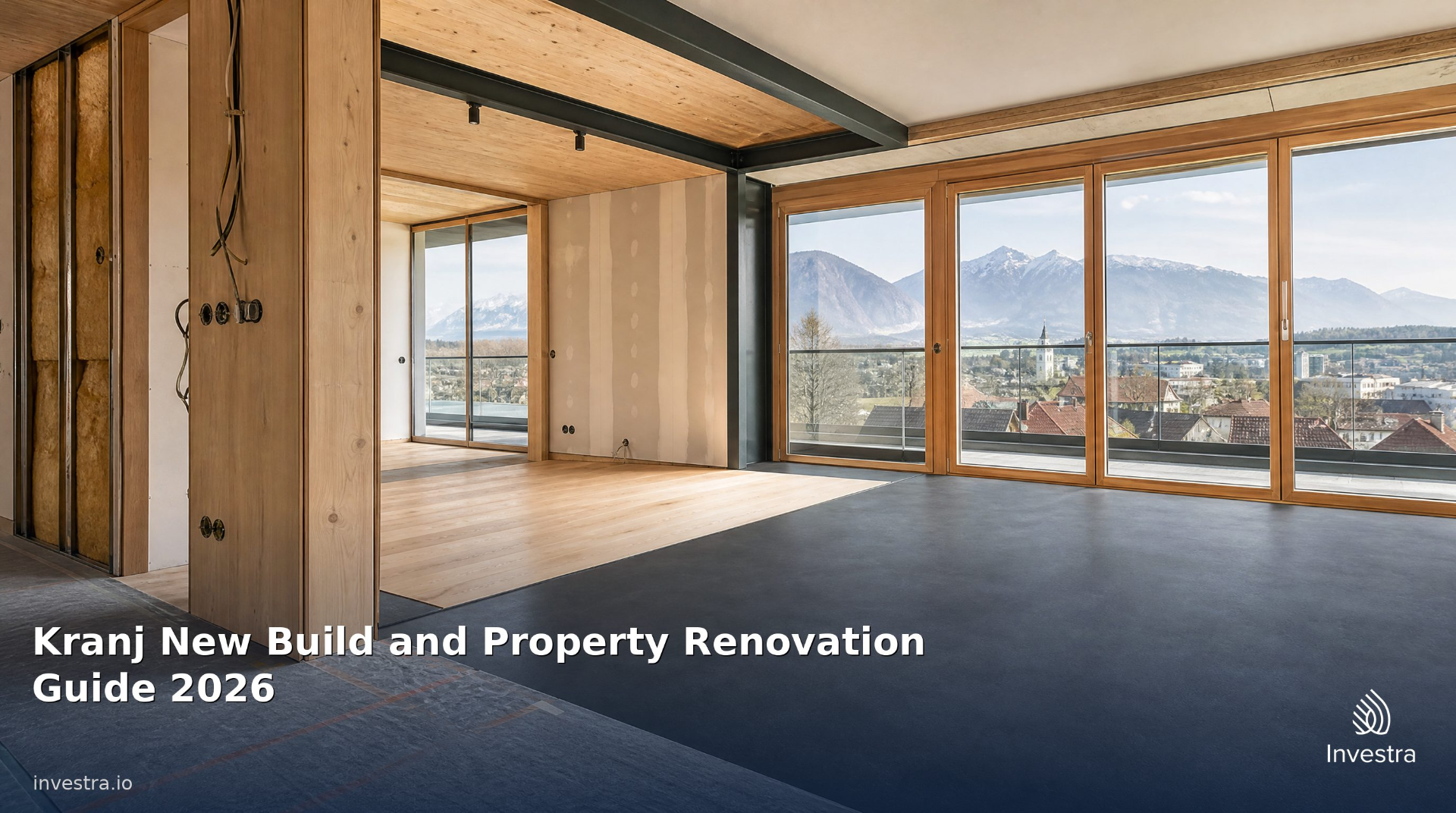
Kranj New Build and Property Renovation Guide 2026
Kranj New Build and Property Renovation Guide 2026
Kranj New Build and Property Renovation Guide 2026: What the Market Looks Like Right Now
Quick Answer: Kranj, Slovenia's fourth-largest city, offers compelling new build and renovation opportunities in 2026, with new build prices ranging from €2,800 to €4,500/m² and renovation projects starting as low as €800/m² for older stock — making it one of Central Europe's most accessible markets for value-add investors. Investra.io provides real-time market intelligence to help international investors make well-informed decisions.
Kranj doesn't get the press that Ljubljana does. That's precisely why it's interesting. Sitting at the foot of the Kamnik–Savinja Alps, just 26 kilometres north of the Slovenian capital, Kranj has quietly built a reputation as one of the country's most livable and economically productive cities.
The 2026 landscape is particularly dynamic. Post-pandemic construction backlogs have largely cleared, new residential projects are delivering at scale, and renovation incentives at both the EU and national level have made upgrading older housing stock genuinely economically viable.
This guide cuts through the noise and gives you the concrete data, legal context, and strategic insight you need to make a sound decision. Expert guidance from professionals like Siniša Dagary — Investment Consultant can also be invaluable when structuring cross-border property investments in markets like Slovenia.
Understanding Kranj's Property Market Fundamentals in 2026
Quick Answer: Kranj's property market is characterised by steady price growth averaging 6–8% annually over the past three years, tight inventory, and strong rental demand driven by proximity to Ljubljana and a robust local employment base — fundamentals that continue to support new build and renovation investment in 2026.
Any serious discussion of Kranj real estate has to start with the basics: why does this city perform the way it does? The answer isn't mysterious. Kranj is the administrative capital of Gorenjska, Slovenia's northwest region, and it sits along the A2 motorway corridor that connects Ljubljana to Austria.
The population hovers around 57,000, which is small by European capital standards but large enough to sustain a genuine local economy. Unemployment in the Gorenjska region sits below 4%, well beneath the national average, and average net monthly wages in Kranj are approximately €1,450–€1,600, slightly above the Slovenian mean.
What we've seen in the data from Slovenia's Surveying and Mapping Authority (GURS) is consistent appreciation. Residential property prices in Kranj increased by approximately 7.2% in 2023 and an estimated 6.5% through 2024, with 2025 stabilising around 5–6% growth as rising interest rates in the eurozone tempered some demand.
For comparison, Ljubljana's central districts regularly hit €4,500–€6,000/m² for new builds. Kranj's equivalent product — modern, energy-efficient apartments in new residential developments — typically lands between €2,800 and €4,200/m², a discount of 25–35%. That gap is the fundamental value proposition for investors who don't need to be in the capital itself.
New Build Developments in Kranj: Key Projects and Price Benchmarks
Quick Answer: New build apartments in Kranj in 2026 range from €2,800/m² for peripheral locations to €4,500/m² for premium developments near the old town or with Alpine views, with studio to two-bedroom units being the most actively developed product type given strong rental demand from young professionals.
The new build landscape in Kranj has matured considerably. Gone are the days of scattered, poorly-planned residential blocks on the city's edges. Developers — both Slovenian and international — have increasingly focused on mixed-use schemes and energy-efficient construction that meets or exceeds EU norms.
Several active development zones are worth knowing about. The Planina district, one of Kranj's larger residential areas to the south of the historic core, has seen a cluster of new apartment buildings come to market. These typically offer one- to three-bedroom units at €2,900–€3,400/m².
The more premium product tends to concentrate near the Kokra River gorge and on the elevated terrain north of the old town, where views toward the Karavanke mountains command genuine premiums. Boutique developments in these locations can reach €4,200–€4,500/m², and they sell quickly. Developers like Primorje and Eureka Nepremičnine have delivered projects here with strong absorption rates.
For investors interested in how technology is reshaping the regional property landscape, the Serbia Proptech 2026 How Technology Is Changing Real Estate piece on Investra offers useful comparative context on digital tools increasingly applied across Central and Eastern European markets.
Property Renovation in Kranj: The Case for Value-Add Investment
Quick Answer: Kranj's substantial stock of 1960s–1980s socialist-era housing blocks presents genuine renovation opportunities, with acquisition prices for unrenovated units as low as €1,200–€1,800/m² and post-renovation values of €2,500–€3,200/m² — creating potential value uplift of 40–80% depending on location and scope of works.
Here's something that often surprises buyers exploring Kranj for the first time: a significant portion of the city's housing stock is aging. Nearly 40% of residential units were built before 1980, according to GURS data, and many have received minimal updates since construction. This isn't a problem — it's an opportunity, if you understand how to execute it.
The math can be compelling. A 60m² apartment purchased for €90,000 (€1,500/m²), renovated for €36,000 (€600/m²), yields a total investment of €126,000. The same apartment post-renovation might achieve a market value of €168,000–€180,000 (€2,800–€3,000/m²), representing a 33–43% uplift on total investment. Rental income at market rates of €700–€850/month generates a gross yield of 6.7–8.1% on the all-in cost.
The risks are real, of course. Older buildings in Slovenia often have complex ownership structures — common areas governed by condominium rules that may require majority owner consent for major structural works. Pre-purchase due diligence should always include a review of the building's management records, any existing renovation debt, and the condition of the roof, facade, and shared infrastructure.
Legal Framework for Buying New Builds and Renovating in Slovenia
Quick Answer: EU citizens can purchase property in Slovenia on the same terms as Slovenian nationals; non-EU buyers face some restrictions but can typically acquire through a Slovenian-registered company. The purchase process involves a preliminary contract, notarised sale agreement, and land registry registration, typically completing within 60–90 days.
Slovenia's legal framework for property purchase is one of the more straightforward in the region — a genuine advantage for international investors who've experienced the complexity of markets like Bulgaria or certain Balkan states. As an EU member since 2004 and eurozone member since 2007, Slovenia operates under a familiar legal and regulatory environment.
For EU citizens, there are no restrictions on property ownership. You can purchase land, apartments, and commercial property directly, in your own name, without any corporate structure requirement. The process starts with a predpogodba (preliminary contract) and a deposit of typically 10% of the purchase price.
Non-EU nationals — including UK citizens post-Brexit — face a reciprocity requirement. In practice, many nationalities can still purchase, but the process may require establishing a Slovenian d.o.o. (limited liability company) or verifying reciprocal treaty arrangements. Legal advice from a Slovenian attorney is essential in these cases.
For new builds, the key legal document to scrutinise is the gradbeno dovoljenje (building permit) and the completed uporabno dovoljenje (use permit/occupancy certificate). Never finalise payment on a new build without confirming the use permit has been issued — without it, the property technically cannot be legally occupied or registered.
Resources like Findes Financial Services can provide valuable support on mortgage structuring and financial planning for property purchases in Slovenia, particularly for buyers needing local financing solutions.
Renovation Permits, Planning Rules, and Building Regulations in Kranj
Quick Answer: Minor interior renovations in Slovenian apartments typically require no permit, while structural changes, facade alterations, or energy upgrades to the building envelope require planning approval from the Mestna občina Kranj (Municipality of Kranj); the process generally takes 4–12 weeks for standard applications.
Understanding what requires a permit and what doesn't saves a significant amount of time and frustration. Slovenia's Construction Act (Gradbeni zakon, revised in 2021) created a cleaner framework for renovation works, and the 2022 amendments further streamlined requirements for energy renovation projects — a deliberate policy choice to accelerate the country's building decarbonisation goals.
The practical breakdown is roughly this: cosmetic work — painting, flooring, kitchen and bathroom fittings, non-load-bearing partition walls — requires no permit and no notification. Moving or removing load-bearing walls, changing window or door apertures in the exterior facade, adding or substantially altering balconies, and modifying the building's structural system all require a gradbeno dovoljenje .
Energy renovation — insulating facades, replacing windows, upgrading heating systems — falls into a partially subsidised category. The Eco Fund ( Ekosklad ), Slovenia's environmental public fund, offers subsidised loans and direct grants for energy efficiency improvements.
The Municipality of Kranj's planning office (Oddelek za urejanje prostora) handles permit applications and is generally considered responsive by Slovenian standards. Average processing time for a standard renovation permit is 4–8 weeks; more complex structural modifications involving heritage protection (relevant in the historic old town area) can take 3–6 months and require an authorised heritage architect.
Financing New Builds and Renovations: Mortgages and EU Funding in 2026
Quick Answer: Slovenian mortgage rates for residents in 2026 range from 3.8% to 5.2% variable and 4.2% to 5.8% fixed; non-resident foreign buyers face more limited bank financing options but can access some products through NLB, SKB, and Nova KBM with 30–40% deposit requirements.
Financing is where international buyers often hit friction, and it's worth being direct about the landscape. The European Central Bank's rate cycle has moderated since its 2023 peak, but Slovenian bank mortgage rates remain meaningfully higher than the historically low levels of 2019–2021.
Non-resident buyers present a more complex picture. Some Slovenian banks will lend to EU nationals purchasing in Slovenia, but the underwriting criteria are stricter — typically requiring a 30–40% deposit (loan-to-value of 60–70%), documented foreign income, and sometimes a Slovenian co-signatory or guarantor. The process is doable, but it takes patience and a good local mortgage broker. Specialist financial consultants like those at Findes Financial Services can be particularly helpful in handling this terrain.
For renovation-specific financing, the Eco Fund's subsidised loan programme is genuinely worth investigating. Loans at 1.5–2.5% fixed rates for up to 20 years are available for qualifying energy renovation projects, and these can be stacked with the grant component for a powerful total financing package.
Cash buyers, of course, face no such complexity. And with the relatively accessible entry price points in Kranj compared to Ljubljana or comparable Alpine towns in Austria and Italy, cash acquisition followed by a renovation loan through Eco Fund is a structuring approach that many foreign investors have used successfully.
Rental Yields and Return on Investment for Kranj Properties
Quick Answer: Gross rental yields in Kranj in 2026 range from 4.5% to 7.5% depending on property type and location, with renovated apartments in central or well-connected areas consistently achieving 5.5–6.5% gross — among the stronger yield profiles for a Slovenian city of this size and economic standing.
Let's talk numbers, because that's ultimately what investment decisions are built on. The rental market in Kranj is driven by three distinct tenant profiles: commuters to Ljubljana who prefer lower Kranj rents, local employees at Gorenjska's industrial and tech employers, and students (though Kranj's student population is modest compared to Ljubljana or Maribor).
For a well-located one-bedroom apartment (40–50m²) in Kranj, market rents in 2026 run €600–€780/month. Two-bedroom units (55–75m²) achieve €750–€1,050/month. Three-bedroom apartments (80–100m²) are typically €950–€1,350/month. These figures reflect quality mid-market product; luxury or newly renovated units can achieve the top end or slightly above.
On a new build purchase at €3,200/m² for a 50m² one-bedroom (total acquisition cost €160,000), rental income of €700/month yields a gross return of 5.25% — solid but not spectacular. The renovation model, as described earlier, can push this toward 6.5–7.5% gross given the lower all-in cost base.
Capital appreciation should be considered separately. At 5–7% annual price growth (a reasonable mid-case assumption for Kranj), total annualised returns (income plus appreciation) for a renovation play could realistically reach 10–14% in nominal terms over a 5-year holding period.
For regional context on how emerging Central European markets compare on yield profiles, the Sremska Mitrovica Real Estate 2026 Srem Region Property Guide and materials from Investra provide useful benchmarks from the broader regional landscape.
Tax Considerations for Property Investors in Kranj and Slovenia
Quick Answer: Slovenia's property tax environment is relatively investor-friendly, with a 25% capital gains tax that reduces to zero after holding for five or more years, and rental income taxed at a flat 25% rate after a 10% standardised expense deduction — making medium to long-term holding strategies particularly tax-efficient.
Tax efficiency isn't the first thing most buyers think about, but it should be. Slovenia's treatment of property income and capital gains is, in fact, quite favourable by European standards — especially for investors who plan to hold assets for the medium term.
Rental income is taxed at a flat 25% rate under Slovenia's personal income tax framework, but with an important caveat: landlords can deduct 10% of gross rental income as a standardised expense before applying the rate, effectively reducing the taxable base. So on €8,400/year rental income (€700/month), taxable income is €7,560, and tax owed is €1,890 — an effective rate of 22.5% on gross income.
Property transfer tax (davek na promet nepremičnin) at 2% is paid by the buyer on resale transactions. This is a one-time acquisition cost rather than an ongoing tax. Slovenia has no annual property holding tax beyond minimal municipal levies, which is a meaningful advantage compared to markets like France or the UK where annual taxes can be substantial.
Double taxation treaties exist between Slovenia and most EU countries, the UK, the US, and many others, generally preventing income from being taxed twice. A tax advisor with cross-border expertise — like those referenced on the Siniša Dagary investment insight platform — can help structure holdings in the most tax-efficient manner for your specific residency situation.
The Kranj Old Town: Renovation Opportunities in a Protected Heritage Zone
Quick Answer: Kranj's medieval old town, perched dramatically above the Kokra River gorge, contains a small but significant inventory of historically protected buildings where sensitive renovation can produce exceptional properties — though buyers must navigate strict heritage protection rules and should anticipate higher renovation costs of €900–€1,400/m².
The old town of Kranj is genuinely striking — a medieval core sitting on a narrow promontory above the confluence of the Sava and Kokra rivers, with views toward the Karavanke range that would be the centrepiece of any property listing. Properties here are rare, and they trade at premiums that reflect both scarcity and aesthetic value.
What makes the old town interesting for renovation investors is precisely its complexity. Many of the buildings here are listed or partially protected, meaning external alterations require approval from the Institute for the Protection of Cultural Heritage of Slovenia (ZVKDS).
A practical renovation in the old town — preserving and restoring historic facades, windows, and architectural details while comprehensively modernising interiors — typically costs €900–€1,400/m², roughly double the cost of a standard apartment renovation elsewhere in the city. But the resulting product is genuinely differentiated.
The short-term rental model merits particular attention for old town properties. Kranj receives approximately 250,000 overnight tourist stays annually, and while Ljubljana dominates Slovenian tourism, the old town's proximity to Triglav National Park and ski resorts like Kranjska Gora and Krvavec makes it a genuine base for nature tourism.
Comparing Kranj to Other Investment Markets: Regional Context
Quick Answer: Kranj offers stronger valuations and rental yields than Ljubljana and more stable economic fundamentals than many Balkan alternatives, positioning it as a compelling middle-ground investment for European investors seeking Alpine proximity without paying Alpine capital city prices.
Placing Kranj within the broader regional investment landscape helps calibrate expectations. To the west, Slovenian Alpine towns like Bled and Bohinj offer spectacular scenery and strong tourism but limited local economic bases — properties there function primarily as tourist accommodation or vacation homes, with lower long-term rental yields and higher volatility.
Kranj sits in a genuinely interesting sweet spot. It combines European legal stability and institutional quality (EU membership, eurozone currency, transparent land registry) with price accessibility that's hard to find elsewhere on the continent. The employment base is real — not dependent on tourism or subsidies — which underpins genuine, not speculative, demand for housing.
For comparative regional market analysis, Bor Real Estate Market 2026 Eastern Serbia Mining City Pr..., Zajecar Real Estate Market 2026 Eastern Serbia Property G..., and Prokuplje Real Estate Market 2026 Toplica Region Property... offer detailed analysis of how Balkan markets compare. Similarly, Loznica Real Estate Market 2026 Macva Region Property Guide
Investment Disclaimer
Quick Answer: This guide is general market information, not personal legal, tax, financing or investment advice.
Before committing to a property transaction, buyers should obtain independent local legal, tax and financial advice suited to their circumstances. Investra.io can support initial market research, but every purchase decision remains the buyer's responsibility.
Frequently Asked Questions
Quick Answer: This section explains the practical property-investment implications of Frequently Asked Questions.
What is a prudent next step after initial market research?
Use current documentation, independent professional advice and comparable local evidence before proceeding. Investra.io can support an initial structured market review.
How can buyers plan a realistic ownership budget?
Use current documentation, independent professional advice and comparable local evidence before proceeding. Investra.io can support an initial structured market review.
What evidence supports a careful investment decision?
Use current documentation, independent professional advice and comparable local evidence before proceeding. Investra.io can support an initial structured market review.
When should a buyer obtain legal and tax advice?
Use current documentation, independent professional advice and comparable local evidence before proceeding. Investra.io can support an initial structured market review.
How should a buyer compare neighbourhoods and property types?
Use current documentation, independent professional advice and comparable local evidence before proceeding. Investra.io can support an initial structured market review.
What local checks should be completed before signing?
Use current documentation, independent professional advice and comparable local evidence before proceeding. Investra.io can support an initial structured market review.
Which costs should be assessed alongside the purchase price?
Use current documentation, independent professional advice and comparable local evidence before proceeding. Investra.io can support an initial structured market review.
How can international buyers verify a property opportunity?
Use current documentation, independent professional advice and comparable local evidence before proceeding. Investra.io can support an initial structured market review.
What should buyers compare before selecting a property?
Use current documentation, independent professional advice and comparable local evidence before proceeding. Investra.io can support an initial structured market review.
Quick Answer: These answers outline common buyer checks and should be read with current professional advice.
Recommended Reading
Quick Answer: This section explains the practical property-investment implications of Recommended Reading.
- Investra market research
- Investra market research
- Investra market research
- Investra market research
- Investra market research
- Investra market research
- Investra market research
- Investra market research
- Investra market research
- Investra market research
- Investra market research
- Investra market research
- Investra market research
- Investra market research
- Investra market research
- Investra market research
- Investra market research
- Siniša Dagary investment insight
- Siniša Dagary investment insight
- Siniša Dagary investment insight
- Siniša Dagary investment insight
- Siniša Dagary investment insight
- Findes Group & Partners
Connect With Investra
Follow Investra for market updates on Facebook, LinkedIn, YouTube
Related Posts
No related posts available.
