
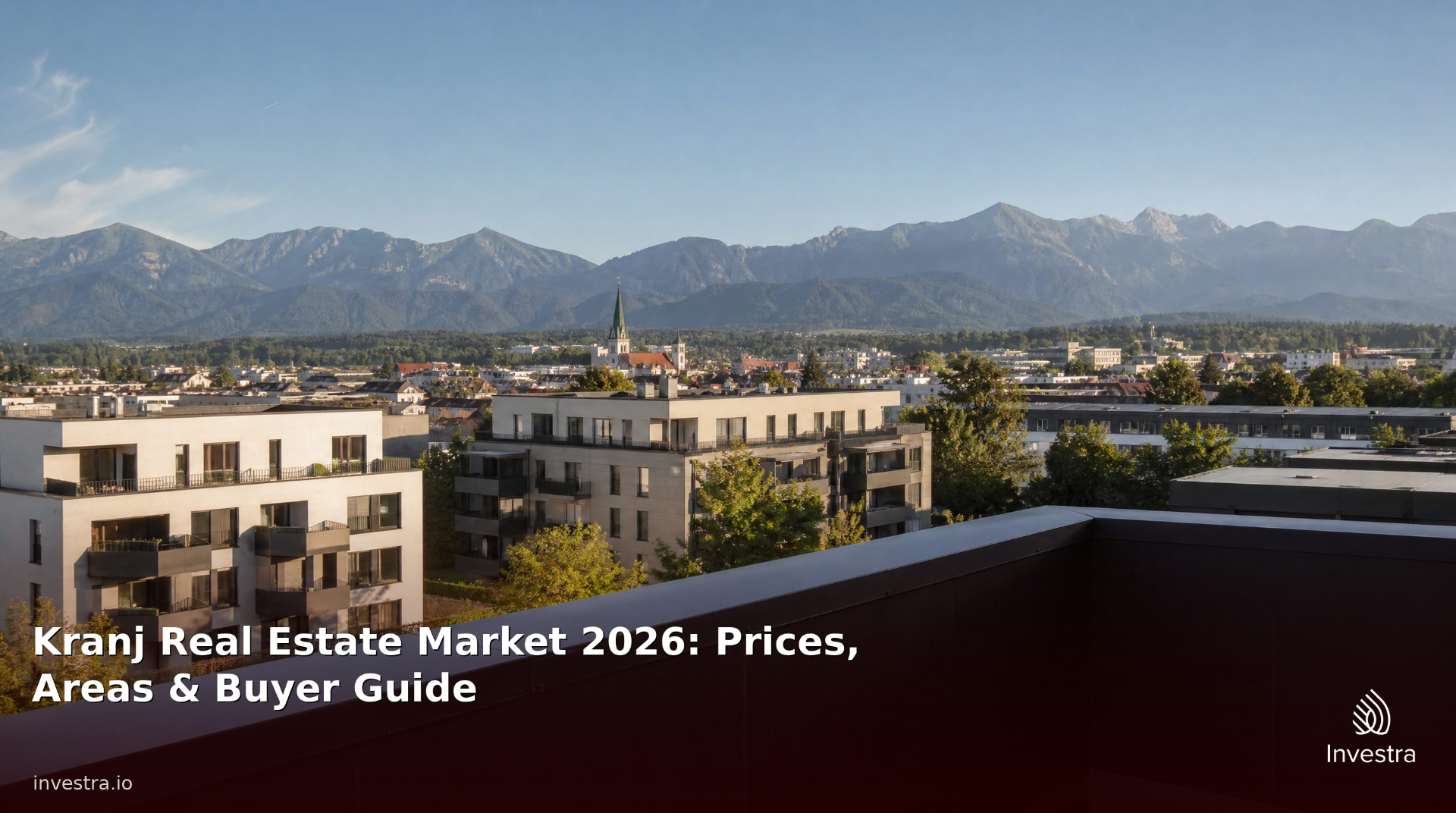
Kranj Real Estate Market 2026: Prices, Areas & Buyer Guide
Kranj Real Estate Market 2026: Prices, Areas & Buyer Guide
Kranj Real Estate Market 2026: What You Need to Know Before Buying
Quick Answer: Kranj's real estate market in 2026 is one of Slovenia's most dynamic outside the capital, with property prices ranging from €2,200 to €4,500/m² depending on location and property type. The city's proximity to Ljubljana, strong industrial base, and growing expat community make it a compelling target for both residential buyers and yield-focused investors.
Kranj doesn't always make international headlines the way Ljubljana does — and that's precisely why savvy investors are paying close attention. Slovenia's fourth-largest city sits at the foot of the Kamnik-Savinja Alps, just 26 kilometers northwest of the capital, and has been quietly building a reputation as one of Central Europe's more undervalued property markets.
What's changed heading into 2026 is the pace of that change. After years of modest appreciation, Kranj has seen accelerating demand from Ljubljana commuters priced out of the capital, remote workers from Western Europe seeking quality of life at lower cost, and a steady stream of foreign nationals drawn to Slovenia's EU membership and stable legal framework.
For broader regional context and emerging European investment trends, the team at Siniša Dagary investment insight has been tracking Central and Southeast European real estate cycles in detail, offering perspective that goes well beyond single-market analysis.
Understanding Kranj: Location, Economy, and Why It Attracts Buyers
Quick Answer: Kranj is Slovenia's fourth-largest city, functioning as the economic capital of the Gorenjska region with strong industrial, tech, and tourism underpinnings that support consistent real estate demand. Its 26km distance from Ljubljana, combined with direct motorway and rail connections, makes it a genuine commuter hub and increasingly a destination in its own right.
The economy here isn't built on a single pillar. Gorenjska's industrial heritage includes precision engineering, rubber manufacturing (home to Sava Tire's operations), electronics, and more recently, a growing technology sector with several mid-sized software and manufacturing firms establishing regional bases.
Tourism adds another layer. Bled and Bohinj, two of Slovenia's most internationally recognized destinations, are less than 40 minutes from Kranj by car. The city itself offers the medieval old town (Stari Kraj), the Sava River gorge, and a calendar of cultural events that draws visitors year-round.
Property Prices in Kranj 2026: A Detailed Breakdown by Area and Type
Quick Answer: In 2026, apartment prices in Kranj average €2,800–€3,600/m² in established residential areas, while prime Old Town and renovated properties reach €4,000–€4,500/m². Family houses in suburban districts trade between €250,000 and €550,000 depending on size, condition, and plot size.
Let's get into the numbers, because the headline figures only tell part of the story. Kranj's property market has a meaningful internal geography — where you buy within the city matters almost as much as the fact that you're buying in Kranj at all.
Stari Kraj (Old Town): The historic city center commands premium pricing. Renovated apartments in historic buildings with original architectural features trade at €3,800–€4,500/m². New or fully renovated units with modern interiors and parking can touch the top of that range. Supply here is genuinely constrained — the Old Town is protected, limiting new development significantly.
Planina and Zlato Polje: These are Kranj's primary established residential districts, developed largely in the post-war socialist era but increasingly renovated and upgraded. Typical apartment prices fall in the €2,600–€3,200/m² range. Older communist-era panel buildings (bloki) at the lower end; renovated mid-rises with newer infrastructure at the upper end.
Primskovo and Huje: More recently developed residential suburbs with a mix of newer apartment blocks and standalone family homes. Apartments here range from €2,800–€3,400/m², while family houses on modest plots typically start around €280,000 and reach €450,000+ for larger properties with gardens.
Britof, Mavčiče, and Surrounding Villages: The broader Kranj municipality extends into several smaller settlements that offer genuine value for those prioritizing space over urban convenience. Detached houses in these areas can be found starting at €200,000, with larger or recently built properties reaching €500,000+. The trade-off is car dependence and somewhat longer commute times.
Year-over-year, Kranj prices have appreciated approximately 6–9% annually over the 2023–2025 period, outpacing the broader Slovenian national average of around 5–7%. New-build prices have risen faster than the existing stock, driven by construction cost inflation and persistent supply shortages.
Rental Market and Yields: What Income Investors Can Realistically Expect
Quick Answer: Long-term rental yields in Kranj typically range from 4.5% to 6.5% gross depending on property type and location, with short-term rental strategies targeting tourist and business visitors potentially pushing net yields higher in well-positioned units. Student and worker accommodation near the city center consistently achieves strong occupancy rates.
The rental market in Kranj operates across several distinct demand segments, and understanding which one your property serves will determine your return profile significantly.
Long-term residential rentals form the backbone of the market. A typical two-bedroom apartment (50–65m²) in the Planina or Zlato Polje districts rents for €700–€950 per month in 2026. In the Old Town or newly renovated buildings, the same apartment profile commands €950–€1,200/month.
For those willing to manage more actively, short-term rentals through platforms like Airbnb and Booking.com have developed a meaningful niche in Kranj. The city serves as an excellent base for exploring the Julian Alps, Bled, Triglav National Park, and the broader Gorenjska region, and international visitors have discovered this.
What surprises many investors is how stable the corporate and business accommodation segment has become. Gorenjska's industrial and tech companies regularly place visiting workers, consultants, and project teams into furnished apartments for weeks or months at a time.
For comparative yield benchmarks from neighboring markets in the broader Central and Southeast European context, Serbia Proptech 2026 How Technology Is Changing Real Estate offers an instructive case study of how digital platforms and proptech infrastructure drive rental demand across regional secondary markets — a dynamic that mirrors elements of Kranj's own evolving tenant acquisition landscape.
The Legal Framework for Foreign Buyers in Slovenia
Quick Answer: EU/EEA citizens can purchase real estate in Slovenia on equal terms with Slovenian nationals with no restrictions. Non-EU citizens face additional requirements and may need to purchase through a locally registered company or meet specific bilateral treaty conditions. Slovenia's legal system is transparent and property rights are strongly protected under EU law.
Slovenia's legal landscape for property acquisition is notably straightforward by European standards — especially compared to some of its neighbors. The country's EU membership since 2004 means that EU/EEA citizens enjoy exactly the same property rights as Slovenian nationals.
For non-EU citizens, the situation is more nuanced but far from prohibitive. Nationals of countries with which Slovenia has bilateral reciprocity agreements (the list includes the United States, Canada, and several others) can generally purchase directly.
The standard property transaction process in Slovenia follows a clear sequence. Once a purchase price is agreed, a preliminary contract (predpogodba) is typically signed with a 10% deposit. The final sale contract must be notarized — a notarial act (notarski zapis) is legally mandatory for real estate transfers.
Title searches and due diligence are critically important. Buyers should verify that the property is free of encumbrances (mortgages, easements, pre-emption rights) and that the seller has clear, unencumbered title.
For insights into how digital tools and proptech platforms are streamlining property due diligence across the broader region, Sremska Mitrovica Real Estate 2026 Srem Region Property G... explores trends that are increasingly applicable to Slovenia's own digitizing property sector.
Taxes, Costs, and Transaction Fees: The True Cost of Buying in Kranj
Quick Answer: Buyers in Slovenia pay a 2% real estate transfer tax (DPN) on existing properties, while new builds from VAT-registered developers attract 9.5% VAT instead. Total transaction costs including taxes, notarial fees, and agency commissions typically add 5–8% on top of the purchase price for existing properties.
No investment calculation is complete without a clear picture of transaction costs, and Slovenia is pleasingly transparent on this front. The headline tax is the Real Estate Transfer Tax (Davek na Promet z Nepremičninami — DPN), levied at 2% of the agreed purchase price or the officially assessed value (whichever is higher) on transfers of existing properties.
New properties purchased directly from a developer registered for VAT (DDV) are subject to 9.5% VAT on the purchase price instead of DPN. For buyers, this means new-build transactions carry a higher embedded tax burden than second-hand purchases — though developers typically build this into their pricing structures.
Buyers themselves face several direct costs. Notarial fees are set by a regulated tariff scale and typically range from €500–€2,000 for residential transactions depending on value. Land registry fees add €100–€200.
All told, a buyer purchasing an existing €300,000 apartment in Kranj should budget approximately €15,000–€24,000 in transaction costs beyond the property price itself — representing 5–8% of the purchase price. For new builds, the effective cost burden is higher due to VAT, though some developers offer purchase incentives that offset this partially.
Annual holding taxes in Slovenia are notably light by European standards. The existing real estate tax (Nadomestilo za uporabo stavbnega zemljišča — NUSZ) is a municipal charge that varies by location and property type but typically amounts to €100–€500 annually for a residential apartment — genuinely modest compared to most Western European jurisdictions.
For those comparing regional tax environments, the Negotin Real Estate Market 2026 Zajecar District Property... guides offer comparative fiscal analysis across Central and Southeast European markets in useful depth.
Kranj's Best Neighborhoods for Investment: A Practical Guide
Quick Answer: The Old Town (Stari Kraj) leads for short-term rental and capital appreciation potential; Planina and Zlato Polje offer stable long-term rental income; Primskovo and Huje attract family buyers seeking newer construction; and the surrounding villages present the most affordable entry points for those with longer investment horizons.
Choosing the right neighborhood within Kranj shapes virtually every aspect of your investment — acquisition cost, rental yield, tenant profile, exit liquidity, and capital appreciation trajectory. Each district has its own logic, and the "best" choice depends entirely on what you're trying to achieve.
Planina — Best for Stable Yield: The city's largest established residential district is a workhorse market. Large apartment blocks, good public transport, proximity to schools and shopping — it attracts the bulk of the city's working population. Entry prices are accessible (€2,500–€3,000/m² for older stock), rental yields are solid (5–6.5% gross), and vacancy is low.
Zlato Polje — Best for Balanced Growth: Located east of the center, Zlato Polje has attracted more recent residential development and a somewhat younger demographic. It offers a blend of newer apartment blocks and more affordable family houses. Appreciation trends have been positive, and the improving infrastructure makes it an area to watch for medium-term value creation.
Primskovo — Best for Family Buyers: Quieter, greener, with a higher proportion of detached and semi-detached housing stock. Buyers targeting families — who provide more stable, longer-tenancy rentals — often focus here. The market is less liquid than central districts but the tenant quality is typically very high.
Surrounding Villages (Britof, Mavčiče, Trboje): For buyers with patience and a budget-conscious approach, the villages of Kranj's wider municipality offer the most attractive entry-level pricing. Values here haven't risen as sharply, which means upside potential remains meaningful if regional infrastructure improves and urban sprawl continues its current trajectory.
The New Construction Market: Developments and Supply Pipeline
Quick Answer: New construction activity in Kranj has been constrained by land availability, construction cost inflation, and administrative permit timelines, keeping supply tight and supporting price appreciation in both new-build and existing stock segments throughout 2025–2026.
Supply is arguably the single most important factor shaping Kranj's price trajectory — and the supply picture is decidedly tight. Construction costs across Slovenia have risen substantially since 2021, with material and labor cost inflation running cumulatively 25–35% over the four-year period.
The administrative process for obtaining building permits in Slovenia, while legally structured, is time-consuming in practice. Municipal spatial plans (OPN — Občinski prostorski načrt) in Kranj and surrounding settlements limit developable land, and changes to permitted uses require politically complex plan amendments that can take years.
What new construction does reach the market commands significant premiums over older stock. Energy efficiency ratings (EI — energetska izkaznica) have become a serious purchasing consideration for both end-users and investors conscious of future operating costs.
Several smaller boutique developments in and around the Old Town have drawn significant attention, combining historic character with contemporary interiors and infrastructure. These represent a small but influential segment — typically selling quickly to a mix of affluent local buyers and foreign investors drawn to the combination of authenticity and modernity.
The constrained supply environment means that investors buying today are likely to benefit from continued price support over the medium term. Structural undersupply in attractive, accessible Central European cities has proven remarkably persistent across markets — a dynamic explored in detail across several regional guides, including the Bor Real Estate Market 2026 Eastern Serbia Mining City Pr... analysis of supply dynamics in similarly constrained regional markets.
Kranj vs. Ljubljana: The Investment Case for Slovenia's Secondary City
Quick Answer: Kranj offers entry prices 35–50% below Ljubljana levels while sharing the same labor market, infrastructure corridor, and EU economic fundamentals, creating a compelling relative value proposition for investors who believe Ljubljana's price premium has stretched beyond what underlying fundamentals justify.
The Ljubljana comparison is unavoidable — and useful. Slovenia's capital has seen property prices in prime central districts reach €5,500–€7,000/m² as of 2025-2026, with even mid-ring neighborhoods trading at €4,000–€5,000/m². These are prices that increasingly price out ordinary Slovenian buyers and compress rental yields to 3–4% gross in the best cases.
Kranj, sitting 26km away with direct motorway access (A2) and rail connections running 30–40 minutes to Ljubljana's main station, captures enormous overspill demand from this dynamic. Young professionals working in Ljubljana increasingly choose to buy or rent in Kranj, accepting a modest commute in exchange for substantially more space and lower costs.
But investors should understand that Kranj isn't simply "cheap Ljubljana." The city has its own economic identity, its own tenant base, and its own investment logic. The risk profile is different: Ljubljana has deeper liquidity, more international brand recognition, and more institutional investor interest.
What we've consistently observed in maturing European property cycles is that the secondary cities adjacent to highly priced capitals tend to undergo significant re-rating as price differentials become impossible to justify on fundamental grounds. Bratislava-to-Trnava, Vienna-to-Baden, Zurich-to-Winterthur — the pattern repeats.
Financing Your Kranj Property Purchase: Mortgages and Funding Options
Quick Answer: Slovenian banks offer mortgages to qualifying foreign buyers, typically at 60–80% LTV for EU residents, with interest rates in 2026 ranging from 4.2–5.8% depending on the lender, loan profile, and whether the rate is fixed or variable. Non-EU buyers generally face more restrictive lending criteria and may find private or developer financing more accessible.
For EU citizens with Slovenian residency or a demonstrable Slovenian income source, the mortgage process is relatively accessible. Standard residential mortgages are available at 70–80% LTV, with the property serving as collateral.
EU citizens without Slovenian residency — including many foreign investment buyers — find the process more complex. Banks typically require evidence of sufficient income in the buyer's home country, existing asset statements, and sometimes additional guarantees. LTV ratios for non-resident EU buyers tend to be capped at 60–70%.
For those seeking expert guidance on structuring financing for Slovenian property acquisition, the financial advisory services at Findes Group & Partners represent a specialized resource with particular expertise in Slovenian mortgage markets for foreign buyers — a genuinely valuable connection for international purchasers approaching their first Slovenian acquisition.
Building Permits, Renovations, and Property Development Compliance
Quick Answer: Building permits in Slovenia are mandatory for all significant construction work and require applications through the municipal authority. Renovation scope determines permit requirements; cosmetic updates typically need only municipal notification, while structural work requires formal permits. Compliance timelines typically range from 4–12 weeks depending on project scope and municipal responsiveness.
For investors considering renovation projects or new construction, understanding Slovenia's regulatory framework is essential. The country operates under a detailed building code system (Zakon o graditvi objektov — ZGO) that governs permits, inspections, and approvals across all property development activities.
Building permits are categorized by project scale. Minor work (painting, fixtures, non-structural improvements) may require only notification to the municipal authority.
The permit process requires submission of detailed technical documentation prepared by licensed Slovenian architects or engineers. This documentation must comply with current energy efficiency standards (thermal insulation requirements, energy performance minimums) and building safety codes.
Inspections occur at multiple stages: foundation/structural work, internal installations (
Investment Disclaimer
Quick Answer: This guide is general market information, not personal legal, tax, financing or investment advice.
Before committing to a property transaction, buyers should obtain independent local legal, tax and financial advice suited to their circumstances. Investra.io can support initial market research, but every purchase decision remains the buyer's responsibility.
Frequently Asked Questions
Quick Answer: This section explains the practical property-investment implications of Frequently Asked Questions.
What is a prudent next step after initial market research?
Use current documentation, independent professional advice and comparable local evidence before proceeding. Investra.io can support an initial structured market review.
How can buyers plan a realistic ownership budget?
Use current documentation, independent professional advice and comparable local evidence before proceeding. Investra.io can support an initial structured market review.
What evidence supports a careful investment decision?
Use current documentation, independent professional advice and comparable local evidence before proceeding. Investra.io can support an initial structured market review.
When should a buyer obtain legal and tax advice?
Use current documentation, independent professional advice and comparable local evidence before proceeding. Investra.io can support an initial structured market review.
How should a buyer compare neighbourhoods and property types?
Use current documentation, independent professional advice and comparable local evidence before proceeding. Investra.io can support an initial structured market review.
What local checks should be completed before signing?
Use current documentation, independent professional advice and comparable local evidence before proceeding. Investra.io can support an initial structured market review.
Which costs should be assessed alongside the purchase price?
Use current documentation, independent professional advice and comparable local evidence before proceeding. Investra.io can support an initial structured market review.
How can international buyers verify a property opportunity?
Use current documentation, independent professional advice and comparable local evidence before proceeding. Investra.io can support an initial structured market review.
What should buyers compare before selecting a property?
Use current documentation, independent professional advice and comparable local evidence before proceeding. Investra.io can support an initial structured market review.
Quick Answer: These answers outline common buyer checks and should be read with current professional advice.
Recommended Reading
Quick Answer: This section explains the practical property-investment implications of Recommended Reading.
- Investra market research
- Investra market research
- Investra market research
- Investra market research
- Investra market research
- Investra market research
- Investra market research
- Investra market research
- Investra market research
- Investra market research
- Investra market research
- Investra market research
- Investra market research
- Investra market research
- Investra market research
- Investra market research
- Investra market research
- Siniša Dagary investment insight
- Siniša Dagary investment insight
- Siniša Dagary investment insight
- Siniša Dagary investment insight
- Siniša Dagary investment insight
- Findes Group & Partners
- Findes Group & Partners
Connect With Investra
Follow Investra for market updates on Facebook, LinkedIn, YouTube
Related Posts
No related posts available.
