
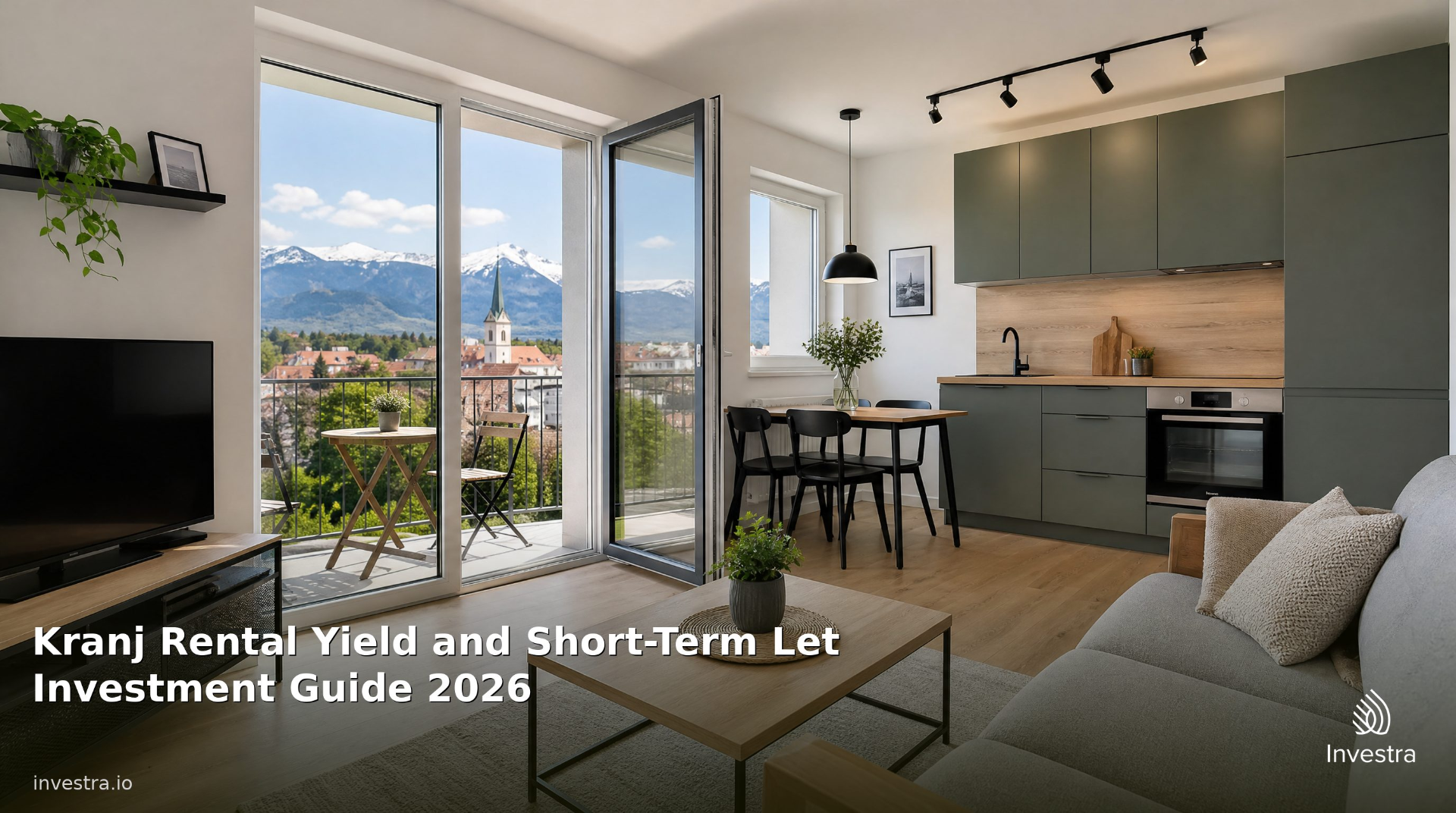
Kranj Rental Yield and Short-Term Let Investment Guide 2026
Kranj Rental Yield and Short-Term Let Investment Guide 2026
Why Kranj Is Becoming One of Slovenia's Most Watched Rental Markets
Quick Answer: Kranj is Slovenia's fourth-largest city and a rapidly emerging rental investment hub, offering gross rental yields of 4–7% and growing short-term let demand driven by its proximity to Ljubljana, the Julian Alps, and Lake Bled.
Kranj doesn't shout. It doesn't need to. Sitting just 26 kilometres north of Ljubljana, with the Karawanks mountain range as its backdrop and the Sava River cutting through its medieval old town, Slovenia's fourth-largest city has quietly built a compelling case for rental property investment that more international buyers are starting to notice.
The city has a population of around 57,000 and serves as the administrative capital of the Gorenjska region — the alpine northwestern corner of Slovenia. It's an industrial and tech corridor that houses major employers including Iskra, Hidria, and a growing cluster of logistics and manufacturing firms. That employer base matters enormously for the long-term rental market.
What surprised many buyers who looked at Kranj seriously is just how undervalued it remains relative to Ljubljana. The capital's central districts now regularly exceed €5,000/m², while Kranj's best neighbourhoods still trade at €2,800–€3,400/m².
The short-term rental picture is equally interesting. Kranj sits within easy striking distance of Bled (30 minutes), Bohinj (50 minutes), Triglav National Park, and the ski resort of Kranjska Gora. Tourists who want lower accommodation costs than Bled commands are increasingly booking Kranj as a base.
For investors who are still exploring the broader Central and European market, resources like the Siniša Dagary investment insight platform offer useful frameworks for comparing yield environments across the region, including Slovenia, Serbia, and beyond.
Kranj Property Market Overview: Prices, Trends, and What the Data Shows in 2026
Quick Answer: Kranj apartment prices range from approximately €2,200/m² for older stock in peripheral areas to €3,800/m² for new-build city centre units in 2026, with annual price growth averaging 5–8% over the past three years.
The numbers don't lie, and in Kranj's case they tell a consistent story: moderate but steady appreciation, broad transaction volumes, and a buyer profile that is gradually internationalising. Let's break down what the data actually shows.
The Statistical Office of the Republic of Slovenia (SURS) and the Geodetic Administration of Slovenia (GURS) track property transaction data quarterly. What we've seen over 2023–2025 is a Kranj market that has held price growth despite broader European market cooling.
Current price benchmarks by area and property type include Old Town/Stari Trg at €2,900–€3,800/m² for renovated apartments featuring medieval architecture along the Sava gorge, with strong demand from short-term rental investors. Primskovo and Planina range from €2,400–€3,000/m² as principal residential districts popular with long-term tenants.
Transaction volumes in the Gorenjska region reached approximately 1,800 residential sales in 2024, with Kranj municipality accounting for around 40% of that total. Demand from buyers relocating from Ljubljana — where prices have become prohibitive — is the single biggest driver right now.
Understanding Rental Yields in Kranj: Long-Term vs Short-Term Let Returns
Quick Answer: Long-term rental yields in Kranj average 4–5.5% gross, while well-managed short-term Airbnb lets in tourist-accessible locations can achieve 6–8% gross yield, with net returns depending on occupancy rates, management costs, and seasonal variation.
Yield is the number investors fixate on, and rightly so. But raw yield figures without context are about as useful as a weather forecast without a city name. Here's what the actual Kranj rental return landscape looks like when you cut through the noise.
Long-term residential rentals in Kranj operate in a market where demand consistently outpaces supply. Monthly rents for a standard 50–60m² two-bedroom apartment in a central or well-connected location range from €650–€900/month. Newer builds with good energy ratings command €850–€1,100/month.
Short-term lets change the maths significantly. A well-located 45m² apartment in Kranj's Old Town or near the train station can generate €70–€95/night during summer and ski-season peaks. Shoulder season rates run €45–€65/night. An optimised listing with 65–75% annual occupancy generates gross annual revenue of approximately €14,000–€19,000.
The reality is that most Airbnb operators achieve occupancy rates of 55–65% rather than the theoretical maximum. Platform fees (typically 3% host fee on Airbnb), cleaning costs, linen, toiletries, and property management fees for owners who aren't locally present reduce net returns considerably.
The Airbnb and Short-Term Rental Landscape in Kranj: Regulations, Registration, and Reality
Quick Answer: Short-term lets in Slovenia are legally permitted but require registration as a tourist accommodation provider, payment of tourist tax (approximately €1–2/night per guest), and compliance with fire safety and habitability standards. Kranj's municipality has not implemented Airbnb caps as of 2026.
Slovenia has taken a more measured approach to short-term rental regulation than cities like Amsterdam or Barcelona, which have moved aggressively to restrict Airbnb. That said, operating a short-term let here without understanding the legal framework is a mistake that can result in fines, back-tax assessments, and forced deregistration.
Slovenia's tourist tax (turistična taksa) is set by individual municipalities. Kranj's rate in 2026 is approximately €1.50–€2.00 per adult guest per night. Hosts are responsible for collecting this tax from guests and remitting it to the municipality quarterly.
Rental income from short-term lets is subject to Slovenian income tax. The standard approach for individual landlords is to declare rental income under personal income tax, with a 40% normative expense deduction (or actual expenses if documented), resulting in a net taxable income taxed at a flat rate of 25%.
Properties must meet minimum habitability standards, have functioning smoke detectors, and comply with fire safety requirements. Condominium buildings may have house rules or homeowners' association restrictions on short-term letting — this should be checked before purchase. Airbnb is the dominant platform in Kranj, while Booking.com has a meaningful presence for the tourist segments.
Best Neighbourhoods in Kranj for Rental Investment: A Practical Location Guide
Quick Answer: Kranj's Old Town (Stari Trg) is the prime zone for short-term let investment, while Primskovo and Planina offer the best risk-adjusted returns for long-term rental strategies. New developments along the Gorenjska corridor attract premium corporate tenants.
Location selection in Kranj is arguably the most consequential decision a rental investor makes. The city is compact enough that the wrong choice rarely means a catastrophic mistake, but the right neighbourhood choice can mean the difference between a 4% and a 7% net yield.
Stari Trg (Old Town) is Kranj's showpiece. The medieval old town perches dramatically above the Sava gorge, with preserved historic architecture, independent restaurants, and a genuine sense of place that photographs well and travels well on Airbnb listings. Short-term rental demand here is the strongest in the city, fed by tourists using Kranj as a base for alpine adventures.
Primskovo is Kranj's most established residential suburb, west of the city centre, with good road connections to the A2 motorway. Strong demand from working families and young professionals characterises this area. Less flashy than the Old Town but more liquid — properties here trade frequently and vacancy rates are among the lowest in the city. Prices range around €2,600–€3,000/m².
Planina is south of the city centre and is Kranj's largest housing district. Panel-block apartments from the 1970s–1980s sit alongside more recent infill development. The tenant demographic skews toward employed workers in manufacturing and logistics. Gross yields here are the highest in the city at 5–6.5% due to lower entry prices, but the property quality requires active management.
The city centre and Koroška cesta corridor forms the commercial spine of Kranj, with a mix of residential above commercial units and some newer apartment buildings. Walking distance to train and bus connections makes this attractive for corporate short-term lets and professionals relocating for work. Prices range €2,800–€3,400/m².
Britof is a quieter residential area north of the centre, popular with families. Less relevant for Airbnb but good for long-term family rentals, with lower entry costs and stable demand.
How to Buy Property in Kranj as a Foreign National: Legal Process and Practical Steps
Quick Answer: EU citizens can purchase property in Slovenia without restrictions. Non-EU nationals face some limitations depending on bilateral treaties, but the process is well-structured, typically takes 2–3 months to complete, and requires a Slovenian tax number (davčna številka) and notarised purchase contract.
The buying process in Slovenia is more straightforward than in many neighbouring countries, but it does have specific procedural requirements that differ from what buyers from the UK, US, or Asia might be used to. Getting the process right from the start saves time, money, and considerable frustration.
EU/EEA citizens have the same property rights as Slovenian nationals and face no restrictions. Citizens of countries that have bilateral reciprocity agreements with Slovenia — which includes most OECD countries including the USA, UK, Australia, and Canada — can also purchase.
A Slovenian property lawyer or notary will conduct title searches through the Land Register (Zemljiška knjiga), verify there are no encumbrances, mortgages, easements, or disputes attached to the property, and check building permit compliance. This step is non-negotiable for any serious investor. The purchase agreement (kupoprodajna pogodba) is drafted and both parties sign before a notary.
A real estate transfer tax of 2% of the assessed value applies to second-hand property purchases. New-build properties are subject to VAT at 9.5% instead. The transaction is registered in the Land Register following payment.
Total transaction costs for a buyer typically run 4–6% of the purchase price, including transfer tax, notary fees, legal fees, and agent commission (typically 2–3% paid by the seller, though this varies).
Investors who want broader regional context while exploring Slovenia should also look at Investra's coverage of neighbouring Balkan markets, including the Sremska Mitrovica Real Estate 2026 Srem Region Property Guide and the Loznica Real Estate Market 2026 Macva Region Property Guide for comparative yield analysis.
Financing a Kranj Property Purchase: Mortgages, Rates, and Investor Options in 2026
Quick Answer: Slovenian banks offer mortgage financing to foreign nationals with Slovenian income or significant assets, with LTV ratios of 60–70% for non-residents and interest rates of 3.8–5.2% in 2026. Alternative financing through international lenders or equity release from existing properties is also commonly used.
Financing strategy directly shapes your net yield and your overall return on equity. A cash purchase maximises net yield but ties up capital. A used purchase can amplify equity returns but introduces interest rate risk and reduces monthly cashflow. Neither approach is universally correct — it depends entirely on the investor's capital position, income profile, and risk tolerance.
For those seeking Slovenian bank financing, the landscape in 2026 reflects the post-ECB rate cycle. After the rate hiking period of 2022–2023, Slovenian mortgage rates peaked and have since moderated somewhat.
Loan-to-value ratios for non-residents typically cap at 60–70%, meaning buyers need to bring 30–40% equity to the transaction. On a €200,000 apartment, that means €60,000–€80,000 in cash plus transaction costs. At 65% LTV on a rental property generating €850/month, the used return on equity can exceed 8–10% depending on financing terms and achieved occupancy.
Some international investors use equity release or portfolio financing from their home country to fund Slovenian purchases outright, sidestepping Slovenian bank requirements entirely. This is a valid approach and increasingly common among UK, German, and Austrian buyers who have significant home equity.
Expert financial modelling specific to Slovenian investment structures is available through Siniša Dagary investment insight, whose consultancy work spans regional real estate finance and investment structuring.
Tax Obligations for Rental Property Owners in Slovenia: What You Actually Need to Know
Quick Answer: Rental income in Slovenia is taxed at a flat 25% rate on net income (after a standard 40% normative deduction or actual documented expenses). Property tax is minimal at around 0.15% annually, and there is no wealth tax. Capital gains on property held over 15 years are exempt from tax.
Slovenia's tax environment for property investors is genuinely one of the more favourable in the European Union, though it's not without its compliance requirements. The reality is that taxes here are simpler and less burdensome than in many Western European countries, which is a meaningful advantage for international investors.
Whether income comes from a long-term let or a short-term Airbnb arrangement, it's taxed under the personal income tax regime in Slovenia. The standard approach is a flat 25% tax on net rental income. Net income is calculated by deducting either actual documented expenses or the normative 40% expense deduction from gross rental income.
Individual landlords operating residential lets are generally not subject to VAT. Those who register as business entities and exceed the €50,000 annual turnover threshold must register for VAT. Most small-scale rental investors remain below this threshold and are not affected.
This annual charge is set by municipalities and varies by location and property use. For residential property in Kranj, it typically amounts to €100–€500/year for a standard apartment — negligible in the context of investment returns.
Gains on property sales are taxed on a sliding scale based on holding period: 25% if sold within 5 years, 20% at 5–10 years, 15% at 10–15 years, and 0% after 15 years of ownership. This structure strongly incentivises long-term holds and is one reason why Slovenia attracts buy-and-hold investors rather than short-term speculators.
Property transfers between first-degree relatives are exempt. More distant relatives and unrelated parties face rates of 5–39% depending on relationship and value.
Investors should engage a local tax advisor (davčni svetovalec) or use platforms like Findes Financial Services to ensure correct filings and to structure ownership in the most tax-efficient manner available for their specific situation.
Seasonal Patterns and Occupancy Dynamics for Kranj Short-Term Lets
Quick Answer: Kranj's short-term rental market has two distinct peak seasons — summer (June–September) for alpine hiking and lake tourism, and winter (December–March) for ski season proximity — with shoulder months offering moderate occupancy and business travel demand providing year-round baseline.
Understanding the seasonality of Kranj's rental market is essential for accurate yield modelling. This isn't a city where you can assume flat demand throughout the year and divide annual revenue by twelve. The peaks are real, the troughs are real, and smart investors plan their pricing and marketing strategy around them.
Summer (June–September) is the strongest period for short-term lets in Kranj. Lake Bled is at its most spectacular, the hiking trails in Triglav National Park are accessible, and the Julian Alps draw visitors from across Europe.
Winter season (December–March) brings skiing demand. Kranjska Gora ski resort is approximately 60 kilometres from Kranj, making the city a cost-effective base for ski holiday visitors, particularly families or groups who want more space and lower accommodation costs than ski resort villages offer.
Shoulder seasons (April–May and October–November) represent the transitional periods. April to May occupancy typically runs at 45–60%, with rates of €50–€70/night. October to November sees slightly stronger demand from early ski season planners and autumn mountain tourism, with occupancy of 50–65% and rates of €55–€75/night.
A well-positioned Kranj short-term let with annual occupancy of 62% generates approximately 226 booked nights. At blended average rates of €75/night (weighted for seasonal variation), that produces gross revenue of approximately €16,950/year.
Infrastructure, Transportation, and Growth Catalysts in Kranj
Quick Answer: Kranj benefits from direct rail connections to Ljubljana and Lake Bled, excellent motorway access, ongoing urban regeneration projects, and growing investment in industrial and tech sectors, which support both property price appreciation and long-term rental demand.
Infrastructure and connectivity are often the overlooked fundamentals that drive long-term property value appreciation. Kranj has been systematically improving its position on both fronts, and these developments matter enormously for assessing the investment case.
The Slovenian Railways (Slovenske železnice) operates frequent regional trains from Kranj to Ljubljana (25 minutes), extending to Lake Bled (30 minutes) and the Jesenice industrial zone (45 minutes). This connectivity is substantial.
Road access is equally strong. The A2 motorway connects Kranj directly to Ljubljana (15 minutes), Austria via the Karawanks tunnel (90 minutes to Salzburg), and the Slovenian coast (2.5 hours to Trieste or Portorož). This makes Kranj genuinely accessible from multiple European labour markets and tourist origin points.
The Kranj Urban Regeneration Programme has invested substantially in public space improvements, pedestrian infrastructure, and riverside development along the Sava. These improvements are still ongoing and will continue to enhance the city's attractiveness to both residents and short-term visitors through 2026 and beyond.
The Kranj Technology Park, operating since 2008, houses around 80 companies in sectors including software development, IT services, and advanced manufacturing. This cluster attracts skilled workers and generates rental demand for modern apartments with good amenities and
Investment Disclaimer
Quick Answer: This guide is general market information, not personal legal, tax, financing or investment advice.
Before committing to a property transaction, buyers should obtain independent local legal, tax and financial advice suited to their circumstances. Investra.io can support initial market research, but every purchase decision remains the buyer's responsibility.
Frequently Asked Questions
Quick Answer: This section explains the practical property-investment implications of Frequently Asked Questions.
What is a prudent next step after initial market research?
Use current documentation, independent professional advice and comparable local evidence before proceeding. Investra.io can support an initial structured market review.
How can buyers plan a realistic ownership budget?
Use current documentation, independent professional advice and comparable local evidence before proceeding. Investra.io can support an initial structured market review.
What evidence supports a careful investment decision?
Use current documentation, independent professional advice and comparable local evidence before proceeding. Investra.io can support an initial structured market review.
When should a buyer obtain legal and tax advice?
Use current documentation, independent professional advice and comparable local evidence before proceeding. Investra.io can support an initial structured market review.
How should a buyer compare neighbourhoods and property types?
Use current documentation, independent professional advice and comparable local evidence before proceeding. Investra.io can support an initial structured market review.
What local checks should be completed before signing?
Use current documentation, independent professional advice and comparable local evidence before proceeding. Investra.io can support an initial structured market review.
Which costs should be assessed alongside the purchase price?
Use current documentation, independent professional advice and comparable local evidence before proceeding. Investra.io can support an initial structured market review.
How can international buyers verify a property opportunity?
Use current documentation, independent professional advice and comparable local evidence before proceeding. Investra.io can support an initial structured market review.
What should buyers compare before selecting a property?
Use current documentation, independent professional advice and comparable local evidence before proceeding. Investra.io can support an initial structured market review.
Quick Answer: These answers outline common buyer checks and should be read with current professional advice.
Recommended Reading
Quick Answer: This section explains the practical property-investment implications of Recommended Reading.
- Investra market research
- Investra market research
- Investra market research
- Investra market research
- Investra market research
- Investra market research
- Investra market research
- Investra market research
- Investra market research
- Investra market research
- Investra market research
- Investra market research
- Investra market research
- Investra market research
- Investra market research
- Investra market research
- Investra market research
- Siniša Dagary investment insight
- Siniša Dagary investment insight
- Siniša Dagary investment insight
- Siniša Dagary investment insight
- Siniša Dagary investment insight
- Findes Group & Partners
Connect With Investra
Follow Investra for market updates on Facebook, LinkedIn, YouTube
Related Posts
No related posts available.
