
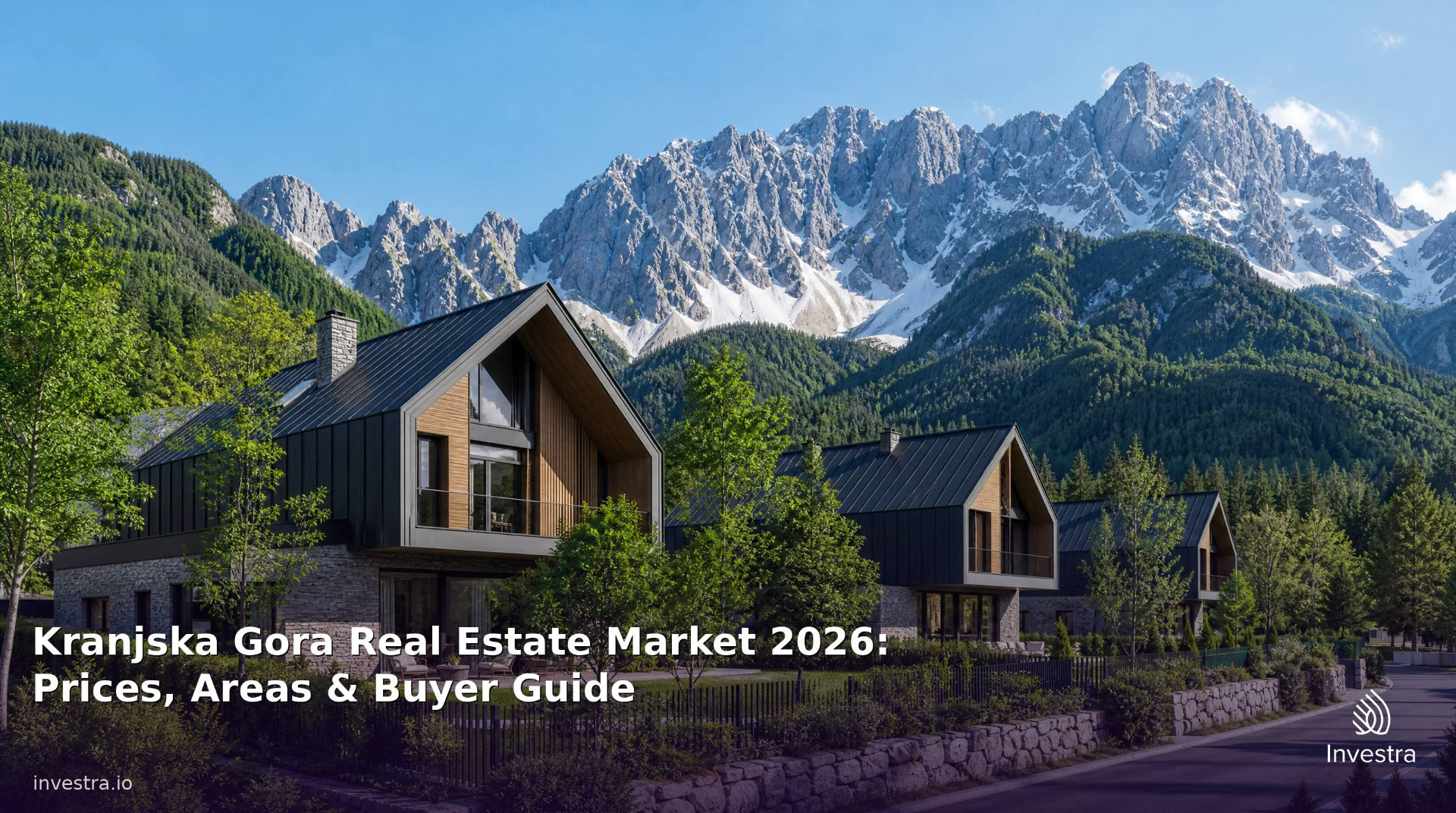
Kranjska Gora Real Estate Market 2026: Prices, Areas & Buyer Guide
Kranjska Gora Real Estate Market 2026: Prices, Areas & Buyer Guide
Kranjska Gora Real Estate Market Overview 2026
Quick Answer: Kranjska Gora's real estate market in 2026 is characterized by strong demand, limited supply, and rising prices — with residential properties averaging €3,500–€6,500/m², making it one of Slovenia's most competitive alpine investment destinations. Investra.io tracks emerging European property markets to help investors identify the best opportunities across the continent.
Kranjska Gora sits at the northwestern tip of Slovenia, cradled between the Julian Alps and sharing borders with both Austria and Italy. It's small — population barely scratches 5,500 — but its real estate market punches well above its weight. This is Slovenia's premier alpine resort town, and in 2026, the market reflects exactly that status.
What makes 2026 particularly interesting is the confluence of pressures shaping prices. European interest rates have begun to ease following years of tightening, which has reignited buyer appetite across premium alpine markets. Simultaneously, Slovenia's broader economy has held steady, with GDP growth hovering around 2.1% in 2025 and inflation cooling toward the 3% range.
The town's appeal isn't seasonal in the traditional sense. Skiing draws visitors from November through April, but summer hiking, cycling, and alpine tourism have transformed Kranjska Gora into a genuine year-round destination.
What surprised many buyers entering the market in 2024 and 2025 was the sheer pace of price appreciation. Average residential values increased by approximately 8–12% year-on-year between 2022 and 2024, though the pace has moderated slightly to 5–7% annually in 2025–2026 as affordability constraints begin to bite.
Current Property Prices in Kranjska Gora 2026
Quick Answer: In 2026, Kranjska Gora property prices range from approximately €3,200/m² for older apartments needing renovation up to €7,500/m² or more for premium new-build chalets and ski-in/ski-out properties. The average transaction price across all residential categories sits around €4,800–€5,400/m².
Let's get specific, because vague ranges don't help anyone make a real decision. The Kranjska Gora property market in 2026 is segmented fairly clearly across three tiers, each with distinct price dynamics.
Entry-level and older stock: Apartments and smaller units built during the Yugoslav era or early post-independence period (generally pre-2000) typically trade between €3,200 and €4,200/m². These properties often require cosmetic or structural renovation, which adds cost but also creates value-add opportunity.
Mid-range residential: Properties built or renovated between 2000 and 2018 — including well-maintained apartments in established complexes, townhouses, and older chalets — typically command €4,200–€5,500/m². A typical 80m² apartment in this bracket would price around €340,000–€440,000.
Land prices are a separate conversation. Building plots in the core resort area range from €200 to €450 per m², depending on location, planning permissions, and access.
For broader Slovenian context, these prices sit significantly above Ljubljana's average of approximately €3,800–€4,500/m² for comparable-quality apartments, underscoring Kranjska Gora's premium positioning even within its own country. Platforms like Findes Group & Partners can help buyers structure financing and understand total acquisition costs in this market.
Best Areas to Buy Property in Kranjska Gora
Quick Answer: The core village centre and the ski slopes access areas command the highest prices and strongest rental demand; satellite villages like Podkoren and Rateče offer better value while still benefiting from proximity to all resort amenities.
Geography matters enormously in a resort market. Where you buy in Kranjska Gora determines not just your price per square metre, but your rental yield potential, your resale liquidity, and your day-to-day lifestyle. Here's how the key sub-areas break down in 2026.
Kranjska Gora village centre: The heart of the resort. Walking distance to restaurants, shops, the ski lifts on Vitranc, and the Jasna Lake area. Properties here are the most liquid and command the premium prices outlined above.
Podkoren: Just 2km east of the village centre along the main road, Podkoren is increasingly popular with buyers seeking more residential space without paying core-village premiums. Prices run approximately 10–15% below the village average, and the area has seen notable new development activity.
Rateče: Situated near the Italian border, Rateče is the most affordable of the three primary sub-markets. Properties here trade at roughly 15–25% discounts to the village core. It's quieter and more residential in character, which suits buyers prioritizing personal use over intensive rental operation.
Gozd Martuljek: This small settlement southeast of the main resort cluster sits in the Martuljek gorge area, known for spectacular waterfalls. It appeals to buyers seeking genuine seclusion and nature immersion. Prices are among the most accessible in the broader Kranjska Gora municipality, and while rental demand is lower, the area attracts high-value, longer-stay visitors willing to pay premium rates for exclusivity. A specialist like Siniša Dagary investment insight can help international investors evaluate which sub-area genuinely aligns with their financial objectives.
Rental Yields and Investment Returns in Kranjska Gora
Quick Answer: Gross rental yields in Kranjska Gora typically range from 4% to 7% annually depending on property type and management approach, with short-term holiday rentals consistently outperforming long-term residential leasing in this market.
The yield story in Kranjska Gora is nuanced, and that nuance matters. Raw gross yield figures can be misleading in a seasonal resort market where the income isn't evenly distributed across the year, and where management costs run higher than in standard residential markets.
Net yields, after accounting for management fees (typically 20–25% of revenue for full-service management), platform commissions, cleaning costs, maintenance, property tax, and occasional refurbishment, typically land in the 3.5–5.5% range. That's a realistic expectation, not a pessimistic one.
Long-term residential rentals offer lower yields but much less operational complexity. A standard 70m² apartment in the village core might achieve €900–€1,300/month in long-term rent, against a purchase price of €340,000–€420,000 — generating gross yields of approximately 2.6–3.7%.
Capital appreciation has been the dominant return driver over the past decade. Between 2015 and 2025, quality properties in Kranjska Gora appreciated by approximately 85–110% in nominal euro terms — a compound annual growth rate (CAGR) of roughly 6.3–7.7%.
For investors exploring comparable alpine-adjacent European markets at lower price points, the Serbia Proptech 2026 How Technology Is Changing Real Estate report provides useful context on how digital platforms are reshaping property investment decisions across Southeast Europe.
Legal Framework for Foreign Buyers in Slovenia
Quick Answer: EU citizens can purchase property in Slovenia on identical terms to Slovenian nationals, with no restrictions on residential or commercial acquisition. Non-EU buyers face some limitations on agricultural land but can generally purchase urban and resort properties freely, provided they meet standard legal and documentation requirements.
Slovenia's legal framework for property ownership is one of the cleaner, more investor-friendly systems in Central and Eastern Europe. The country joined the EU in 2004, and since then, the principle of free movement of capital has applied fully — meaning EU citizens face essentially no additional hurdles compared to Slovenian buyers.
Non-EU nationals — including buyers from the US, UK (post-Brexit), Canada, Australia, and most non-EU countries — can purchase property in Slovenia's resort and urban areas without restriction. The primary limitation applies to agricultural land, where non-EU buyers may face additional approval requirements.
The transaction process follows a straightforward sequence. After agreeing on a price with the seller, the buyer and seller sign a preliminary purchase agreement (predpogodba), typically accompanied by a deposit of 10% of the agreed price.
Full ownership transfer is registered in the land registry after the remaining purchase price is paid. The entire process typically takes 4–8 weeks from signed preliminary agreement to final registration, though complex transactions or title issues can extend this timeline.
Buyers working with international investment consultants familiar with cross-border transactions — such as those documented at the Siniša Dagary investment insight page — can significantly streamline the process of coordinating between legal, financial, and administrative parties in Slovenia.
Taxes and Purchase Costs in Slovenia
Quick Answer: Property acquisition costs in Slovenia typically total 3–5% of the purchase price for resale properties, including real estate transfer tax of 2% and notary/registration fees. New-build purchases are subject to 9.5% VAT instead of transfer tax, which materially increases upfront costs.
Understanding the full cost of acquisition before committing to a purchase is essential — and Slovenia has some specifics that can catch unprepared buyers off guard.
Real Estate Transfer Tax (RETT): For second-hand (resale) properties, Slovenia charges a 2% transfer tax on the transaction value. This is the buyer's responsibility. On a €400,000 purchase, that's €8,000 in RETT alone.
VAT on new-builds: New construction properties are subject to 9.5% VAT rather than transfer tax. This is a significant cost differential. A €500,000 new-build chalet carries €47,500 in VAT — substantially higher than the €10,000 RETT you'd pay on an equivalent resale. Developers sometimes advertise prices inclusive of VAT, but buyers should always verify this explicitly.
Notary fees: Notary fees in Slovenia are regulated by a sliding scale based on transaction value. On a €400,000 transaction, notary fees typically amount to €800–€1,500. These are modest relative to some Western European markets where notary costs can reach 1–2% of transaction value.
Land registry fees: Registration of ownership transfer in the land registry costs approximately €500–€1,000 for standard transactions.
Legal fees: Independent legal representation — strongly recommended for foreign buyers — typically costs €1,500–€3,500 for a standard residential transaction, depending on complexity.
Estate agent commissions: Slovenian real estate agents typically charge 3–4% commission, often split between buyer and seller (1.5–2% each). It's common, however, for the agent to represent both parties — a practice that requires careful management of potential conflicts of interest.
Ongoing property taxes: Annual property taxes in Slovenia are relatively low by Western European standards. The nadomestilo za uporabo stavbnega zemljišča (building land use charge) varies by municipality, property size, and location, but typically amounts to €200–€800/year for a standard apartment. There is no annual wealth tax on property in Slovenia.
Financing Options for Property Buyers in Kranjska Gora
Quick Answer: Slovenian banks offer mortgages to foreign nationals, though non-residents typically face stricter loan-to-value ratios (50–70% LTV) and documentation requirements compared to Slovenian residents. International financing arrangements and equity release from existing property can provide viable alternatives.
Getting financing in place is often the most complicated part of buying property in a foreign country, and Slovenia is no exception — though it's far from the most difficult market to navigate.
Slovenian banks — including NLB (Nova Ljubljanska Banka), SKB Bank, and Intesa Sanpaolo Bank Slovenia — do offer mortgage products to non-resident foreign nationals, but the criteria are more demanding than for residents. Non-residents typically need to demonstrate stable, documentable income, provide comprehensive financial records, and accept lower LTV ratios than Slovenian buyers.
Mortgage interest rates in Slovenia have tracked the ECB rate cycle closely. Following the ECB's rate-hiking cycle that peaked in late 2023, rates on Slovenian mortgages reached 4.5–6% for non-resident borrowers. By mid-2025, as the ECB began easing, rates have moderated to approximately 3.8–5.2% for euro-denominated loans.
Specialist financial brokers with experience in alpine resort markets can provide significant value here. Findes Group & Partners offers advisory services specifically tailored to property financing in the Slovenian market, helping buyers structure transactions that optimize both the financing cost and the tax efficiency of their investment.
Tourism Trends Driving Kranjska Gora Property Demand
Quick Answer: Kranjska Gora attracted over 500,000 overnight stays in 2024, a figure that has grown consistently year-on-year, underpinned by both winter ski tourism and rapidly expanding summer adventure tourism — both trends directly supporting short-term rental demand and property values.
The investment case for Kranjska Gora real estate is inseparable from its tourism fundamentals. Understanding what drives visitor numbers — and what threatens them — is essential context for any serious buyer.
The ski resort itself is compact compared to mega-resorts in Austria or France. Kranjska Gora's Vitranc ski area covers approximately 20km of piste, which puts it in the "boutique resort" category. But don't mistake compact for inferior.
Summer tourism has emerged as a genuine second season. Mountain biking, via ferrata climbing, paragliding, river activities on the Sava Dolinka, and hiking on marked trails connecting to the wider Triglav National Park network have drawn a growing cohort of active summer visitors.
The wider European trend toward "slow travel," "nature-based tourism," and escaping urban environments has disproportionately benefited smaller alpine resorts like Kranjska Gora. Post-pandemic, the preference for private accommodation over hotels has also permanently elevated the short-term rental market's share of total visitor accommodation.
Climate is an acknowledged risk factor. Like all lower-altitude Alpine resorts, Kranjska Gora faces questions about the long-term reliability of natural snow as climate patterns shift. The resort has invested in snowmaking infrastructure, and at 810m elevation (with slopes extending up toward 1,630m), it maintains a reasonable natural snow window.
New Development and Construction Activity in 2026
Quick Answer: Kranjska Gora's new development pipeline in 2026 is limited by strict planning regulations within Triglav National Park and the municipality's commitment to preserving the resort's character, which keeps supply constrained and supports long-term price appreciation for existing property owners.
Supply constraints are a fundamental driver of Kranjska Gora's sustained price appreciation — and understanding the development landscape explains why those constraints are unlikely to ease significantly.
The municipality of Kranjska Gora lies largely within or adjacent to Triglav National Park, Slovenia's only national park and one of the oldest in Europe. Park regulations strictly limit construction, and even outside formal park boundaries, municipal planning policies prioritize preserving the alpine character of settlements.
What development does occur tends to be small-scale, high-quality, and premium-priced. Boutique chalet developments — typically 8–20 units — have been the dominant new product in recent years. Several such projects have completed or broken ground in 2024–2026, primarily in the Podkoren area and on the fringes of the village core.
Off-plan purchases in Kranjska Gora carry the same risks as off-plan purchases anywhere: developer insolvency, construction delays, and final product quality diverging from specifications. Slovenian consumer protection law requires stage payments to be backed by bank guarantees, which provides meaningful protection against developer failure.
The renovation and conversion of older properties — particularly larger family homes and older hotels — into contemporary boutique accommodations has become an increasingly popular strategy. These projects can create significant value, but they require handling Slovenian planning and heritage regulations, which can be complex.
Comparing Kranjska Gora to Other European Alpine Real Estate Markets
Quick Answer: Kranjska Gora offers significantly lower entry prices than comparable Austrian (Kitzbühel, Zell am See) or Swiss (Verbier, Zermatt) resorts while delivering similar lifestyle attributes, making it one of Europe's most compelling value propositions in the alpine resort property segment as of 2026.
Context is everything in property investment, and Kranjska Gora looks very different when placed alongside its alpine neighbors.
Kitzbühel in Austria — perhaps the most famous comparable in the region — sees prime property trading at €15,000–€20,000/m² in the core resort areas. Zell am See, another major Austrian alpine resort, commands €9,000–€14,000/m². Swiss resorts are even more expensive: Verbier trades at €18,000–€25,000/m², while Zermatt reaches €20,000–€30,000/m² for premium properties.
That price differential has attracted a systematic wave of capital from German and Austrian buyers capitalizing on the currency and market arbitrage opportunity. A buyer who can purchase in Kranjska Gora at €5,000/m² versus €12,000/m² in Kitzbühel gains an effective edge on any international market where demand for alpine property is fundamentally the same.
The trade-offs are real. Kranjska Gora is smaller and less established than Kitzbühel or Zermatt. Rental management infrastructure, while improving, remains less mature than in mega-resorts. The après-ski scene is more modest. And there's a legitimate question about whether the lower price point reflects not just market inefficiency but also lower perceived quality or ambience.
For value-focused investors, however — particularly those comfortable with boutique over famous-name properties — Kranjska Gora has no peer in Europe. It delivers alpine credentials, proven tourism demand, EU legal protections, and substantially lower acquisition and holding costs than comparable Western European alternatives.
Market Outlook and Investment Recommendations for 2026
Quick Answer: Kranjska Gora's fundamentals remain supportive for price appreciation through 2026–2028, though the market is transitioning from explosive growth to moderation; selective opportunities in secondary properties and renovation plays still offer compelling risk-adjusted returns.
Looking forward from mid-2026, the Kranjska Gora market faces a period of normalization after several years of exceptional appreciation.
Several structural factors remain supportive. Interest rates are easing across the eurozone, which typically reopens demand for discretionary property purchases. Slovenia's ongoing EU membership and EU-funded infrastructure investment continue. The summer tourism boom is
Investment Disclaimer
Quick Answer: This guide is general market information, not personal legal, tax, financing or investment advice.
Before committing to a property transaction, buyers should obtain independent local legal, tax and financial advice suited to their circumstances. Investra.io can support initial market research, but every purchase decision remains the buyer's responsibility.
Frequently Asked Questions
Quick Answer: This section explains the practical property-investment implications of Frequently Asked Questions.
What is a prudent next step after initial market research?
Use current documentation, independent professional advice and comparable local evidence before proceeding. Investra.io can support an initial structured market review.
How can buyers plan a realistic ownership budget?
Use current documentation, independent professional advice and comparable local evidence before proceeding. Investra.io can support an initial structured market review.
What evidence supports a careful investment decision?
Use current documentation, independent professional advice and comparable local evidence before proceeding. Investra.io can support an initial structured market review.
When should a buyer obtain legal and tax advice?
Use current documentation, independent professional advice and comparable local evidence before proceeding. Investra.io can support an initial structured market review.
How should a buyer compare neighbourhoods and property types?
Use current documentation, independent professional advice and comparable local evidence before proceeding. Investra.io can support an initial structured market review.
What local checks should be completed before signing?
Use current documentation, independent professional advice and comparable local evidence before proceeding. Investra.io can support an initial structured market review.
Which costs should be assessed alongside the purchase price?
Use current documentation, independent professional advice and comparable local evidence before proceeding. Investra.io can support an initial structured market review.
How can international buyers verify a property opportunity?
Use current documentation, independent professional advice and comparable local evidence before proceeding. Investra.io can support an initial structured market review.
What should buyers compare before selecting a property?
Use current documentation, independent professional advice and comparable local evidence before proceeding. Investra.io can support an initial structured market review.
Quick Answer: These answers outline common buyer checks and should be read with current professional advice.
Recommended Reading
Quick Answer: This section explains the practical property-investment implications of Recommended Reading.
- Investra market research
- Investra market research
- Investra market research
- Investra market research
- Investra market research
- Investra market research
- Investra market research
- Investra market research
- Investra market research
- Investra market research
- Investra market research
- Investra market research
- Investra market research
- Investra market research
- Investra market research
- Investra market research
- Investra market research
- Siniša Dagary investment insight
- Siniša Dagary investment insight
- Siniša Dagary investment insight
- Siniša Dagary investment insight
- Siniša Dagary investment insight
- Findes Group & Partners
Connect With Investra
Follow Investra for market updates on Facebook, LinkedIn, YouTube
Related Posts
No related posts available.
