
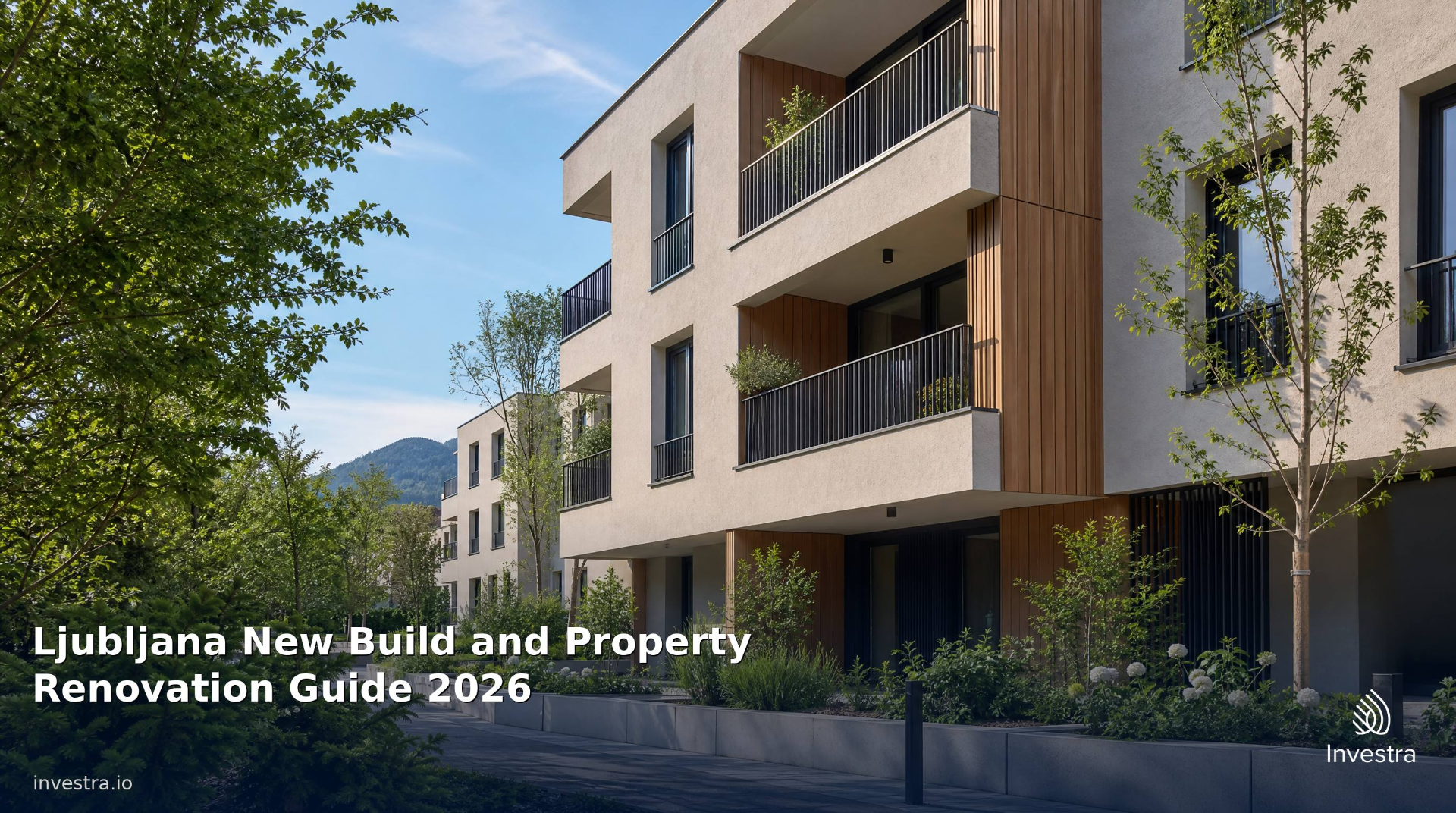
Ljubljana New Build and Property Renovation Guide 2026
Ljubljana New Build and Property Renovation Guide 2026
Ljubljana New Build and Property Renovation Market Overview 2026
Quick Answer: Ljubljana's new build and renovation property market in 2026 offers strong opportunities for investors, with new build prices ranging from €3,500 to €7,000/m² in prime areas and renovation yields reaching 5–7% annually. Investra.io tracks emerging European real estate markets to help investors capitalize on exactly these kinds of opportunities.
Ljubljana doesn't make headlines the way Lisbon or Barcelona do. That's precisely why sharp investors are paying close attention. Slovenia's capital has been quietly building one of Central Europe's most resilient property markets, underpinned by EU membership, a highly educated workforce, political stability, and a chronic undersupply of quality housing stock.
In 2026, the Ljubljana market sits at a fascinating crossroads. Post-pandemic demand for quality urban living collided with construction cost inflation and a limited land bank, driving new build prices to record levels. At the same time, the city's aging pre-socialist and socialist-era building stock has created an enormous renovation opportunity — one that many international investors are only beginning to recognize.
This guide cuts through the marketing noise to give you real numbers, real legal frameworks, and honest analysis of where the opportunities — and the risks — actually lie in 2026.
Why Ljubljana? Understanding the Investment Case
Quick Answer: Ljubljana is one of the eurozone's smallest capitals but punches well above its weight on quality-of-life metrics, economic stability, and long-term property appreciation, making it a compelling target for European property diversification. Technology-driven market intelligence is increasingly helping investors identify Ljubljana's micro-market dynamics.
Start with the fundamentals. Ljubljana has a population of roughly 295,000 in the city proper and around 550,000 in the wider metropolitan area. It's small by European capital standards, but that compactness is one of its defining strengths.
Slovenia's GDP per capita (PPP) sits at approximately €38,000–€40,000 — comfortably above the EU average and significantly ahead of neighboring Balkan states. Unemployment has remained below 4% for several consecutive years. These aren't the demographics of an emerging market taking a punt on future growth; they're the demographics of a stable, mature economy with a functioning rental market and predictable demand drivers.
The housing supply problem is real and structural. Ljubljana has strict urban planning controls, green belt protections, and a relatively conservative approach to high-density development. New build completions have consistently fallen short of household formation rates, particularly for smaller apartments targeting young professionals and the growing expat community.
For investors comparing options across the broader region, markets like Sremska Mitrovica in Serbia offer higher yield potential at lower entry prices, while Ljubljana offers lower yield but much stronger capital preservation and liquidity. The right choice depends entirely on your risk profile and investment timeline.
New Build Property Prices in Ljubljana 2026: Neighborhood by Neighborhood
Quick Answer: New build apartment prices in Ljubljana range from approximately €3,500/m² in outer districts to €6,500–€7,000/m² in the Old Town and Trnovo premium zones, with the citywide average for new builds sitting around €4,800–€5,200/m² in 2026.
Pricing in Ljubljana's new build market is intensely location-specific, and understanding the neighborhood hierarchy is essential before committing capital. The city's residential market is broadly divided into the historic center and inner-ring neighborhoods, the middle-ring established residential areas, and the outer suburbs where the majority of new construction activity is concentrated.
Center and Premium Inner City (Center, Trnovo, Šiška premium zones): New build prices here are eye-watering by regional standards — €5,500 to €7,000/m² for quality apartments, with boutique developments in the most sought-after streets occasionally exceeding this range. Supply is extremely limited due to heritage restrictions and land scarcity.
Established Inner Suburbs (Bežigrad, Vič, Moste, Šentvid): This is where the most interesting new build activity is happening in 2026. Prices range from €4,000 to €5,500/m² depending on the specific micromarket, build quality, and developer reputation. Bežigrad, adjacent to the center and home to major employers and educational institutions, commands the premium end of this range.
Outer Suburbs and Fringe Areas (Rudnik, Polje, Jarše, Šmartno pri Ljubljani): Here you'll find the bulk of new housing estate developments, with prices ranging from €3,500 to €4,200/m². These areas attract first-time buyers and investors targeting the long-term rental market for young families. Yields can be slightly stronger here, though capital appreciation tends to be more modest compared to central locations.
One important data point: parking is priced separately in virtually all Ljubljana new build developments. A standard parking space adds €15,000–€25,000 to the purchase cost, and in the center, underground spaces can command €30,000–€40,000. Don't overlook this in your total investment calculation.
The Ljubljana Renovation Opportunity: What the Numbers Say
Quick Answer: Renovation properties in Ljubljana's inner suburbs can be acquired for €2,000–€3,500/m² in un-renovated condition, with post-renovation values of €3,800–€5,500/m², creating gross margins of 20–40% for well-executed projects when construction costs are properly managed.
The renovation play in Ljubljana is genuinely compelling, but it requires a more hands-on approach than buying a new build turnkey. Here's the honest picture. Ljubljana has a substantial stock of apartments and houses built between 1950 and 1990 — the socialist-era panel blocks (known locally as bloki) and the more characterful inter-war period buildings in districts like Tabor and parts of Šiška.
Post-renovation, that same apartment in a good location — Bežigrad, central Vič, or the better parts of Šiška — can achieve €4,200–€5,000/m², meaning a total investment of €220,000–€320,000 (purchase plus renovation) can produce an asset worth €294,000–€350,000. That's not guaranteed — it depends heavily on execution quality, location selection, and market timing — but the margin logic is sound.
What surprised many buyers entering this market recently is the strength of demand for renovated properties from domestic buyers. There's a strong cultural preference in Slovenia for move-in-ready homes. Slovenes are generally not a DIY nation in the real estate sense; they want quality done for them.
For context on how renovation-driven value creation compares to other markets in the broader region, opportunities in similarly priced segments across Southeast Europe offer different risk-return profiles — useful for portfolio diversification thinking.
Legal Framework for Foreign Buyers: EU Citizens vs. Non-EU Nationals
Quick Answer: EU citizens can purchase property in Slovenia on equal terms with Slovenian nationals. Non-EU citizens face restrictions on agricultural land but can generally purchase urban residential and commercial property, often through a Slovenian-registered company or with government authorization in specific cases.
Slovenia's legal framework for foreign property ownership is relatively investor-friendly, particularly for EU and EEA citizens. Since Slovenia's EU accession in 2004, citizens of EU member states have held the same property rights as Slovenian nationals — no restrictions, no additional registration requirements, no special permits. You buy, you own, full stop.
For non-EU nationals (Americans, Canadians, Australians, Gulf investors, etc.), the picture is more nuanced. Urban residential and commercial property can generally be purchased, either directly or through a locally registered company (d.o.o. — the Slovenian equivalent of an LLC). Agricultural and forest land carries stricter controls and is generally not available to non-EU buyers without specific authorization.
The purchase process itself follows a straightforward structure. Once a purchase agreement is reached, both parties engage a notary (notar) who prepares the official purchase contract. The notary verifies the land registry (zemljiška knjiga), checks for encumbrances or liens, and ensures the transaction is legally valid.
For investment guidance that bridges real estate and broader business structuring considerations, Siniša Dagary investment insight provides strategic perspective on Central and Southeast European market entry, including Slovenia's corporate and tax environment.
Rental Yields and the Ljubljana Lettings Market in 2026
Quick Answer: Gross rental yields in Ljubljana range from 3.5–4.5% for standard long-term residential lets in prime areas, rising to 5–7% in outer districts or for well-managed short-term rental operations. Net yields after costs and taxes typically land 1–1.5 percentage points lower.
Ljubljana's rental market is tight. That's the defining characteristic for 2026. The student population alone — approximately 50,000 students at the University of Ljubljana and other institutions — generates enormous sustained demand that the housing stock struggles to meet.
Long-term residential rental rates in 2026 look roughly like this: a 50–60m² one-bedroom apartment in the center or inner suburbs achieves €900–€1,400/month. A 70–90m² two-bedroom in similar locations commands €1,200–€1,800/month. Student-oriented studio apartments (30–45m²) near the university cluster around Rožna Dolina and Vič achieve €650–€950/month and are among the most reliable rental assets in the city — vacancy is essentially zero.
The short-term rental market (Airbnb, Booking.com, and similar platforms) has grown significantly, particularly in the historic center and neighborhoods accessible to Ljubljana Castle and the Old Town. Occupancy rates for well-managed short-term apartments averaged 72–80% in 2024–2025, with nightly rates ranging from €90–€180 for a one-bedroom. Annual gross revenues for a centrally located 50m² apartment can reach €22,000–€28,000.
The reality is that gross yield figures don't tell the full story. Once you account for property management fees (typically 8–12% of rental income), maintenance reserves (budget 1–1.5% of property value annually for older stock), insurance, and the 25% income tax on net rental income (after allowable deductions), net yields compress noticeably. A property yielding 4.5% gross might realistically deliver 3–3.5% net.
New Build Development Process: From Permit to Completion
Quick Answer: Ljubljana's new build development process typically takes 3–5 years from land acquisition to completion, with the permitting phase alone requiring 12–24 months. Understanding this timeline is critical for both developers and off-plan investors calculating their return horizons.
For investors considering developer-side participation — buying land or early-stage development projects — understanding how the planning and construction process works in Ljubljana is non-negotiable. The bureaucratic timeline is the single biggest variable in development feasibility analysis here.
Land acquisition comes first, obviously. Developable land in Ljubljana is genuinely scarce. The Spatial Plan (OPN — Občinski prostorski načrt) strictly defines what can be built where, and rezoning is a lengthy, uncertain process.
The building permit process (gradbeno dovoljenje) is the primary pain point. In theory, straightforward applications should be decided within 2 months; in practice, the combination of heritage review requirements (for anything near the center), environmental impact assessments, and the simple administrative backlog at the Municipality of Ljubljana means permit timelines of 12–24 months are typical.
Construction timelines for residential buildings are generally 18–30 months for projects of 10–50 apartments. Construction costs in Slovenia have increased significantly post-2021, driven by labor shortages and materials inflation.
Off-plan purchases (buying during construction) are common and legally regulated. Buyers typically pay in tranches: 10% reservation deposit, 30–40% at foundation stage, 30–40% at structural completion, and the balance at handover. The Slovenian Consumers Protection Act provides meaningful protections for off-plan buyers, including mandatory developer bank guarantees, but independent legal review of the purchase contract remains essential.
Energy Efficiency Standards and the Green Renovation Premium
Quick Answer: Slovenia's EU-aligned energy efficiency standards require new builds to meet near-zero energy building (nZEB) criteria, and renovations targeting A or B energy ratings can unlock EU cohesion fund grants of €5,000–€25,000 per unit while commanding 8–15% price premiums in the resale market.
This is an area where many investors leave serious money on the table — or fail to factor in meaningful cost savings. Slovenia's building energy regulations have become progressively stricter in line with EU directives, and 2026 marks a critical juncture as the EU's Energy Performance of Buildings Directive (EPBD) recast pushes member states toward mandatory renovation timelines for the worst-performing buildings.
The renovation opportunity here is substantial. Ljubljana's older housing stock is heavily populated with D, E, and F energy-rated buildings. These are the exact properties that face mandatory renovation requirements under the EPBD trajectory.
The grant framework through Eko sklad (the Slovenian Environmental Public Fund) provides financial incentives for energy renovations. Individual apartment owners can access grants covering 20–30% of eligible renovation costs, with maximum amounts of €8,000–€20,000 for comprehensive thermal envelope improvements.
For strategic thinking on how sustainability trends are reshaping property investment across the region, Siniša Dagary investment insight covers broader European market trends that contextualize Ljubljana's green building evolution.
Financing New Builds and Renovation Projects in Slovenia
Quick Answer: Slovenian banks offer mortgage financing to both residents and non-resident EU citizens, with typical LTV ratios of 60–80% for residential properties and interest rates currently in the 3.8–5.2% range for euro-denominated loans, though non-resident applications face more stringent income verification requirements.
Financing is where international investors often hit their first serious obstacle in the Ljubljana market, and being realistic about this upfront saves considerable frustration. The Slovenian banking sector is conservative by European standards — think Austrian-style risk culture, which makes sense given the historical ownership links between Slovenian and Austrian banking groups.
Major lenders active in the Ljubljana residential market include NLB (Nova Ljubljanska Banka), SKB Banka (now part of OTP Group), Unicredit Slovenia, and Intesa Sanpaolo Slovenia. All offer mortgage products to EU citizens, with loan-to-value ratios typically capped at 80% for primary residences and 70–75% for investment properties. Non-residents face a de facto LTV ceiling of 60–70% in practice, even if formal policy suggests higher limits.
Current (2026) mortgage rates for euro-denominated loans sit in the 3.8–5.2% range depending on loan term, LTV, and applicant profile. Variable-rate products tied to 3-month or 6-month EURIBOR are common; fixed-rate products for 5–10 years are available at a premium of 30–60 basis points.
For renovation projects specifically, Eko sklad (the environmental fund mentioned in the previous section) also offers subsidized green renovation loans at below-market rates — currently around 1.5–2.5% for qualifying energy efficiency projects. These are worth serious consideration for renovation investors who can meet the documentation requirements. Findes Group & Partners provides specialist financing advisory for real estate transactions in Slovenia, including navigation of the Eko sklad application process and mortgage structuring for international buyers.
Cash purchases remain common in the Ljubljana market, particularly in the €300,000–€600,000 segment where domestic high-net-worth buyers and international investors compete. There's no particular advantage to cash beyond speed and simplicity — Slovenia doesn't offer meaningful purchase price discounts for cash buyers the way some less-liquid markets do.
Tax Considerations for Ljubljana Property Investors
Quick Answer: Property investors in Ljubljana face a 2% real estate transfer tax on second-hand purchases (or 9.5% VAT on new builds), a 25% flat income tax on net rental income, and capital gains tax of 25% (declining to 0% after 20 years of ownership), making long-term holds significantly more tax-efficient than short-term flips.
Slovenia's tax framework for real estate investment is relatively transparent and investor-comprehensible — not as aggressive as some Western European jurisdictions, not as lax as some Eastern European ones. Understanding the key taxes upfront prevents unpleasant surprises in your return calculations.
Purchase taxes are modest. Second-hand property attracts Davek na promet z nepremičninami (real estate transfer tax) at 2% of assessed value. New builds completed within 5 years of construction attract 9.5% VAT (DDV) instead. This VAT rate is significantly lower than the 22% standard VAT rate, reflecting a deliberate policy choice to encourage residential construction.
Rental income is taxed at 25% of net rental income after a statutory 10% maintenance deduction (for property management costs), meaning the effective tax rate on gross rental income is approximately 22.5%. Alternatively, actual documented expenses can be deducted — this is more advantageous for properties with high genuine maintenance costs or significant depreciation claims.
Capital gains (Davek na kapitalski dobiček) apply at 25% in the first year of ownership, declining by 5 percentage points for each subsequent 5-year holding period: 20% after 5 years, 15% after 10 years, 10% after 15 years, and 0% after 20 years. This sliding scale strongly incentivizes long-term investment and makes Ljubljana property naturally suited to hold strategies rather than frequent trading.
For non-resident investors, Slovenia has double tax treaties with most major investing nations, which typically allow credit for Slovenian tax against home country tax liability. Non-residents must register with the Slovenian tax authority (FURS — Finančna uprava Republike Slovenije) and file annual tax returns on Slovenian-source income.
Comparing New Build vs. Renovation: Which Strategy Wins in 2026?
Quick Answer: New builds offer turnkey appeal and strong long-term appreciation in prime locations, while renovations offer faster value creation and better yield profiles. The optimal choice depends on your capital availability, timeline, risk tolerance, and management capacity.
This is the core strategic question facing investors in Ljubljana in 2026, and the answer is genuinely context-dependent. Both strategies have merit; the key is matching strategy to your specific investment profile.
The New Build Case:
Investment Disclaimer
Quick Answer: This guide is general market information, not personal legal, tax, financing or investment advice.
Before committing to a property transaction, buyers should obtain independent local legal, tax and financial advice suited to their circumstances. Investra.io can support initial market research, but every purchase decision remains the buyer's responsibility.
Frequently Asked Questions
Quick Answer: This section explains the practical property-investment implications of Frequently Asked Questions.
What is a prudent next step after initial market research?
Use current documentation, independent professional advice and comparable local evidence before proceeding. Investra.io can support an initial structured market review.
How can buyers plan a realistic ownership budget?
Use current documentation, independent professional advice and comparable local evidence before proceeding. Investra.io can support an initial structured market review.
What evidence supports a careful investment decision?
Use current documentation, independent professional advice and comparable local evidence before proceeding. Investra.io can support an initial structured market review.
When should a buyer obtain legal and tax advice?
Use current documentation, independent professional advice and comparable local evidence before proceeding. Investra.io can support an initial structured market review.
How should a buyer compare neighbourhoods and property types?
Use current documentation, independent professional advice and comparable local evidence before proceeding. Investra.io can support an initial structured market review.
What local checks should be completed before signing?
Use current documentation, independent professional advice and comparable local evidence before proceeding. Investra.io can support an initial structured market review.
Which costs should be assessed alongside the purchase price?
Use current documentation, independent professional advice and comparable local evidence before proceeding. Investra.io can support an initial structured market review.
How can international buyers verify a property opportunity?
Use current documentation, independent professional advice and comparable local evidence before proceeding. Investra.io can support an initial structured market review.
What should buyers compare before selecting a property?
Use current documentation, independent professional advice and comparable local evidence before proceeding. Investra.io can support an initial structured market review.
Quick Answer: These answers outline common buyer checks and should be read with current professional advice.
Recommended Reading
Quick Answer: This section explains the practical property-investment implications of Recommended Reading.
- Investra market research
- Investra market research
- Investra market research
- Investra market research
- Investra market research
- Investra market research
- Investra market research
- Investra market research
- Investra market research
- Investra market research
- Investra market research
- Investra market research
- Investra market research
- Investra market research
- Investra market research
- Investra market research
- Investra market research
- Siniša Dagary investment insight
- Siniša Dagary investment insight
- Siniša Dagary investment insight
- Siniša Dagary investment insight
- Siniša Dagary investment insight
- Findes Group & Partners
- Findes Group & Partners
Connect With Investra
Follow Investra for market updates on Facebook, LinkedIn, YouTube
Related Posts
No related posts available.
