
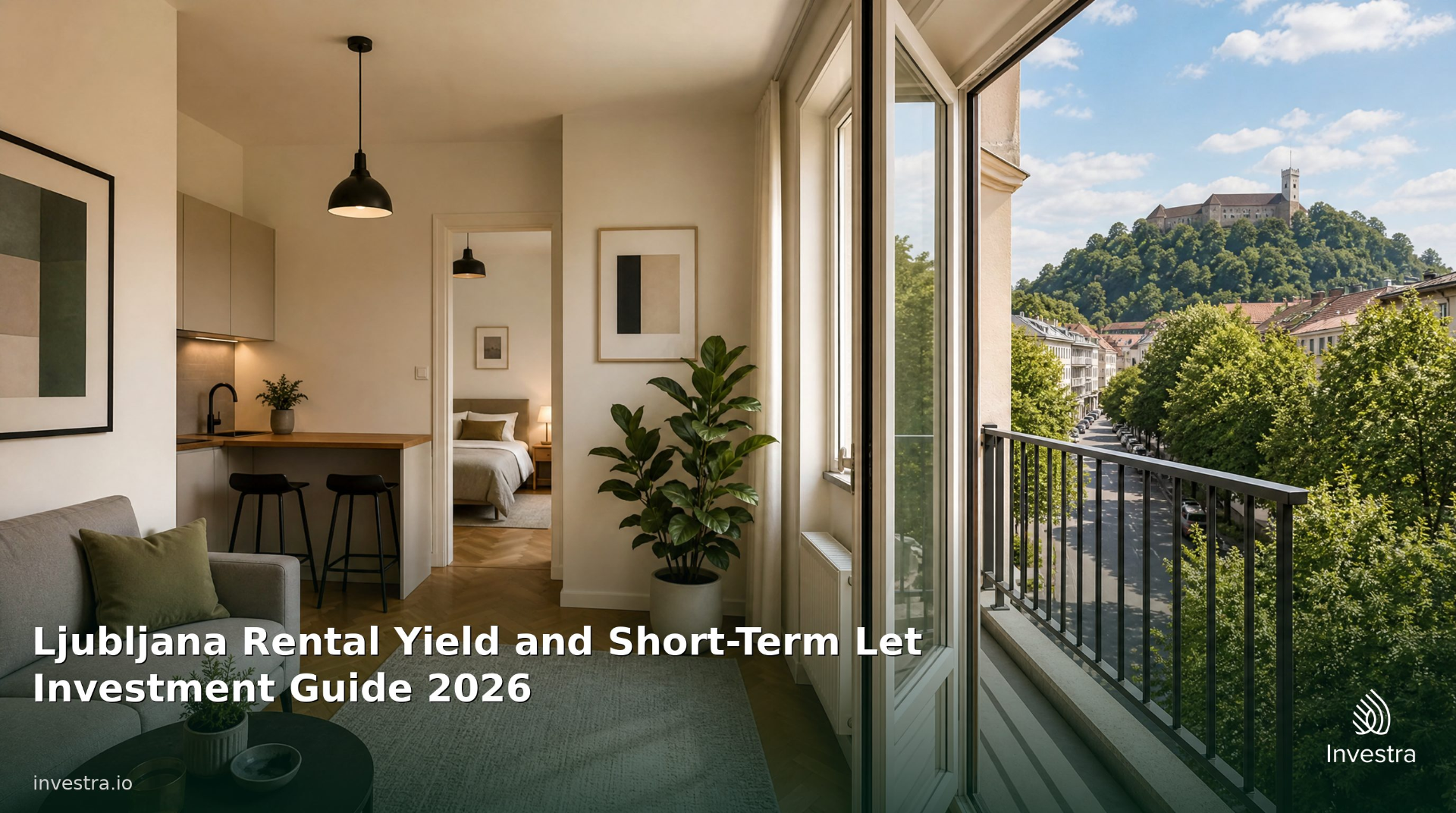
Ljubljana Rental Yield and Short-Term Let Investment Guide 2026
Ljubljana Rental Yield and Short-Term Let Investment Guide 2026
Ljubljana Rental Market Overview: Why 2026 Is a Pivotal Year
Quick Answer: Ljubljana's rental market in 2026 is characterized by strong demand, limited housing supply, and rising yields driven by tourism growth and a housing shortage — making it one of Central Europe's most compelling short-term and long-term rental investment destinations. Investra.io tracks emerging European markets to help investors identify the best entry points.
Ljubljana doesn't command the same media attention as Prague or Lisbon. That's actually part of its appeal. Slovenia's compact capital has quietly assembled an investment profile that would impress even the most skeptical property analyst: a UNESCO-recognized old town, a booming tech-and-startup scene, one of the EU's most educated urban workforces, and a tourism sector that consistently punches above its weight.
The city's population hovers around 295,000, but the urban catchment area swells that number considerably. The University of Ljubljana alone enrolls roughly 40,000 students, generating fierce rental demand in central and inner-ring neighborhoods.
What really sets 2026 apart is the regulatory environment. Slovenia has been watching its European neighbors wrestle with short-term rental restrictions — think Amsterdam's 30-night cap or Barcelona's Airbnb crackdowns — and has begun introducing its own framework.
For those building a wider Central and Eastern European portfolio, Ljubljana pairs naturally with markets like those explored in our Sremska Mitrovica Real Estate 2026 Srem Region Property Guide — different risk profiles, but complementary geographic exposure across the Western Balkans and Alpine corridor.
Ljubljana Property Prices Per Square Meter in 2026
Quick Answer: Ljubljana property prices in 2026 range from approximately €3,200/m² in outer districts to €6,500+/m² in premium central locations, with the city-wide average for apartments sitting around €4,400–€4,800/m² — representing a roughly 8–12% annual appreciation over 2024 levels.
Let's talk numbers, because this is where Ljubljana genuinely surprises people. The city isn't cheap by Balkan standards, but compared to Vienna (€6,500–€10,000/m²), Munich (€8,000–€12,000/m²), or even Prague (€4,500–€7,000/m²), Ljubljana still offers relative value for a fully integrated EU capital with eurozone stability.
Breaking prices down by district tells a more nuanced story. Center (Stari Trg and Mestni Trg areas): €5,200–€6,800/m² for renovated historic apartments. Bežigrad: €3,800–€4,600/m². Šiška: €3,400–€4,200/m². Moste-Polje: €3,000–€3,800/m². Vič-Rudnik: €3,500–€4,400/m². The newest residential developments on the city's southern fringe near BTC City and the emerging Brdo district are pricing new-build units at €4,200–€5,500/m².
What surprised many buyers entering the market in 2024–2025 is how quickly secondary neighborhoods appreciated. Šiška, historically considered a working-class area, has undergone remarkable gentrification.
New construction carries a premium but comes with significant advantages for rental investors: modern insulation ratings (critical for Slovenia's energy efficiency regulations), underground parking (enormously valued in car-dependent Ljubljana), and contemporary layouts that outperform on Airbnb listing photography. For a 60m² two-bedroom new-build in an inner-ring district, expect to pay €270,000–€320,000 all-in.
Short-Term Rental Yields: Airbnb and Booking.com Performance Data
Quick Answer: Well-located Ljubljana short-term rentals are generating gross rental yields of 6–9% annually in 2026, with top-performing central apartments on Airbnb achieving occupancy rates of 75–85% and average daily rates of €90–€160 during peak season.
The short-term rental economics in Ljubljana are genuinely compelling — but they require honest assessment rather than promotional gloss. The reality is that performance varies significantly by location, property quality, and operator competence.
Here's what the data actually shows. Average nightly rates in Ljubljana's Center: €95–€155 for a one-bedroom, €140–€220 for a two-bedroom. Shoulder season (April-June, September-October) average daily rates: €75–€120. Winter occupancy drops to 50–65%, while peak summer months (July-August) regularly hit 88–92% occupancy for well-managed properties.
After deducting platform fees (Airbnb charges hosts approximately 3%, Booking.com typically 15%), cleaning costs (€35–€55 per turnover), property management fees (15–22% of revenue for full-service operators), utilities, and minor maintenance, net yields typically land in the 4.5–6.5% range. That's notably stronger than Ljubljana's long-term rental market, which produces net yields of 3.2–4.8% in most districts.
For strategic context on yield comparisons across different European markets, the Business Strategy Blog by investment consultant Siniša Dagary regularly publishes analyses of Central European property markets that contextualize these numbers within broader portfolio strategy.
The high season concentration in Ljubljana is worth addressing directly. Unlike year-round coastal destinations, Ljubljana's tourism peaks sharply in summer and around major events (Dragon Castle Festival, Ana Desetnica street theatre festival, the Christmas market which draws enormous crowds from November through January).
Long-Term Rental Market: Student and Professional Tenant Demand
Quick Answer: Long-term rental yields in Ljubljana range from 3.5–5.2% net for well-maintained apartments, with monthly rents of €700–€1,100 for one-bedroom and €1,000–€1,600 for two-bedroom units in central and near-central districts in 2026.
Not every investor wants the operational intensity of short-term letting. For those preferring stable, predictable income with lower management overhead, Ljubljana's long-term rental market is surprisingly tight — in the best possible way for landlords.
Student housing deserves special attention. The University of Ljubljana's campus stretches across multiple city districts, and student dormitory capacity has chronically failed to keep pace with enrollment. Private student accommodation commands €500–€750/month per room in shared apartments, with some investors running purpose-configured flat-shares yielding significantly above market averages.
Corporate relocation rental — housing international employees of Ljubljana's growing tech and pharmaceutical sectors — represents perhaps the most attractive long-term rental segment. Companies including Outfit7 (creator of Talking Tom), Zemanta, and a growing cluster of Austrian and German corporate subsidiaries bring highly paid employees who expect quality housing and pay above-market rents without negotiation.
The legal framework for long-term rentals in Slovenia is landlord-friendly by European standards. Leases are typically 1-2 years with standard renewal clauses. Tenant eviction for non-payment, while requiring court process, moves faster than in countries like France or Germany. Security deposits of two months' rent are standard and legally enforceable.
Legal Framework for Foreign Property Buyers in Slovenia
Quick Answer: EU citizens face no restrictions purchasing property in Slovenia; non-EU nationals can buy through a Slovenian-registered company or via bilateral treaty provisions. The purchase process typically takes 6–10 weeks and involves a notarial deed, land register entry, and 2% property transfer tax.
Slovenia joined the EU in 2004 and adopted full property market liberalization for EU citizens in 2007. If you hold an EU or EEA passport, buying property in Ljubljana is legally identical to buying in your home country — no special permits, no foreign ownership caps, no restricted zones.
Non-EU buyers — Americans, British post-Brexit, Australians, Canadians, UAE residents — face a somewhat more complex path but one that's entirely navigable. The most common route is establishing a Slovenian d.o.o. (the local equivalent of a limited liability company), which can purchase property with the same rights as any Slovenian entity. The d.o.o.
The purchase transaction itself follows a clear sequence. First: due diligence — a comprehensive land register (zemljiška knjiga) search confirming clean title, no encumbrances, and accurate cadastral records. Second: a preliminary purchase agreement (predpogodba) with a 10% deposit. Third: the final notarial deed (notarska pogodba), witnessed and certified by a registered notary.
Total transaction costs for buyers run 4–7% of purchase price: 2% DDT, 1–2% notarial fees, 1–2% agency commission (though in Ljubljana, seller-paid agency is common), and legal fees. Using a local property lawyer — budget €800–€1,500 for a standard transaction — is strongly recommended even for experienced investors. The Findes Group & Partners team has experience supporting international buyers through Slovenian property transactions and financial structuring.
Short-Term Rental Regulations and Ljubljana Airbnb Laws 2026
Quick Answer: Ljubljana requires short-term rental operators to register with the municipal authorities, pay tourist tax (€3.13 per person per night in 2026), and comply with residential zoning provisions — with draft regulations potentially introducing annual night caps for owner-absent rentals under discussion for 2026–2027 implementation.
This is the section that separates well-informed investors from those who get an unpleasant surprise two years into their investment. Slovenia's approach to regulating short-term rentals has been more measured than some of its EU neighbors, but the direction of travel is unmistakably toward tighter oversight.
Current requirements (as of 2026): All short-term rental operators must register their property with the Slovenian Tourism Organization (STO) and obtain a registration number, which must appear on all platform listings. Tourist tax of €3.13 per adult per night must be collected from guests and remitted monthly to Ljubljana's municipal administration.
The City of Ljubljana has been studying a framework that would limit owner-absent short-term rentals (i.e., investment properties run entirely by management companies) to 90–120 nights annually in the Center district, mirroring restrictions seen in Vienna and Amsterdam. As of mid-2026, this remains in consultation phase, but prudent investors should factor this potential constraint into their pro forma calculations.
Practically speaking, compliance isn't burdensome for legitimate operators. Registration is straightforward, tourist tax collection is handled automatically by Airbnb and Booking.com (they remit directly to authorities in Slovenia), and the documentation requirements are manageable with basic administrative systems.
Taxation of Rental Income in Slovenia: What Investors Actually Pay
Quick Answer: Rental income in Slovenia is taxed at a flat 25% rate for individuals after a 10% standard deduction for expenses, or at standard corporate income tax rates (19%) if held through a company — with various deductions available for depreciation, interest, and operating costs.
Tax efficiency is where many Ljubljana investment decisions are actually made. The headline individual rate of 25% on rental income sounds significant, but the effective rate is considerably lower once legitimate deductions are applied — and for investors using company structures, the picture improves further.
Individual ownership: Rental income is treated as a separate income category (dohodek iz oddajanja premoženja v najem) and taxed at 25% flat after the standard 10% notional expense deduction. So on €20,000 in annual rental income, taxable base is €18,000, and tax liability is €4,500. Effective rate: 22.5%.
Company ownership (d.o.o.): Corporate rental income is subject to 19% corporate income tax, but the real advantage lies in deductibility. Mortgage interest, depreciation (typically 3% per year on the property value), management fees, accounting costs, and any bona fide business expenses all reduce taxable profit.
VAT considerations: Residential rental is VAT-exempt in Slovenia. Short-term tourist accommodation is technically subject to the standard 22% VAT rate, but the threshold for registration (€50,000 annual turnover) means most individual property investors stay below the VAT registration requirement. Company-structure investors running multiple properties should model their VAT exposure carefully.
Slovenia and most major investor home countries have double taxation treaties (DTAs), including with the UK, USA, Germany, Austria, and Netherlands. These treaties typically allow rental income taxes paid in Slovenia to be offset against home-country tax obligations, preventing double taxation on the same income stream.
Best Neighborhoods for Rental Investment in Ljubljana
Quick Answer: Center (Stari Trg), Bežigrad, and Šiška offer the strongest combination of rental demand, yield potential, and capital appreciation for investors in 2026 — with Center commanding premium short-term rates and Šiška providing better entry prices and strong long-term rental demand from young professionals.
Not all Ljubljana neighborhoods are created equal for rental investors, and the right choice depends entirely on your investment thesis: are you chasing short-term yield, long-term capital growth, or the most stable passive income stream? Each neighborhood produces a different answer.
Center / Stari Trg — This is the obvious choice for Airbnb investors, and the numbers justify the premium purchase price. Walking distance to the castle, the Ljubljanica riverfront, and the covered market means occupancy rates rarely dip below 70% even in shoulder season.
Bežigrad — The residential neighborhood north of Center appeals strongly to corporate and professional long-term tenants. Embassy row runs through the Rožna Dolina sub-district, and the proximity to the University campus creates reliable student demand. Entry prices of €3,800–€4,600/m² make this the sweet spot for yield-focused long-term rental investment, with net yields of 4.2–5.0% achievable on well-priced acquisitions.
Šiška — The story here is gentrification momentum. Independent cafés, creative workspaces, and the Kino Šiška cultural centre have transformed this former industrial district's image. Entry prices remain 20–25% below Center, but the tenant demographic is increasingly identical: young, employed, and willing to pay for quality. Five-year capital appreciation of 35–40% in parts of Šiška has outpaced the city average.
Vič / Trnovo — This southern riverside neighborhood has a distinctly bohemian character — artists, academics, and international residents clustered around the Trnovo church and canal area. Properties here are harder to find but hold value exceptionally well. Ideal for investors seeking a single quality asset held long-term.
For investors who want to compare Ljubljana's neighborhood dynamics with other growing European markets, our analysis of the Bor Real Estate Market 2026 Eastern Serbia Mining City Pr... offers an interesting contrast — a market at an earlier appreciation stage with different risk-reward dynamics.
Financing Options: Slovenian Mortgages and International Lending
Quick Answer: Slovenian banks offer non-resident mortgages at 50–70% LTV with interest rates of 3.8–5.2% in 2026, while EU-resident buyers with strong domestic credit profiles may access more competitive terms — making used Ljubljana acquisitions viable but requiring careful cash-flow modeling.
The financing landscape for Ljubljana property investment has normalized considerably since the ECB's rate hiking cycle of 2022–2023. After peak variable rates touching 5.5–6% in late 2023, Slovenian mortgage rates have eased to the 3.8–5.2% range depending on loan tenure, LTV ratio, and borrower profile.
Loan tenures for investment properties typically run 15–25 years, shorter than the 30-35 year terms available for primary residence loans. This produces higher monthly payments — on a €200,000 mortgage at 4.5% over 20 years, expect approximately €1,265/month — which must be comfortably covered by rental income with a stress-tested buffer.
For investors who prefer to avoid Slovenian bank bureaucracy, using equity from an existing property in Germany, Austria, or the Netherlands to fund a Ljubljana cash purchase is increasingly common. This strategy eliminates mortgage interest costs and significantly simplifies the transaction. The investment consultant About Siniša Dagary profile outlines how experienced investors structure these cross-border equity deployment strategies across Central and Eastern European markets.
Return on Investment Analysis: 5-Year and 10-Year Projections
Quick Answer: A well-selected Ljubljana investment property purchased in 2026 at €280,000–€320,000 can realistically deliver total returns of 45–70% over 10 years, combining net rental income yields of 4.5–6.5% annually with projected capital appreciation of 4–7% per annum based on current demand fundamentals.
Let's model this concretely, because abstract yield percentages mean nothing without a full return picture. Consider a representative investment: a 55m² one-bedroom apartment in Bežigrad, purchased for €290,000 (approximately €5,270/m²). The property requires €15,000 in furnishing and minor renovation to Airbnb-ready standard. Total capital deployed: €305,000. Assume no mortgage (cash purchase) for simplicity.
Short-term rental scenario: Gross annual income €19,500 (based on 175 nights at average €115/night, partially blended with off-peak periods). After all costs: platform fees €2,400, cleaning €3,500, management €3,900, insurance €600, utilities €1,200, maintenance €1,000, tourist tax handling €500. Net income: approximately €6,400. Net yield: 2.1%. This looks underwhelming — until you add capital appreciation.
Long-term rental comparison: A similar property in Bežigrad, let to professional tenants at €850/month, produces €10,200 annual gross income. After 25% tax and €1,500 annual expenses, net income drops to €6,675 — barely outpacing the Airbnb scenario despite higher perceived stability.
The five-year horizon tells a different story. With Ljubljana's recent appreciation rates, that same property likely appreciates to €370,000 (27% capital gain) within five years, while accumulating €33,000 in net rental income. Total return: 66% on equity, or annualized 10.5%. These numbers explain why institutional investors are quietly increasing Ljubljana exposure.
Emerging Regulations and Investment Risk Factors for 2026–2027
Quick Answer: The primary regulatory risk in Ljubljana involves potential caps on owner-absent short-term rentals, though current draft proposals suggest implementation delays into 2027 or 2028 — giving savvy investors a narrow window to establish portfolios before constraints take effect.
Every investment decision should account for regulatory risk, and Ljubljana's short-term rental market faces real headwinds on the horizon. The city's aldermen have acknowledged that rapid growth in platform-mediated lettings has contributed to housing affordability challenges for local residents — a political reality that makes restrictive regulation increasingly likely.
The European pattern is instructive. Amsterdam implemented its 30-night annual cap in late 2023, Barcelona capped Airbnb permits at roughly 10,000 properties, and Paris technically abolished short-term rentals by restricting commercial operators while allowing limited owner-occupied lettings.
Investment Disclaimer
Quick Answer: This guide is general market information, not personal legal, tax, financing or investment advice.
Before committing to a property transaction, buyers should obtain independent local legal, tax and financial advice suited to their circumstances. Investra.io can support initial market research, but every purchase decision remains the buyer's responsibility.
Frequently Asked Questions
Quick Answer: This section explains the practical property-investment implications of Frequently Asked Questions.
What is a prudent next step after initial market research?
Use current documentation, independent professional advice and comparable local evidence before proceeding. Investra.io can support an initial structured market review.
How can buyers plan a realistic ownership budget?
Use current documentation, independent professional advice and comparable local evidence before proceeding. Investra.io can support an initial structured market review.
What evidence supports a careful investment decision?
Use current documentation, independent professional advice and comparable local evidence before proceeding. Investra.io can support an initial structured market review.
When should a buyer obtain legal and tax advice?
Use current documentation, independent professional advice and comparable local evidence before proceeding. Investra.io can support an initial structured market review.
How should a buyer compare neighbourhoods and property types?
Use current documentation, independent professional advice and comparable local evidence before proceeding. Investra.io can support an initial structured market review.
What local checks should be completed before signing?
Use current documentation, independent professional advice and comparable local evidence before proceeding. Investra.io can support an initial structured market review.
Which costs should be assessed alongside the purchase price?
Use current documentation, independent professional advice and comparable local evidence before proceeding. Investra.io can support an initial structured market review.
How can international buyers verify a property opportunity?
Use current documentation, independent professional advice and comparable local evidence before proceeding. Investra.io can support an initial structured market review.
What should buyers compare before selecting a property?
Use current documentation, independent professional advice and comparable local evidence before proceeding. Investra.io can support an initial structured market review.
Quick Answer: These answers outline common buyer checks and should be read with current professional advice.
Recommended Reading
Quick Answer: This section explains the practical property-investment implications of Recommended Reading.
- Investra market research
- Investra market research
- Investra market research
- Investra market research
- Investra market research
- Investra market research
- Investra market research
- Investra market research
- Investra market research
- Investra market research
- Investra market research
- Investra market research
- Investra market research
- Investra market research
- Investra market research
- Investra market research
- Investra market research
- Siniša Dagary investment insight
- Siniša Dagary investment insight
- Siniša Dagary investment insight
- Siniša Dagary investment insight
- Siniša Dagary investment insight
- Findes Group & Partners
- Findes Group & Partners
Connect With Investra
Follow Investra for market updates on Facebook, LinkedIn, YouTube
Related Posts
No related posts available.
