
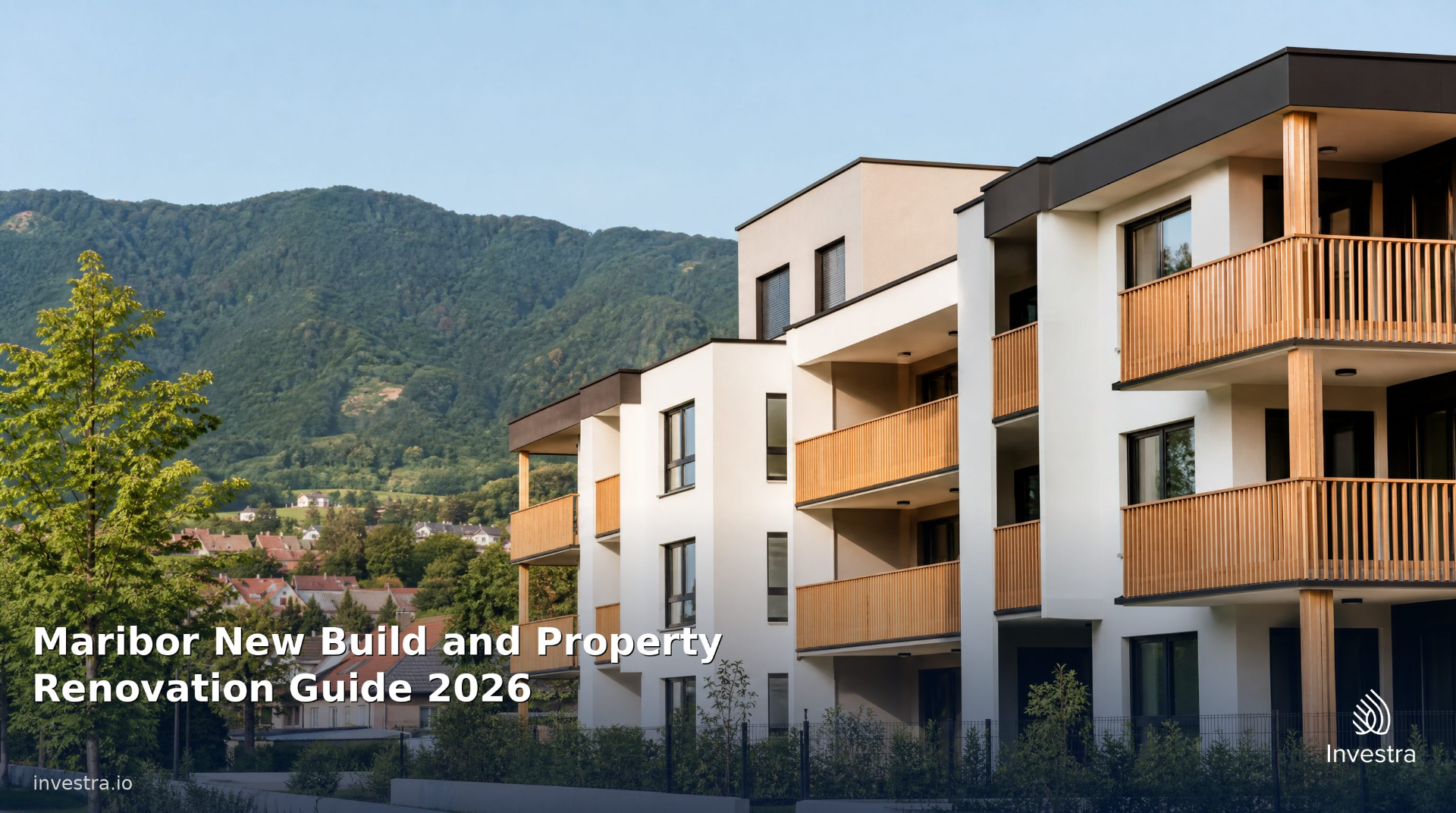
Maribor New Build and Property Renovation Guide 2026
Maribor New Build and Property Renovation Guide 2026
Maribor New Build and Property Renovation Guide 2026: What Investors Need to Know
Quick Answer: Maribor's new build and renovation property market in 2026 offers compelling opportunities for both domestic and international investors, with new construction prices ranging from €2,200 to €4,500/m² and renovation projects starting from as low as €600/m² in older districts. Investra.io tracks emerging European real estate markets to help investors make data-driven decisions.
Maribor has quietly become one of Central Europe's most intriguing real estate stories. Slovenia's second-largest city—home to roughly 112,000 residents—sits at the crossroads of Austria, Croatia, and Hungary, and that geography alone makes it strategically significant. But there's something else happening here.
Understanding Maribor's Real Estate Market Context in 2026
Quick Answer: Maribor's property market has seen consistent price growth of 6–9% annually since 2021, driven by student housing demand, tourism recovery, and urban regeneration projects—making it one of Slovenia's most active secondary markets. Investra.io's Eastern European market guides provide useful regional context for comparative investment analysis.
Before committing capital to any new build or renovation project, you need to understand what's driving demand in Maribor—and why 2026 looks different from the years that came before.
The University of Maribor enrolls approximately 17,000 students, creating a structural baseline for rental demand that insulates the market from short-term economic fluctuations. This isn't a seasonal dynamic—it's a permanent feature of the city's economy.
Tourism is the second engine. Maribor sits at the heart of the Štajerska wine region and hosts one of Europe's oldest living grapevines—a genuine tourist draw. The city received approximately 280,000 overnight stays in 2023, a figure that has been climbing steadily since 2020.
The third factor is urban regeneration. The municipal government has committed significant EU Cohesion Fund money to revitalize districts like Tabor, Magdalena, and the riverside Lent area. Infrastructure improvements—new cycling paths, riverside promenades, and public space upgrades—tend to precede property price acceleration.
What surprised many buyers entering this market is how fragmented the property stock is. Unlike Ljubljana, which has seen large-scale developer projects, Maribor's new build pipeline consists mostly of smaller developments of 20–80 units. This creates both challenges (less choice at any given moment) and opportunities (less competition, more negotiating room with developers).
New Build Property Prices in Maribor 2026
Quick Answer: New build apartments in Maribor range from approximately €2,200/m² in outer districts to €4,500/m² in prime city center and riverside locations, with the average sitting around €3,100/m² for quality new construction in 2026.
Price transparency in Maribor's new build sector has improved markedly. Here's what the numbers actually look like across different city segments:
City Center and Lent Riverfront (Premium Zone): New construction here commands €3,800–€4,500/m². These are typically boutique developments of 15–40 units, often involving partial renovation of heritage-listed structures. Buyers pay a premium for walkability, short-term rental potential, and prestige. A 60m² two-bedroom apartment in this zone typically lists at €228,000–€270,000.
University Quarter and Pobrežje: The sweet spot for yield-focused investors. New builds here price between €2,800–€3,400/m², with typical two-bedroom apartments coming in at €168,000–€204,000. Developer incentives—particularly for buyers committing early in the construction phase—can bring effective prices 5–8% below list.
Suburban Districts (Radvanje, Kamnica, Pekre): Family-oriented new construction in these greener outer areas runs €2,200–€2,900/m². Detached new-build houses—which see limited supply—can range from €320,000 to €520,000 depending on plot size and specification level.
Off-Plan Pricing: Purchasing during the planning or early construction phase typically yields a 10–15% discount versus the completed price. This is a legitimate and common practice in Slovenia, provided you work through a licensed notary and ensure the purchase contract includes construction timeline guarantees and escrow-protected stage payments.
Construction costs for self-build projects (where an individual commissions a contractor directly) currently run €1,400–€2,200/m² for a turnkey finish, depending on specification. Steel and concrete input costs stabilized in late 2023 after the post-COVID spike, but labor costs in Slovenia have risen 8–12% annually, reflecting the tight construction workforce market.
Property Renovation Opportunities: Where the Real Value Is
Quick Answer: Renovation projects in Maribor—particularly in the Tabor, Magdalena, and historic center districts—offer the highest potential returns, with renovation costs of €600–€1,200/m² transforming undervalued properties into assets worth 40–70% more than their pre-renovation price.
Here's the truth that many new investors overlook: in Maribor's current market, renovation often delivers better returns than new build. The math is compelling when you run it properly.
Consider a typical pre-war or early socialist-era apartment in the Tabor district. These properties frequently sell for €900–€1,400/m² in their unrenovated state—well below replacement cost. A comprehensive renovation (new electrical, plumbing, insulation, windows, kitchen, bathrooms, and finishes) runs €600–€900/m² for standard quality, or €900–€1,200/m² for premium specification.
On a 70m² apartment purchased at €1,100/m² (€77,000) with €750/m² renovation (€52,500) plus €12,000 in transaction costs and contingency, your all-in cost sits around €141,500. Post-renovation market value: approximately €182,000–€196,000. That's a gross profit of €40,000–€55,000 on a relatively straightforward project—or roughly 28–39% return on capital deployed.
The renovation landscape in Maribor breaks down into three main categories:
Cosmetic Renovation: New floors, paint, kitchen units, and bathroom fixtures. Costs €150–€350/m². Suitable for properties built after 1980 with sound structure and modern infrastructure. Adds 15–25% to market value in good locations.
Full Interior Renovation: Everything inside is stripped and rebuilt—new electrics, plumbing, insulation, and finishes. Costs €600–€900/m². Most common strategy for inter-war and early post-war buildings. The quality of the final product is what drives the rental premium or resale uplift.
Structural + Full Renovation: Includes addressing foundation issues, roof replacement, structural wall modifications, or load-bearing changes. Requires architectural sign-off and permits. Costs €900–€1,500/m². Typically reserved for larger projects or heritage properties where grant funding can offset part of the cost.
One thing we've consistently observed in markets like this: renovation timelines matter as much as the budget. A project planned for 6 months that runs to 14 months is a return killer. Experienced local project managers charge 8–12% of total renovation cost but routinely save investors 15–20% through better contractor coordination and material procurement. Don't skip this.
Legal Framework for Foreign Buyers in Slovenia
Quick Answer: EU citizens can purchase property in Slovenia on the same terms as Slovenian nationals, while non-EU buyers face additional requirements including establishing a Slovenian company or meeting bilateral treaty conditions—but the process is well-regulated and transparent. Understanding regional legal frameworks is essential before committing capital to any European market.
Slovenia has one of the more investor-friendly legal frameworks in the former Yugoslav space, largely because of its EU membership since 2004 and its adoption of the euro in 2007. But the rules differ meaningfully depending on where you're coming from.
EU/EEA Citizens: Full equal treatment with Slovenian nationals. You can purchase any type of property—residential, commercial, agricultural (with some restrictions)—in your personal name without additional permits. The process is entirely notary-based.
Non-EU Citizens: The situation is more complex. Nationals of countries that have bilateral treaties with Slovenia (which includes the US, UK post-Brexit, and several others) can purchase residential property but must follow a specific registration process with the Ministry of Justice.
The Purchase Process—Step by Step:
First, the buyer and seller agree on terms and sign a preliminary purchase agreement (predpogodba), typically accompanied by a 10% deposit. This deposit is legally protected but not held in escrow automatically—using a notary-supervised deposit account is strongly recommended.
Second, the main purchase contract (kupoprodajna pogodba) is drafted and signed before a notary. Slovenia requires notarial authentication of property transactions—there's no option to bypass this. Notary fees are regulated by statute and scale with transaction value: approximately €500–€1,500 for a typical residential transaction.
Third, property transfer tax (2% of assessed value) is paid within 30 days of signing. The assessed value is determined by GURS (the Geodetic Administration of the Republic of Slovenia) and can differ from the actual transaction price—in practice, GURS values often run 5–15% below market price for older properties.
Fourth, registration in the Land Register (Zemljiška knjiga) is completed by the notary. This process typically takes 2–6 weeks. Until registration is complete, the buyer's ownership is not fully legally protected, so ensuring all prior encumbrances are cleared before closing is non-negotiable.
For new builds, the process includes reviewing the building permit status, checking the developer's track record, and ensuring construction is covered by a bank guarantee or insurance policy. Working with a lawyer who specializes in Slovenian real estate—not just a general practice firm—is genuinely worth the €1,000–€2,500 in fees for international buyers.
Planning Permission and Building Regulations for New Builds
Quick Answer: Obtaining building permits in Maribor typically takes 3–9 months and requires engagement with the Municipal Spatial Planning Department, with the process governed by Slovenia's Construction Act (Gradbeni zakon)—efficient by regional standards but demanding in documentation requirements.
Slovenia reformed its construction permitting system significantly with the 2018 Gradbeni zakon (Construction Act), which was further amended in 2021 to streamline procedures and reduce bureaucratic friction. The result is a system that, while not simple, is predictable—which matters enormously when you're planning project timelines and financing drawdowns.
For new build projects in Maribor, the permitting journey starts with a check of the spatial planning documentation (Prostorski informacijski sistem—PIS). Before spending anything on architects, this free online check tells you what the land is zoned for, what FAR (floor area ratio) is permitted, height restrictions, and any environmental or cultural heritage overlays.
The actual building permit (gradbeno dovoljenje) process requires:
A certified project documentation (PZI—project for construction), prepared by a licensed architect. For a residential new build, expect to pay €8,000–€25,000 for architectural services depending on project size and complexity.
The permit decision from the municipality typically comes within 30 days for standard cases, though complex or heritage-sensitive projects can extend to 6–9 months. Appeals from neighboring property owners are a genuine risk in densely built urban areas—factoring a 60-day appeal window into your timeline is prudent.
Renovation projects follow a different track. Minor works (like internal reconfiguration without structural changes) can proceed under a simplified notification procedure. Projects involving structural modifications, facade changes in protected areas, or changes of use require full permit applications on the same basis as new builds.
Renovation Grants, Subsidies, and Energy Efficiency Incentives
Quick Answer: Slovenian property owners can access Eco Fund grants covering 20–50% of energy renovation costs, with EU-backed programs targeting deep renovation of older buildings—potentially offsetting €15,000–€40,000 of total renovation expenditure on a typical apartment. Findes Financial Services can help structure renovation financing to maximize available grant funding.
This is an area where informed investors gain a meaningful edge over those who simply hire a contractor and start swinging hammers. Slovenia's grant landscape for property renovation is genuinely rich—driven by EU Green Deal commitments and national climate targets—but it requires proactive engagement to capture.
For a 70m² apartment undergoing comprehensive energy renovation, cumulative Eco Fund grants can realistically reach €12,000–€22,000—a significant offset to total project cost. Applications must be filed before renovation commences (not retrospectively), and works must be performed by certified contractors. The administrative process takes 4–8 weeks for approval.
EU Cohesion Fund Programs: Through Slovenia's Recovery and Resilience Plan, additional funding channels exist for building owners undertaking deep renovation (defined as achieving at least 60% energy performance improvement). These programs, administered through regional development agencies, can layer on top of Eco Fund grants.
Heritage Property Grants: Properties listed under Slovenia's cultural heritage protection register can access separate restoration grants through the Ministry of Culture. These are competitive and require approved restoration methodology, but can cover 30–60% of approved restoration costs for facade work, roofing, and structural elements in historic buildings.
Eco Fund Loans: For costs not covered by grants, the Eco Fund also offers subsidized loans at 0.7–1.2% annual interest—substantially below commercial bank rates—for energy renovation purposes. The combination of grants plus soft loans can finance 70–80% of total renovation cost at very favorable terms.
The strategic implication is clear: a well-structured renovation project in Maribor that incorporates energy efficiency measures isn't just an environmental decision—it's a financial optimization that meaningfully improves project returns.
Rental Yields and Return on Investment Analysis
Quick Answer: Gross rental yields in Maribor range from 4.5–7.8% depending on property type and location, with student-oriented and short-term rental properties at the upper end—delivering net yields of 3.8–6.2% after operating costs and taxes. Investra market research puts Maribor among the top-performing secondary cities in Central Europe.
Let's get specific about numbers, because vague claims about "good yields" don't help investors make decisions.
Student/Long-Term Residential Rental: A renovated 45–55m² one-bedroom apartment near the university rents for €550–€750/month. At a total investment cost (purchase + renovation) of €130,000–€155,000, gross yield sits at 5.1–5.8%. Net yield after property tax (around €200–€400/year), management fees (8–10%), insurance, and maintenance provision drops to approximately 4.2–4.9%.
Short-Term/Holiday Rental: Properly positioned apartments in the Lent historic district or within 800m of Maribor Castle achieve €65–€95/night on Airbnb during peak season (May–October, wine festival weeks, and winter ski season). Annual occupancy for well-managed listings runs 65–75%.
Commercial Property Renovation: Ground-floor commercial conversions in pedestrian zones show different dynamics. A small retail or café unit of 60–80m² in a renovated historic building can achieve €15–€22/m²/month in rent.
For those exploring similar value-yield dynamics in neighboring regional markets, the Loznica Real Estate Market 2026 Macva Region Property Guide and the Prokuplje Real Estate Market 2026 Toplica Region Property Guide offer useful comparison data from markets at different stages of their investment cycles.
Taxes, Costs, and Financial Structuring for Property Investment
Quick Answer: The total transaction cost of purchasing property in Slovenia typically adds 4–7% to the purchase price (including 2% transfer tax, notary fees, and agent commission), while ongoing holding costs are modest—with rental income taxed at a flat 25% rate after a 10% expense deduction. Siniša Dagary investment insight provides structured investment planning for European property portfolios.
Tax clarity is what separates disciplined investors from those who get unpleasant surprises at year-end. Slovenia's tax framework for property investors is relatively straightforward, but the details matter.
Acquisition Taxes and Costs: Property transfer tax (DDPO) is 2% of the assessed value—paid by the buyer within 30 days of contract signing. For new build purchases from VAT-registered developers, the transaction is subject to 9.5% VAT (for primary residential use) instead of transfer tax.
Additional acquisition costs: notary fees (€500–€1,500), land register fees (€100–€250), legal fees for international buyers (€1,000–€2,500), and estate agent commission (typically 2–4% in Slovenia, sometimes split between buyer and seller).
Rental Income Tax: Individuals earning rental income in Slovenia pay a flat 25% tax rate on net income—where "net" is calculated after a standard 10% expense deduction (or actual expenses if documented and higher). On €10,000 gross annual rent, taxable income is €9,000, and tax liability is €2,250—an effective rate of 22.5% on gross income.
Property Tax: Annual ownership tax is minimal by Western European standards, typically €150–€400/year depending on property type and market value. Homeowner exemptions apply to primary residences.
Capital Gains Tax: When selling an investment property held longer than 5 years, capital gains are taxed at the individual's marginal income tax rate (capped at 34.8% as of 2024). Properties held less than 5 years face higher capital gains rates. Strategic holding periods can meaningfully optimize exit tax consequences.
Financing Considerations: Slovenian banks offer mortgages with loan-to-value ratios up to 80–90% for primary residence purchases, with slightly tighter terms for investment properties. Interest rates in early 2026 have stabilized in the 2.8–3.8% range for fixed-rate 20-year mortgages.
Explore renovation financing structures with Siniša Dagary investment consulting or contact Findes Financial Services for structured advice.
Market Comparison: Maribor Versus Other Slovenian Investment Cities
Quick Answer: While Ljubljana commands premium pricing and lower yields due to capital-city dynamics, Maribor offers superior rental yields, faster capital appreciation from a lower base, and less developer competition—making it the more attractive opportunity for value-focused investors in 2026. Belgrade Vs
Investment Disclaimer
Quick Answer: This guide is general market information, not personal legal, tax, financing or investment advice.
Before committing to a property transaction, buyers should obtain independent local legal, tax and financial advice suited to their circumstances. Investra.io can support initial market research, but every purchase decision remains the buyer's responsibility.
Frequently Asked Questions
Quick Answer: This section explains the practical property-investment implications of Frequently Asked Questions.
What is a prudent next step after initial market research?
Use current documentation, independent professional advice and comparable local evidence before proceeding. Investra.io can support an initial structured market review.
How can buyers plan a realistic ownership budget?
Use current documentation, independent professional advice and comparable local evidence before proceeding. Investra.io can support an initial structured market review.
What evidence supports a careful investment decision?
Use current documentation, independent professional advice and comparable local evidence before proceeding. Investra.io can support an initial structured market review.
When should a buyer obtain legal and tax advice?
Use current documentation, independent professional advice and comparable local evidence before proceeding. Investra.io can support an initial structured market review.
How should a buyer compare neighbourhoods and property types?
Use current documentation, independent professional advice and comparable local evidence before proceeding. Investra.io can support an initial structured market review.
What local checks should be completed before signing?
Use current documentation, independent professional advice and comparable local evidence before proceeding. Investra.io can support an initial structured market review.
Which costs should be assessed alongside the purchase price?
Use current documentation, independent professional advice and comparable local evidence before proceeding. Investra.io can support an initial structured market review.
How can international buyers verify a property opportunity?
Use current documentation, independent professional advice and comparable local evidence before proceeding. Investra.io can support an initial structured market review.
What should buyers compare before selecting a property?
Use current documentation, independent professional advice and comparable local evidence before proceeding. Investra.io can support an initial structured market review.
Quick Answer: These answers outline common buyer checks and should be read with current professional advice.
Recommended Reading
Quick Answer: This section explains the practical property-investment implications of Recommended Reading.
- Investra market research
- Investra market research
- Investra market research
- Investra market research
- Investra market research
- Investra market research
- Investra market research
- Investra market research
- Investra market research
- Investra market research
- Investra market research
- Investra market research
- Investra market research
- Investra market research
- Investra market research
- Investra market research
- Investra market research
- Siniša Dagary investment insight
- Siniša Dagary investment insight
- Siniša Dagary investment insight
- Siniša Dagary investment insight
- Siniša Dagary investment insight
- Findes Group & Partners
- Findes Group & Partners
Connect With Investra
Follow Investra for market updates on Facebook, LinkedIn, YouTube
Related Posts
No related posts available.
