
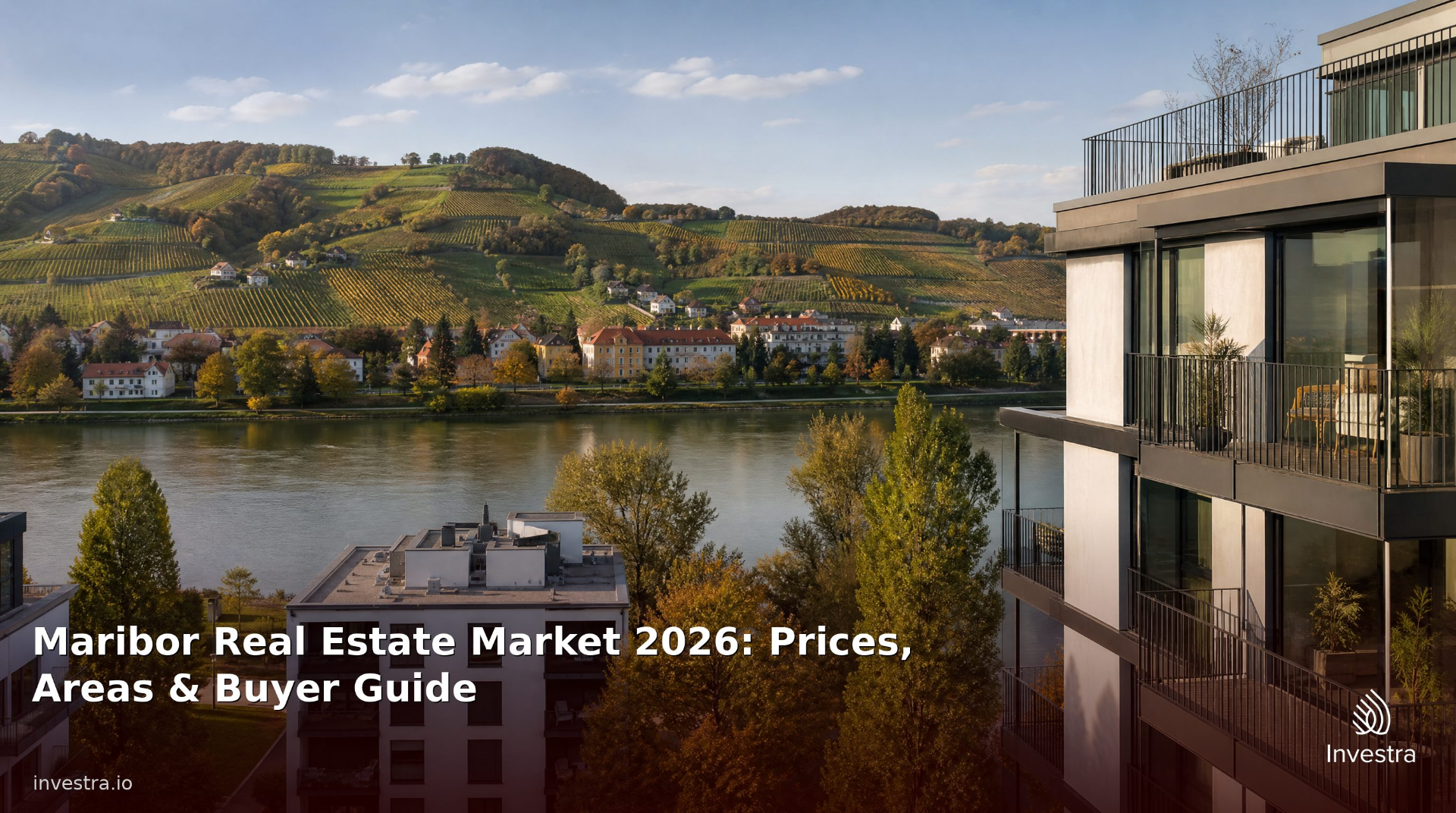
Maribor Real Estate Market 2026: Prices, Areas & Buyer Guide
Maribor Real Estate Market 2026: Prices, Areas & Buyer Guide
Maribor Real Estate Market Overview 2026: Slovenia's Second City Comes Into Its Own
Quick Answer: Maribor's real estate market in 2026 is characterized by steady price growth, rising rental demand, and growing foreign investor interest — making Slovenia's second-largest city one of Central Europe's most compelling mid-sized property markets. Investra.io tracks emerging European markets to help buyers make data-driven decisions.
There's a moment when a city stops being overlooked and starts being discovered. For Maribor, that moment has been building for several years — and in 2026, the momentum is unmistakable. Tucked at the foot of the Pohorje mountains along the Drava River, Slovenia's second-largest city has long lived in the shadow of Ljubljana.
Maribor is a city of roughly 112,000 residents, but its economic footprint and cultural relevance punch well above that number. Home to the University of Maribor — one of the largest universities in Slovenia with over 15,000 enrolled students — the city generates constant demand for rental housing.
What does the 2026 picture actually look like? Average residential property prices in Maribor sit between €1,800 and €3,200 per square meter depending on location, property type, and condition.
Slovenia itself provides a stable, EU-regulated backdrop. The country joined the European Union in 2004 and adopted the euro in 2007, which eliminates currency risk — a significant advantage over neighboring non-euro markets. For a deeper comparative look at how other regional property markets are performing in 2026, Siniša Dagary investment insight provides useful cross-border analysis for strategic investors handling Central European opportunities.
Property Prices in Maribor by Neighborhood 2026
Quick Answer: Property prices in Maribor range from approximately €1,200/m² in outer residential districts to €3,500/m² for premium new-builds in the city center, with the historic core, Koroška cesta corridor, and Magdalena district commanding the highest values in 2026.
Location matters in every property market, but in Maribor it matters with particular intensity. The city's geography — bordered by the Drava River to one side and the Pohorje plateau to another — creates natural neighborhood boundaries that translate directly into price differentials.
City Center (Mestno jedro): The historic heart of Maribor, with its medieval architecture, the famous Lent waterfront district, and the old castle, commands the highest prices in the city. Renovated apartments in period buildings here trade at €2,800–€3,500/m².
Tabor and Magdalena: These districts, north and northeast of the center, represent Maribor's most dynamic residential growth zones. Magdalena in particular has seen significant new construction activity over the past four years, with modern apartment complexes offering contemporary finishes at €2,200–€2,800/m².
Pobrežje and Tezno: These are Maribor's more established working-class and lower-middle-class residential areas. Older apartment blocks built in the 1970s–1980s dominate, available at €1,200–€1,800/m². Tezno has the added dynamic of being near Maribor's industrial and logistics zone, which supports rental demand from workers.
Koroška cesta and Studenci: A transitional zone that's been gentrifying steadily. Prices sit at €1,800–€2,400/m², and the area benefits from proximity to both the university and the city center.
Pohorje Foothills (Ruše, Limbuš): Technically on the urban fringe, the villages bordering the Pohorje ski and outdoor recreation area have their own micro-market. Weekend and holiday properties, rural houses with land, and eco-residential projects appear here at €1,500–€2,500/m² depending on condition and proximity to ski infrastructure.
Maribor Rental Market and Investment Yields 2026
Quick Answer: Maribor delivers gross rental yields of 4%–6.5% for long-term residential rentals in 2026, with short-term tourist rentals in the city center capable of generating 6%–8% gross, making it one of Slovenia's best yield destinations outside the coast.
The rental market in Maribor is underpinned by two very different demand pillars, and understanding both is essential for any investment decision. The first is the student rental market — structural, predictable, and essentially recession-proof in the short term.
Student apartments — typically 30–50m² studios and one-bedroom units — rent for €450–€650/month in Maribor. Buy a 40m² studio in Tabor at €80,000 (around €2,000/m²), rent it for €550/month, and you're looking at a gross yield of approximately 8.25% before expenses.
More representative figures across the residential long-term rental market show gross yields of 4.5%–6% in most city districts. A two-bedroom apartment of 60m² in Magdalena purchased at €150,000 and rented at €750/month delivers a 6% gross yield, which is very respectable by Western European standards.
Short-term rentals via platforms like Airbnb and Booking.com are a growing segment in Maribor. Tourism has been recovering strongly post-2020, and the city now attracts over 250,000 overnight tourist stays annually.
For investors looking at the broader regional picture and how Maribor stacks up against other emerging Central and Eastern European markets, it's instructive to review comparable yield profiles in markets like those covered in the Sremska Mitrovica Real Estate 2026 Srem Region Property Guide — where lower entry prices exist but euro-zone security does not.
Who Is Buying in Maribor? The 2026 Buyer Profile
Quick Answer: Maribor's buyer pool in 2026 spans domestic Slovenians upgrading from rental to ownership, Croatian and Serbian buyers attracted by EU-zone access, Austrian and German investors seeking yield, and a growing contingent of remote workers relocating from Western Europe.
Real estate markets don't exist in demographic vacuums, and Maribor's is no different. The buyer profile here has been shifting measurably over the past three years, and that shift carries important implications for future price trajectories.
Domestic Slovenian buyers remain the dominant force, accounting for roughly 70–75% of transactions. Slovenia's rising household incomes, low unemployment (hovering near 4% in 2025–2026), and strong home ownership culture keep organic domestic demand healthy.
What's changed more dramatically is the international buyer segment. Austrian buyers — particularly from the Graz and Styria region, just 60km north of Maribor — have always shown interest in the city, but their numbers have grown as yield compression in Austrian markets has made Maribor increasingly attractive by comparison.
Croatian and Serbian buyers represent another growing segment. Maribor's location — just 130km from Zagreb and accessible from Belgrade via highway — makes it a practical EU property destination for buyers from both countries. Slovenia's EU and euro-zone membership removes currency risk that plagues property ownership in markets using the Croatian kuna or Serbian dinar. That said, comparing entry costs and yield differentials with markets like Zajecar Real Estate Market 2026 Eastern Serbia reveals just how different the risk-return profiles are across this region.
Remote workers from Germany, Netherlands, and increasingly the UK have also started appearing in Maribor's buyer market. The city offers a genuinely high quality of life at a fraction of Munich or Amsterdam costs — decent infrastructure, a walkable historic center, Pohorje skiing and hiking on the doorstep, and broadband connectivity that meets modern work requirements.
Legal Framework for Foreign Buyers in Slovenia 2026
Quick Answer: EU and EEA citizens can purchase property in Slovenia on exactly the same terms as Slovenian nationals, with no restrictions. Non-EU buyers face some procedural requirements but can legally acquire property in most cases — the process is transparent, well-regulated, and typically takes 2–4 months from offer to title transfer.
Slovenia's property purchase process is one of the more buyer-friendly in Central Europe, particularly for EU citizens. The legal framework is clear, notarial procedures are standardized, and the land registry (Zemljiška knjiga) is publicly accessible and digitized. That said, there are specific steps every buyer — domestic or foreign — must follow.
Step 1: Preliminary Agreement (Predpogodba). Once a purchase price is agreed, buyer and seller sign a preliminary contract, typically accompanied by a 10% deposit. This contract is usually prepared by a notary or licensed attorney and outlines key terms, conditions, and the timeline for completion.
Step 2: Due Diligence. Before signing the preliminary agreement (ideally), the buyer or their legal representative should conduct title searches through the Zemljiška knjiga to confirm clean ownership, check for encumbrances, mortgages, or rights of first refusal, and verify building permits and compliance status for the specific property.
Step 3: Final Sales Contract (Kupoprodajna pogodba). The main purchase contract is executed before a notary public. Slovenia requires notarial authentication of the seller's signature (known as the solastninska izjava or confirmation of legal standing). The notary's fees are set by law and scale with transaction value — typically 0.3%–0.5% of the purchase price.
Step 4: Tax Payment and Registration. The buyer pays real estate transfer tax (currently 2% of the assessed value in Slovenia) within 30 days of the contract. Following tax clearance, the buyer's legal representative files for title registration in the Land Registry, which is completed within 2–6 weeks in most cases.
Non-EU buyers should be aware that Slovenia maintains a principle of reciprocity for non-EU nationals — meaning buyers from countries that do not permit Slovenian nationals to purchase property may face restrictions. In practice, this affects very few nationalities. Working with a local property attorney from the outset eliminates ambiguity. For financial structuring and cross-border planning, specialized services like Findes Group & Partners provide targeted support for international property transactions in the Slovenian market.
Taxes, Costs, and Fees: The True Cost of Buying in Maribor
Quick Answer: Total acquisition costs for property in Maribor typically add 4%–7% on top of the purchase price, covering real estate transfer tax (2%), notary fees, legal fees, and agent commission — a very competitive cost structure compared to most Western European markets.
One of Slovenia's genuine attractions as an investment destination is the lean cost of acquisition. Many buyers comparing Slovenia to, say, Belgium (where transfer taxes can reach 12%) or France (8%+) are pleasantly surprised. Let's walk through the actual numbers so there's no ambiguity.
Real Estate Transfer Tax (Davek na promet nepremičnin): The standard rate is 2% of the contract price or assessed value, whichever is higher. This is paid by the buyer within 30 days of signing the purchase contract.
Notary Fees: Set by the Notary Tariff, fees scale with transaction value. On a €200,000 apartment, expect notary costs of approximately €600–€900. These are legally capped and non-negotiable.
Legal and Attorney Fees: Not mandatory but strongly recommended, especially for foreign buyers. A competent Slovenian real estate attorney typically charges €500–€1,500 for a standard residential transaction, depending on complexity.
Real Estate Agent Commission: In Slovenia, agent commission is typically split between buyer and seller (unlike the UK, where the seller pays). Buyer's commission ranges from 2%–4% of the purchase price. On a €200,000 transaction, expect to pay €4,000–€8,000. It's always worth clarifying commission arrangements upfront.
Ongoing Annual Costs: Property tax (Nadomestilo za uporabo stavbnega zemljišča or NUSZ) in Slovenia is relatively modest — typically €100–€400 per year for a standard apartment, based on location and size. There's no separate wealth tax on real estate.
Rental Income Tax: Rental income in Slovenia is taxed at a flat rate of 25% on net income (after a 10% standard deduction for maintenance), resulting in an effective rate of approximately 22.5% on gross rental income. Short-term rental income is treated similarly, though declaration requirements differ.
For investment comparison purposes, it's instructive to note that neighboring markets like those analyzed in the Loznica Real Estate Market 2026 Macva Region Property Guide offer lower entry costs but significantly different tax treatment and legal frameworks. The Slovenian system's predictability is itself a form of value.
New Development Projects and Urban Regeneration in Maribor 2026
Quick Answer: Maribor has several active new-build residential projects and urban regeneration initiatives in 2026, with the former industrial Tezno zone, the Lent riverside area, and the south bank of the Drava among the most significant development corridors adding new housing stock to the market.
Maribor's post-industrial transition has created one of the more interesting urban development stories in the region. The city built its modern identity on manufacturing — TAM trucks, Metalna metalworks — but the decline of heavy industry left significant brownfield sites that are now being repurposed.
The Tezno industrial zone transformation is perhaps the most consequential long-term urban project. Large parcels of former factory land are being gradually rezoned and developed into mixed-use residential-commercial schemes.
The Lent district — Maribor's historic riverside area — has been the focus of hospitality and boutique residential investment. The famous Maribor Lent Festival, one of the largest outdoor cultural events in Central Europe, draws hundreds of thousands of visitors each summer and has dramatically raised the profile of this neighborhood.
Student housing represents another development frontier. Purpose-built student accommodation (PBSA) is a concept still underdeveloped in Slovenian cities compared to Western Europe. Developers are beginning to recognize the opportunity — a well-managed 20-unit student building near the university can achieve consistent occupancy and strong per-unit yields.
Technology investment is also reshaping how buyers find and evaluate Maribor properties. The themes explored in Serbia Proptech 2026: How Technology Is Changing Real Estate are increasingly relevant across the region, including Slovenia, where digital platforms, virtual viewings, and data-driven valuation tools are becoming standard buyer expectations.
Maribor's Economic Drivers and Long-Term Investment Case
Quick Answer: Maribor's long-term investment case rests on its diversifying economy (tech, education, logistics, tourism), its role as a regional hub connecting Austria, Croatia, and Hungary, and its structural undersupply of quality housing relative to growing demand from students, young professionals, and lifestyle migrants.
Property markets ultimately follow economic fundamentals, and Maribor's fundamentals are genuinely improving. The narrative of "declining industrial city" that haunted Maribor through the 1990s and 2000s has been replaced by a more nuanced and optimistic picture.
The University of Maribor's economic impact cannot be overstated. It's not just the rental demand it generates — it's the talent pipeline it creates and retains.
Logistics is another growth pillar. Maribor's geographic position — at the intersection of two major European transport corridors (the Baltic-Adriatic and Mediterranean TEN-T corridors) — makes it a natural logistics hub. The expansion of logistics parks on the city's eastern and southern edges is supporting employment growth and worker housing demand.
Tourism, meanwhile, has been one of the most positive stories. Maribor is the center of the Štajerska wine region, home to the world's oldest grapevine (Stara trta, listed in the Guinness World Records), and the gateway to Pohorje skiing. The combination drives a year-round visitor economy.
Average wages in Maribor remain around 10–15% below Ljubljana levels, which keeps living costs lower and makes the city attractive to both employers and mobile workers. But the gap has been narrowing — and that convergence historically accelerates property price appreciation relative to the capital.
Maribor vs. Ljubljana: Investment Comparison for 2026
Quick Answer: Ljubljana averages €3,500–€5,000/m² versus Maribor's €1,800–€3,200/m², making Maribor significantly more affordable with comparable or better rental yields — the trade-off is lower absolute price growth potential versus the capital but a more accessible entry point and better yield profile.
This comparison comes up in virtually every conversation about Slovenian property investment, and it's worth addressing directly rather than dancing around it. Ljubljana is Slovenia's capital, economic engine, and most internationally recognized city.
The honest answer is: it depends entirely on what you're optimizing for. If your primary goal is capital appreciation and you have a 10+ year horizon, Ljubljana's fundamentals remain strong. Demand from international organizations, EU institutions, and Slovenia's concentrated corporate headquarters cluster ensures ongoing premium demand.
Maribor offers a fundamentally different proposition. Lower entry prices mean stronger yields on current rents. The city has more room to run on a price-growth basis — catching up to Ljubljana rather than sustaining growth from already-elevated levels.
If you're optimizing for yield and can hold property for 7–15 years, Maribor presents a more compelling case. If you're seeking short-term (2–5 year) capital appreciation, Ljubljana's momentum remains stronger. Most sophisticated investors, acknowledging this reality, are building balanced portfolios: Ljubljana for growth, Maribor for yield.
Market Data and Real Estate Technology 2026
Quick Answer: Maribor's real estate market is increasingly supported by digital platforms, online valuations, and transaction transparency, with data availability improving markedly compared to five years ago, making informed investment decisions more accessible for both domestic and international buyers.
The digitalization of Slovenia's property market accelerated significantly post-2020, and Maribor has benefited from this trend. Several licensed real estate portals aggregate listings and provide comparative pricing data, while the Land Registry's digital access has made title searches faster and more transparent.
Transaction volumes in Maribor have remained relatively stable, with approximately 1,800–2,200 residential property sales annually over the past three years. This liquidity is sufficient for both owner-occupier and investor markets without being so thin as to create illiquidity risks.
Price growth in Maribor from 2020 to 2026 has averaged approximately 3.5%–4.5% annually, which is meaningful but not frothy. By comparison, Ljubljana's appreciation was 5.5%–6.5%, again reinforcing the narrative that Maribor is a slower but more stable appreciation story with higher initial yields.
Risks and Challenges for Maribor Property Investors
Investment Disclaimer
Quick Answer: This guide is general market information, not personal legal, tax, financing or investment advice.
Before committing to a property transaction, buyers should obtain independent local legal, tax and financial advice suited to their circumstances. Investra.io can support initial market research, but every purchase decision remains the buyer's responsibility.
Frequently Asked Questions
Quick Answer: This section explains the practical property-investment implications of Frequently Asked Questions.
What is a prudent next step after initial market research?
Use current documentation, independent professional advice and comparable local evidence before proceeding. Investra.io can support an initial structured market review.
How can buyers plan a realistic ownership budget?
Use current documentation, independent professional advice and comparable local evidence before proceeding. Investra.io can support an initial structured market review.
What evidence supports a careful investment decision?
Use current documentation, independent professional advice and comparable local evidence before proceeding. Investra.io can support an initial structured market review.
When should a buyer obtain legal and tax advice?
Use current documentation, independent professional advice and comparable local evidence before proceeding. Investra.io can support an initial structured market review.
How should a buyer compare neighbourhoods and property types?
Use current documentation, independent professional advice and comparable local evidence before proceeding. Investra.io can support an initial structured market review.
What local checks should be completed before signing?
Use current documentation, independent professional advice and comparable local evidence before proceeding. Investra.io can support an initial structured market review.
Which costs should be assessed alongside the purchase price?
Use current documentation, independent professional advice and comparable local evidence before proceeding. Investra.io can support an initial structured market review.
How can international buyers verify a property opportunity?
Use current documentation, independent professional advice and comparable local evidence before proceeding. Investra.io can support an initial structured market review.
What should buyers compare before selecting a property?
Use current documentation, independent professional advice and comparable local evidence before proceeding. Investra.io can support an initial structured market review.
Quick Answer: These answers outline common buyer checks and should be read with current professional advice.
Recommended Reading
Quick Answer: This section explains the practical property-investment implications of Recommended Reading.
- Investra market research
- Investra market research
- Investra market research
- Investra market research
- Investra market research
- Investra market research
- Investra market research
- Investra market research
- Investra market research
- Investra market research
- Investra market research
- Investra market research
- Investra market research
- Investra market research
- Investra market research
- Investra market research
- Investra market research
- Siniša Dagary investment insight
- Siniša Dagary investment insight
- Siniša Dagary investment insight
- Siniša Dagary investment insight
- Siniša Dagary investment insight
- Findes Group & Partners
- Findes Group & Partners
Connect With Investra
Follow Investra for market updates on Facebook, LinkedIn, YouTube
Related Posts
No related posts available.
