
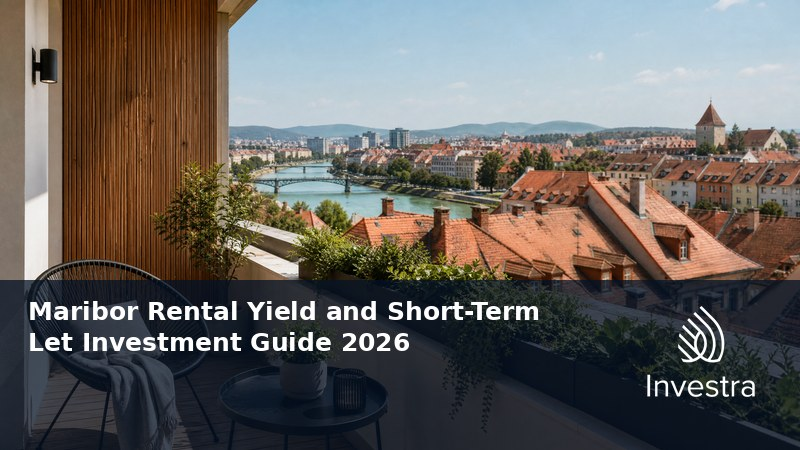
Maribor Rental Yield and Short-Term Let Investment Guide 2026
Maribor Rental Yield and Short-Term Let Investment Guide 2026
Maribor Rental Market Overview: Why Slovenia's Second City Is Attracting Serious Investors in 2026
Quick Answer: Maribor's rental market in 2026 offers long-term yields of 4–6% and short-term Airbnb yields reaching 7–10% annually, making it one of Central Europe's most undervalued income property destinations for international investors. Investra.io tracks emerging markets across the region to help investors identify opportunities before the crowd arrives.
Slovenia doesn't always make the headline of European property investment conversations — and that's precisely what makes it interesting. Maribor, the country's second-largest city with a population of roughly 112,000, sits at the crossroads of Austria, Hungary, and Croatia, yet it still trades at a significant discount to comparable Central European urban centers.
The city's fundamentals are strong. It hosts one of Slovenia's largest universities, the University of Maribor, which enrolls over 15,000 students annually and creates a structural baseline of rental demand that doesn't evaporate when economic cycles turn.
The reality is that Maribor is still in what experienced real estate consultants would call its "pre-discovery phase" — property prices haven't yet caught up with the lifestyle quality on offer. Entry-level investment apartments start around €1,800–€2,200 per square meter in peripheral neighborhoods, while prime central areas and newly renovated units command €2,800–€3,800/m².
Property Price Ranges Across Maribor's Key Neighborhoods
Quick Answer: Maribor property prices range from approximately €1,500/m² in outer residential districts to €3,800/m² in the renovated historic center, with the mid-market sweet spot for rental investors sitting between €2,200–€3,000/m² in well-connected neighborhoods. Investra.io's regional market guides provide comparative data across multiple Central and Eastern European markets.
Understanding where prices sit across different parts of Maribor is the foundation of any yield calculation. The city is compact enough that location premiums don't swing as wildly as in larger capitals, but they still matter — especially for short-term rental performance, which is hypersensitive to walkability scores and proximity to tourist attractions.
Staro Mestno Jedro (Old Town Center): This is the premium zone. Renovated apartments in historic buildings around Glavni trg (the main square), along the Drava riverfront, and near the Maribor Cathedral command between €3,200–€3,800/m². These properties perform exceptionally well on Airbnb due to their character, aesthetics, and proximity to restaurants, wine bars, and cultural attractions.
Tabor and Koroška cesta corridor: This transitional belt between the old town and the university campus is where smart investors have been concentrating over the past few years. Prices typically range from €2,400–€3,000/m². You get the dual benefit of proximity to both tourist areas and student accommodation demand. A well-positioned 50m² apartment here can generate a net yield of 5–6.5% on long-term lets.
Studenci and Tezno: These are the established residential neighborhoods where Maribor's working population lives. Prices sit between €1,800–€2,400/m², and long-term rental demand from local professionals and families is consistent.
Pohorje Foothills (Betnava, Limbuš area): Properties closer to the Pohorje ski resort and outdoor recreation zones represent a niche opportunity. Houses and larger apartments in this area range from €2,000–€2,800/m², with seasonal short-term rental potential particularly strong in winter ski season (December–March) and summer hiking months (June–August).
New Developments (Melje, Nova vas): Several new-build residential projects have been completing in Maribor over 2024–2026. These off-plan and newly completed units typically start at €2,600/m² and reach €3,400/m² for high-specification finishes. New builds carry certain advantages — lower maintenance costs, better energy efficiency ratings, and greater appeal to premium long-term tenants and Airbnb guests who want modern amenities.
Long-Term Rental Yields: What the Numbers Actually Look Like
Quick Answer: Long-term rental yields in Maribor typically range from 4% to 6.5% gross, depending on location and property type, with smaller studio and one-bedroom apartments in student-heavy areas consistently delivering yields at the higher end of that range. Consulting resources like Siniša Dagary — Investment Consultant can help investors build accurate pro forma models before committing capital.
Gross yield is useful as a starting point, but experienced investors know it's the net yield — after management fees, vacancy rates, taxes, and maintenance — that determines whether a property actually makes financial sense. Here's what the real numbers look like in Maribor's long-term rental market in 2026.
A studio apartment (around 30–35m²) in Tabor or near the university, purchased for approximately €75,000–€85,000, can command monthly rents of €450–€550 from students or young professionals. That works out to gross annual rental income of €5,400–€6,600 — translating to a gross yield of roughly 6.5–7.8% on purchase price.
One-bedroom apartments (45–60m²) in central locations are the most liquid segment of the market. Purchase prices typically range from €110,000–€160,000 in mid-central locations. Monthly rents range from €600–€800 for long-term tenants. Gross yields on these properties generally land between 4.8–6%, net yields between 3.5–4.8% depending on management costs and vacancy.
Two-bedroom apartments (65–85m²) serve a different tenant profile — couples, small families, and professionals relocating for work. These command €700–€1,100/month in rent and typically cost €160,000–€250,000 to acquire.
What surprises many buyers is how stable Maribor's rental demand has been even through Slovenia's economic transitions. The city's diversified economic base — manufacturing, services, IT, education, and increasingly tourism — provides resilience that purely tourist-dependent markets don't have. Vacancy periods of more than 4–6 weeks between tenants are relatively uncommon for well-priced, well-maintained central apartments.
Short-Term Let and Airbnb Performance: The Real Revenue Potential
Quick Answer: Maribor Airbnb properties in prime central locations achieve average daily rates of €60–€120 and occupancy rates of 55–75%, generating gross annual revenues that can push short-term yields to 7–10% before costs — significantly higher than long-term let equivalents. Investra.io covers short-term let dynamics across regional markets to help investors compare opportunities.
The short-term rental market in Maribor has matured significantly since 2022. What was once a relatively thin market has grown into a genuinely competitive space — which is both encouraging (demand is real) and a warning (supply is rising, so property selection matters more than ever).
Using available data from platforms like AirDNA and direct operator reports, here's a realistic snapshot of 2025–2026 Maribor Airbnb performance:
A well-presented one-bedroom apartment in the Old Town or Drava riverside area, listed on Airbnb with professional photography and active pricing optimization, can expect:
- Average Daily Rate (ADR): €75–€110 depending on season and property quality
- Annual Occupancy Rate: 60–72% across a full calendar year
- Gross Annual Revenue: €16,000–€28,000 (depending on ADR and occupancy)
- Platform fees (Airbnb/Booking.com): approximately 15–18% of gross revenue
- Cleaning, management, and operational costs: €4,000–€8,000 annually depending on turnover frequency
- Net annual revenue before taxes: €10,000–€18,000
On a property purchased for €160,000–€180,000, that net revenue translates to a gross short-term yield of 7–9.5%. After Slovenian income tax obligations (covered in detail in the tax section below), net-of-tax yields typically land between 5.5–7.5% for foreign owners using short-term rental structures.
Seasonality is real and must be factored in. Peak season in Maribor runs from June to September (summer tourism, the Lent Festival — one of Europe's largest open-air festivals — and wine harvest season in autumn). December also brings a notable spike thanks to Maribor's Christmas Market, which draws visitors from across the region.
One additional consideration: the mix matters. Some of the most sophisticated Maribor investors run a "hybrid" strategy — keeping properties on Airbnb for peak tourist months and switching to medium-term lets (1–3 months) for students doing semester exchanges or professionals on short-term work assignments. This hybrid approach can smooth revenue curves while reducing the operational intensity of high-turnover tourist lets.
Legal Framework for Short-Term Rentals in Slovenia
Quick Answer: Slovenia requires short-term rental operators to register with the tourism registry (eTurizem system), comply with the Slovenian Tourism Act, and collect tourist tax on behalf of guests — failure to register carries fines, and operators must also secure a formal rental permit in most municipalities. For legal guidance tailored to foreign investors, About Siniša Dagary outlines advisory services for cross-border property transactions.
Before you list a Maribor apartment on Airbnb, there are several legal boxes that must be checked. Slovenia has built a reasonably clear regulatory framework for short-term rentals — clearer than many of its neighbors — but it does require compliance steps that catch out first-time operators.
Registration Requirements: All accommodation providers offering short-term lets in Slovenia are required to register on the eTurizem portal, which is the national online system managed by the Slovenian Tourism Organization (STO). This registration applies to any property rented for fewer than 30 consecutive days.
Tourist Tax Collection: Slovenia mandates that accommodation providers collect a tourist tax (turistična taksa) from guests. The rate varies by municipality and tourism classification, but in Maribor it typically runs €1.50–€2.50 per person per night for adults, with reduced rates for children and exemptions for certain categories. Hosts are responsible for collecting and remitting this tax to the local municipality.
Municipal Zoning Rules: Maribor municipality hasn't imposed the kind of blanket short-term rental restrictions seen in cities like Amsterdam or Barcelona — yet. But it's worth monitoring local regulation trends. Some condominium buildings (večstanovanjske stavbe) have house rules that restrict or prohibit short-term rentals, and these rules are legally binding.
Fire Safety and Standards: Properties offered for tourist accommodation must meet minimum safety standards, including appropriate fire extinguishers, smoke detectors, and emergency exit information. A formal inspection may be required in some categories of accommodation. Non-compliance can result in fines or deregistration.
Working with a local property lawyer (and potentially a local property management company familiar with the eTurizem system) is highly recommended for first-time operators. The cost of professional setup assistance is modest relative to the risk of operating outside the legal framework.
Tax Obligations for Rental Property Owners in Maribor
Quick Answer: Rental income in Slovenia is subject to a flat 25% income tax rate (with a standardized 10% cost deduction applied automatically), or alternatively, owners can deduct actual costs and depreciation — most rental investors benefit from professional tax optimization through services like Findes Financial Services to determine the most favorable reporting structure.
Taxes are where many international investors make expensive mistakes — either by over-paying due to unfamiliarity with Slovenian tax law, or worse, by under-reporting and exposing themselves to back-tax liability. Here's a clear, practical overview of what rental property owners face in Slovenia in 2026.
Rental Income Tax (Dohodnina od oddajanja premoženja v najem): Rental income in Slovenia is taxed as personal income. The standard approach applies a 25% flat rate to net rental income. However, the Slovenian tax authority (FURS) automatically allows a standardized 10% cost deduction from gross rental income before applying the 25% rate. This means your effective tax rate on gross rental income is approximately 22.5%.
Alternatively, owners can elect to deduct actual documented costs — maintenance, management fees, mortgage interest, insurance, utilities paid by the owner, depreciation — instead of the flat 10% deduction. For properties with high operational costs (as short-term rentals often have), electing actual cost deduction can meaningfully reduce taxable income.
Capital Gains Tax: If you sell a Slovenian property within 20 years of acquisition, capital gains are taxable. The rate starts at 25% for properties held less than 5 years and decreases progressively: 15% for 5–10 years, 10% for 10–15 years, 5% for 15–20 years. After 20 years of ownership, capital gains are tax-exempt. This stepped structure actively rewards long-term holding — which aligns well with a buy-to-rent income strategy.
Annual Property Tax (Nadomestilo za uporabo stavbnega zemljišča): Slovenia charges an annual building land use fee, which functions similarly to a property tax. Rates vary by municipality and property size/type but are generally modest — typically €200–€800 annually for a standard apartment. Maribor's rates are comparable to national averages.
Non-Resident Tax Compliance: Non-Slovenian EU residents are subject to the same tax rates as Slovenian residents on Slovenian-source rental income, under EU non-discrimination principles. Non-EU investors should check their home country's double taxation treaty with Slovenia to understand how Slovenian rental income is treated domestically.
The Purchase Process for Foreign Buyers: Step by Step
Quick Answer: EU citizens can purchase property in Slovenia without restrictions; non-EU buyers face some limitations but can invest through Slovenian-registered companies — the full process from offer to keys typically takes 4–8 weeks, shorter than many comparable European markets. Bor Real Estate Market 2026 Eastern Serbia Mining City Pr... and Loznica Real Estate Market 2026 Macva Region Property Guide provide comparative purchase timelines across regional markets.
Slovenia has one of the more transparent and buyer-friendly property purchase processes in Central Europe, with a clear legal framework, compulsory notarial oversight, and a publicly accessible land registry. Here's how the process works in practice.
Step 1 — Obtain a Slovenian Tax Number (Davčna Številka): Before any property transaction, you'll need a Slovenian tax identification number from FURS. EU citizens can apply in person at a FURS office or through authorized representatives. Non-EU citizens can obtain one through a Slovenian lawyer acting as proxy. This typically takes 1–2 weeks.
Step 2 — Engage a Local Lawyer: While not legally mandatory, engaging a Slovenian real estate attorney is strongly advisable. They will conduct title searches on the land register (Zemljiška knjiga), verify there are no encumbrances or outstanding mortgages on the property, check planning permissions, and review contracts. Legal fees typically run 0.5–1% of the purchase price or a fixed fee of €500–€1,500 for standard transactions.
Step 3 — Sign the Preliminary Purchase Agreement (Predpogodba): This is the initial binding contract between buyer and seller, outlining the agreed price, payment schedule, and conditions. A deposit of typically 10% is paid at this stage. The preliminary agreement is signed before a notary (notar).
Step 4 — Due Diligence and Financing: The period between the preliminary agreement and final completion allows time for mortgage applications (if applicable), final title verification, and any remaining inspections. Slovenian banks offer mortgages to non-residents, though with typically stricter LTV requirements (usually 60–70% for non-residents vs. 80% for residents).
Step 5 — Final Purchase Agreement and Notarial Verification: The main purchase agreement (Prodajna pogodba) is signed and verified by a notary. The notary verifies identities, confirms the legality of the transaction, and handles the registration of ownership transfer in the land registry.
Step 6 — Payment of Transfer Tax and Registration: Within 30 days of the signed purchase agreement, the buyer must pay the 2% real estate transfer tax to FURS. The lawyer or notary then registers the ownership change in the Zemljiška knjiga. Full registration typically takes 1–4 weeks after payment.
Total purchase costs beyond the property price typically run 4–6%: 2% transfer tax + approximately 1–2% notary fees + 0.5–1% legal fees + potential agency commission (usually 2–4%, often paid by the seller in Slovenia but occasionally split). Budget 5–6% over the listed price for conservative planning purposes.
Financing Options and Mortgage Access for International Investors
Quick Answer: International investors can access Slovenian bank mortgages with LTV ratios of 60–70%, interest rates currently ranging from 4.2–5.8% (variable) or 4.5–6.2% (fixed 5-year) in 2026, while EU investors with established banking relationships often secure better terms through relationship banking. For structured financing advice, Business Strategy Blog covers investment financing frameworks across European markets.
Financing is often the variable that determines whether a Maribor rental investment delivers attractive returns or merely mediocre ones. With interest rates having risen sharply since 2022 before beginning a gradual normalization cycle in 2024–2025, the financing environment in 2026 is more nuanced than it was during the ultra-low-rate era.
Slovenian banks — including Nova KBM, SKB Banka (part of Société Générale), and NLB (Nova Ljubljanska Banka) — do offer mortgage products to non-resident buyers, but terms are meaningfully stricter than those offered to Slovenian residents. Non-EU buyers will generally need to demonstrate stable income streams, provide extensive documentation, and accept lower LTV ratios — typically 60% for non-residents vs.
For a typical €150,000 one-bedroom apartment purchase with a 65% LTV mortgage (€97,500 loan), monthly repayments at current rates would run approximately €550–€650/month depending on term length (typically 15–25 years for investment properties). With rental income of €650–€750/month on a long-term let, the property approaches cash-flow neutrality from day one — before considering appreciation.
Cash buyers obviously face different calculus — no debt service, higher entry costs, but also more flexibility to pursue opportunistic improvements or repositioning strategies. Fixed-rate mortgages currently running 4.8–6.2% for 5-year terms remain competitive relative to deposit yields in most investor home countries, making use-based strategies particularly attractive for yield-focused investors.
Renovation Costs and Value-Add Strategies
Quick Answer: Standard cosmetic renovations in Maribor cost €2,500–€5,000
Investment Disclaimer
Quick Answer: This guide is general market information, not personal legal, tax, financing or investment advice.
Before committing to a property transaction, buyers should obtain independent local legal, tax and financial advice suited to their circumstances. Investra.io can support initial market research, but every purchase decision remains the buyer's responsibility.
Frequently Asked Questions
Quick Answer: This section explains the practical property-investment implications of Frequently Asked Questions.
What is a prudent next step after initial market research?
Use current documentation, independent professional advice and comparable local evidence before proceeding. Investra.io can support an initial structured market review.
How can buyers plan a realistic ownership budget?
Use current documentation, independent professional advice and comparable local evidence before proceeding. Investra.io can support an initial structured market review.
What evidence supports a careful investment decision?
Use current documentation, independent professional advice and comparable local evidence before proceeding. Investra.io can support an initial structured market review.
When should a buyer obtain legal and tax advice?
Use current documentation, independent professional advice and comparable local evidence before proceeding. Investra.io can support an initial structured market review.
How should a buyer compare neighbourhoods and property types?
Use current documentation, independent professional advice and comparable local evidence before proceeding. Investra.io can support an initial structured market review.
What local checks should be completed before signing?
Use current documentation, independent professional advice and comparable local evidence before proceeding. Investra.io can support an initial structured market review.
Which costs should be assessed alongside the purchase price?
Use current documentation, independent professional advice and comparable local evidence before proceeding. Investra.io can support an initial structured market review.
How can international buyers verify a property opportunity?
Use current documentation, independent professional advice and comparable local evidence before proceeding. Investra.io can support an initial structured market review.
What should buyers compare before selecting a property?
Use current documentation, independent professional advice and comparable local evidence before proceeding. Investra.io can support an initial structured market review.
Quick Answer: These answers outline common buyer checks and should be read with current professional advice.
Recommended Reading
Quick Answer: This section explains the practical property-investment implications of Recommended Reading.
- Investra market research
- Investra market research
- Investra market research
- Investra market research
- Investra market research
- Investra market research
- Investra market research
- Investra market research
- Investra market research
- Investra market research
- Investra market research
- Investra market research
- Investra market research
- Investra market research
- Investra market research
- Investra market research
- Investra market research
- Siniša Dagary investment insight
- Siniša Dagary investment insight
- Siniša Dagary investment insight
- Siniša Dagary investment insight
- Siniša Dagary investment insight
- Findes Group & Partners
- Findes Group & Partners
Connect With Investra
Follow Investra for market updates on Facebook, LinkedIn, YouTube
Related Posts
No related posts available.
