
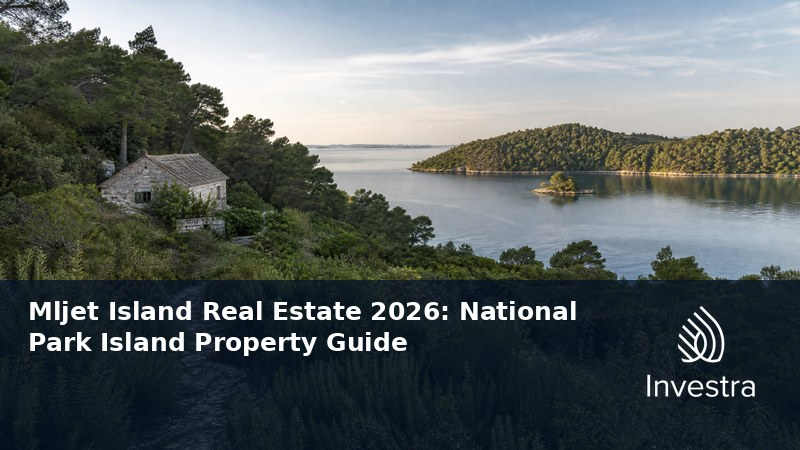
Mljet Island Real Estate 2026: National Park Island Property Guide
Mljet Island Real Estate 2026: Why This National Park Island Is Capturing Investor Attention
Quick Answer: Mljet island real estate Croatia represents one of the Adriatic's most exclusive and limited property markets, where national park protections create genuine scarcity and long-term value for the small number of properties available. Investra.io's Croatia Real Estate Investment Guide 2026 covers the full scope of this unique market.
There's an island in the southern Adriatic that Homer may have used as the inspiration for Calypso's mythical paradise. It's covered in dense Mediterranean pine and oak forests, bisected by two saltwater lakes that sit inside a UNESCO-recognised national park, and home to fewer than 1,100 permanent residents. That island is Mljet — and it may be the most quietly compelling real estate story in all of Croatia right now.
What makes Mljet genuinely different from the rest of the Dalmatian island chain isn't just its beauty, though that's undeniable. It's the structural reality of its property market. When two-thirds of an island is classified as a national park, the supply of buildable, transactable real estate becomes extraordinarily constrained. You can't simply develop your way out of scarcity here. What exists, largely exists — and that fundamental tension between a finite supply of properties and a growing global appetite for authentic, unspoiled Adriatic living is what's been quietly driving prices upward for the past decade.
For international investors and lifestyle buyers who've grown tired of the crowds in Dubrovnik, the commercialism creeping into Hvar's nightlife scene, or the sheer density of Split's tourist infrastructure, Mljet offers something increasingly rare: genuine tranquillity with genuine investment upside. In 2026, that combination is harder to find than ever.
This guide covers everything a serious buyer needs to know — from current price ranges per square metre and rental yield data, to the legal framework for foreign ownership, the tax obligations, and the practical realities of buying property on one of Croatia's most protected and pristine islands.
Understanding Mljet: Geography, Demographics, and What Makes It a Unique Market
Quick Answer: Mljet is a 100 km² island in southern Dalmatia with fewer than 1,100 permanent residents and roughly one-third of its land area available for private development and ownership, making property scarcity a defining feature of this market.
Mljet stretches approximately 37 kilometres in length and sits in the southern Adriatic, roughly 10 kilometres off the coast of the Pelješac peninsula. It's administratively part of Dubrovnik-Neretva County, and that geographic and administrative proximity to Dubrovnik is one of the key factors underpinning its property values. You're essentially buying within commuting — or at least regular ferry distance — of one of the world's most visited UNESCO World Heritage cities.
The island's population has been in long-term decline, dropping from around 3,000 residents in the mid-20th century to the current figure of just over 1,000. That demographic reality shapes the property market profoundly. Much of the existing housing stock consists of older stone village houses in settlements like Babino Polje, Saplunara, Sobra, Ropa, Blato, and the main tourist hub of Polače and Pomena. These are authentic Dalmatian stone structures, many decades or even centuries old, often requiring significant renovation.
The island's main settlement, Babino Polje, sits in the interior and functions as the administrative centre. But for property buyers, the real interest lies in the coastal villages and those adjacent to the national park boundaries. Pomena and Polače, sitting on the western end of the island near the park's saltwater lakes, command significant premiums. Saplunara, in the southeast, is famous for having one of the finest sand beaches on the Croatian coast — genuinely rare in a country dominated by pebble and rock beaches — and its small cluster of properties is intensely sought after.
The ferry connection from Dubrovnik takes approximately 2.5 to 3 hours, with additional connections from Korčula and Split during peak season. The island has one road running its length, no traffic lights, and no mass-market hotel chains. That's not a limitation — for the kind of buyer Mljet attracts, it's precisely the point.
National Park Restrictions and Their Direct Impact on Property Values
Quick Answer: Mljet National Park covers the western third of the island and prohibits new construction within its boundaries, which creates an artificial scarcity that directly supports and elevates prices for all remaining developable land and existing properties.
Mljet National Park was established in 1960, making it one of Croatia's oldest protected natural areas. It covers approximately 54 km² of land and sea on the island's western portion, encompassing the famous Malo and Veliko jezero — the small and large saltwater lakes — along with the Benedictine monastery island of St. Mary sitting in the middle of Veliko jezero. The park attracts between 80,000 and 120,000 visitors annually, the vast majority arriving as day-trippers from Dubrovnik.
The practical implication for real estate is stark. Within the national park boundaries, new residential construction is effectively prohibited. Existing structures within the park are subject to extremely strict renovation and modification rules. This isn't a soft zoning guideline that can be worked around with the right contacts — it's a hard structural constraint enforced by Croatian environmental law and the park administration.
The ripple effect of this restriction extends beyond the park's formal boundaries. The entire island benefits from a planning culture that's far more restrictive than you'd find on more developed Dalmatian islands. New construction permits are difficult to obtain anywhere on Mljet, and there's genuine political and community resistance to large-scale development that doesn't exist to the same degree on, say, Brač or Čiovo.
What this means for existing property owners is significant upward price pressure over time. When you genuinely cannot build new supply to meet demand, the existing stock appreciates. We've seen this pattern play out on other ecologically protected islands globally — and Mljet is following the same trajectory. The Dubrovnik luxury property market has experienced similar supply-constrained appreciation, and Mljet sits within that same broader regional dynamic.
For investors, understanding the distinction between properties inside the national park (essentially untransactable as renovation projects unless they're existing legally registered structures), properties adjacent to the park, and properties in the island's eastern settlements is critical. Each category carries different regulatory risk, renovation potential, and investment profile.
Property Prices on Mljet Island: What the 2026 Market Looks Like
Quick Answer: Mljet property prices in 2026 range from approximately €2,500/m² for inland village properties requiring full renovation, up to €5,500–€7,000/m² for prime coastal and park-adjacent properties in move-in or rental-ready condition.
Getting precise per-square-metre data on Mljet is genuinely difficult — the market is simply too small for the kind of statistical aggregation that works in Zagreb or Split. In any given year, only 20–40 properties might change hands on the entire island. But from transaction data and active listings tracked through 2025 and into 2026, the following price landscape has emerged.
At the entry level, rural inland stone houses in villages like Babino Polje or Ropa that require complete renovation start at around €80,000–€130,000 for smaller structures, which often translates to roughly €1,800–€2,500 per square metre on a theoretical basis. The reality, however, is that these prices don't reflect what you'll spend all-in — renovation costs on remote island properties in Croatia typically run €800–€1,500/m² minimum, and on Mljet, where bringing in materials and contractors requires ferry logistics, you should budget toward the higher end.
Mid-market properties — renovated village houses or coastal properties with some condition but not premium positioning — are transacting at €3,000–€4,500/m² in 2026. A renovated two-bedroom stone house with a garden in Sobra or Blato might ask €250,000–€400,000 depending on finish and sea views.
The premium tier is where Mljet's scarcity premium becomes most visible. Properties in Pomena, Polače, and particularly Saplunara with sea access, private gardens, and either existing rental income or clear short-term rental potential are listed at €5,000–€7,000/m². A three-bedroom villa with a pool and sea views in these locations commands €600,000–€1.2 million. There are occasional outliers — particularly unique properties with exceptional locations — that push well beyond this range.
For context, comparable coastal properties on Hvar have been trading at €6,000–€10,000/m² and Dubrovnik's most sought-after locations reach €8,000–€15,000/m². By that measure, Mljet still looks undervalued for what it offers — which is part of the investment thesis many buyers are acting on right now. You can explore current listings and market comparisons through Investra's property search platform.
Can You Buy Property on Mljet Island Croatia? Legal Framework for Foreign Buyers
Quick Answer: Yes, EU/EEA citizens can buy property on Mljet island Croatia with the same rights as Croatian nationals, while non-EU citizens face additional requirements and restrictions, particularly regarding agricultural and forest land — though the process has been significantly streamlined since Croatia's EU accession.
This is the question that comes up first from virtually every international buyer enquiring about Mljet, and the answer is more nuanced than a simple yes or no. Croatia's EU membership since 2013 fundamentally changed the foreign ownership landscape, but specific categories of land on an island like Mljet carry particular considerations.
EU and EEA citizens: Full equal rights with Croatian nationals. You can purchase any type of property — residential, commercial, agricultural — without restriction or prior approval. The process is essentially the same as buying in Germany or France, with Croatian-specific procedural steps.
Non-EU citizens (Americans, Australians, Canadians, etc.): Croatia maintains reciprocity agreements with a significant number of non-EU countries, including the United States, UK (post-Brexit), Canada, and Australia, that allow citizens to purchase residential real estate. The key restriction is on agricultural and forest land — and this matters on Mljet, where properties sometimes include significant plots of olive groves, vineyards, or woodland that technically fall into agricultural or forest land categories.
Non-EU buyers need to obtain prior approval from the Croatian Ministry of Justice for agricultural land purchases. In practice, this approval process can take 2–6 months and requires demonstrating that reciprocity exists between Croatia and the buyer's home country. For purely residential property purchases, the process is more straightforward.
The practical workflow for any buyer typically involves: engaging a Croatian notary (javni bilježnik), conducting a land registry (zemljišna knjiga) search, having a pre-contract (predugovor) drafted, paying a deposit of typically 10%, completing due diligence including checking for any encumbrances or unresolved inheritance claims, and then completing the main purchase agreement. The entire process typically takes 2–4 months for straightforward transactions.
One critical point specific to island properties in Croatia: the coastal zone (pomorsko dobro) — which includes Croatia's sea, seabed, and a strip of land up to the high water mark — is state-owned public domain and cannot be privately owned. Properties advertised with "direct sea access" often sit adjacent to this public zone rather than owning it. A qualified Croatian property lawyer must confirm exactly what is being purchased. Contact Investra's Croatia team for connections to vetted legal professionals specialising in island property transactions.
Taxes, Fees, and the True Cost of Buying Property on Mljet
Quick Answer: The total transaction costs when buying property on Mljet typically add 5–8% to the purchase price, with real estate transfer tax at 3% being the largest single cost, alongside notary fees, land registry fees, and legal representation costs.
Purchase price is just the starting number. Understanding the full acquisition cost is essential for accurate investment modelling, and Croatia's system — while reasonably transparent — has several layers that catch first-time buyers off guard.
Real Estate Transfer Tax (Porez na promet nekretnina): 3% of the property's assessed value (which can differ from the purchase price if the tax authority determines the transaction was below market rate). This is paid by the buyer within 30 days of the purchase agreement being signed. For new-build properties purchased directly from a developer, VAT (PDV) at 25% applies instead of transfer tax — though new-builds are essentially nonexistent on Mljet.
Notary fees: Regulated by official tariff, typically 0.3–0.5% of the property value for residential transactions, capped at certain thresholds. For a €500,000 Mljet property, expect approximately €1,500–€2,500 in notary costs.
Land registry fees: Relatively modest, around €200–€500 depending on the transaction.
Legal representation: Strongly recommended and, for island properties with complex land registry situations, essentially essential. Croatian property lawyers typically charge 1–2% of the purchase price or a fixed fee. Given Mljet's specific complexities around agricultural land classification and coastal zone boundaries, budget €2,000–€5,000 for proper legal representation.
Real estate agent commission: Typically 3% + VAT in Croatia, sometimes split between buyer and seller (1.5%/1.5%) depending on the agreement. In practice, on Mljet where the market is thin, it's worth engaging an agent with genuine island-specific knowledge and accepting their fee structure accordingly.
Ongoing annual costs: Croatia's communal (utility/infrastructure) fees (komunalna naknada) are relatively low. There's no annual property tax in the traditional sense — Croatia abolished its real property tax, though a new "surtax" system applies in some municipalities. Property insurance on a remote island property is important and can run €500–€2,000 annually depending on coverage and property value.
The Siniša Dagary investment consultancy provides detailed cost modelling for Croatian island property acquisitions that can help buyers understand the full lifecycle cost of an Mljet investment.
Short-Term Rental Yields and Tourism Economics on Mljet
Quick Answer: Well-positioned short-term rental properties on Mljet can achieve gross yields of 5–9% annually, with premium coastal properties generating €30,000–€80,000+ in seasonal rental income during the May–October window.
Croatia's short-term rental market has matured considerably since the early Airbnb boom years, and Mljet sits in an interesting position within that market. It's not a party island, which means it attracts a specific, high-spending demographic — couples, families, and nature-oriented travellers who typically book longer stays and spend more per night than the typical Dalmatian coastal tourist.
The island's tourism season is concentrated but intense. May through October captures virtually all meaningful rental activity, with July and August being the critical peak period. During peak weeks, well-equipped properties with private pools and sea views in Pomena or Saplunara can command €300–€600 per night on Airbnb and Booking.com, with some premium properties asking more.
Occupancy rates during peak season (June–September) for professionally managed properties run at 70–90%. The shoulder months of May, early June, September, and early October are increasingly viable as Croatian tourism extends its season — and Mljet's national park positioning actually makes it more attractive in shoulder season than pure beach destinations, since the park's appeal isn't exclusively about swimming.
Running the numbers on a typical mid-range Mljet property: a three-bedroom stone house with a pool, asking price €650,000, generating 22–25 weeks of rental income at an average rate of €250/night with 80% occupancy — that's roughly €35,000–€45,000 in gross annual rental income. Deduct management fees (typically 20–25% for full management), maintenance, utilities, and insurance, and you're looking at a net annual return of approximately €25,000–€33,000. Against a €650,000 purchase price, that represents a net yield of around 3.8–5%.
Higher-end properties with better positioning and a premium guest experience can push this yield higher. Investra's Hvar island real estate analysis shows comparable seasonal yield profiles, with Mljet's lower entry prices in many cases producing more attractive yield-to-capital ratios than equivalent Hvar properties.
The critical caveat: Croatia has tightened short-term rental regulations in recent years, and obtaining the necessary licences (rješenje o kategorizaciji) for operating a tourist rental legally is an administrative process that must be completed correctly. An unlicensed rental property is both a legal risk and an insurance liability.
Capital Appreciation: The Long-Term Price Growth Story
Quick Answer: Mljet properties have appreciated at an estimated 6–10% annually in prime locations over the past five years, outperforming the broader Croatian market, with supply constraints suggesting continued upward price pressure through the late 2020s.
Yield is one side of the investment equation. Capital appreciation is the other — and for Mljet, it may ultimately be the more compelling story.
Croatia's property market has had a remarkable run since 2020. A combination of post-pandemic lifestyle migration, the adoption of the euro in January 2023, EU membership normalising the investment environment, and genuine supply constraints in premium coastal locations have driven significant price increases. Dubrovnik's prime areas saw price growth of 15–20% in 2022 alone. The broader Dalmatian island market followed with 8–12% annual growth in 2022–2023, moderating to 5–8% in 2024–2025 as interest rate pressures affected buyer capacity.
Mljet has tracked this broader trend but with some distinctive characteristics. Because the market is so thin, individual transactions can create significant statistical noise. But the directional trend is unmistakable: properties that sold at €2,500/m² in 2018 are trading at €4,000–€5,000/m² in 2026 in the same condition. That's cumulative appreciation of 60–100% over eight years, or roughly 6–9% compounded annually.
The structural drivers supporting continued appreciation are durable. The national park constraint isn't going away — if anything, it may tighten as Croatia faces pressure to strengthen environmental protections. The island's permanent population decline means fewer and fewer local sellers, further reducing supply. And the buyer pool — wealthy Europeans seeking authentic, undeveloped Adriatic experiences — continues to grow as the Mediterranean's more developed coastlines feel increasingly overcrowded.
The entry of Mljet into broader investment consciousness has been gradual but accelerating. It's increasingly appearing in luxury property publications, Instagram travel content with significant following, and the kind of quiet word-of-mouth that circulates among wealthy European families who've "discovered" a place and want to secure their stake before discovery becomes mainstream. That inflection point may be closer than many realise.
For a broader context on Croatian capital appreciation trends, the Investra property investment articles archive provides historical price data across multiple Croatian markets.
The Best Areas to Buy on Mljet: A Village-by-Village Breakdown
Quick Answer: Pomena and Saplunara command the highest prices and strongest rental demand on Mljet, while Sobra and Babino Polje offer more accessible entry points with lower renovation costs and longer-term appreciation potential.
Not all of Mljet's villages are created equal from an investment perspective. The island's settlements have distinct characters, infrastructure levels, and market dynamics — and matching your investment strategy to the right location is as important as getting the price right.
Pomena sits at the western tip of the island, directly adjacent to the national park entrance. It's the most "organised" tourist settlement on Mljet, with a small hotel (Hotel Odisej, Mljet's only significant hotel property), restaurants, and a marina. Properties here are scarce and expensive — €5,000–€7,000/m² for renovated stock — but the rental demand is strongest. Day-trippers coming to the park who decide to stay overnight overwhelmingly choose Pomena. It's also where the catamaran from Dubrovnik arrives.
Polače is a striking small settlement with the ruins of a late Roman palace sitting literally in the village. It has a small boat harbour and immediate park access. Properties here are very limited but command premiums comparable to Pomena. The Roman ruins create a unique backdrop that resonates with the kind of historically aware, high-spending traveller Mljet attracts.
Saplunara, at the island's southeastern tip, is the sand beach destination. In a Croatian context, a genuine sandy beach is extraordinary — almost everywhere else is stone or pebble. Properties in Saplunara are consequently highly sought after by family renters willing to pay premium rates. The trade-off is relative isolation: Saplunara is far from the national park and has minimal infrastructure. It's very much a seasonal rental play.
Sobra is the island's main ferry port and most year-round functioning settlement. Properties here are more affordable — €2,500–€3,500/m² — and the permanent infrastructure (supermarket, petrol station, pharmacy) makes it more viable as a year-round base. Investment potential is more moderate but more stable.
Babino Polje and Ropa, in the island's interior, offer the cheapest properties but the longest path to rental income. They suit buyers with the patience and vision for a longer-term restoration project, and those who want a genuine local living experience rather than a tourist rental operation.
Renovation and Development: What's Possible and What Isn't
Quick Answer: Renovation of existing stone structures is the dominant investment approach on Mljet, with new construction permits being extremely difficult to obtain; renovation costs typically run €800–€1,500/m² with significant logistics premiums for island delivery of materials.
Buying to renovate is the dominant strategy for value-seeking buyers on Mljet — and it's a strategy that requires eyes wide open about what island renovation actually entails.
Croatia's building permit system has been subject to various reform efforts over the past decade, with the government attempting to regularise legacy structures that were built without permits during the socialist and immediate post-independence period. The "legalization" (legalizacija) process has resolved the status of many properties that were technically in planning limbo, making them transactable. Any buyer considering a renovation project must confirm the property's planning status before committing — a task for a Croatian property lawyer, not a trust-and-hope exercise.
Genuine new construction permits on Mljet are rare and primarily available for properties in formally designated building zones (građevinsko područje) in settlement areas. Even within these zones, height restrictions, footprint limits, and architectural style requirements constrain what can be built. The island's planning culture actively resists the kind of contemporary villa development that's proliferated on Brač and Čiovo.
For renovation projects, the logistics premium is real. Every truckload of materials — cement, roof tiles, steel, windows — arrives by ferry. Every specialist contractor either lives on the island (rare) or must be ferried over and often accommodated. These logistics add a genuine cost premium of 20–40% over equivalent mainland renovation costs. Budget conservatively and build in a substantial contingency reserve.
The upside of renovation on Mljet is the authenticity of the finished product. A properly restored Dalmatian stone house with period features — stone fireplaces, wooden ceiling beams, vaulted ground floors, traditional terracotta floors — commands a meaningful premium in the rental market over modern construction. Guests who choose Mljet are specifically choosing away from generic and toward authentic. A well-executed renovation project delivers exactly that.
Working with architects and contractors familiar with Dalmatian stone vernacular architecture is essential. There are excellent Croatian firms with this specialisation, and Investra's Croatia advisors can facilitate introductions to vetted renovation professionals with Dalmatian island experience.
The Euro Advantage: How Croatia's Eurozone Entry Changed the Investment Case
Quick Answer: Croatia's adoption of the euro in January 2023 eliminated currency risk for eurozone investors, simplified transactions, and triggered a measurable increase in international buyer interest that has contributed directly to property price appreciation on premium islands like Mljet.
January 1, 2023 was a more significant date for Croatian real estate than most casual observers appreciated. When the kuna was replaced by the euro, Croatia didn't just simplify its currency — it fundamentally changed its risk profile for the European investor community.
Before eurozone entry, buying Croatian property meant holding an asset denominated in kuna. For German, Austrian, Dutch, or French investors, this introduced currency risk into an already complex cross-border investment. The euro eliminated that layer entirely. A German retiree buying a Mljet property now holds a euro-denominated asset in the same currency as their pension, their savings, and their living expenses. That's a materially different psychological and financial proposition.
The market response was visible. International buyer enquiries for Croatian coastal property jumped significantly in 2023, and premium island markets including Mljet saw accelerated price appreciation in the 12–18 months following euro adoption. What we've seen since is a more stable but persistent upward price trend that reflects genuine demand from a wider pool of eurozone investors who previously considered Croatian property too complex.
For non-eurozone buyers — Americans, British (post-Brexit), Australians — the picture is different. These buyers do face currency risk, though the euro's stability relative to the US dollar and Australian dollar has historically been relatively contained. The Findes Financial Services platform offers currency hedging and international payment solutions that can help non-eurozone buyers manage this aspect of their Croatian property acquisition.
The euro adoption also simplified the ongoing management of Croatian rental income. Rental receipts, management fees, maintenance costs, and taxes are now all in euros — dramatically reducing the administrative complexity of owning and operating a Croatian rental property from abroad.
Comparing Mljet to Other Croatian Island Markets
Quick Answer: Mljet offers lower entry prices than Hvar or Dubrovnik's surroundings while providing comparable or superior natural beauty and scarcity-driven appreciation potential, making it an attractive relative value proposition for investors who can accept lower liquidity.
Context matters when evaluating any real estate market. Where does Mljet sit relative to Croatia's other coveted island destinations — and what does that comparison tell you about where value lies?
Hvar has long been Croatia's most internationally recognised island, and its property market reflects that status. Prime Hvar town properties are trading at €7,000–€12,000/m², and even more accessible locations like Stari Grad or Jelsa command €3,500–€6,000/m². The island's strong rental market (tourist arrivals consistently exceed 700,000 annually) supports yields, but the entry cost is substantially higher than Mljet and the appreciation runway is more limited given how far prices have already run.
Korčula, Mljet's neighbour to the northwest, sits in an interesting middle ground. As a market it's more mature and more accessible than Mljet, with stronger permanent infrastructure but somewhat less dramatic natural protection. Prime Korčula town properties trade at €4,000–€6,500/m². The Split real estate market analysis — Split being the main gateway city for northern Dalmatian island access — shows how gateway city dynamics influence island pricing across the entire region.
Vis, often cited alongside Mljet as an "unspoiled" island, had its own wave of discovery in the mid-2010s following the discovery of the "Crystal Clear" beach and rising celebrity visitor profiles. Vis properties have appreciated sharply and now trade at comparable or slightly higher levels than Mljet's premium locations.
The honest comparative assessment: Mljet in 2026 represents the best combination of scarcity, natural protection, Dubrovnik proximity, and relative undervaluation among the major southern Dalmatian islands. The trade-off is lower liquidity — this is a thin market, and reselling can take longer — and the island's remoteness genuinely limits its appeal to a specific buyer type. It's not for everyone. For those it suits, it's increasingly hard to find a better opportunity in the Croatian Adriatic.
The Zagreb property market tells a completely different story — Croatia's capital city offers strong rental yields and liquidity for investors who prioritise those characteristics over lifestyle appeal.
Property Management and the Remote Ownership Challenge
Quick Answer: Professional property management is essentially mandatory for absentee owners on Mljet, with full-service management fees of 20–30% of rental income, and choosing a manager with genuine island-specific experience being critical given the logistical complexities of remote island maintenance.
Owning property on a remote island when you don't live in Croatia requires solving a fundamental practical problem: who looks after it when you're not there? This is the question that distinguishes successful Mljet investors from frustrated ones, and it deserves honest treatment.
The island's permanent population of around 1,000 people includes a small number of property management operators — local families and small businesses who handle rental bookings, key exchanges, cleaning, and basic maintenance for absentee owners. These local operators often have deep island knowledge and genuine reliability, but their capacity is limited. Finding a good one before buying, rather than after, is advisable.
There are also a small number of Dubrovnik-based property management companies that operate on Mljet, handling bookings through Airbnb, Booking.com, and direct channels while coordinating with local contacts for on-the-ground logistics. These companies typically charge 20–25% of gross rental income for a full management service including listing management, guest communication, cleaning coordination, and minor maintenance.
Major maintenance — plumbing emergencies, roof repairs, appliance replacements — will test your logistics patience. Contractors who work on Mljet know they hold a degree of leverage, and prices reflect island premium realities. Building a reliable local network before you need it is part of the investment preparation process.
The good news is that Croatia's digital infrastructure has improved dramatically. Remote monitoring systems, smart locks, and digital guest management tools mean that absentee ownership is far more manageable than it was a decade ago. Many overseas owners now have a surprisingly clear real-time picture of their property's condition and occupancy status from their phones.
For investment strategy and management structure advice beyond the Croatian market, the Siniša Dagary business strategy blog covers investment asset management frameworks applicable to international property portfolios.
Legal Due Diligence: The Critical Checks Every Mljet Buyer Must Complete
Quick Answer: Croatian island properties carry specific due diligence risks including unresolved inheritance claims, incomplete land registry records, coastal zone boundary questions, and agricultural land classifications — all of which must be verified by a qualified Croatian property lawyer before any contract is signed.
Croatia's land registry system, while vastly improved since EU accession, still carries legacy complications that can surprise unprepared buyers. On islands like Mljet, where much of the property stock is older stone houses passed through multiple generations of the same families over decades or centuries, these complications appear with above-average frequency.
The most common issue is fragmented inheritance (suvlasništvo) — properties with multiple co-owners arising from inheritance situations where the land was divided between siblings or cousins who themselves later passed it to their children. Buying a property where one of five co-owners hasn't been identified, located, or legally confirmed creates a title risk that can be extremely difficult and expensive to resolve post-purchase. A complete land registry search must confirm that all registered owners have signed off on the sale.
The agricultural land reclassification issue affects many island properties where the formal land registry designation (as forest or agricultural land) differs from the actual on-the-ground situation (a house and garden that has been used residentially for generations). Clarifying the proper classification and ensuring the property is correctly registered for its intended residential and rental use is non-negotiable.
Coastal zone (pomorsko dobro) boundary confirmation is critical for any property described as having sea access or being near the waterfront. The public domain boundary must be clearly established, and any structures that accidentally encroach on the public coastal zone represent a significant legal liability.
Building legality verification — confirming that all structures on the property are either legally permitted or have been properly legalized through Croatia's amnesty programs — affects the property's insurability, its ability to be operated as a tourist rental, and ultimately its resale value.
None of this due diligence is impossible or even unusual — it's standard Croatian property buying practice. But doing it properly requires a qualified Croatian property lawyer, not just a friendly agent or a do-it-yourself land registry search. Budget for proper legal representation and consider it the best investment you'll make in the transaction. The Siniša Dagary consulting team has experience coordinating international buyer due diligence processes for Croatian real estate acquisitions.
Sustainable Tourism and Mljet's Evolving Visitor Economy
Quick Answer: Mljet's tourism model is shifting toward higher-spending, longer-stay visitors as Croatia's tourism authorities promote sustainable tourism, a trend that benefits property owners operating premium short-term rentals targeting the upper end of the market.
Croatia has spent the past several years grappling with the same overtourism concerns affecting most of the Mediterranean — and Mljet sits at an interesting intersection of that policy debate. Unlike Dubrovnik, which has faced genuine resident displacement crises from tourism overload, Mljet's tiny population and protected natural status mean that policy conversations about its tourism development are shaped by very different priorities.
The Croatian Ministry of Tourism has been actively promoting a "quality over quantity" shift in recent years — fewer budget visitors, more high-spending travellers, longer average stays, and better distribution across the shoulder season. Mljet is, intentionally or otherwise, almost perfectly positioned for this strategy. It isn't set up for mass tourism. There are no all-inclusive resorts, no party infrastructure, no cheap accommodation blocks. What it has is natural beauty, authenticity, and the kind of experience that premium travellers are increasingly willing to pay serious money for.
The growth of the Croatian "slow tourism" narrative — cycling, hiking, kayaking, wine tourism, gastronomy — plays directly to Mljet's strengths. The island has excellent cycling infrastructure along its central road, kayaking access to the park's saltwater lakes, olive oil production from ancient groves, and proximity to the Pelješac wine region (accessible by ferry). These aren't abstract selling points — they're elements of a guest experience narrative that justifies premium nightly rates and attracts the repeat visitor who eventually enquires about buying their own piece of the island.
For property investors, this trend represents a genuine tailwind. The addressable market for premium Mljet accommodation is growing even as the overall number of tourists to the island stays controlled. That combination — growing premium demand, constrained supply — is the exact setup that supports both rental income growth and long-term capital appreciation. You can stay current with Croatian tourism and real estate trends through the Investra Blog's latest market news.
Financing Croatian Property: Mortgage Options and Payment Structures
Quick Answer: Croatian bank mortgages for non-residents are available but carry stricter conditions than in most Western European markets, and many international buyers of Mljet property purchase with equity or a combination of home-country financing and cash, to maximise negotiating position in a thin market.
The financing landscape for foreign buyers of Croatian property is more limited than in France, Spain, or Portugal, though it has improved since eurozone entry. Understanding what's realistically available shapes how buyers should structure their approach.
Croatian banks including Erste, Raiffeisen, Privredna Banka Zagreb (PBZ), and Zagrebačka Banka offer mortgages to non-residents, but the terms are typically less favourable than for Croatian residents. Loan-to-value ratios of 50–70% for foreign buyers are typical, with interest rates that in 2025–2026 have been running at approximately 4–6% for fixed-rate euro loans. Income verification requirements are stringent, and Croatian banks generally want to see stable documented income in euros or a major currency.
The practical reality for many Mljet buyers — particularly those purchasing at the €500,000–€1.5 million end of the market — is that they're drawing on equity from existing property in their home country, liquidating investment portfolios, or using a combination of cash and a home-country bank loan secured against their primary residence. This approach often produces cleaner, faster transactions and stronger negotiating positions on a thin market where sellers can and do choose between buyers partly on transaction simplicity.
For buyers considering equity release or remortgage financing from their home country to fund a Croatian property purchase, professional financial advice is essential. Findes Financial Services has experience in cross-border property financing structures for Central and Eastern European real estate markets.
One strategic note: in a market as illiquid as Mljet, cash or near-cash buyers hold meaningful leverage in price negotiations. Sellers on a remote island with limited buyer visibility tend to prefer certainty of close over a marginally higher offer contingent on uncertain financing. This is worth factoring into your approach.
Practical Steps to Buying Property on Mljet: A Step-by-Step Process Guide
Quick Answer: The Mljet property purchase process typically takes 2–5 months from initial search to title transfer, involving property search and viewing, legal due diligence, pre-contract and deposit, planning/permit verification, and final notarised purchase agreement with land registry transfer.
Theory is useful. But for buyers who've decided Mljet is the right market and are ready to act, a practical step-by-step framework is what actually moves things forward.
Step 1 — Market Research and Property Search: Start with online platforms and specialist Croatian island property agents. Remote research has its limits on a market this thin; visiting the island in person — ideally outside peak summer season when you can actually get a sense of the off-season reality — is extremely valuable. Don't try to buy
Investment Disclaimer
The information provided in this article is for educational and informational purposes only and should not be construed as financial, legal, or investment advice. Real estate investments carry inherent risks, and past performance does not guarantee future results. Investors should not invest money they cannot afford to lose. Always conduct thorough due diligence and consult with qualified financial and legal advisors before making any investment decisions. Investra.io does not guarantee returns on any investment.
Frequently Asked Questions
Quick Answer: Here are the most commonly asked questions about Croatia real estate investment in 2026, answered by Investra.io experts.
Is Croatia a good country for real estate investment in 2026?
Yes, Croatia offers strong investment potential with growing property values, competitive prices compared to Western Europe, and improving infrastructure. Investra.io provides comprehensive market data and investment guidance.
Can foreigners buy property in Croatia?
EU citizens can buy property freely in Croatia. Non-EU citizens may need to meet specific requirements. Investra.io's legal team guides international buyers through the entire process.
What is the average property price in Mljet?
Property prices in Mljet vary significantly by location and property type. Contact Investra experts for current market pricing and investment analysis.
What rental yields can I expect?
Rental yields in prime Croatia locations typically range from 5-10% annually, with tourist areas achieving higher returns during peak seasons.
What taxes apply to property purchases?
Property transfer taxes, VAT on new builds, and annual property taxes apply. Rates vary by property type and location. Consult Siniša Dagary for tax optimization strategies.
How long does the purchase process take?
Typically 30-60 days from offer to completion. Working with Investra.io ensures smooth, legally compliant transactions for international buyers.
What financing options are available?
Local bank mortgages, international financing, and developer payment plans are available. Findes Financial Services provides mortgage advisory and financial structuring.
Is property management available for rental properties?
Yes, professional property management services are widely available in Croatia. Investra.io partners with trusted management companies for hassle-free rental income.
What are the best areas to invest in Mljet?
Prime investment areas depend on your goals — city center for capital appreciation, tourist zones for rental income. Investra.io's market analysis identifies the best opportunities.
Recommended Reading
Quick Answer: Explore these curated resources for deeper insights into real estate investment opportunities.
- Đerdap National Park Real Estate 2026: Danube Gorge Property Guide
- Hvar Island Real Estate 2026: Luxury Property & Investment Guide
- Brač Island Real Estate 2026: Bol & Supetar Property Guide
- Korčula Island Real Estate 2026: Medieval Town Property Guide
- Krk Island Real Estate 2026: Croatia's Golden Island Property Guide
- Rab Island Real Estate 2026: Kvarner Bay Property Investment Guide
Related Posts
No related posts available.
