
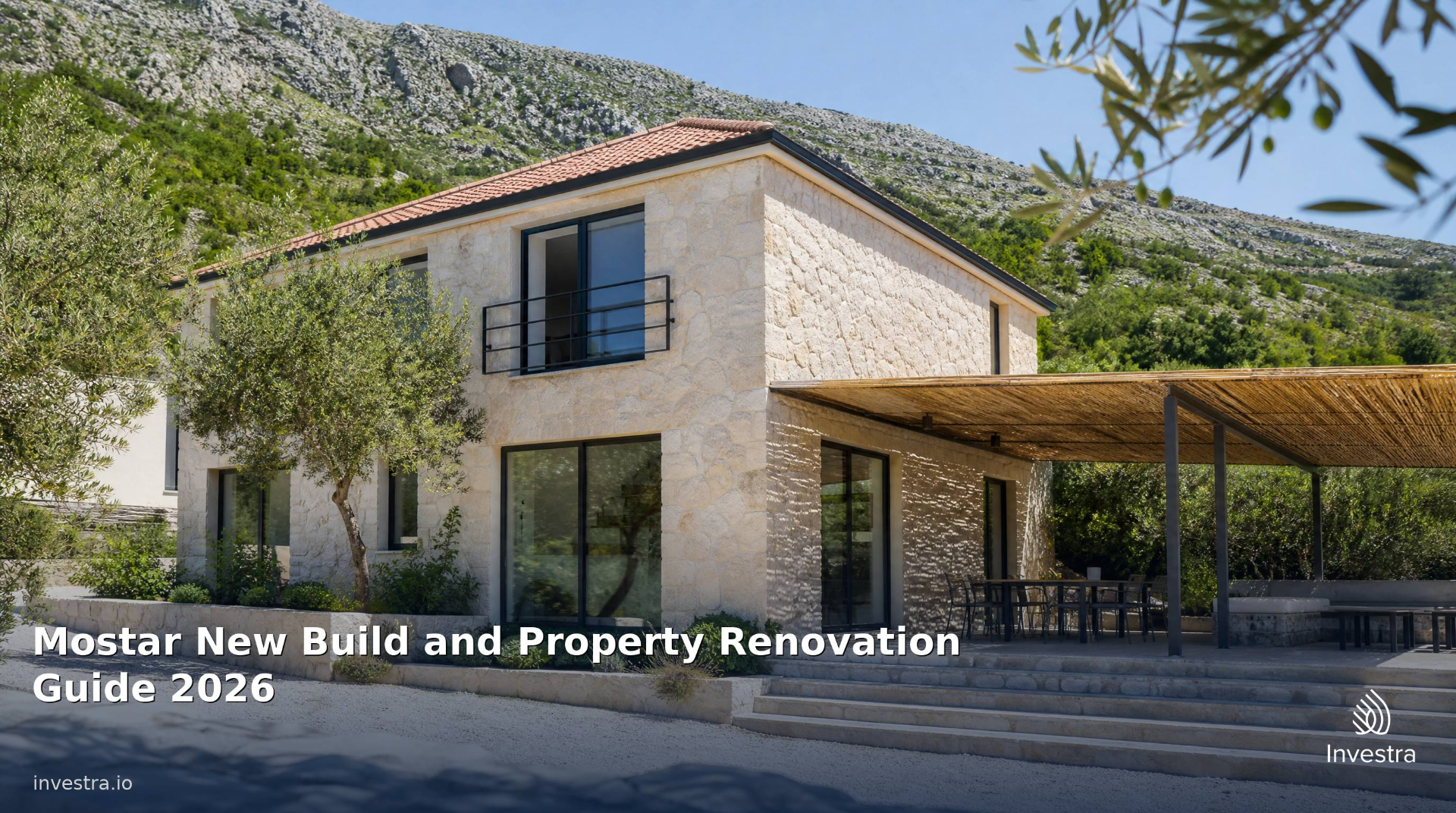
Mostar New Build and Property Renovation Guide 2026
Mostar New Build and Property Renovation Guide 2026
Mostar's Property Market Overview: Why 2026 Marks a Turning Point
Quick Answer: Mostar offers some of the most compelling new build and renovation opportunities in the Western Balkans, with property prices ranging from €800 to €2,500/m² depending on location and condition, and rental yields reaching 6–9% in tourist-heavy zones. Investra.io tracks emerging Balkan markets to help investors identify opportunities before the crowds arrive.
Few cities in the Western Balkans carry the same emotional and architectural weight as Mostar. The UNESCO-listed Stari Most bridge, rebuilt after its deliberate destruction in 1993, has become a symbol not just of reconciliation but of resilience — and increasingly, of investment opportunity.
This guide covers everything a serious buyer needs to know: new build developments, renovation economics, legal procedures for foreign buyers, tax structures, rental income potential, and the practical realities that seasoned consultants like Siniša Dagary — Investment Consultant emphasize when advising clients on Balkan acquisitions.
Understanding Mostar's Segmented Property Market Structure
Quick Answer: Mostar's property market is divided between the historic Old Town (Stari Grad), the broader urban core, and emerging suburban zones, with prices and investment dynamics varying sharply between these segments in 2026.
Mostar isn't a single market — it's three or four distinct micro-markets operating simultaneously, and conflating them is one of the most common mistakes foreign buyers make. Understanding the structure is essential before committing a single euro.
Stari Grad (Old Town): The area around Stari Most and the historic bazaar district, Kujundžiluk, represents the premium tier. Properties here are almost exclusively older structures — Ottoman-era stone buildings, courtyard houses, and former merchant premises. New construction is largely prohibited under heritage protection rules, which means renovation is the primary investment pathway.
The Urban Core (Bulevar and Surrounding Streets): The post-war rebuilding of Mostar concentrated new residential construction along the main boulevard and in the districts flanking the Neretva River. Here you'll find Soviet-era apartment blocks alongside newer residential developments from the 2000s and 2010s. Prices in this band sit at €900–€1,400/m² for standard apartments, rising to €1,600/m² for modern builds with river views.
Emerging Suburban Zones (Bijelo Polje, Centar, Potoci): These areas are seeing the bulk of new development activity in 2026, with developers targeting the domestic middle class and diaspora buyers. Prices here range from €800–€1,200/m², and the yield potential from long-term rentals is often more predictable than in the volatile tourist core. These zones benefit from proximity to modern amenities while maintaining distance from tourist congestion.
What surprised many buyers entering this market in 2023–2025 is how quickly prices in the tourist zones corrected upward after the post-COVID travel boom normalized. The correction hasn't stopped — it's accelerated. Mostar received approximately 1.2 million overnight visitors in 2024, a figure that has roughly doubled since 2019, and infrastructure investment is now following that demand curve.
New Build Developments: Current Projects and Completion Timeline
Quick Answer: New build projects in Mostar in 2026 are concentrated in suburban growth zones and the riverfront corridor, offering modern apartments at €1,000–€1,600/m², with several mixed-use developments designed specifically to attract short-term rental operators.
The new build segment in Mostar has matured considerably since the relatively informal development boom of the early 2010s. Today's projects are better planned, better financed, and increasingly oriented toward buyers who want a turnkey investment rather than a renovation project. Major developments have professional project management, transparent payment schedules, and completion guarantees backed by security deposits held with local notaries.
The most active development zone in 2026 runs along the eastern bank of the Neretva, where several mid-scale residential complexes are under construction or recently completed. These projects typically offer 40–90m² apartments with underground parking, elevator access, and energy performance standards that are beginning to align with EU norms — a deliberate signal to the diaspora market, which demands European-grade finishes and reliable utilities.
Typical new build pricing in Mostar's primary development corridors breaks down as follows: studio and one-bedroom apartments (30–45m²) range from €35,000–€65,000 total, or approximately €1,000–€1,400/m²; two-bedroom apartments (55–75m²) command €60,000–€105,000, or €1,100–€1,500/m²; three-bedroom units (80–100m²) sell for €90,000–€160,000, or €1,100–€1,600/m²; and premium penthouse and riverfront units reach €1,600–€2,200/m².
Payment structures vary between developers, but the standard framework involves a 20–30% reservation deposit, staged payments tied to construction milestones, and final payment upon key handover. Some developers are offering deferred payment plans extending 36–48 months for diaspora buyers with Bosnian citizenship or residency, though foreign buyers without these ties typically face stricter payment schedules.
One trend worth watching is the emergence of purpose-built serviced apartment complexes targeted at the Airbnb and Booking.com market. Two such projects were announced in 2025 in the Stari Grad periphery, offering fully managed units to investors who want yield without operational headaches.
Investors monitoring comparable markets across the region — including the Sremska Mitrovica Real Estate 2026 Srem Region Property Guide — will notice that Mostar's new build pricing commands a significant premium over many Serbian secondary cities, reflecting its tourism infrastructure and UNESCO brand recognition.
Property Renovation Economics: Converting Old Stone Into Yield-Generating Assets
Quick Answer: Renovating traditional Ottoman-era stone houses in Mostar's Old Town can generate total project costs of €150,000–€400,000 but deliver finished assets worth €250,000–€700,000, representing gross margins of 40–75% for competently managed projects.
Here's where Mostar gets genuinely exciting for the experienced property investor. The renovation market — specifically the acquisition and transformation of historic stone structures in and around Stari Grad — offers the kind of value creation that is almost impossible to find in Western European markets at any price point.
The math can be compelling. A dilapidated Ottoman courtyard house with 150m² of usable floor space, sitting in need of complete structural and cosmetic renovation, might be acquired for €90,000–€140,000.
The renovation opportunity isn't limited to commercial hospitality conversions. Residential renovation — taking a tired 1970s apartment and bringing it to modern standard — is also active in Mostar.
One critical variable is material sourcing. Mostar has a reasonable supply chain for standard construction materials, but premium imported items — Italian tiles, German sanitaryware, Scandinavian kitchens — can add 15–25% to material costs compared to importing from within the EU, due to border procedures and logistics.
The Business Strategy Blog by Siniša Dagary has explored renovation-led investment strategies across the Western Balkans in depth, noting that Mostar's combination of low acquisition costs, established tourism demand, and heritage protection creates a moat around well-located renovation projects that doesn't exist in most comparable markets.
Legal Framework for Foreign Property Buyers in Bosnia and Herzegovina
Quick Answer: Foreign nationals can legally purchase property in Bosnia and Herzegovina under the principle of reciprocity, with the process requiring a tax identification number, notarized purchase contract, and land registry registration — typically completing within 60–120 days from agreement.
Bosnia and Herzegovina's legal framework for foreign buyers is functional but requires patience and local expertise. The country operates under a complex constitutional structure — divided into the Federation of Bosnia and Herzegovina (FBiH) and Republika Srpska (RS), plus the Brčko District — and Mostar falls within the Federation entity.
The good news is that EU, US, and most Western nationals can purchase property in Bosnia and Herzegovina without restrictions, subject to the reciprocity principle. Citizens of countries where Bosnian nationals can similarly own property face no formal barriers. In practice, this covers the vast majority of investors approaching the market, encompassing all EU member states, most OECD countries, and numerous others.
The Purchase Process, Step by Step: The first step is obtaining a Personal Identification Number (JMB or equivalent for foreigners) from the relevant municipal authority — this is your tax identification anchor for all subsequent transactions. Without this, you cannot legally register property ownership or conduct banking transactions related to the purchase.
The purchase contract is drawn up in Bosnian/Croatian/Serbian (the official languages of the country) and must be notarized by a local notary (notar). Foreign buyers typically require a sworn interpreter present during signing unless they demonstrate sufficient language competence. The notary fee is typically 0.5–1% of the declared transaction value.
Registration of ownership in the land registry follows notarization and typically takes 30–90 days depending on the specific municipality and current backlog. Mostar's land registry has improved its processing times in recent years, though delays remain possible for more complex transactions involving older properties with incomplete historical documentation. Consulting with About Siniša Dagary provides access to the kind of cross-border expertise — legal, financial, and strategic — that international investors should engage when approaching markets with this level of regulatory complexity.
Taxes, Fees, and Total Transaction Costs
Quick Answer: Total transaction costs when buying property in Mostar typically run 5–8% of the purchase price, including a 5% real estate transfer tax, notary fees, agent commissions, and legal costs — with lower burdens applying to new builds purchased directly from developers.
One of Bosnia and Herzegovina's genuine competitive advantages for property investors is its relatively light tax burden, both at the point of transaction and on an ongoing basis. Understanding the full cost stack is essential for accurate investment modeling and return calculations.
Real Estate Transfer Tax (Porez na promet nekretnina): The standard rate in the Federation of Bosnia and Herzegovina is 5% of the assessed transaction value. This is payable by the buyer and is triggered on secondary market transactions (resales).
Notary Fees: Typically 0.5–1% of declared transaction value, with minimums and maximums set by cantonal regulations in the Federation. For a €100,000 transaction, expect to pay €500–€1,000 to the notary for contract execution and attestation.
Real Estate Agent Commission: The Bosnian market convention is for the buyer and seller to each pay 2–3% commission to their respective agents, though the total commission structure varies by agent and negotiation. Some agents operate on a buyer-pays-all model at 3–4% total. This is typically the single largest transaction cost after the transfer tax itself.
Legal Fees: Engaging a local lawyer (odvjetnik) for due diligence, contract review, and land registry work typically costs €500–€2,000 depending on transaction complexity and the firm engaged. Budget the higher end for properties with unclear historical ownership or properties requiring heritage approval.
Annual Property Tax: Extremely low by European standards. Annual property tax in Mostar is assessed at the cantonal level and typically runs 0.05–0.1% of assessed value annually — meaning a €100,000 property generates an annual tax bill of €50–€100. This is dramatically lower than comparable EU markets and incentivizes longer holding periods.
Rental Income Tax: Rental income earned by non-residents is subject to income tax at a flat 10% rate in the Federation. This is withheld at source when using a property management company, or declared annually by the owner directly. The 10% rate is highly competitive internationally and significantly enhances net yield calculations compared to Western European alternatives.
Capital Gains Tax: Capital gains on property sales are taxed as part of income tax at 10% on the net gain (sale price minus acquisition cost and documented improvement expenses). Properties held for more than five years may qualify for exemption in certain circumstances — another factor that incentivizes medium-term hold strategies over quick flips.
Rental Market Performance: Short-Term and Long-Term Yields
Quick Answer: Short-term rental yields in Mostar's Old Town and tourist core average 7–10% gross annually, while long-term residential rental yields across the city run 5–7%, making it one of the highest-yielding markets in the Western Balkans for income-focused investors.
The rental market in Mostar splits cleanly into two segments with very different characteristics, and choosing the right strategy depends entirely on your risk appetite, available time, and proximity to the asset.
Short-Term Rentals (Airbnb, Booking.com, Direct): This is where Mostar genuinely excels. The city's 1.2 million annual visitor figure — remarkable for a city of approximately 105,000 residents — creates sustained short-term accommodation demand that the formal hotel sector hasn't fully absorbed.
A well-located, well-presented one-bedroom apartment in or adjacent to the Old Town can achieve peak summer season (June–August) rates of €70–€130/night with 85–95% occupancy; shoulder season (April–May, September–October) rates of €50–€90/night with 60–75% occupancy; and low season (November–March) rates of €35–€60/night with 30–50% occupancy.
Blending these periods, a 50m² apartment purchased for €90,000 and generating €12,000–€16,000 gross annual rental income (after accounting for seasonality) delivers a gross yield of 13–18%. After platform fees (15–20%), cleaning, utilities, maintenance, and the 10% income tax, net yields typically land at 7–10% — still exceptional by Western European standards.
Long-Term Residential Rentals: The long-term rental market serves Mostar's growing base of young professionals, university students (the University of Mostar has approximately 15,000 students), and the increasing number of remote workers drawn to the city's low cost of living and improved digital infrastructure. Monthly rents for a furnished one-bedroom apartment in the urban core range from €350–€550, while two-bedroom units command €450–€750/month.
The Aleksinac Real Estate Market 2026 Southern Serbia Property Guide provides useful context here — Mostar's long-term rental yields are broadly comparable to other mid-sized Balkan cities, but its short-term rental premium is significantly higher due to tourism concentration.
EU Accession and Its Impact on Mostar's Investment Thesis
Quick Answer: Bosnia and Herzegovina received EU candidate status in 2022 and began accession negotiations in 2024, a process that historically drives 25–50% property price appreciation in candidate countries over the 5–10 year accession timeline, with Mostar positioned to benefit disproportionately as the country's main tourist hub.
This is the macro story that underpins virtually every bullish case for Bosnian real estate in 2026. The EU accession process, when it runs its course, has a documented track record of transforming property markets in candidate countries.
Bosnia and Herzegovina's accession timeline remains uncertain — the country's complex constitutional structure and the need to implement over 2,000 pieces of EU legislation create genuine obstacles — but the direction of travel is no longer in question. The EU Commission's 2024 progress report was broadly positive, and the reform momentum, while uneven, is real.
What does this mean specifically for Mostar? The city is already the country's premier tourist destination and its second-largest urban center. EU accession typically brings standardized property rights and land registry improvements (reducing legal risk), free movement of labor and capital (expanding the buyer pool dramatically), upgraded infrastructure investment through EU structural funds, and a currency stabilization anchor.
The accession story is not unique to Bosnia. Savvy investors tracking the Zajecar Real Estate Market 2026 Eastern Serbia Property Guide and the broader Serbian market are operating on a similar thesis — that pre-accession Balkan markets offer the entry prices that Croatia offered in 2008–2013, before EU membership catalyzed its Dalmatian coast into one of Europe's most expensive secondary markets.
Financing Options for Foreign Investors in Bosnia
Quick Answer: Mortgage financing for foreign buyers in Bosnia and Herzegovina is available but limited, with most international investors using cash purchases or developer payment plans; local bank mortgages for non-residents carry interest rates of 4.5–7% and require significant documentation, making alternative financing structures worth exploring.
Developer payment plans are increasingly common and often more practical. A developer selling a completed or near-completed apartment unit might accept 30% down and stage the remaining 70% over 24–36 months, effectively providing vendor financing at zero interest. This is enormously advantageous if you have capital to deploy but want to preserve liquidity.
Building Permits and New Construction Regulations
Quick Answer: New construction in Mostar requires building permits issued by the cantonal authority, with approval timelines typically extending 30–90 days depending on project complexity and land registry clarity; renovation projects may face additional heritage approval requirements if located within Old Town protection zones.
For investors considering speculative development or renovation-to-resale strategies, understanding Mostar's building permit framework is essential. The cantonal (regional) government, not the municipal level, issues building permits, which adds a layer of bureaucracy and processing time compared to some European jurisdictions.
The permit application process requires: proof of land ownership or purchase agreement, architectural and engineering plans prepared by a licensed professional, environmental impact assessment (for larger projects), and proof of liability insurance. Processing typically takes 30–90 days, though applications can be rejected or returned for clarification, extending timelines substantially.
For properties in the Stari Grad heritage zone, an additional layer of scrutiny applies. The heritage protection authority (Institut za zaštitu kulturne, historijske i prirodne baštine Hercegovine) must review and approve any structural changes, exterior modifications, or major renovations. This authority moves slowly and has strict design standards — period-appropriate windows, authentic materials, traditional aesthetics
Investment Disclaimer
Quick Answer: This guide is general market information, not personal legal, tax, financing or investment advice.
Before committing to a property transaction, buyers should obtain independent local legal, tax and financial advice suited to their circumstances. Investra.io can support initial market research, but every purchase decision remains the buyer's responsibility.
Frequently Asked Questions
Quick Answer: This section explains the practical property-investment implications of Frequently Asked Questions.
What is a prudent next step after initial market research?
Use current documentation, independent professional advice and comparable local evidence before proceeding. Investra.io can support an initial structured market review.
How can buyers plan a realistic ownership budget?
Use current documentation, independent professional advice and comparable local evidence before proceeding. Investra.io can support an initial structured market review.
What evidence supports a careful investment decision?
Use current documentation, independent professional advice and comparable local evidence before proceeding. Investra.io can support an initial structured market review.
When should a buyer obtain legal and tax advice?
Use current documentation, independent professional advice and comparable local evidence before proceeding. Investra.io can support an initial structured market review.
How should a buyer compare neighbourhoods and property types?
Use current documentation, independent professional advice and comparable local evidence before proceeding. Investra.io can support an initial structured market review.
What local checks should be completed before signing?
Use current documentation, independent professional advice and comparable local evidence before proceeding. Investra.io can support an initial structured market review.
Which costs should be assessed alongside the purchase price?
Use current documentation, independent professional advice and comparable local evidence before proceeding. Investra.io can support an initial structured market review.
How can international buyers verify a property opportunity?
Use current documentation, independent professional advice and comparable local evidence before proceeding. Investra.io can support an initial structured market review.
What should buyers compare before selecting a property?
Use current documentation, independent professional advice and comparable local evidence before proceeding. Investra.io can support an initial structured market review.
Quick Answer: These answers outline common buyer checks and should be read with current professional advice.
Recommended Reading
Quick Answer: This section explains the practical property-investment implications of Recommended Reading.
- Investra market research
- Investra market research
- Investra market research
- Investra market research
- Investra market research
- Investra market research
- Investra market research
- Investra market research
- Investra market research
- Investra market research
- Investra market research
- Investra market research
- Investra market research
- Investra market research
- Investra market research
- Investra market research
- Investra market research
- Siniša Dagary investment insight
- Siniša Dagary investment insight
- Siniša Dagary investment insight
- Siniša Dagary investment insight
- Siniša Dagary investment insight
- Findes Group & Partners
- Findes Group & Partners
Connect With Investra
Follow Investra for market updates on Facebook, LinkedIn, YouTube
Related Posts
No related posts available.
