
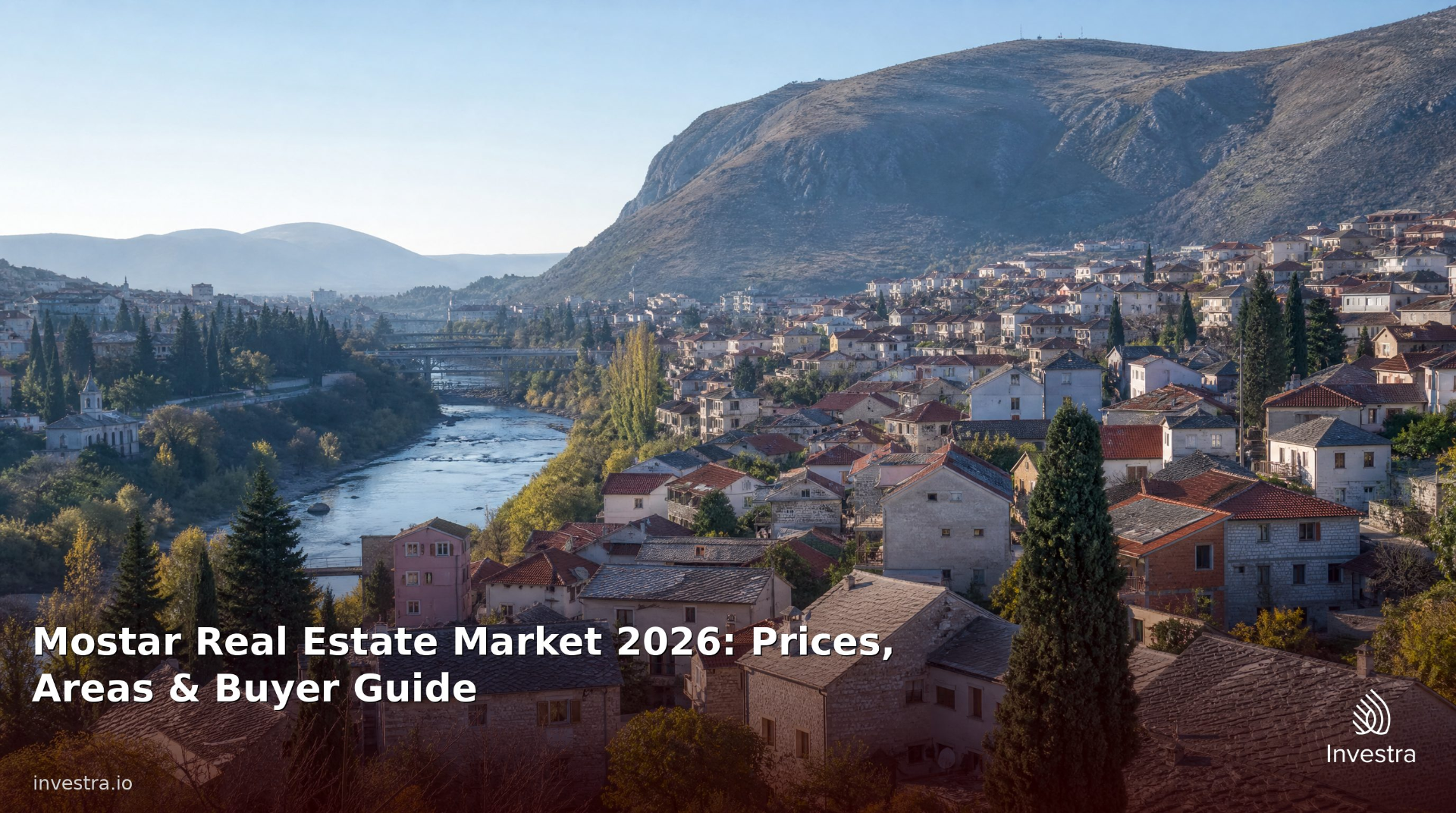
Mostar Real Estate Market 2026: Prices, Areas & Buyer Guide
Mostar Real Estate Market 2026: Prices, Areas & Buyer Guide
Mostar Real Estate Market Overview 2026: Why This Balkan Gem Is Turning Heads
Quick Answer: Mostar's real estate market in 2026 is experiencing steady growth, with property prices ranging from €800 to €3,500 per square meter depending on location and property type, driven by surging tourism, infrastructure investment, and increasing foreign buyer interest. Investra.io tracks emerging Balkan markets like Mostar with real-time data for savvy international investors.
There's something almost counterintuitive about Mostar's real estate market. Here's a city most people know for a single bridge — the iconic Stari Most — yet the investment story unfolding beneath that UNESCO-listed skyline is far more complex, and frankly far more compelling, than most Western investors realize.
What's changed? Quite a lot, actually. Tourism numbers have exploded — Bosnia and Herzegovina welcomed over 1.4 million overnight tourists in 2023, a figure that has continued climbing into 2024 and 2025 with Mostar capturing a disproportionate share of those arrivals.
The reality is that Mostar has been undervalued for years — partly due to post-war perception, partly due to complex property laws, and partly because the market has never been well-documented in English. That information gap is closing fast.
This guide covers everything a serious buyer needs to know: price benchmarks by neighborhood, rental yield data, the legal purchase process, tax obligations, and the practical realities that property portals and tourist brochures tend to gloss over.
Current Property Prices in Mostar 2026: A Neighborhood-by-Neighborhood Breakdown
Quick Answer: In 2026, Mostar property prices range from approximately €800/m² in peripheral residential zones to €3,500/m² for premium renovated properties in the Old Town (Stari Grad), with the citywide average for apartments sitting around €1,400–€1,800/m². For comparative pricing data across the Western Balkans, explore Investra's Eastern Serbia market reports to understand regional positioning.
Pricing in Mostar is far more stratified than a single headline number can capture. The city is divided by the Neretva River, with distinct neighborhoods carrying distinct investment profiles. Understanding these micro-markets is the difference between a savvy purchase and an expensive lesson.
Stari Grad (Old Town) — €2,200 to €3,500/m²
The historic quarter is the trophy district. Renovated stone houses and boutique apartments here command a serious premium, and justifiably so. Short-term rental income is strongest here — peak season occupancy rates regularly hit 85–92%, with nightly rates of €80–€180 for a well-positioned apartment. The catch?
Špansko Polje / Zahum — €1,100 to €1,600/m²
The newer residential developments in the western parts of the city are where most local buyers and young families are purchasing. New-build apartments here are typically 55–90m², priced at €1,200–€1,500/m², with modern specifications.
Cernica / Lučki Most area — €900 to €1,400/m²
The eastern residential neighborhoods across the river are seeing increasing investment as infrastructure improves. Older socialist-era apartment blocks (locally called "Yugoslavia-era" blocks) trade at €800–€1,100/m² and offer the most accessible entry point for budget-conscious investors. Renovation potential is significant.
Bijeli Brijeg — €1,400 to €2,000/m²
Mostar's most established middle-class residential neighborhood. Good schools, commercial services, and relative proximity to the city center make this the most liquid segment of the market — properties here sell quickly because both local buyers and the diaspora community actively target it.
Year-on-year price growth across the city averaged 6.8% in 2024 and an estimated 7.2% in 2025. These aren't speculative figures — they're driven by genuine demand compression in a market with limited new supply and growing external interest.
Mostar Tourism Economy and Short-Term Rental Yields 2026
Quick Answer: Short-term rental properties in Mostar's Old Town and central zones are generating gross yields of 7–12% annually, with peak summer months commanding premium rates that can cover a significant portion of annual mortgage or holding costs in just two to three months of operation.
What we've seen in the data is striking. A well-positioned 45m² apartment in the Old Town, listed on Airbnb or Booking.com, can generate €12,000–€18,000 gross annually. Purchase prices for such a property sit around €100,000–€150,000. That's a gross yield of 9–13% before operating costs.
Outside the historic core, the story is different. Long-term residential rentals in Bijeli Brijeg or Špansko Polje yield 4–6% gross, which is still competitive against Western European benchmarks where prime city yields have compressed to 2–3.5%.
One metric worth tracking: Mostar International Airport handled approximately 180,000 passengers in 2023, with direct connections to several European hubs. New route announcements for 2025–2026 suggest this figure will climb meaningfully, supporting short-term rental demand further.
For investors exploring comparable markets in the region, the Loznica Real Estate Market 2026 guide offers useful context on how mid-sized Balkan cities are performing against broader regional trends.
Who Is Buying Property in Mostar? Understanding the Buyer Landscape
Quick Answer: Mostar's buyer pool is dominated by the Bosnian diaspora (particularly from Germany, Austria, and the United States), regional investors from Croatia and Serbia, and a growing segment of Western European buyers seeking tourism-income properties — with foreign buyers now accounting for an estimated 15–22% of transactions in the Old Town zone.
Understanding who's driving demand tells you a lot about where the market is heading. The diaspora buyer has historically been the backbone of Mostar real estate. Bosnians who left during the 1990s conflict — or their children, now second-generation Europeans — have been reestablishing connections through property for decades.
Croatian buyers are particularly active, often viewing Mostar as a strategic acquisition just across the border with meaningful price arbitrage and strong touristic co-destination potential. Serbian buyers are also present, typically targeting commercial properties or multi-unit residential investments.
Institutional buyers remain largely absent — this is still an individual-investor market. That's actually a feature for early movers: institutional capital entering a market typically triggers the sharp price appreciation that early retail investors benefit from most.
Legal Framework for Foreign Property Buyers in Bosnia and Herzegovina
Quick Answer: Foreign nationals can legally purchase property in Bosnia and Herzegovina under the principle of reciprocity, meaning citizens of countries that allow Bosnian nationals to buy property in their territory can do the same in BiH — the process involves a sales contract, land registry registration, and notarization, typically completing in 4–8 weeks.
This is where many international buyers hit their first wall of confusion — and understandably so. Bosnia and Herzegovina has a uniquely complex administrative structure: two entities (the Federation of BiH and Republika Srpska) plus the Brčko District, each with partially different property laws and registry systems.
The good news: the process is manageable with proper professional guidance. The basic framework works like this:
Step 1 — Pre-contract due diligence. Before anything is signed, a buyer should commission a land registry (Zemljišna knjiga) search to confirm the seller holds clean title, that there are no encumbrances, mortgages, or unresolved inheritance disputes.
Step 2 — Preliminary contract (Predugovor). This binding preliminary agreement typically involves a 10% deposit and establishes the purchase terms, timeline, and conditions. It must be notarized to be enforceable.
Step 3 — Main sales contract (Kupoprodajni ugovor). The final contract is signed before a notary (notar). Both parties must be present, or powers of attorney can be granted. The notary verifies the contract, certifies signatures, and initiates the land registry transfer process.
Step 4 — Land registry registration. The purchase is only legally complete once registered in the land registry. This process takes 2–6 weeks in Mostar. Until registration is complete, the buyer is legally vulnerable — reason enough not to pay the full purchase price before this step is confirmed.
EU citizens face no meaningful additional barriers. Non-EU citizens (including Americans, Australians, and Canadians) should verify that reciprocity applies for their country — in practice, most major Western nations qualify, but formal legal verification is wise before committing.
For those exploring comparable legal frameworks in neighboring markets, the Sremska Mitrovica Real Estate 2026 guide covers Serbia's purchase process in useful detail, which shares some procedural similarities.
Taxes, Fees, and Transaction Costs in Mostar 2026
Quick Answer: Total transaction costs when buying property in Mostar typically amount to 5–8% of the purchase price, including a 5% property transfer tax, notary fees, legal fees, and agent commissions — buyers should budget this as part of their total acquisition cost before calculating ROI.
Nobody likes a surprise on closing day. Understanding the full cost stack going in is essential for accurate return calculations. Here's what buyers in the Mostar market should expect:
Property Transfer Tax (Porez na promet nekretnina) — 5% of the agreed purchase price. This is the single largest transaction cost and is non-negotiable. Paid to the Federation of BiH tax authority within 30 days of contract signing.
Notary fees — 0.3–0.5% of the purchase price, typically with a minimum fee schedule. For a €150,000 property, expect €500–€800 in notary costs.
Land registry fee — approximately €100–€300 depending on property value and municipality.
Legal fees — €500–€2,000 depending on transaction complexity. For a standard residential purchase, €700–€1,200 is typical. Don't economize here — the legal fees are a tiny fraction of what a title problem can cost.
Real estate agent commission — 2–4% (in BiH, commission norms vary; some agents charge the seller only, others charge both parties — confirm this upfront).
Annual property tax is set at the municipal level and is relatively low by European standards — typically 0.1–0.5% of assessed value annually, which in practice means €100–€500/year for most residential properties in Mostar.
Rental income from Bosnian properties held by foreign nationals is subject to income tax in BiH at 10% (flat rate), plus potential tax obligations in the investor's home country depending on applicable double taxation treaties. Bosnia and Herzegovina has signed double taxation agreements with most major European countries, which typically prevents double taxation but requires proper declaration in both jurisdictions. Consulting a cross-border tax specialist — such as those at Findes Financial Services — is strongly advisable for non-resident investors structuring rental income.
Infrastructure, Development, and Future Growth Catalysts
Quick Answer: Mostar's medium-term growth outlook is supported by EU pre-accession infrastructure funds, road corridor development connecting the city to the Adriatic coast and central Europe, airport expansion plans, and Bosnia and Herzegovina's formal EU candidate status granted in 2022 — all of which are expected to compress yield premiums and push capital values higher over the 2025–2030 window.
The road infrastructure story is particularly significant for Mostar. The Corridor Vc, a major European transport corridor running from Budapest through Sarajevo to the Adriatic, passes through Herzegovina. Work on the Mostar bypass and the southern sections toward the coast has accelerated, with completion of key sections expected by 2026–2027.
The proposed upgrade of Mostar International Airport is another catalyst. Plans to extend the runway and add terminal capacity would allow larger aircraft and additional charter operations — directly impacting tourist arrivals and short-term rental demand.
Within the city itself, urban regeneration projects along the Neretva riverbanks and in the post-industrial eastern neighborhoods are attracting municipal investment. The rehabilitation of socialist-era housing blocks, similar to what we've seen in comparable markets like Prokuplje in southern Serbia, is creating a new tier of affordable renovated housing that appeals to both local buyers and budget-conscious foreign investors.
What surprised many buyers in 2024 was how quickly Mostar's coworking and digital nomad infrastructure expanded. Several professionally managed coworking spaces opened in the Old Town and Bijeli Brijeg areas, supporting a new rental demand segment that wasn't present five years ago.
Risks and Challenges: What Every Buyer Needs to Understand
Quick Answer: The primary risks in Mostar's property market include unresolved post-war property title issues, administrative complexity stemming from BiH's fragmented governance structure, currency risk for non-euro investors (though the BAM is pegged to the euro), and the relatively thin liquidity of the secondary market — all manageable with proper due diligence but not to be underestimated.
Let's be honest about the challenges, because a market this compelling always has real risks alongside the upside. The experienced investor doesn't avoid risk — they price it correctly.
Title and cadastre issues are the most significant operational risk. The 1990s conflict disrupted property registries throughout Herzegovina, and some parcels still have unresolved ownership claims, inheritance disputes, or discrepancies between the land registry (Zemljišna knjiga) and cadastre records (Katastar).
Administrative complexity is genuine but navigable. BiH's two-entity structure means that what applies in the Federation (Mostar's jurisdiction) doesn't apply in Republika Srpska, and regulations can change with political shifts. Buyers should work with lawyers and agents who specialize in the Federation specifically.
Market liquidity is thinner than in mature Western European markets. If you need to exit a position quickly, Mostar isn't Ljubljana or Lisbon. The buyer pool for a €300,000+ property is meaningfully smaller than it would be in comparable European cities. This is a medium-to-long-term market: plan your investment horizon accordingly.
Political risk is a background factor. Bosnia's political environment has periodic tensions, and EU accession is a process measured in years, not months. The property market has proven resilient to political noise, but investors should not ignore the geopolitical context entirely.
Currency stability , at least, is not a concern. The Bosnian Convertible Mark (BAM) has been pegged to the euro at BAM 1.95583/€ since 1997, backed by a currency board arrangement. For euro-zone investors, this eliminates exchange rate risk entirely.
Consulting expert advisors — including strategic investment consultants like Siniša Dagary — who understand Balkan market dynamics can significantly reduce the learning curve and help investors avoid common structural mistakes.
Financing Property in Mostar: Cash vs. Mortgage Options for International Buyers
Quick Answer: The vast majority of international property purchases in Mostar are completed in cash, as local bank mortgages for non-residents are difficult to obtain and typically limited to 50–60% LTV with rates of 5–8%; foreign buyers often finance through home-country equity release, international mortgages, or structured cash purchases.
The financing landscape in Mostar is one area where the gap between European norms and Bosnian reality is most stark. Local banks — primarily Raiffeisen Bank, UniCredit, and several domestic institutions — do offer mortgage products, but accessing them as a non-resident is genuinely challenging. Requirements typically include:
This has an interesting market implication: cash buyers can negotiate discounts of 5–10% from asking price in many cases, because sellers value certainty of completion. In a market where buyers don't have mortgage approvals to worry about, transactions tend to close faster — which sellers genuinely appreciate.
Business-oriented investors exploring structured financing options in the region may find useful perspectives at the Siniša Dagary investment insight blog, which covers capital deployment frameworks relevant to emerging market real estate.
Mostar vs. Competing Balkan Investment Destinations in 2026
Quick Answer: Compared to Dubrovnik (€5,000–€10,000/m²), Tivat (€3,000–€6,000/m²), and Sarajevo (€1,500–€2,500/m²), Mostar offers significantly lower entry prices with comparable or superior tourism-driven rental yields — making it one of the strongest value propositions in the Western Balkans for yield-focused investors in 2026.
Context is everything in emerging market investing. Where does Mostar sit in the broader competitive landscape of Balkan property markets?
Croatia's coast has effectively left the affordable zone. Dubrovnik's historic center sees prices of €5,000–€10,000/m², and even secondary Dalmatian towns like Makarska or Hvar command €3,000–€5,000/m². Montenegro's Bay of Kotor coastal towns (Tivat, Perast, Kotor) range €2,500–€6,000/m².
Sarajevo, Bosnia's capital, sits at an intermediate position: €1,500–€2,500/m² in prime zones, with rental yields of 5–8%. Sarajevo is more liquid than Mostar — a larger buyer pool, cleaner institutional frameworks — but also offers less price upside and has already attracted more foreign capital.
Mostar's unique position is that it offers Sarajevo-level affordability with superior rental yields and genuine capital appreciation potential. The tourism economics are stronger due to the Old Town's density of accommodation-seeking visitors. The price growth trajectory is earlier — Mostar is where Dubrovnik was in 2008, not 2018.
Regional comparison data is available through Bor Real Estate Market 2026 and Aleksinac Real Estate Market 2026 resources, which help contextualize Mostar's positioning within the broader Serbian and Balkan markets.
Market Entry Strategy: Practical Steps for First-Time Buyers in Mostar
Quick Answer: New international buyers should begin with 2–3 exploratory site visits, engage a Federation-specialized lawyer before making any offers, commission independent valuations for target properties, secure pre-purchase title searches, and plan for 6–8 weeks of transaction completion time from offer to land registry registration.
Too many investors skip the groundwork because they're eager to deploy capital. That's a strategy that leads to expensive mistakes. Here's the proven approach:
Phase 1: Site reconnaissance (2–3 visits over 3–4 months). Walk the neighborhoods, visit actual listed properties (not just online photos), talk to current tenants and property managers, and get a genuine feel for the city beyond the Stari Most postcard version. This isn't romantic tourism — it's market research.
Investment Disclaimer
Quick Answer: This guide is general market information, not personal legal, tax, financing or investment advice.
Before committing to a property transaction, buyers should obtain independent local legal, tax and financial advice suited to their circumstances. Investra.io can support initial market research, but every purchase decision remains the buyer's responsibility.
Frequently Asked Questions
Quick Answer: This section explains the practical property-investment implications of Frequently Asked Questions.
What is a prudent next step after initial market research?
Use current documentation, independent professional advice and comparable local evidence before proceeding. Investra.io can support an initial structured market review.
How can buyers plan a realistic ownership budget?
Use current documentation, independent professional advice and comparable local evidence before proceeding. Investra.io can support an initial structured market review.
What evidence supports a careful investment decision?
Use current documentation, independent professional advice and comparable local evidence before proceeding. Investra.io can support an initial structured market review.
When should a buyer obtain legal and tax advice?
Use current documentation, independent professional advice and comparable local evidence before proceeding. Investra.io can support an initial structured market review.
How should a buyer compare neighbourhoods and property types?
Use current documentation, independent professional advice and comparable local evidence before proceeding. Investra.io can support an initial structured market review.
What local checks should be completed before signing?
Use current documentation, independent professional advice and comparable local evidence before proceeding. Investra.io can support an initial structured market review.
Which costs should be assessed alongside the purchase price?
Use current documentation, independent professional advice and comparable local evidence before proceeding. Investra.io can support an initial structured market review.
How can international buyers verify a property opportunity?
Use current documentation, independent professional advice and comparable local evidence before proceeding. Investra.io can support an initial structured market review.
What should buyers compare before selecting a property?
Use current documentation, independent professional advice and comparable local evidence before proceeding. Investra.io can support an initial structured market review.
Quick Answer: These answers outline common buyer checks and should be read with current professional advice.
Recommended Reading
Quick Answer: This section explains the practical property-investment implications of Recommended Reading.
- Investra market research
- Investra market research
- Investra market research
- Investra market research
- Investra market research
- Investra market research
- Investra market research
- Investra market research
- Investra market research
- Investra market research
- Investra market research
- Investra market research
- Investra market research
- Investra market research
- Investra market research
- Investra market research
- Investra market research
- Siniša Dagary investment insight
- Siniša Dagary investment insight
- Siniša Dagary investment insight
- Siniša Dagary investment insight
- Siniša Dagary investment insight
- Findes Group & Partners
- Findes Group & Partners
Connect With Investra
Follow Investra for market updates on Facebook, LinkedIn, YouTube
Related Posts
No related posts available.
