
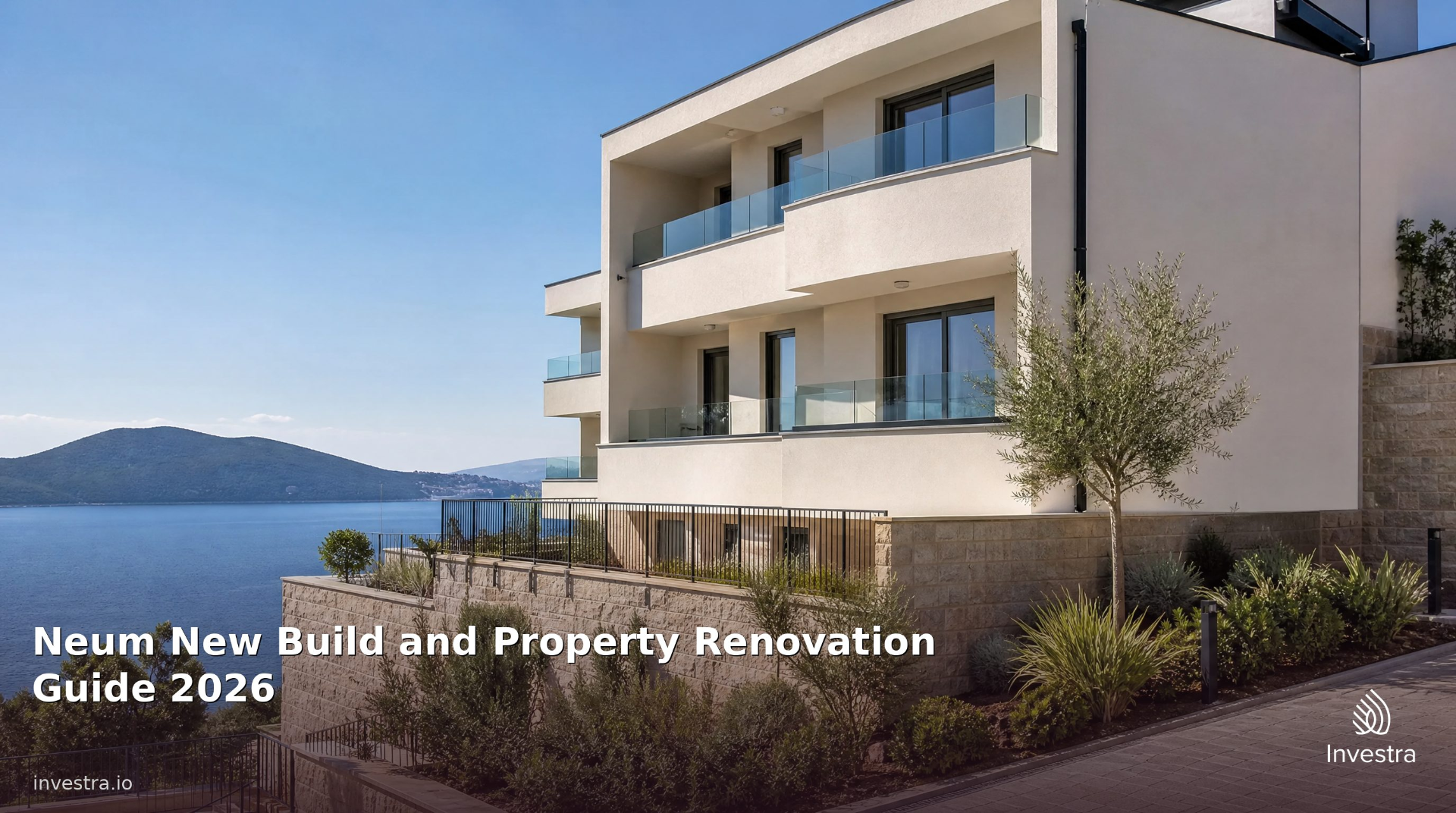
Neum New Build and Property Renovation Guide 2026
Neum New Build and Property Renovation Guide 2026
Why Neum Represents a Unique Coastal Investment Opportunity
Quick Answer: Neum is Bosnia and Herzegovina's only coastal town, offering new build apartments from €1,800–€3,500/m² and renovation projects from €600–€1,200/m² in 2026, making it one of the most undervalued Adriatic investment destinations available to international buyers. Investra.io provides real-time market intelligence for investors exploring Balkan coastal real estate.
Bosnia and Herzegovina possesses exactly 24.5 kilometers of coastline, and every meter of that shoreline runs through Neum—a small town of roughly 4,500 permanent residents positioned between Croatian territory on both sides. This geographic peculiarity makes Neum unlike any other investment destination in the Western Balkans. It is not merely a real estate market; it represents the only coastal property market available to investors seeking Bosnian seaside assets.
What's unfolding in Neum during 2026 deserves attention from investors who've watched the Adriatic coast become progressively unaffordable. While Dubrovnik sits just 25 kilometers distant with prices routinely exceeding €5,000–€7,000/m², Neum continues to offer new development projects and renovation opportunities at substantial discounts.
This guide addresses precisely that inquiry. Whether you're evaluating a new build off-plan apartment, planning property renovation for short-term rental income, or attempting to understand how the local market operates for foreign nationals, what follows provides practical, evidence-based analysis of Neum's property landscape in 2026. Strategic insights from Siniša Dagary investment insight and comparative analysis with regional Balkan markets inform the detailed examination that follows.
Understanding Neum's Investment Case and Catalysts
Quick Answer: Neum represents a compelling combination of Adriatic coastal access, substantially lower entry prices than Croatian neighbours, and accelerating infrastructure investment—including the transformative Pelješac Bridge connection—creating a distinctive value opportunity in 2026.
The Pelješac Bridge's completion in 2022 fundamentally altered Neum's position within the Adriatic tourism and investment landscape. Prior to the bridge's opening, travelers driving from Split toward Dubrovnik had no option but to traverse through Neum—creating mandatory transit traffic and positioning the town as an unavoidable waypoint along one of Europe's busiest coastal corridors.
The actual outcome has proven more nuanced than the initial pessimistic projections. The bypass has catalyzed Neum's transition from functioning as a mere transit location toward developing distinctive identity as an intentional destination.
The investment thesis rests on multiple reinforcing foundations. First, the price differential proves undeniable: acquiring coastal Adriatic property at Neum's valuations simply isn't achievable anywhere else along the Mediterranean shoreline. Second, Bosnia and Herzegovina's achievement of formal EU candidacy status in December 2022 establishes regulatory harmonization pressures and generates long-term stability signals for international investors.
Investors conducting comparative analysis with Balkan interior markets addressed in the Zajecar Real Estate Market 2026 Eastern Serbia Property Guide will recognize Neum's coastal premium as justifiable—though the yield mechanics diverge substantially between coastal tourism assets and interior urban residential properties.
Neum Property Market Overview: Pricing, Segments, and Trends
Quick Answer: In 2026, Neum property prices range from approximately €600/m² for unrenovated inland properties to €3,500/m² for premium new build sea-view apartments, with the mid-market new build segment clustered between €1,800–€2,400/m².
The numbers genuinely matter, because Neum delivers genuine surprises for investors who've encountered pricing obstacles along the Croatian coast.
The market segments into three distinct categories. The entry-level bracket comprises older socialist-era apartments and houses—many requiring substantial renovation—trading at €600–€1,200/m². These properties typically occupy inland positions or offer limited sea views, forming the fundamental foundation of the renovation investment opportunity detailed subsequently in this analysis.
Year-over-year price appreciation has registered approximately 8–12% for the new build segment, though considerable variation exists based on specific projects and positioning within Neum. The renovation segment has experienced more temperate appreciation of 5–8% annually, constrained by elevated perceived risk and practical challenges of renovation in a small coastal town where qualified trades face scarcity constraints during peak seasonal demand.
When compared to comparable regional markets—see the Loznica Real Estate Market 2026 Macva Region Property Guide for context on Balkan pricing dynamics—Neum occupies a fascinating intersection: costly by Bosnian standards, yet genuinely extraordinary value by Adriatic coastal benchmarks.
Seasonal rental pricing illuminates distinct opportunity patterns. A well-positioned two-bedroom apartment in Neum commands €80–€150 nightly during July and August, with shoulder season rates (May–June, September) of €45–€80 per night. Annual rental yield potential for a professionally managed short-term rental property reaches 5–8%, though achieving upper-range returns demands active management and robust platform presence across Booking.com and Airbnb.
New Build Development Landscape and Construction Activity
Quick Answer: New build activity in Neum in 2026 is concentrated in small-to-medium residential and mixed-use developments, predominantly targeting the second-home and short-term rental market, with off-plan prices offering 10–20% discounts compared to completed unit valuations.
Neum is not experiencing construction activity reminiscent of Dubai-scale development—and this characteristic fundamentally contributes to the market's appeal. Development here follows measured progression. The town's geography imposes natural constraints: the coastline is narrow, hillsides are steep, and the municipal planning framework—while undergoing modernization—has historically restricted large-scale resort development.
Off-plan purchasing in Neum adheres to broadly comparable patterns established across the Western Balkans. Purchasers typically deploy 20–30% upon preliminary contract execution (predugovor), with staged payments distributed throughout the construction interval, and final settlement upon completion.
Build quality demonstrates considerable variance. Numerous buyers who've committed to off-plan Neum projects report meaningful discrepancies between marketing representations and delivered products—particularly regarding interior finishes and communal amenities. Due diligence regarding developer track records remains non-negotiable. Examine completed projects, engage previous purchasers in substantive conversation, and retain local legal counsel before executing any agreements.
For investors seeking parallel context on new development economics within undervalued Balkan markets, the Bor Real Estate Market 2026 Eastern Serbia Mining City Property Guide furnishes instructive comparison regarding how infrastructure-driven investment cycles materialize across the region.
Property Renovation Strategy: Economics, Costs, and Execution
Quick Answer: Comprehensive renovation of an older Neum property typically costs €350–€700/m² for mid-range finishes in 2026, with total project budgets for a 60m² apartment ranging from €21,000–€42,000—a potentially high-ROI strategy if acquisition costs are methodically managed.
The renovation opportunity in Neum represents one of the most analytically compelling angles that experienced investors pursue once they develop market understanding. A generation of properties constructed during the 1970s and 1980s—the Yugoslav workers' resort development period—remains structurally sound but cosmetically and functionally obsolete.
Practical renovation challenges in Neum warrant explicit acknowledgment. The market faces structural labor constraints: qualified trades—tilers, plumbers, electricians—experience severe scarcity during summer season (June through September) because every available tradesperson is servicing hotels and tourism infrastructure.
Permitting requirements for renovation range from straightforward (interior-only work requires no permit for cosmetic interventions in most instances) to complex (structural modifications, terrace enclosures, or work altering building footprint or facade demand careful navigation). The municipal planning office (Općina Neum) functions as the essential initial contact before budgeting structural work.
Legal Framework and Foreign Property Acquisition Process
Quick Answer: EU and most international citizens can purchase property in Bosnia and Herzegovina under reciprocity principles, though the process involves handling the country's dual-entity legal structure—engaging a qualified local lawyer is essential before any purchase commitment.
Bosnia and Herzegovina's legal system exhibits distinctive complexity. The country operates under a dual-entity configuration—the Federation of Bosnia and Herzegovina and Republika Srpska—with further subdivision in the Federation across ten cantons, each possessing independent legislative authority.
The foundational query for foreign buyers concerns purchase eligibility. The answer, for citizens of most EU and Western democracies, is affirmative—under reciprocity principles, where citizens of countries permitting Bosnian nationals to acquire property can reciprocate. In practical application, this encompasses virtually all EU nationals, UK citizens, Americans, Canadians, and most others. However, exercising this right requires careful legal navigation and procedural precision.
The acquisition sequence follows these essential steps. Initially, a preliminary contract (predugovor or ugovor o kupoprodaji) receives execution and typically a 10% deposit is remitted. Subsequently, comprehensive due diligence investigates the property's legal status—cadastral registry verification, building permit confirmation, outstanding liens or encumbrances investigation, and verification of clean seller title.
The due diligence phase commands particular emphasis in Neum's specific context. Properties exist within the town—particularly from the Yugoslav era—where ownership documentation is incomplete, where building permits for extensions or additions were never procured, or where unresolved inheritance claims remain pending. While none of these constitute insurmountable obstacles, identification before purchase rather than after proves essential.
For investors comparing legal processes across the region, resources including Siniša Dagary investment insight present useful strategic frameworks for handling Balkan property transactions effectively.
Acquisition Costs, Taxes, and Total Investment Calculations
Quick Answer: Total acquisition costs for Neum property typically represent 7–12% above the purchase price, including 5% property transfer tax, notary fees, land registry charges, and legal costs—all of which must be integrated into investment projections from inception.
Understanding genuine acquisition costs constitutes where numerous first-time Balkan real estate buyers encounter unexpected complications. The stated price does not represent the all-in cost. Here's a realistic decomposition of what to anticipate.
The Property Transfer Tax (Porez na promet nekretnina) is established at 5% of assessed value in the Federation of Bosnia and Herzegovina. The Tax Administration determines assessed value, generally approximating—though not invariably equaling—the contractual price. For new builds purchased directly from developers (initial sales), VAT at 17% may apply instead of transfer tax, contingent upon the developer's VAT status.
Notary fees typically range €300–€600 for standard residential transactions, scaling with complexity and transaction magnitude. Land registry registration expenses remain modest—approximately €100–€200. Legal fees for qualified English-language capable lawyers run €1,000–€2,500 based on transaction complexity.
On an annual basis, property owners in Bosnia and Herzegovina remit an annual property tax, with rates varying by canton and municipality—in Neum, anticipate approximately 0.05–0.1% of assessed value annually. This represents low taxation by European standards. Utility expenses (water, electricity, communal maintenance) for a 60m² apartment approximate €100–€200/month based on occupancy and consumption patterns.
For declared rental income, entity-level taxation applies to rental revenue at rates generally ranging 10–13% for individual proprietors. Proper accounting and tax declaration through a qualified local accountant (računovođa) proves essential—both for regulatory compliance and for optimizing deductible expense treatment of renovation and management costs.
Rental Economics: Short-Term Vacation vs Long-Term Residential Yields
Quick Answer: Short-term vacation rentals in Neum generate 5–8% gross annual yields with pronounced July–August concentration, while long-term residential rentals yield 3–5% annually—short-term models substantially outperform for well-located, professionally managed properties, though operational complexity increases considerably.
Neum's rental market exhibits nearly complete seasonal character. The town's tourism economy concentrates intensely during summer months—June through September captures approximately 75–80% of annual overnight accommodations, with July and August alone representing perhaps 50–55%. This fundamental seasonality means the rental investment case is essentially a short-term vacation rental strategy, not a stable year-round residential income proposition.
Let's examine the numbers with unflinching honesty. A 45m² one-bedroom apartment positioned decently—not first-row oceanfront, but with sea visibility from the terrace—acquired for €90,000 and renovated to solid standard for €20,000 generates a €110,000 total investment. During peak season (eight weeks), achievable nightly rates reach €70–€100. At 85% occupancy during peak, this produces €4,760–€6,800 from July–August exclusively.
Subtract management fees (typically 15–20% if engaging local property managers), platform commissions (3–15% depending on Booking.com versus Airbnb versus direct bookings), cleaning costs, linens, maintenance, and utilities—net seasonal income reaches €3,800–€6,000. Against a €110,000 investment, this generates net yields of 3.5–5.5%, which appears modest until layering capital appreciation potential into the analysis.
The long-term residential rental market in Neum remains thin and underdeveloped. The permanent population is modest, employment opportunities concentrate primarily in hospitality and public administration, and demand from professionals or students pales compared to what materializes in Sarajevo or Mostar. Long-term rents for one-bedroom apartments run €250–€400/month, implying yields of 3–4% on the acquisition valuations outlined above.
Platform selection carries outsized importance. Booking.com dominates Neum's short-term rental landscape by booking volume, but Airbnb is experiencing accelerating growth, particularly among international guests. Investors combining both platforms with professional website deployment—and investing in high-quality photography—consistently exceed those relying on single-channel distribution.
Financing Mechanisms: Mortgages, Capital Deployment, and Developer Finance
Quick Answer: Most foreign investors finance Neum property through cash reserves or international financing sources, as domestic BiH mortgage products for non-residents are limited and interest rates remain elevated at 5–8%; developer payment plans represent the most practical financing option for new build acquisitions.
This domain represents material divergence from Western European norms. Do not anticipate accessing competitive mortgage products through Sarajevo banking institutions as a non-resident foreign purchaser. The domestic banking sector—while stable and reasonably capitalized—offers limited product formulations designed for international acquirers, and collateral and income verification requirements prove burdensome for those lacking local employment or banking relationships.
Current domestic mortgage rates in Bosnia and Herzegovina sit at approximately 5–8% annually, materially exceeding what a strategically-positioned European investor might access through home-country financing. For those capable of drawing on equity from properties in Germany, Austria, Slovenia, or elsewhere in the EU, home-country financing typically proves more economical than pursuing local BiH mortgage arrangements.
For new build acquisitions, developer payment structures function as the de facto financing mechanism. Most Neum developers propose payment arrangements approximating 30% upon contract, 40% distributed throughout construction, and 30% upon completion. Certain developers offer extended completion payment terms of 12–24 months post-handover, effectively functioning as informal installment financing.
Financial advisory services such as Findes Group & Partners deliver guidance on cross-border financing architectures for Balkan property investments, particularly for Slovenian and EU-based investors optimizing capital deployment into markets like Neum.
One essential procedural note: all property transactions in Bosnia and Herzegovina must execute through bank transfer mechanisms—cash payments lack legal recognition for property transactions. Establishing a local bank account proves advisable for ongoing property administration but remains non-essential for the acquisition itself if international transfers fund the purchase.
Infrastructure Development, Tourism Growth, and Long-Term Investment Positioning
Quick Answer: Neum's long-term investment thesis is positively shaped by the planned highway connection to the BiH corridor network, expanding regional tourism demand, and EU accession trajectory—though investors should contemplate 5–10 year horizons to fully capture infrastructure-driven value appreciation.
The transformative infrastructure initiative for Neum's investment case is the planned motorway connection. Corridor Vc, extending from the Sava River in northern Bosnia through Sarajevo toward Mostar, is designed to eventually link to the coast through a connection toward Neum.
Tourism data presents a supportive narrative. Bosnia and Herzegovina achieved record tourist arrivals in 2023 and 2024, with Neum registering estimated 350,000–400,000 annual overnight stays. Growth trajectory has registered 8–15% year-over-year in recent years, propelled by domestic Bosnian tourists, visitors from Serbia and Croatia, and incrementally growing international segments attracted by duty-free shopping and the distinctive appeal of Bosnia's singular coastal location.
Neum's duty-free status itself represents an underestimated asset. Legally, Neum operates as a free trade zone under Bosnian customs frameworks—fuel, cigarettes, alcohol, and electronics pricing materially undercuts adjacent Croatian positioning. This generates distinct visitor demographics and sustains year-round commercial activity that purely tourism-dependent coastal towns fail to achieve.
Regarding EU accession: Bosnia and Herzegovina obtained EU candidate status in December 2022, and while the pathway to membership remains extended and complex, the directional signal proves consequential for property investors. EU candidate status typically correlates with regulatory harmonization, enhanced transparency in land registries, and elevated foreign investor confidence—all supporting real estate market development.
Comparative analysis of regional development patterns tracked through resources including the Prokuplje Real Estate Market 2026 Toplica Region Property... and Aleksinac Real Estate Market 2026 Southern Serbia Propert... illustrates how infrastructure catalyzes market evolution throughout the region.
Regional Context and Comparative Market Analysis
Quick Answer: Neum's investment profile becomes more analytically coherent when examined against regional Balkan markets, where tourism-dependent coastal assets demonstrate different yield mechanics compared to interior residential or commercial properties.
Understanding Neum requires contextual comparison with related markets across the Western Balkans. Properties in mining-dependent regions like those profiled in the Bor Real Estate Market 2026 Eastern Serbia Mining City Property Guide demonstrate dramatically different appreciation dynamics and income profiles compared to coastal tourism destinations. Similarly, logistics hubs profiled in Sremska Mitrovica Real Estate 2026 Srem Region Property G... offer substantially different investment mechanics and risk profiles.
The technology-enabled transformation occurring across regional real estate markets—detailed comprehensively in resources like Serbia Proptech 2026 How Technology Is Changing Real Estate—increasingly applies to Neum, where digital platforms facilitate short-term rental marketing and property management. Emerging residential models like those analyzed in
Investment Disclaimer
Quick Answer: This guide is general market information, not personal legal, tax, financing or investment advice.
Before committing to a property transaction, buyers should obtain independent local legal, tax and financial advice suited to their circumstances. Investra.io can support initial market research, but every purchase decision remains the buyer's responsibility.
Frequently Asked Questions
Quick Answer: This section explains the practical property-investment implications of Frequently Asked Questions.
What is a prudent next step after initial market research?
Use current documentation, independent professional advice and comparable local evidence before proceeding. Investra.io can support an initial structured market review.
How can buyers plan a realistic ownership budget?
Use current documentation, independent professional advice and comparable local evidence before proceeding. Investra.io can support an initial structured market review.
What evidence supports a careful investment decision?
Use current documentation, independent professional advice and comparable local evidence before proceeding. Investra.io can support an initial structured market review.
When should a buyer obtain legal and tax advice?
Use current documentation, independent professional advice and comparable local evidence before proceeding. Investra.io can support an initial structured market review.
How should a buyer compare neighbourhoods and property types?
Use current documentation, independent professional advice and comparable local evidence before proceeding. Investra.io can support an initial structured market review.
What local checks should be completed before signing?
Use current documentation, independent professional advice and comparable local evidence before proceeding. Investra.io can support an initial structured market review.
Which costs should be assessed alongside the purchase price?
Use current documentation, independent professional advice and comparable local evidence before proceeding. Investra.io can support an initial structured market review.
How can international buyers verify a property opportunity?
Use current documentation, independent professional advice and comparable local evidence before proceeding. Investra.io can support an initial structured market review.
What should buyers compare before selecting a property?
Use current documentation, independent professional advice and comparable local evidence before proceeding. Investra.io can support an initial structured market review.
Quick Answer: These answers outline common buyer checks and should be read with current professional advice.
Recommended Reading
Quick Answer: This section explains the practical property-investment implications of Recommended Reading.
- Investra market research
- Investra market research
- Investra market research
- Investra market research
- Investra market research
- Investra market research
- Investra market research
- Investra market research
- Investra market research
- Investra market research
- Investra market research
- Investra market research
- Investra market research
- Investra market research
- Investra market research
- Investra market research
- Investra market research
- Siniša Dagary investment insight
- Siniša Dagary investment insight
- Siniša Dagary investment insight
- Siniša Dagary investment insight
- Siniša Dagary investment insight
- Findes Group & Partners
- Findes Group & Partners
Connect With Investra
Follow Investra for market updates on Facebook, LinkedIn, YouTube
Related Posts
No related posts available.
