
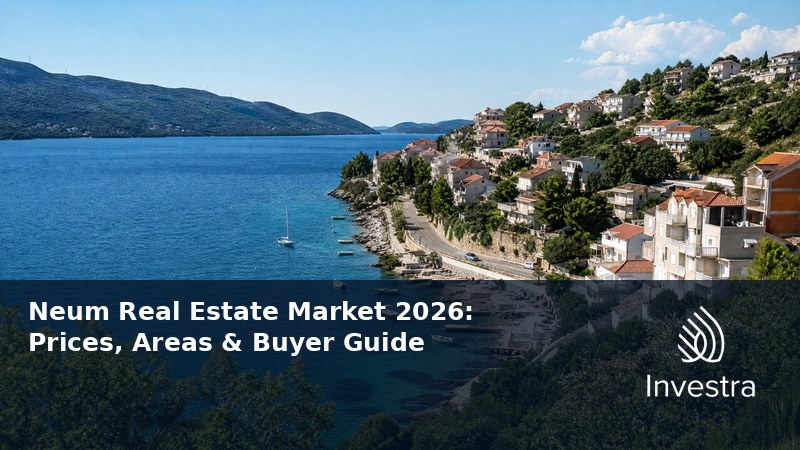
Neum Real Estate Market 2026: Prices, Areas & Buyer Guide
Neum Real Estate Market 2026: Prices, Areas & Buyer Guide
Why Neum Is Emerging as the Adriatic's Most Undervalued Coastal Market
Quick Answer: Neum is Bosnia and Herzegovina's only coastal town, offering some of the most competitively priced Adriatic seafront property in Europe — with prices ranging from €1,200 to €3,500/m² depending on location and property type. Investra market research tracks emerging Balkan markets like Neum for investors seeking high-growth, undervalued coastal opportunities.
Neum represents one of Europe's most compelling yet overlooked real estate opportunities. Situated on a narrow 24-kilometer strip of Adriatic coastline — the only maritime access point for Bosnia and Herzegovina — this small coastal municipality of roughly 4,500 permanent residents has historically occupied a peculiar economic niche.
The investment thesis has fundamentally shifted over the past four years. The opening of the Pelješac Bridge in 2022 initially appeared to threaten Neum's transit-based economy, but it actually catalyzed a reorientation toward destination tourism rather than through-traffic.
The Unique Geographic and Economic Position That Defines Neum's Market
Quick Answer: Neum's strategic location as BiH's sole coastal access point, combined with evolving tourism infrastructure and improved regional connectivity, creates a structurally distinct real estate market with fundamentally different supply-demand dynamics than any other Western Balkan destination.
Geography has always been Neum's defining characteristic — and paradoxically, both its limitation and its opportunity. The town sits in the Herzegovina region of Bosnia and Herzegovina, within Canton 10 of the Federation entity, nestled along the Adriatic Highway (E65/M17.3) that connects the Split and Dubrovnik corridors.
This transit-dependent economic model sustained Neum's tourism infrastructure through the early 2020s but left it structurally vulnerable to any routing changes. The Pelješac Bridge's 2022 completion fundamentally altered those routing patterns, eliminating the necessity to pass through Neum. Initial market anxieties about economic contraction proved partially correct — casual transit revenue did decline measurably.
The permanent resident economy remains modest: tourism accounts for 60–70% of seasonal GDP, with the remainder distributed across duty-free retail operations, hospitality employment, and small-scale commercial activity. Off-season unemployment runs structurally high, as is typical for monoculture coastal economies across the Adriatic.
Understanding these economic fundamentals is essential for realistic investment projections. Comparable secondary markets across the Balkans operate on similar seasonal patterns. For comparative context on how smaller Balkan cities navigate economic diversification and infrastructure change, analysis from Siniša Dagary investment insight provides valuable frameworks for evaluating emerging market transitions.
Current Property Price Structure Across Neum's Market Segments
Quick Answer: Neum property pricing in 2026 ranges from approximately €1,200/m² for older inland residential stock to €3,500/m² for premium seafront apartments, with mid-market sea-view properties (€1,800–€2,500/m²) offering the optimal balance of yield and appreciation potential for most investors.
Property valuation in Neum follows a clearly defined pricing structure determined primarily by proximity to the Adriatic, property age, and construction quality. Understanding these price bands is fundamental to investment decision-making.
Seafront and first-row waterfront properties: Properties with direct sea access or unobstructed seafront positioning command the premium segment, trading at €2,800–€3,500/m² for contemporary construction or thoroughly renovated units. This represents the most supply-constrained category, as buildable seafront land is finite and often encumbered by complex historical ownership structures or long-duration development projects.
Second and third-line sea-view properties: This segment — characterized by partial or full sea views from non-seafront positions — represents the market's most dynamic trading zone, with prices ranging €1,800–€2,500/m². A typical 60–65m² two-bedroom apartment in well-maintained 2000s-era construction trades at €110,000–€150,000.
Inland residential without sea view: Older Yugoslav-era apartment blocks and single-family homes positioned away from the waterfront trade at €1,200–€1,600/m², representing the market's entry-level segment. A typical 55m² apartment lists between €65,000 and €85,000.
Development land and buildable plots: Raw land suitable for construction ranges €150–€400/m² depending on proximity to the coast, existing utility infrastructure, and planning permission status. This segment requires heightened due diligence given Bosnia's complex cadastral records and development approval processes.
Year-on-year appreciation for quality seafront and sea-view stock has consistently tracked 5–8% annually since 2021, outperforming most inland Bosnian cities and aligning with broader Western Balkans coastal appreciation trends. This appreciation profile compares favorably with mature European coastal markets where price growth has compressed toward 2–3% annually.
Neighborhood Segmentation and Micro-Location Investment Strategy
Quick Answer: Neum's investment opportunity matrix divides into three distinct zones — the central waterfront for premium positioning, developing hillside areas for growth exposure, and peripheral settlements for land value and value-add development — each serving different investor profiles and return objectives.
While Neum's geographic footprint is compact, distinct neighborhood characteristics create meaningful investment differentiation. Understanding these micro-locations is essential for matching property selection to investor objectives.
Central Seafront and Neum Bay: The waterfront promenade and immediate beachfront zone represent Neum's highest-value real estate, where hotels, restaurants, residential buildings, and public spaces directly abut the Adriatic. This area commands the strongest short-term rental demand and the highest per-square-meter valuations.
Hillside Development Zones (Upper Neum and Heights): As waterfront land values appreciated and supply tightened, developers shifted focus to hillside terracing overlooking the main bay. These developments frequently offer superior panoramic views compared to ground-level seafront buildings that can be visually blocked by adjacent structures.
Peripheral Settlements (Hutovo, Drace, Klek municipalities): The broader Neum municipality encompasses smaller satellite settlements offering substantially lower entry prices for investors prioritizing land value over immediate proximity. Properties in these areas trade at €800–€1,200/m², and land parcels become available at genuinely accessible valuations.
Hotel and Mixed-Use Zones: Several substantial socialist-era hotel properties occupy prime waterfront positions and are currently undergoing renovation or redevelopment into mixed-use residential-hospitality complexes. These larger-scale projects represent an interesting investment vector for capital allocations exceeding €500,000, offering both commercial performance and residential rental upside.
Legal Framework for Foreign Ownership and Property Registration
Quick Answer: Foreign nationals can legally acquire real estate in Bosnia and Herzegovina under reciprocal nationality agreements; EU citizens generally enjoy unrestricted ownership rights, while non-EU buyers should verify specific reciprocity arrangements and consider corporate ownership structures for agricultural land.
Property ownership rights for international buyers in Bosnia and Herzegovina are determined by two primary variables: the geographic entity (Federation or Republika Srpska) and the buyer's citizenship status. Neum, located within the Federation of BiH, applies reciprocity principles that permit nationals from countries allowing Bosnian citizens to own property to themselves acquire Bosnian real estate.
In practical terms, EU citizens enjoy nearly unrestricted ownership of residential and commercial real estate under reciprocal treatment frameworks. This encompasses most EU member states, neighboring Balkan nations, and numerous non-European countries including the United States, Canada, and Australia.
Agricultural land represents a distinct legal category with more stringent restrictions across the entire region — though this rarely concerns coastal property investors focused on residential or commercial use.
The practical transaction process involves execution of a notarized purchase-sale agreement, transfer of title to the land registry (gruntovnica), and payment of applicable transfer taxes. A critical procedural requirement: comprehensive legal due diligence preceding any commitment.
For investors structuring cross-border acquisitions and seeking clarity on broader legal frameworks, consulting resources from Siniša Dagary investment insight provides specialized guidance on property law compliance and investment structuring across Balkan markets.
Comprehensive Tax and Transaction Cost Accounting
Quick Answer: Total acquisition costs in Neum typically amount to 5–8% above the base purchase price, encompassing 5% property transfer tax, notary fees (0.3–0.5%), legal representation, and registration charges — positioning BiH among the more favorable transaction cost jurisdictions in the Balkans.
Understanding complete acquisition economics requires detailed accounting of all transaction and ongoing tax obligations. Bosnia and Herzegovina compares favorably with neighboring markets on transaction cost burden.
Property Transfer Tax: The Federation of BiH assesses a 5% transfer tax on the purchase price (or official market assessment, whichever is higher) of residential properties, typically borne by the purchaser. New-build transactions from VAT-registered developers may be subject to 17% VAT instead of transfer tax depending on seller registration status and property classification.
Notarization Fees: Bosnian real estate transactions require notarial execution. Regulated notary charges scale progressionally with transaction value, typically ranging 0.3–0.5% of transaction amount, with meaningful caps that benefit higher-value transactions.
Legal and Professional Fees: Competent Bosnian real estate attorneys typically charge €500–€2,000 for full transaction support including due diligence investigation, contract documentation, and land registry coordination. This represents essential protective cost rather than discretionary expense.
Annual Property Tax: Cantonal and municipal-level property taxation in BiH runs remarkably low compared to EU norms — typically 0.1–0.5% of assessed property value annually. A €150,000 property likely incurs €150–€750 in annual property tax depending on local municipal rates.
Rental Income Tax: Rental revenue is subject to flat-rate income tax of 10% on net rental income (gross revenue less documented operating expenses). This 10% rate represents one of Europe's lowest tax burdens on rental income and provides significant competitive advantage over Croatian (approximately 30% effective rate) and Slovenian (20% effective rate) tax treatment.
For investors comparing transaction structures across multiple Balkan jurisdictions, examining comparative cost frameworks in Serbian secondary markets provides useful reference data. Markets analyzed in the Zajecar Real Estate Market 2026 Eastern Serbia Property G... and the Aleksinac Real Estate Market 2026 Southern Serbia Propert... research demonstrate transaction cost structures and tax frameworks in comparable regional markets.
Short-Term Rental Yield Analysis and Seasonal Income Modeling
Quick Answer: Well-positioned Neum properties achieve gross short-term rental yields of 6–10% annually, with peak-season occupancy often exceeding 85% during July–August; investors must account for pronounced seasonality requiring capital reserves for expense coverage during low-occupancy winter months.
Neum's rental revenue opportunity is almost entirely concentrated in short-term seasonal tourism accommodations. The permanent resident population of roughly 4,500 cannot support robust long-term rental demand at investment-grade yields. However, the summer tourism season demonstrates genuinely compelling economics.
A well-managed 2-bedroom apartment (55–65m²) positioned in prime seafront or sea-view location achieves daily rental rates of €80–€150 during peak season (late June through August) and €40–€70 during shoulder periods (May–June, September–October). Modeling on conservative utilization assumptions — 70 occupied nights at peak rates averaging €100/night plus 40 shoulder-season nights at €60/night — produces approximately €11,000 in gross annual rental revenue.
Seasonal income concentration represents the material risk consideration. Unlike year-round destination markets, Neum's revenue compresses into 3–4 months, with remaining months generating minimal occupancy. Serious investors must maintain sufficient capital reserves to cover property operating expenses, financing obligations, and reserve capital throughout 8-month low-revenue periods.
Professional property management fees typically run 15–25% of gross revenue regionally. Even accounting for 20% management fees plus property insurance (€200–€300 annually), maintenance (€500–€800 annually), and utilities, net yields of 5–7% on quality properties are consistently achievable. This performance significantly outperforms Western European coastal markets where saturation and high valuations have compressed typical yields below 3–4%.
For international investors structuring rental income across multiple jurisdictions and optimizing currency exposure, financial advisory services like Findes Group & Partners provide comprehensive tax and return analysis for cross-border real estate income streams.
Infrastructure Investment and Tourism Growth as Price Catalysts Through 2026–2028
Quick Answer: Neum's medium-term price outlook benefits from Bosnia's EU accession pathway, Corridor Vc motorway expansion, port modernization initiatives, and hotel redevelopment projects that collectively improve accessibility and tourism destination status — creating genuine value catalysts for early-stage investors.
Infrastructure development represents the single most powerful medium-term value catalyst in secondary real estate markets. Neum possesses a credible infrastructure pipeline that distinguishes it from purely speculative positions.
Bosnia and Herzegovina's December 2022 formal conferral of EU candidate status fundamentally altered the investment framework. EU pre-accession funding (IPA mechanism) is increasingly allocated to infrastructure improvement across BiH, with coastal tourism infrastructure positioned as a priority area.
Corridor Vc — the major central European transport corridor connecting Budapest to the Adriatic Sea via Sarajevo — is progressively expanding southward through Herzegovina. While terminating inland rather than at Neum specifically, improved road connectivity between inland economic centers (Sarajevo, Mostar) and the coast is reducing travel times and making weekend beach breaks logistically feasible for population centers previously requiring 6–8 hours transit.
Port development discussions are advancing regarding vessel modernization and potential small-ship cruise terminal capacity. Neum's natural harbor provides natural protected anchorage suitable for ferry and small cruise vessel accommodation. If realized, ferry connections to Croatian islands or regional ports could dramatically expand tourism reach beyond current road-access limitations.
Hotel sector redevelopment is also accelerating. Multiple legacy socialist-era hotel properties are undergoing comprehensive renovation into contemporary resort facilities, which generates positive externalities for adjacent residential property values by improving overall destination quality and attracting higher-spending tourist demographics who interface with private rental accommodation.
For investors studying how infrastructure development translates into property appreciation across comparable Balkan markets, examining experiences in Serbian secondary cities provides valuable precedent. Detailed analysis in the Sremska Mitrovica Real Estate 2026 Srem Region Property Guide, the Prokuplje Real Estate Market 2026 Toplica Region Property..., and the Bor Real Estate Market 2026 Eastern Serbia Mining City Pr... demonstrate how infrastructure investment reliably translates into property value appreciation in emerging Balkan markets.
The Diaspora Demand Factor: An Underestimated Value Driver
Quick Answer: Bosnia and Herzegovina's diaspora population of 1.5–2 million people living primarily in Germany, Austria, Switzerland, and Scandinavia constitutes a structurally underappreciated demand foundation for Neum properties, particularly for holiday home purchases that combine emotional connection with investment return.
An investment thesis that remains largely absent from standard real estate market analyses but powerfully visible on the ground in Neum involves the diaspora effect. Bosnia and Herzegovina exhibits one of Europe's highest emigration rates relative to domestic population, with an estimated 1.5–2 million Bosnians residing abroad — an extraordinary proportion for a nation of 3.2 million inhabitants.
These diaspora communities — concentrated densely in Germany, Austria, Switzerland, Scandinavia, and increasingly Slovenia and Croatia — maintain robust emotional and financial connections to their country of origin. For many diaspora families, acquiring a holiday property in Neum represents simultaneous investment in emotional homeland connection and rational financial asset allocation.
The purchasing power dynamics are economically significant. A Bosnian professional employed in Munich or Vienna earning German or Austrian wages becomes, effectively, a foreign currency investor when acquiring Bosnian property. A €120,000 Neum apartment represents complete unaffordability within German or Austrian residential markets yet constitutes a psychologically manageable, aspiration-level purchase for diaspora families earning Central European wages.
What has notably evolved over recent years is the professionalization of diaspora investment strategy. Earlier generations of diaspora investors viewed property primarily as sentimental family connection vehicles. The current cohort — age 35–55, typically professional/managerial workers with genuine financial literacy — increasingly approaches Neum property acquisition as calculated investment with transparent return expectations.
The diaspora effect also generates powerful social proof dynamics within tight-knit ethnic communities. When friends and family members in Munich, Vienna, or Zurich achieve positive returns from Neum properties, information disseminates rapidly through community networks, triggering cascade purchasing patterns.
Material Investment Risks and Market Constraints Requiring Honest Assessment
Quick Answer: Neum's key investment risks include Bosnia's complex political and governance structures, persistent land registry complications from post-war periods, pronounced market illiquidity limiting exit timing flexibility, and seasonal income volatility — all manageable but requiring realistic expectation-setting and thorough due diligence.
Balanced market analysis must assign equivalent weight to risk factors as to opportunity catalysts. Neum is genuinely attractive, yet it operates within constraints that every prospective investor must fully understand and internalize.
Political complexity and governance structure: Bosnia and Herzegovina operates under a governance framework combining two constitutive entities, three constituent peoples, and a complex cantonal administration system. This architecture, while representing a workable political compromise, creates measurable administrative complexity for property transactions and development approvals.
Land registry and historical title complications: As previously noted, Bosnia's land registry system contains documented complications originating from post-1990s conflict periods and socialist-era collective property arrangements. Properties with unresolved heirship claims (common for properties passed through multiple family members following 1990s displacement), boundary ambiguities, or incomplete registration histories appear with concerning frequency.
Market illiquidity and limited buyer pools: Neum's real estate market is fundamentally small. Exit liquidity is constrained relative to major urban centers. When investors contemplate property sales, available buyer cohorts remain limited — primarily Bosnian diaspora, regional buyers from surrounding countries, and a modest international investor community. This restricted demand pool extends exit timelines.
Seasonal income concentration: The 3–4 month revenue concentration period creates cash flow timing challenges. Properties generating robust peak-season income must be supported by sufficient capital reserves to cover expenses throughout 8-month low-occupancy periods. Overused positions become untenable quickly when seasonal revenue concentrates into narrow windows.
Currency exposure: Properties purchased in euros introduce currency risk for non-eurozone investors. Non-EU buyers earning in dollars, pounds, or other currencies face exchange rate exposure that can meaningfully impact effective returns. This is not unique to BiH, but it is material for portfolio modeling.
Competitive Positioning Against Alternative Adriatic Coastal Markets
Quick Answer: Compared to Croatian coastal
Investment Disclaimer
Quick Answer: This guide is general market information, not personal legal, tax, financing or investment advice.
Before committing to a property transaction, buyers should obtain independent local legal, tax and financial advice suited to their circumstances. Investra.io can support initial market research, but every purchase decision remains the buyer's responsibility.
Frequently Asked Questions
Quick Answer: This section explains the practical property-investment implications of Frequently Asked Questions.
What is a prudent next step after initial market research?
Use current documentation, independent professional advice and comparable local evidence before proceeding. Investra.io can support an initial structured market review.
How can buyers plan a realistic ownership budget?
Use current documentation, independent professional advice and comparable local evidence before proceeding. Investra.io can support an initial structured market review.
What evidence supports a careful investment decision?
Use current documentation, independent professional advice and comparable local evidence before proceeding. Investra.io can support an initial structured market review.
When should a buyer obtain legal and tax advice?
Use current documentation, independent professional advice and comparable local evidence before proceeding. Investra.io can support an initial structured market review.
How should a buyer compare neighbourhoods and property types?
Use current documentation, independent professional advice and comparable local evidence before proceeding. Investra.io can support an initial structured market review.
What local checks should be completed before signing?
Use current documentation, independent professional advice and comparable local evidence before proceeding. Investra.io can support an initial structured market review.
Which costs should be assessed alongside the purchase price?
Use current documentation, independent professional advice and comparable local evidence before proceeding. Investra.io can support an initial structured market review.
How can international buyers verify a property opportunity?
Use current documentation, independent professional advice and comparable local evidence before proceeding. Investra.io can support an initial structured market review.
What should buyers compare before selecting a property?
Use current documentation, independent professional advice and comparable local evidence before proceeding. Investra.io can support an initial structured market review.
Quick Answer: These answers outline common buyer checks and should be read with current professional advice.
Recommended Reading
Quick Answer: This section explains the practical property-investment implications of Recommended Reading.
- Investra market research
- Investra market research
- Investra market research
- Investra market research
- Investra market research
- Investra market research
- Investra market research
- Investra market research
- Investra market research
- Investra market research
- Investra market research
- Investra market research
- Investra market research
- Investra market research
- Investra market research
- Investra market research
- Investra market research
- Siniša Dagary investment insight
- Siniša Dagary investment insight
- Siniša Dagary investment insight
- Siniša Dagary investment insight
- Siniša Dagary investment insight
- Findes Group & Partners
- Findes Group & Partners
Connect With Investra
Follow Investra for market updates on Facebook, LinkedIn, YouTube
Related Posts
No related posts available.
