
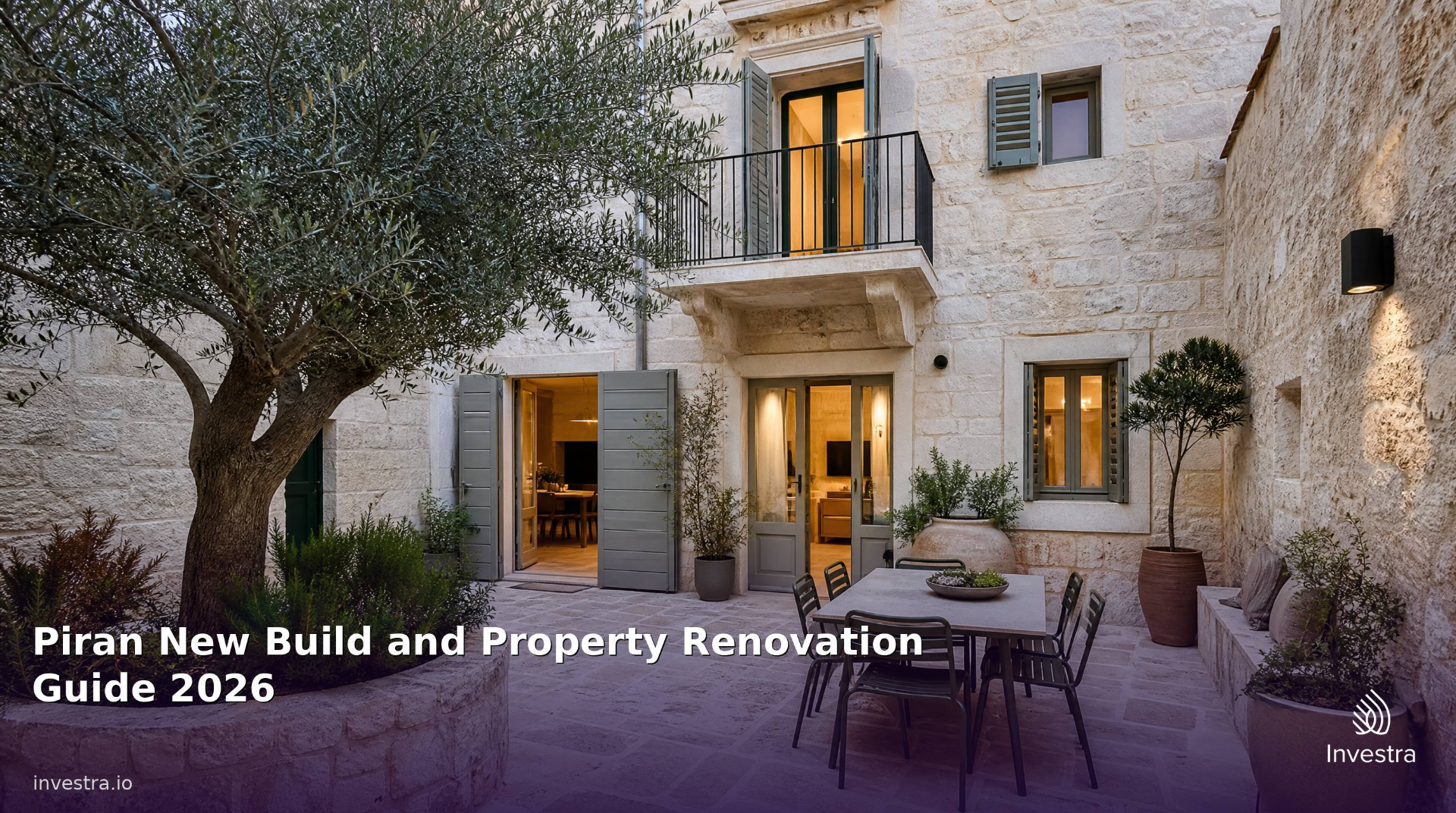
Piran New Build and Property Renovation Guide 2026
Piran New Build and Property Renovation Guide 2026
Piran Real Estate in 2026: Why New Builds and Renovations Are Defining the Market
Quick Answer: Piran's real estate market in 2026 is defined by a tight supply of new builds and a growing renovation opportunity in its UNESCO-listed historic centre, with property prices ranging from €3,500 to over €8,000/m² depending on condition, location, and sea views. Investra.io tracks emerging European markets to help international buyers identify the best entry points.
There's a reason Piran keeps appearing on "Europe's hidden gems" lists — and why those lists are becoming less accurate every year. This compact Venetian-style town on Slovenia's 46-kilometre Adriatic coastline has long attracted artists, romantics, and weekend tourists. What's changed dramatically is the volume of serious capital following them.
The property landscape here is unlike almost anywhere else in Europe. Piran's old town sits on a narrow peninsula with virtually no room for expansion. That physical constraint, combined with strict heritage protection laws, means the supply of properties is essentially fixed. New construction in the traditional sense barely exists within the historic core.
Understanding which path — new build or renovation — makes more financial sense in 2026 requires a detailed look at costs, planning rules, rental yield potential, and the practical realities of working within one of Slovenia's most tightly regulated built environments. That's exactly what this guide covers.
The Piran Property Market: Supply Constraints and Price Dynamics in 2026
Quick Answer: Piran's property market is characterised by extreme supply constraints and steadily rising prices, with average values across the municipality sitting between €4,200 and €6,500/m² in 2026, and premium sea-view properties in the old town regularly exceeding €7,500/m².
To understand why any construction or renovation project in Piran carries such potential, you first need to appreciate just how small and constrained this market truly is. The entire municipality of Piran covers roughly 44 square kilometres, but the old town peninsula — the most desirable address — is barely 600 metres long. The total number of residential properties in the historic centre numbers in the hundreds, not thousands.
Price trends tell the rest of the story. Between 2020 and 2025, residential property values in Piran municipality rose by an estimated 38–45%, outpacing even Ljubljana's celebrated growth trajectory. The Slovenian real estate market as a whole has been robust, but coastal property has been the standout performer.
What's interesting — and what creates opportunity — is the price gap between unrenovated and renovated stock. A dilapidated stone house in the old town might transact at €2,800–€3,500/m² in its current condition, while a fully renovated equivalent with modern installations and maintained Venetian character can command €6,500–€8,500/m². That spread is the renovation premium, and it's what's drawing an increasingly sophisticated class of developer and investor to this market. For context on how other Balkan coastal-adjacent markets are performing, platforms like Zajecar Real Estate Market 2026 Eastern Serbia Property Guide illustrate how different the risk/reward profiles can be across the region.
The rental market reinforces this picture. Short-term holiday rental yields in Piran, when managed professionally, sit at 5–8% gross on well-located, well-renovated properties — healthy numbers for a Western European coastal market. Long-term rental demand is more modest, driven primarily by seasonal workers and locals priced out of ownership.
New Build Development in Piran: Where It's Happening and What It Costs
Quick Answer: True new build development within Piran's historic old town is largely prohibited due to heritage protections, but new residential projects are active in surrounding settlements including Portorož, Lucija, and Strunjan, with new build prices ranging from €4,000 to €6,200/m² depending on finish and proximity to the sea.
Let's be direct about one thing: if you're imagining buying a plot in Piran's old town and constructing a contemporary villa, that's not going to happen. Slovenia's cultural heritage protection framework, combined with the Piran Municipal Spatial Plan, makes new construction within the protected historical zone essentially impossible. The buildings you see on that peninsula today are largely the buildings that will be there in 2050.
The real new build action is happening in the broader Piran municipality, primarily in three areas. Portorož, the larger resort town immediately adjacent to Piran, has several active developments — typically upscale apartment complexes with underground parking, sea-view terraces, and contemporary finishes.
Lucija, a more residential neighbourhood between Portorož and Koper, offers new build apartments at slightly lower price points — typically €3,800–€4,800/m² — with good infrastructure and commuter links. Strunjan, a quieter coastal settlement just north of Piran, has seen boutique development activity, with a handful of small projects offering 5–15 units at premium prices due to the natural landscape protection that limits future supply.
Renovation Projects in Piran's Historic Centre: The Real Opportunity
Quick Answer: Renovating a historic property in Piran's old town offers the strongest value-creation potential in the local market, with well-executed projects achieving end values of €6,500–€8,500/m² against combined acquisition and renovation costs that can fall in the €4,500–€6,000/m² range for experienced buyers.
Here's where things get genuinely interesting. The old town of Piran is a remarkable urban environment — narrow cobblestone lanes, Gothic and Baroque stone buildings, views over the Adriatic, and a UNESCO-recognised cultural heritage status that draws over 1.5 million visitors annually.
These properties represent the defining investment opportunity in Piran real estate right now. A typical candidate might be a 70–120m² stone building on two or three floors, with original architectural features — carved stonework, Venetian arches, terracotta floors — but decades-old plumbing, electrical systems that wouldn't pass a modern inspection, no insulation, and windows that haven't been replaced since the 1970s.
The renovation budget — and this is critical to plan correctly — typically runs at €800–€1,400/m² for a comprehensive project respecting the heritage guidelines. That figure can spike significantly if structural issues are discovered mid-project, if the property requires full masonry restoration, or if the buyer is aiming for high-end finishes. Experienced renovation developers in this market often budget for a 20–25% contingency on top of their initial estimate.
When the numbers work — and they do work when the acquisition price is right and the renovation is well-managed — the returns are compelling. A 90m² property acquired for €280,000 (€3,100/m²), renovated for €110,000 (€1,220/m²), with €30,000 in professional fees, taxes, and financing costs, reaches a total investment of €420,000 (€4,670/m²). Achieving a sale at €550,000–€600,000 (€6,100–€6,670/m²) for a beautifully restored Venetian apartment is entirely realistic in the current market. That's a gross development profit of €130,000–€180,000, or roughly 31–43% on cost — before financing charges but also before tax, which we'll cover separately. For investors comparing risk-adjusted returns across different markets, resources like the Business Strategy Blog by Siniša Dagary — Investment Consultant offer useful frameworks for evaluating these kinds of decisions.
Heritage Protection Rules: What You Can and Cannot Do in Piran
Quick Answer: Any structural or exterior modification to a property within Piran's designated heritage protection zones requires prior approval from the Institute for the Protection of Cultural Heritage of Slovenia (ZVKDS), and non-compliant works can result in mandatory reversal at the owner's expense plus significant fines.
This section deserves serious attention from any buyer considering a renovation project in Piran. The heritage protection framework here is not a bureaucratic formality — it is a comprehensive system with genuine enforcement. ZVKDS maintains an active presence in Piran and regularly inspects ongoing works. Getting this wrong is expensive, time-consuming, and potentially project-destroying.
What the rules mean in practice: the exterior of any building within the protected zone must maintain its historic character. Facade materials, window styles, shutter designs, colour palette — all of these are regulated. You cannot install modern aluminium windows in a Venetian stone building. You cannot change the roofline or add dormer windows without specific justification and approval.
Interior works are somewhat more flexible, but structural changes that affect the building's character or load-bearing elements still require approval. Installing modern kitchens, bathrooms, underfloor heating, and contemporary electrical systems is generally permitted — in fact, it's encouraged as part of responsible stewardship of the building stock.
The approval process typically takes 2–4 months for straightforward projects and can extend to 6–12 months or longer for complex structural works. Every application requires professional architectural drawings prepared by a licensed Slovenian architect, a detailed description of proposed materials and methods, and in many cases a preliminary consultation with ZVKDS before the formal submission.
The practical takeaway? Work with architects and contractors who have specific experience in Piran's heritage context. There's a small network of professionals who know the ZVKDS inspectors, understand the local approval culture, and know which materials suppliers can provide heritage-compliant products. Hiring a general contractor from Ljubljana who has never worked in a protected coastal town is a common mistake that adds months and cost to a project.
Legal Framework for Foreign Buyers: Property Ownership in Slovenia
Quick Answer: EU citizens can purchase property in Slovenia on equal terms with Slovenian nationals, while non-EU buyers can acquire property through a Slovenian-registered company, though the process requires a local notary, standard due diligence, and awareness of Slovenia's property transfer tax and capital gains rules.
Slovenia joined the European Union in 2004, and the property ownership framework for EU nationals is genuinely straightforward. Citizens of EU member states, EEA countries, and Switzerland face no restrictions on purchasing residential or commercial real estate.
For non-EU buyers — Americans, Brits post-Brexit, Canadians, Australians, and others — the most practical route is purchasing through a Slovenian-registered limited liability company (d.o.o.). This adds incorporation costs (typically €1,500–€3,000 for setup) and ongoing accountancy requirements, but it's a well-trodden path that many non-EU investors follow successfully.
For those interested in understanding how property transaction frameworks compare across the broader Balkan region, the Sremska Mitrovica Real Estate 2026 Srem Region Property Guide offers a useful contrast with Serbia's different legal and tax environment.
One area that catches foreign buyers off guard is the mortgage market. Slovenian banks do lend to foreign nationals, but terms are generally less favourable than for residents, and some lenders require a Slovenian bank account and tax number (davčna številka) established well in advance of the purchase.
Renovation Financing and Cost Planning: Building a Realistic Budget
Quick Answer: A comprehensive renovation budget in Piran should account for acquisition costs, 2% transfer tax, architect and heritage approval fees, construction costs of €800–€1,400/m², a 20–25% contingency, and ongoing carrying costs, with total project costs typically falling between €4,500 and €6,500/m² for a finished heritage property.
Let's talk numbers with the directness that investors deserve. The single most common reason renovation projects in Piran either fail commercially or deliver disappointing returns is inadequate cost planning at the outset.
A realistic cost breakdown for a 90m² historic property renovation in Piran's old town in 2026 looks approximately like this. Acquisition at €3,000/m² equals €270,000. Transfer tax at 2% equals €5,400. Legal and notary costs equal €4,000. Architect fees (heritage-compliant design and supervision) equal €14,000. Structural survey and heritage assessment equal €3,500. Planning and ZVKDS approval process costs €2,500 in fees, plus architect time.
That's a tight project. Any structural surprises — and they happen — erode the margin. Any delays in ZVKDS approval push carrying costs higher. Any cost overruns on specialised heritage craftsmanship (and this is where costs spike most frequently) compress the return.
On the financing side, Findes Financial Services is one Slovenian-based firm that specialises in real estate financing solutions for both domestic and international clients, and can be a valuable first conversation for buyers trying to understand what banking options are realistically available in the Slovenian market. For renovation projects specifically, some buyers use a combination of a modest mortgage on the acquisition and then self-fund the renovation — or use a renovation finance facility if their bank offers one.
EU structural funds and Slovenian national heritage incentive programmes are theoretically available for renovation projects in protected zones, but in practice, these schemes are complex, slow, and competitive. Don't build your business case around grant funding unless you have specific professional advice confirming eligibility and realistic timelines. Treat any grants as a potential upside rather than a core assumption.
Short-Term Rental Yields and the Airbnb Economy in Piran
Quick Answer: Well-located, professionally managed short-term rental properties in Piran generate gross yields of 5–8%, with peak season occupancy rates of 85–95% in July and August, though new municipal regulations in 2025–2026 are tightening short-term rental registration requirements and imposing capacity limits in the historic core.
Piran's tourist economy is the engine behind its property investment case. The town attracted approximately 1.6 million visitors in 2024 — an extraordinary figure for a settlement with a permanent population of under 5,000.
The rental yield picture is more nuanced than headline numbers suggest. Peak season — essentially July, August, and a shoulder period running from late June through mid-September — sees occupancy rates close to 100% for well-marketed properties, with nightly rates for a well-renovated 2-bedroom apartment in the old town running €180–€350 per night.
That's not exceptional by global standards, but it comes with capital appreciation that has historically run at 5–8% per annum in this market, making the total return picture considerably more attractive. The risk factors are worth acknowledging: Slovenia's government has been progressively tightening short-term rental regulation, following the pattern of Barcelona, Amsterdam, and other overtouristed European cities.
Taxation of Property Investment in Slovenia: What Foreign Investors Pay
Quick Answer: Property investors in Slovenia pay a 2% transfer tax on purchase, rental income is taxed at a flat 25% rate (or through a company structure), and capital gains from property sold within 20 years of acquisition are taxed on a sliding scale starting at 25% and reducing to zero after 20 years of ownership.
Slovenia's property tax framework is broadly investor-friendly compared to many Western European markets, though there are specifics that catch uninformed buyers. The picture differs depending on whether you own property personally or through a company, and whether your primary activity is passive rental or active development.
For personal ownership: rental income from holiday letting is taxed at a flat 25% on net income (after deducting 10% notional expenses, or actual documented expenses if higher). Capital gains on property sales are taxed at 25% if sold within 5 years of acquisition, declining by 5 percentage points for every subsequent 5-year period — reaching 15% between years 5–10, 10% between years 10–15, 5% between years 15–20, and zero after 20 years.
For development activity conducted through a Slovenian d.o.o. company: corporate income tax is 19% on profits, though the effective rate can be lower with proper tax planning and allowable deductions. VAT registration is required if annual turnover exceeds €50,000 — relevant for developers selling multiple units.
Annual property tax in Slovenia (Nadomestilo za uporabo stavbnega zemljišča, or NUSZ) varies by municipality and property type but is generally modest — typically €200–€800 per year for a residential property in Piran depending on size and zone. It's not a major cost driver but should be included in carrying cost calculations.
For those comparing taxation approaches across regional markets and seeking strategic investment structuring, investment expertise and investment consultation services can provide personalised guidance tailored to specific nationality and investment structure considerations.
Practical Market Conditions and Professional Support for Piran Investors
Quick Answer: Successfully handling Piran's real estate market requires partnership with local professionals including heritage-compliant architects, experienced property lawyers, ZVKDS-familiar contractors, and advisors with established relationships in the coastal investment ecosystem.
On the architectural and heritage side, you need someone who has completed multiple projects within Piran's protected zone, who maintains active working relationships with ZVKDS staff, and who knows which approaches will sail through approval and which will generate months of revision requests. That's not something a generalist architect from Ljubljana can provide, no matter how talented they are.
On the legal side, your property lawyer needs experience with both the transaction documentation (the preliminary agreement, the final purchase deed, title registration) and ideally with rental management structures for short-term letting. Some lawyers also have relationships with local banks and can help negotiate mortgage terms for foreign buyers — a small thing that can save weeks of frustration.
For broader investment structuring, tax planning, and decision-making frameworks around whether to pursue a new build strategy, a renovation path, or rental positioning,
Investment Disclaimer
Quick Answer: This guide is general market information, not personal legal, tax, financing or investment advice.
Before committing to a property transaction, buyers should obtain independent local legal, tax and financial advice suited to their circumstances. Investra.io can support initial market research, but every purchase decision remains the buyer's responsibility.
Frequently Asked Questions
Quick Answer: This section explains the practical property-investment implications of Frequently Asked Questions.
What is a prudent next step after initial market research?
Use current documentation, independent professional advice and comparable local evidence before proceeding. Investra.io can support an initial structured market review.
How can buyers plan a realistic ownership budget?
Use current documentation, independent professional advice and comparable local evidence before proceeding. Investra.io can support an initial structured market review.
What evidence supports a careful investment decision?
Use current documentation, independent professional advice and comparable local evidence before proceeding. Investra.io can support an initial structured market review.
When should a buyer obtain legal and tax advice?
Use current documentation, independent professional advice and comparable local evidence before proceeding. Investra.io can support an initial structured market review.
How should a buyer compare neighbourhoods and property types?
Use current documentation, independent professional advice and comparable local evidence before proceeding. Investra.io can support an initial structured market review.
What local checks should be completed before signing?
Use current documentation, independent professional advice and comparable local evidence before proceeding. Investra.io can support an initial structured market review.
Which costs should be assessed alongside the purchase price?
Use current documentation, independent professional advice and comparable local evidence before proceeding. Investra.io can support an initial structured market review.
How can international buyers verify a property opportunity?
Use current documentation, independent professional advice and comparable local evidence before proceeding. Investra.io can support an initial structured market review.
What should buyers compare before selecting a property?
Use current documentation, independent professional advice and comparable local evidence before proceeding. Investra.io can support an initial structured market review.
Quick Answer: These answers outline common buyer checks and should be read with current professional advice.
Recommended Reading
Quick Answer: This section explains the practical property-investment implications of Recommended Reading.
- Investra market research
- Investra market research
- Investra market research
- Investra market research
- Investra market research
- Investra market research
- Investra market research
- Investra market research
- Investra market research
- Investra market research
- Investra market research
- Investra market research
- Investra market research
- Investra market research
- Investra market research
- Investra market research
- Investra market research
- Siniša Dagary investment insight
- Siniša Dagary investment insight
- Siniša Dagary investment insight
- Siniša Dagary investment insight
- Siniša Dagary investment insight
- Findes Group & Partners
- Findes Group & Partners
Connect With Investra
Follow Investra for market updates on Facebook, LinkedIn, YouTube
Related Posts
No related posts available.
