
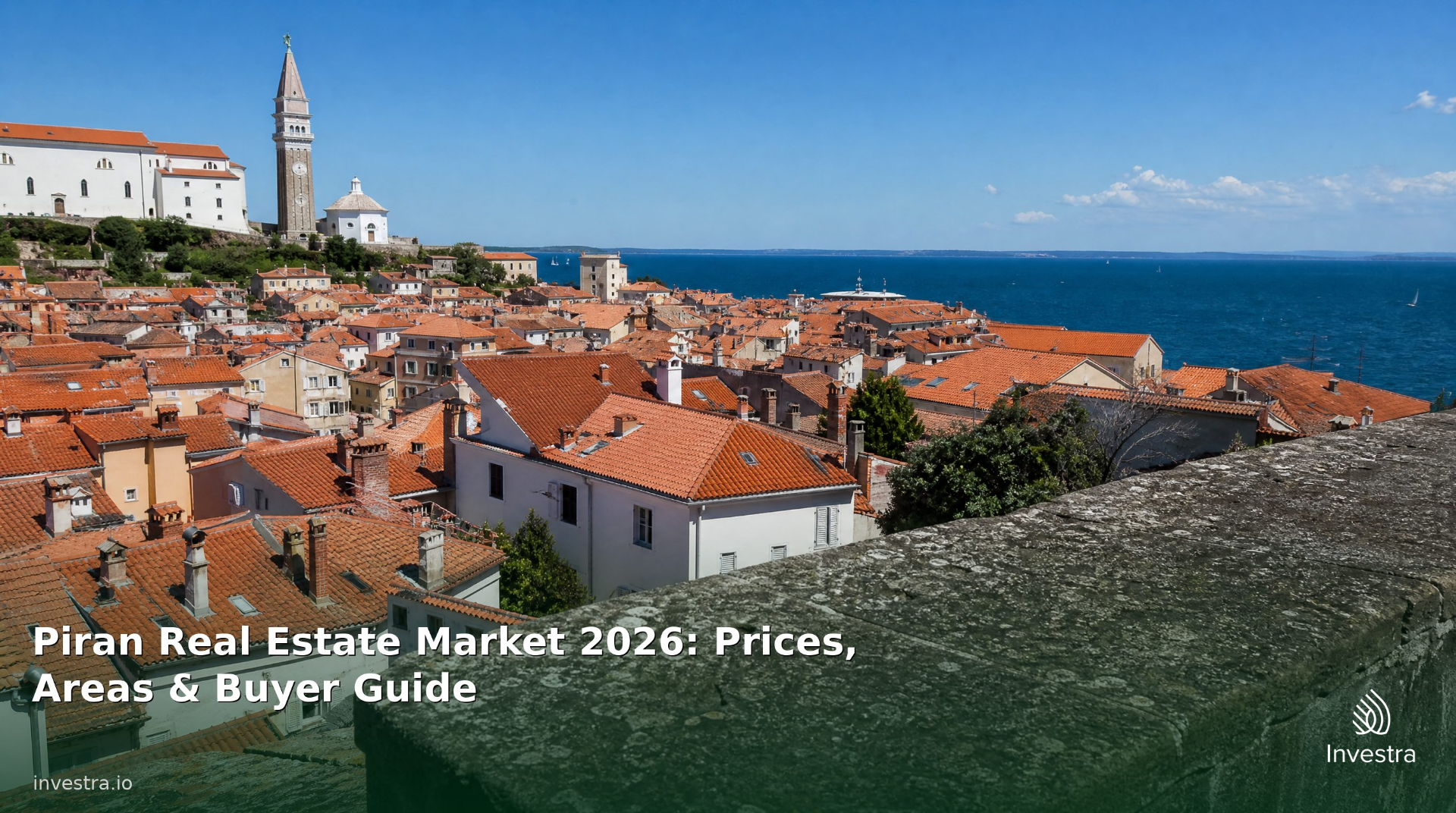
Piran Real Estate Market 2026: Prices, Areas & Buyer Guide
Piran Real Estate Market 2026: Prices, Areas & Buyer Guide
Piran Real Estate Market Overview 2026: Slovenia's Adriatic Crown Jewel
Quick Answer: Piran's real estate market in 2026 is one of the most competitive and premium-priced in Slovenia, with property values ranging from €3,500 to €8,000+ per square meter depending on location, condition, and sea views. Investra.io tracks emerging European property markets to help investors identify the best opportunities at every price point.
There's a reason people fall in love with Piran the moment they see it. Perched on a narrow peninsula jutting into the Adriatic Sea, this medieval Venetian town of roughly 4,500 residents is arguably the most visually striking settlement on Slovenia's tiny 46.6-kilometer coastline.
But here's what serious investors need to understand: Piran isn't just picturesque. It's a fundamentally constrained market. The UNESCO-protected old town cannot expand. There's no room for new construction within the medieval core. Every property that changes hands is, by definition, part of a finite, irreplaceable inventory.
What we've seen in the post-pandemic period is a profound shift in buyer demographics. Wealthy buyers from Austria, Germany, Italy, and increasingly from the Middle East and Asia-Pacific are competing for the same small pool of properties. The result is a seller's market that has pushed average transaction prices well above what many first-time international buyers expect.
The broader Slovenian context matters here too. Slovenia joined the European Union in 2004 and adopted the euro in 2007, providing the monetary and legal stability that cautious international investors demand. Property ownership rights are clear, the judicial system is functional, and the country consistently ranks among the most livable in Central Europe. For investors comparing options across the region — perhaps weighing Piran against emerging markets like those covered in our Bor Real Estate Market 2026 Eastern Serbia Mining City Property Guide — Slovenia represents the premium, lower-risk end of the Central European property spectrum.
Going into 2026, the key market forces are tightening supply, rising construction costs (which make renovation projects increasingly expensive), sustained international demand, and Slovenia's continued growth as both a tourist destination and a residential choice for remote workers and retirees from higher-cost Western European countries.
Property Price Ranges in Piran 2026: What You'll Actually Pay
Quick Answer: In 2026, Piran property prices range from approximately €3,500/m² for inland residential apartments to €7,500–€8,500/m² for prime sea-view properties in the historic old town, making it among the most expensive real estate markets in Slovenia.
Let's cut straight to the numbers, because that's what buyers actually need. The pricing landscape in Piran is far from uniform — there are essentially three distinct tiers that experienced agents recognize immediately, even if listings don't always make this obvious.
Tier 1 — The Old Town Core (Staro Mestno Jedro): This is where the magic — and the premium — concentrates. Apartments and townhouses within the medieval walls, particularly those with sea views, terraces, or proximity to Tartinijev trg (the central square), regularly command €5,500 to €8,500 per square meter.
Tier 3 — Lucija, Seča, and Outer Municipality: The outer zones of Piran municipality, including Lucija (which functionally merges with Portorož) and the quieter settlement of Seča, offer entry points from €2,800–€3,800/m². These areas attract year-round residents more than holiday investors but still benefit from the Piran address and proximity to the sea.
What surprised many buyers entering the 2025–2026 market is how little negotiating power they have in Piran's old town. Well-priced, well-presented properties frequently receive multiple offers. Expect realistic purchase prices to track within 3–5% of listing prices, rather than the 10–15% discounts that might be achievable in less competitive markets like those discussed in our Zajecar Real Estate Market 2026 Eastern Serbia Property Guide.
Neighbourhood Guide: Where to Buy in Piran and Why It Matters
Quick Answer: The most desirable and highest-value areas in Piran are the historic old town core, the waterfront promenade (Prešernovo nabrežje), and properties near Tartinijev trg, while Lucija and Portorož offer more affordable alternatives with excellent rental potential.
Geography shapes everything in Piran, and understanding the micro-geography before committing to a purchase is essential. The peninsula is small — barely 700 meters from the town gate to the lighthouse at the tip — but within that compact footprint, location nuances translate directly into price and rental yield differences.
Prešernovo nabrežje (The Waterfront Promenade): This is Piran's most sought-after address. Properties facing the harbor and open sea on the western side of the peninsula sit at the absolute top of the market.
The Upper Town (Gornje Mesto): The hillside areas above the main tourist circuit attract buyers who want the Piran address and charm without the tourist foot traffic. Properties here tend to be larger, quieter, and slightly more affordable — but they often come with more significant renovation requirements. The views from these elevated positions can be spectacular.
Portorož and Lucija: While technically a separate municipality, Portorož sits immediately adjacent to Piran and functions as its modern, hotel-resort complement. This is where Piran's casino, luxury hotels, a small marina, and the regional airport (Portorož Airport, primarily serving private aviation and seasonal charter flights) are located.
Strunjan and Seča: The nature reserve area of Strunjan, just north of Piran, offers an entirely different proposition — rural Slovenian coastal living with dramatic cliffs and unspoiled beaches. Properties here are rare, highly sought after, and increasingly attractive to buyers seeking privacy over urban amenity.
Foreign Buyer Rules: Can Non-EU Citizens Buy Property in Piran?
Quick Answer: EU citizens can buy property in Slovenia without restrictions, while non-EU buyers face limitations under bilateral treaty agreements, though the rules have gradually liberalized since Slovenia's EU accession — consulting a qualified Slovenian property lawyer is essential before proceeding.
This question comes up constantly, and the answer has more layers than a simple yes or no. Slovenia's property ownership rules have evolved significantly since EU accession, and the current framework in 2026 depends heavily on the buyer's nationality and the type of property being purchased.
EU/EEA Citizens: Full property ownership rights, identical to Slovenian nationals. There are no restrictions whatsoever on EU and EEA citizens purchasing residential or commercial real estate in Slovenia. This applies whether you're buying a Piran apartment as a holiday home, rental investment, or primary residence.
Non-EU Citizens with Bilateral Treaties: Slovenia has entered into bilateral investment treaties and reciprocity agreements with numerous non-EU countries. Citizens of the United States, Switzerland, and several other nations can purchase property under these frameworks, subject to specific conditions.
Citizens Without Treaty Coverage: For nationals of countries without bilateral agreements, direct property purchase is restricted. Common workarounds include establishing a Slovenian or EU-registered company (an SPV — Special Purpose Vehicle) to hold the property.
Agricultural and Forest Land: Separate rules apply to agricultural and forestland, with more restrictive conditions even for EU citizens. Since most Piran old-town transactions involve apartments or townhouses, this is rarely relevant to typical buyers.
The practical recommendation — and this reflects what experienced advisors like Siniša Dagary investment insight consistently emphasize across Central European markets — is to engage a qualified Slovenian notary and property lawyer before making any offer. Don't rely on real estate agents alone for legal interpretation; the agent's interest is in closing the sale, while a lawyer's interest should be in protecting your position.
It's also worth knowing that Slovenia's land registry (Zemljiška knjiga) is digitized, publicly accessible, and relatively reliable. Conducting basic due diligence on ownership history, encumbrances, and registered charges is straightforward compared to many neighboring markets.
The Legal Purchase Process: Step-by-Step in Slovenia
Quick Answer: Buying property in Slovenia follows a clear legal process involving a preliminary purchase agreement, notarized final contract, land registry transfer, and payment of real estate transfer tax, typically taking 2–4 months from offer acceptance to final registration.
The Slovenian property purchase process is orderly by regional standards, but it has specific steps that international buyers need to understand upfront to avoid delays and unexpected costs. Here's what the realistic journey looks like.
Step 1 — Due Diligence and Offer: Before any binding commitment, conduct thorough due diligence. Verify the property's status in the Slovenian land registry (Zemljiška knjiga), check for any encumbrances, pending litigation, heritage protection designations (critical in Piran's old town), and confirm the seller has clear title.
Step 2 — Preliminary Purchase Agreement (Predpogodba): Once due diligence is satisfactory, the buyer and seller sign a preliminary agreement and the buyer pays a deposit — typically 10% of the purchase price. This document is legally binding.
Step 3 — Final Purchase Contract (Kupoprodajna Pogodba): The main contract is drafted (usually by the seller's notary, though buyers can request their own notary review) and signed before a certified Slovenian notary. The notary verifies the identities of parties, reviews the property documentation, and certifies the transaction.
Step 4 — Land Registry Registration: Post-signing, the notary submits the transfer documentation to the Zemljiška knjiga for registration of the new owner. This process typically takes 1–3 months, though it can extend longer in complex cases. The buyer's ownership is formally complete upon registration.
Step 5 — Tax Payment: The buyer is responsible for paying the Real Estate Transfer Tax (Davek na promet nepremičnin) of 2% of the purchase price within 30 days of the notarized contract. VAT (22%) applies instead of transfer tax for new-build properties purchased from a developer.
Total acquisition costs on top of the purchase price typically run 5–8%, which is competitive compared to many Western European markets. Resources like the Siniša Dagary investment insight offer broader context on transaction costs across Central European property markets for comparative analysis.
Rental Yields and Tourism Economy: Piran's Investment Income Potential
Quick Answer: Short-term rental yields in Piran's old town typically range from 4–7% gross annually, with peak-season nightly rates of €120–€350 for well-positioned apartments, though the highly seasonal nature of Adriatic tourism requires careful yield calculation against annual vacancy periods.
Piran's rental market has two very distinct personalities: the frenetic summer peak and the quiet winter off-season. Understanding both is essential before committing to a buy-to-let strategy here.
The numbers during peak season (July–August) are genuinely impressive. A well-positioned two-bedroom apartment with sea views in the old town can command €200–€350 per night on Airbnb or Booking.com. One-bedroom units in good condition run €120–€200.
The seasonal concentration is the yield story's main complication. Occupancy in July and August runs at 85–95% for well-managed properties. May, June, and September are strong shoulder seasons at 60–75% occupancy. October through April, occupancy drops sharply — perhaps 20–35% in the best-case scenario.
Long-term rental (12-month leases) is less profitable but significantly simpler to manage. Monthly long-term rents for a 60m² apartment in Piran old town run approximately €900–€1,400 per month — representing gross yields of roughly 3–4.5% on current purchase prices. The appeal here is stability and minimal management burden.
For investors whose primary interest is yield optimization rather than lifestyle, the calculation increasingly favors comparing Piran against emerging markets where entry prices are lower and yield gaps are wider — markets profiled in our Prokuplje Real Estate Market 2026 Toplica Region Property Guide and similar reports. But for capital preservation combined with personal use, Piran's fundamentals remain compelling.
Capital Appreciation: Has Piran Peaked, or Is There More Upside?
Quick Answer: Piran property has delivered average capital appreciation of 6–9% annually over the 2018–2024 period, and while the pace of growth is expected to moderate slightly in 2026, the structural scarcity of old-town inventory supports continued long-term value preservation and moderate appreciation.
The honest answer to "has Piran peaked?" is: probably not, but the easy gains are behind us. The period from 2018 through 2023 was extraordinary by any measure. Properties that traded at €2,800–€3,200/m² in 2018 were clearing €4,500–€5,500/m² by 2022–2023.
Where does the market go from here? Several structural factors argue for continued, if more moderate, appreciation.
First, supply will never increase in the old town. Heritage protection regulations effectively make new construction within the medieval core impossible. Every earthquake, structural failure, or abandonment actually reduces the total property count rather than increasing it. This is a genuinely unique constraint that underpins long-term value.
Second, Slovenia's tourism trajectory continues upward. The country received approximately 5.8 million tourist arrivals in 2023 (nearly triple its total population), and Piran remains one of the country's top three tourism destinations alongside Ljubljana and Lake Bled.
Third, the relative affordability compared to comparable Adriatic destinations remains. Dubrovnik's old town now trades at €7,000–€12,000/m². Venice proper exceeds €8,000–€15,000/m² for comparable historic properties. Piran, despite its premium positioning, still appears reasonably priced to buyers arriving from Italian, French, or Croatian coastal benchmarks.
The risk factors? Rising interest rates throughout Europe have cooled buyer enthusiasm in some segments. Political and economic uncertainty at the EU level creates periodic hesitation. And there's a legitimate question about whether Piran's tourism infrastructure can absorb further visitor growth without degrading the quality of experience that makes it desirable in the first place. Sustainable tourism is a genuine policy concern for the municipality, and potential restrictions on tourist flows or short-term rentals could affect yield projections. For a comprehensive look at how technology and data analytics are reshaping property investment decisions across the region, the Serbia Proptech 2026 How Technology Is Changing Real Estate analysis offers valuable context on emerging tools available to investors.
Taxes, Costs, and Financial Planning for Piran Property Owners
Quick Answer: Property owners in Slovenia pay real estate transfer tax of 2% on purchase, annual property tax (Nadomestilo za uporabo stavbnega zemljišča) ranging from modest amounts depending on municipality and property type, plus income tax on rental earnings at 25% of the assessed income base after a 10% expense deduction allowance.
Getting the tax picture right before purchasing is non-negotiable — and the good news is that Slovenia's property tax framework, while not simple, is at least transparent and well-documented compared to many Central European alternatives.
Real Estate Transfer Tax: 2% of the contractually agreed purchase price (or market value if assessed higher by the tax authority). Paid by the buyer within 30 days of notarized contract. For new constructions purchased directly from a developer, 22% VAT applies instead, with no transfer tax.
Annual Property Charges (NUSZ — Nadomestilo za uporabo stavbnega zemljišča): This is Slovenia's closest equivalent to an annual property tax. It's levied by municipalities based on a complex formula considering the property's building plot, location category, and usage type.
Rental Income Tax: Rental income earned in Slovenia is taxed under the Personal Income Tax Act. The current regime allows a 10% flat expense deduction, with the remaining 90% of gross rental income subject to a 25% withholding tax. Effective tax rate on gross rental revenue is therefore approximately 22.5%.
Capital Gains Tax: Property sold within 5 years of purchase attracts capital gains tax, starting at 25% and declining by 5 percentage points for each subsequent year held (20% in year 6, 15% in year 7, 10% in year 8, 5% in year 9). Properties held for 20 or more years are exempt from capital gains tax entirely.
For professional guidance on structuring cross-border property investments across the region — including tax-efficient holding structures and estate planning considerations — the expertise available through Findes Group & Partners provides specialized financial services relevant to Slovenian and regional property investors. Similarly, consulting resources like Siniša Dagary investment insight can provide strategic-level guidance on portfolio construction across Central and Eastern European markets.
Renovation and Heritage Protection: The Hidden Complexity of Old-Town Purchases
Quick Answer: Properties within Piran's protected heritage zone require permits from the Institute for the Protection of Cultural Heritage of Slovenia, strict adherence to architectural guidelines, and specialized contractors, typically adding 30–50% to standard renovation costs and extending timelines by 6–12 months.
Here's a critical realization that many international buyers discover only after purchasing: renovation in Piran's old town is not the same as renovation anywhere else in Europe. The entire medieval core is a designated cultural heritage site. The individual buildings are protected. Even internal alterations face oversight.
Every external modification — new windows, roof repairs, facade repainting, door replacements — requires written approval from the Institute for the Protection of Cultural Heritage of Slovenia (ZVKDS). Even internal changes that affect the structural character (removing walls, installing modern kitchen finishes) can trigger the heritage permission process.
In practical terms, what costs €8,000–€12,000 in a standard Slovenian apartment might cost €15,000–€25,000 in a Piran old-town property. A six-month renovation becomes a twelve-month project.
For buyers purchasing unrenovated properties at lower entry prices (the €3,500–€4,200/m² range), the real-world total cost of ownership — purchase plus required renovation — approaches the price of buying a pre-renovated property in better condition. This calculation should inform your negotiating strategy and property selection.
One mitigation: hire a local heritage renovation specialist to inspect any unrenovated property before committing.
Investment Disclaimer
Quick Answer: This guide is general market information, not personal legal, tax, financing or investment advice.
Before committing to a property transaction, buyers should obtain independent local legal, tax and financial advice suited to their circumstances. Investra.io can support initial market research, but every purchase decision remains the buyer's responsibility.
Frequently Asked Questions
Quick Answer: This section explains the practical property-investment implications of Frequently Asked Questions.
What is a prudent next step after initial market research?
Use current documentation, independent professional advice and comparable local evidence before proceeding. Investra.io can support an initial structured market review.
How can buyers plan a realistic ownership budget?
Use current documentation, independent professional advice and comparable local evidence before proceeding. Investra.io can support an initial structured market review.
What evidence supports a careful investment decision?
Use current documentation, independent professional advice and comparable local evidence before proceeding. Investra.io can support an initial structured market review.
When should a buyer obtain legal and tax advice?
Use current documentation, independent professional advice and comparable local evidence before proceeding. Investra.io can support an initial structured market review.
How should a buyer compare neighbourhoods and property types?
Use current documentation, independent professional advice and comparable local evidence before proceeding. Investra.io can support an initial structured market review.
What local checks should be completed before signing?
Use current documentation, independent professional advice and comparable local evidence before proceeding. Investra.io can support an initial structured market review.
Which costs should be assessed alongside the purchase price?
Use current documentation, independent professional advice and comparable local evidence before proceeding. Investra.io can support an initial structured market review.
How can international buyers verify a property opportunity?
Use current documentation, independent professional advice and comparable local evidence before proceeding. Investra.io can support an initial structured market review.
What should buyers compare before selecting a property?
Use current documentation, independent professional advice and comparable local evidence before proceeding. Investra.io can support an initial structured market review.
Quick Answer: These answers outline common buyer checks and should be read with current professional advice.
Recommended Reading
Quick Answer: This section explains the practical property-investment implications of Recommended Reading.
- Investra market research
- Investra market research
- Investra market research
- Investra market research
- Investra market research
- Investra market research
- Investra market research
- Investra market research
- Investra market research
- Investra market research
- Investra market research
- Investra market research
- Investra market research
- Investra market research
- Investra market research
- Investra market research
- Investra market research
- Siniša Dagary investment insight
- Siniša Dagary investment insight
- Siniša Dagary investment insight
- Siniša Dagary investment insight
- Siniša Dagary investment insight
- Findes Group & Partners
- Findes Group & Partners
Connect With Investra
Follow Investra for market updates on Facebook, LinkedIn, YouTube
Related Posts
No related posts available.
