
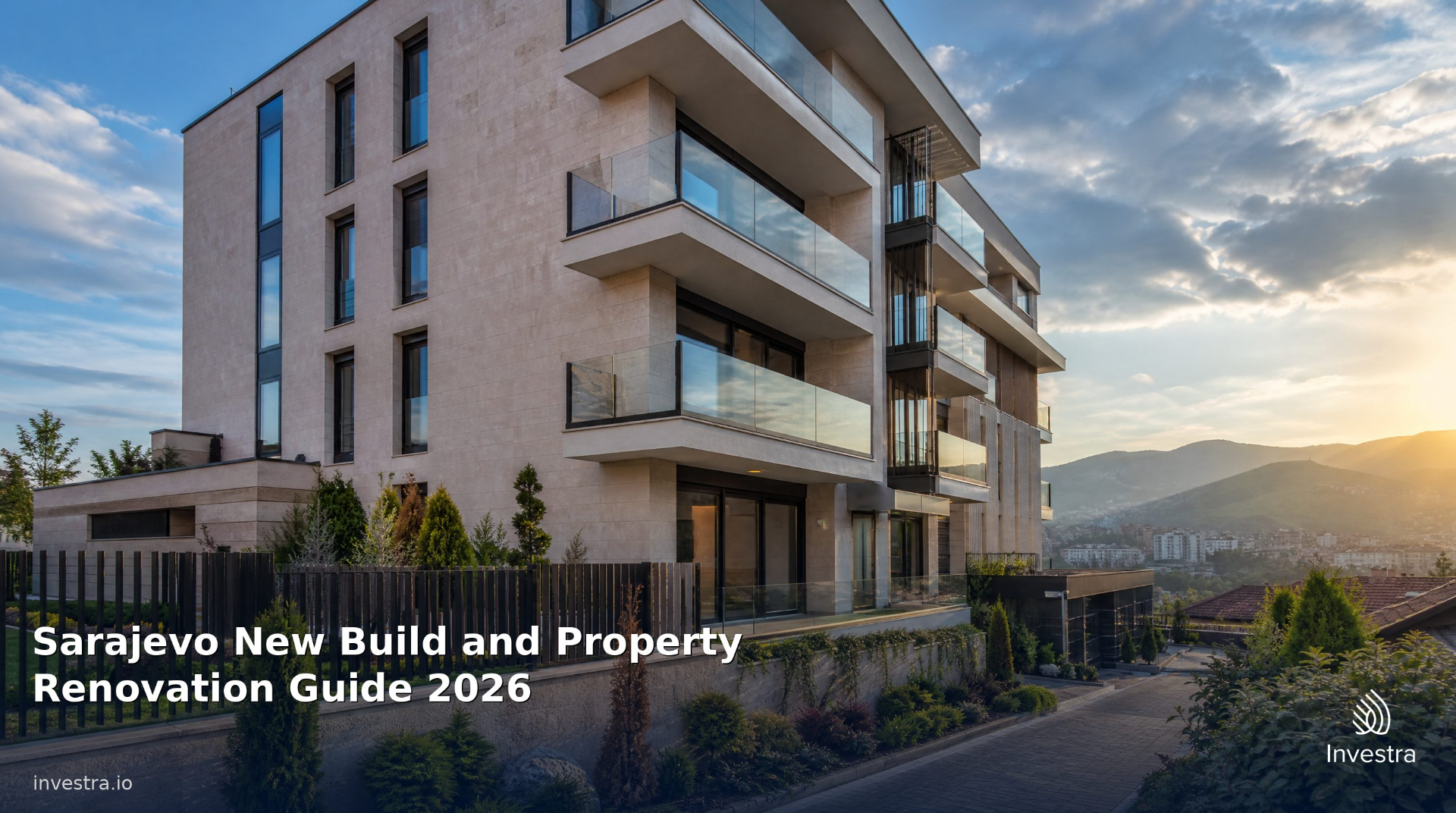
Sarajevo New Build and Property Renovation Guide 2026
Sarajevo New Build and Property Renovation Guide 2026
Sarajevo New Build and Property Renovation Market Overview 2026
Quick Answer: Sarajevo's new build and renovation property market in 2026 presents compelling opportunities, with new construction prices ranging from €1,200 to €3,500/m² and renovation projects offering ROI potential of 15–35% in the right neighbourhoods. Investra.io tracks emerging Balkan property markets to help investors identify high-value opportunities before prices peak.
Sarajevo is experiencing genuine momentum in its property market. The Bosnian capital—once synonymous with its tragic 1990s siege—has rewritten its narrative almost entirely, and what we're seeing now is a city in the middle of a tangible physical transformation. New residential towers are rising in Ilidža and Novo Sarajevo. Old Austro-Hungarian apartment blocks in Grbavica are being gut-renovated and flipped for 40–60% premiums.
Sarajevo is no longer a frontier market curiosity—it's a functioning real estate ecosystem with genuine development activity, measurable rental demand, and consistent transaction volume. Prices have been rising, yes, but they remain dramatically below comparable European capitals. That gap is closing. Understanding whether to buy new build or pursue a renovation project—and where, and for how much—is the core question this guide addresses.
Why Sarajevo Property Is Attracting Global Attention in 2026
Quick Answer: Sarajevo draws international property investors due to its undervalued price-to-yield ratios, growing tourism infrastructure, EU candidate country status for Bosnia and Herzegovina, and a chronic undersupply of quality residential and short-term rental stock in prime areas.
The investment fundamentals are compelling. Bosnia and Herzegovina received EU candidate status in December 2022—a political milestone that historically accelerates foreign direct investment inflows and property price appreciation across emerging economies. The path to EU accession is lengthy and complex, but the candidate status signal alone tends to revalue local assets over a 5–10 year horizon, as demonstrated in Bulgaria, Romania, and Montenegro's development trajectories.
Sarajevo specifically benefits from several converging trends. The city functions as a genuine cultural and tourism magnet, with its unique blend of Ottoman, Austro-Hungarian, Yugoslav, and modern architecture drawing international visitors in ways few Balkan cities can replicate. Tourist arrivals exceeded 580,000 in 2024, approaching pre-pandemic records and growing at roughly 12% year-on-year.
Beyond tourism, genuine domestic middle-class housing demand exists. Sarajevo's urban population of approximately 350,000 has been underserved by quality new residential development for years. The chronic undersupply of modern apartments meeting EU-standard construction norms has created a two-tier market where new builds command substantial premiums.
A substantial discovery for many recent arrivals is how much prime renovation stock remains untouched. Central Grbavica, portions of Bjelave, and much of Kovači still contain buildings from the 1920s–1960s that have seen minimal improvement since the war's conclusion. The upside potential in selective renovation plays is substantial, with comparisons to Lisbon in the early 2010s or Tbilisi circa 2017 not entirely far-fetched for patient investors.
New Build Property in Sarajevo: Prices, Locations, and What to Expect in 2026
Quick Answer: New build apartments in Sarajevo range from €1,200/m² in outer suburbs like Ilidža to €3,200–€3,500/m² for premium developments in Novo Sarajevo and Centar municipality, with average quality new construction sitting between €1,800–€2,400/m² across the city.
The new build landscape in Sarajevo is more segmented than many buyers initially expect. It comprises several distinct micro-markets stacked on top of one another, each with different buyer profiles, price points, and investment logic.
Centar Municipality is where the most expensive new construction is found. Developments here regularly price above €2,800/m², and select premium projects—particularly those with underground parking, energy efficiency certifications, and comprehensive amenity packages—have tested the €3,500/m² ceiling. The buyer pool for these units is almost entirely composed of local upper-middle-class professionals and diaspora returnees.
Novo Sarajevo represents arguably the most active new build zone in the city currently. Positioned along the Miljacka river corridor east of the centre, this municipality has experienced significant residential tower development during the 2021–2026 period. Average new build prices here sit between €2,000–€2,600/m², and developers have been selling out pre-construction phases within 6–9 months of launch—absorption rates that signal genuine demand pressure rather than speculative activity.
Ilidža , located westward along the tram line, offers the city's most affordable new construction. Prices range €1,200–€1,800/m² for quality builds, making it a logical entry point for buyers seeking new construction standards without Centar premiums. The municipality has developed steadily since 2018 and benefits from excellent transport links and airport proximity.
Stari Grad (Old Town) has very limited new construction activity due to stringent heritage protection regulations, but what exists commands extraordinary premiums—north of €3,000/m² for anything genuinely modern built within the old town boundary. Most activity in this zone is renovation-based.
Developers worth monitoring include Bosna Commerce, Integra, and several regional construction groups active across the Adriatic-Balkan corridor. Pre-sales typically require 20–30% deposits, with construction timelines of 18–36 months being standard across quality projects.
Property Renovation in Sarajevo: Opportunities, Costs, and Realistic Returns
Quick Answer: Renovation projects in Sarajevo's central and old-town neighbourhoods can yield 15–35% ROI when executed well, with full gut renovation costs running €400–€900/m² depending on specification level, and finished renovated apartments commanding €2,000–€4,000/m² in prime locations.
The renovation play in Sarajevo represents where substantive opportunity exists for sophisticated investors in 2026. This opportunity is built on straightforward arbitrage: older apartments in prime locations are frequently priced at €700–€1,200/m² in unrenovated condition. A quality renovation brings them to market at €2,000–€3,500/m² for sale, or positions them to generate €600–€1,200/month in short-term rental income.
The mathematics on a typical Baščaršija or Grbavica renovation project breaks down as follows: acquire a 55m² apartment for €55,000–€65,000 (roughly €1,000–€1,180/m²), invest €30,000–€45,000 in quality full renovation (approximately €550–€800/m²), and finish with a unit worth €130,000–€165,000 (€2,400–€3,000/m²). That translates to gross profit margins of €30,000–€60,000 on total project costs of €85,000–€110,000.
The short-term rental dimension makes renovation even more compelling. A well-finished 55m² apartment in Baščaršija or near the Latin Bridge can realistically generate €60–€100/night on Airbnb and Booking.com platforms, with occupancy rates of 60–75% in the current market. This translates to annual gross rental income of €13,000–€27,000—yields of 10–25% on all-in project costs. Even after accounting for platform fees, cleaning, and management, net yields of 7–14% are achievable.
Renovation costs vary significantly by specification level. A basic renovation (new electrics, plumbing, flooring, paint, kitchen) runs €350–€450/m². A mid-range renovation with quality European fixtures, new windows, and modern bathroom suites costs €500–€650/m². Premium renovation featuring boutique hotel-style finishes, smart home integration, and custom woodwork can run €750–€950/m².
Investors with experience in other Balkan renovation markets—including those working within the Sremska Mitrovica Real Estate 2026 Srem Region Property Guide context or broader Serbian markets—consistently report that Sarajevo's renovation quality and contractor ecosystem is more mature than many comparable Balkan cities.
Best Neighbourhoods for New Build and Renovation Investment in Sarajevo
Quick Answer: The strongest neighbourhoods for property investment in Sarajevo in 2026 are Baščaršija/Stari Grad for high-yield renovation plays, Novo Sarajevo for new build growth, Grbavica for mixed strategy value, and Ilidža for affordable new construction with stable long-term rental demand.
Location selection is where investment theses either solidify or collapse in practice. Sarajevo's geography—a long, narrow valley carved by the Miljacka river—creates distinct micro-markets within relatively short distances. A 15-minute drive can mean a 50% per-square-metre price differential.
Baščaršija and Stari Grad remain the crown jewel for renovation investors. This is Sarajevo's historic, pedestrianised core—home to coppersmith workshops, mosques, Ottoman-era commercial buildings, and that unmistakable atmosphere making the city feel unlike anywhere else in Europe. Short-term rental demand here is structural and accelerating. Heritage protection status limits supply of quality accommodation, meaning well-finished apartments command exceptional nightly rates.
Grbavica sits directly south of the river and centre, blending pre-war residential architecture with socialist-era apartment blocks. It's rapidly gentrifying. Young professionals, expats working for international organisations, and diaspora buyers are driving renovation activity. The neighbourhood features excellent café culture, proximity to the university, and walkable access to the centre.
Marijin Dvor functions as Sarajevo's emerging upscale business district, home to the Holiday Inn, major banks, and government buildings. Apartments here are predominantly long-term rental territory—corporate tenants, diplomatic staff, and NGO workers create stable demand foundations. New build prices in the €2,400–€3,200/m² range are justified by tenant quality and rental stability metrics.
Kovači and Bjelave, positioned uphill from Baščaršija, appeal to more adventurous investors—less developed, more authentically local, with spectacular city views. These areas suit buyers with longer time horizons (5–8 years) and tolerance for slower supply chain development. Entry prices can be as low as €600–€900/m² for unrenovated stock, making the upside arithmetic particularly compelling for patient capital.
The neighbourhood selection logic aligns with approaches discussed in the Aleksinac Real Estate Market 2026 Southern Serbia Property Guide—understanding the specific micro-economic drivers of each district before committing capital proves far more important than citywide averages.
Legal Framework for Foreign Buyers: Buying New Build and Renovated Property in Bosnia
Quick Answer: Foreign nationals can legally purchase residential property in Bosnia and Herzegovina with some restrictions—EU and reciprocity-country nationals have the clearest path, while others may need to establish a local company. The purchase process involves a Sales Agreement, land registry registration, and notarization, typically completing in 2–8 weeks.
Bosnia's property ownership rules for foreigners are more navigable than many assume, though the country's complex federal structure—divided between the Federation of BiH and Republika Srpska, with the Brčko District as a separate administrative unit—means rules can vary by entity. Sarajevo falls within the Federation of BiH jurisdiction.
Under Federation of BiH law, foreign nationals from countries with reciprocity agreements with Bosnia—this encompasses most EU countries, the UK, USA, Canada, Australia, and most other developed nations—can purchase residential and commercial property on broadly equivalent terms to Bosnian citizens. The reciprocity principle operates as the legal mechanism: if Bosnia's citizens can buy property in your country, you can acquire property in Bosnia.
For renovation property, additional due diligence is essential. Bosnia's land registry system, while modernized significantly since 2005, still occasionally contains discrepancies between registry records and actual property conditions, particularly for older buildings.
Transaction costs for buyers include a 5% real estate transfer tax (on resale properties—new builds from VAT-registered developers are instead subject to 17% VAT, typically included in the listed price), notary fees of approximately 0.1–0.3% of transaction value, and land registry fees. Total transaction costs on a resale property typically run 6–8% of the purchase price.
Resources like About Siniša Dagary provide useful context on regional investment legal frameworks, helping buyers understand how Bosnia's approach compares to neighbouring markets and broader Balkan property law.
Financing, Mortgages, and Investment Structuring for Sarajevo Property
Quick Answer: Foreign buyers in Sarajevo typically self-fund or bring capital from their home country, as local mortgage financing for non-residents is limited. Bosnian banks offer mortgage rates of 4.5–7% for eligible domestic buyers, while international investors often use equity from existing assets or specialist cross-border lenders.
Financing represents probably the most significant practical limitation for foreign buyers entering the Sarajevo market. This is fundamentally a cash-heavy market by regional comparison.
The practical reality for most international buyers is that they arrive with capital—either from savings, equity release on existing properties in their home countries, or via specialist lenders in more liquid markets. The Findes Financial Services platform exemplifies the cross-border financial services providers that can help structure capital deployment across emerging European markets including the Western Balkans and Central Europe.
For domestic Bosnian buyers and resident foreigners, mortgage access is relatively straightforward. UniCredit Bank BH, Raiffeisen Bank Bosnia, and NLB Banka rank among the most active mortgage lenders. Rates in 2025–2026 have stabilised in the 4.5–6.5% range for qualified borrowers, with LTV ratios typically capped at 70–80% of assessed value. Construction phase financing for new builds exists but typically requires greater documentation and progress certification.
For renovation projects specifically, certain local banks offer renovation loan products that can be drawn down in tranches as work progresses. These typically carry slightly higher rates (5.5–7%) than standard mortgages and require detailed architect-certified renovation plans, building permits, and contractor agreements before funds are released. The administrative overhead is substantial, but the products exist for qualified borrowers.
Sophisticated investors are increasingly exploring corporate purchase structures—establishing a Bosnian d.o.o. (limited liability company, roughly equivalent to a UK Ltd or German GmbH) to hold property. This approach opens additional financing pathways and can offer VAT recovery advantages on certain renovation costs. The corporation tax rate in Bosnia at 10% represents one of Europe's lowest, making company structures attractive for larger portfolios and long-term holdings.
Renovation Permits, Planning Regulations, and Building Codes in Sarajevo
Quick Answer: Renovation permits in Sarajevo are required for any structural work, exterior changes, or additions to existing buildings—minor internal renovations typically don't require permits, but significant works need approval from the relevant canton's urban planning authority, a process that typically takes 4–16 weeks.
Anyone who's renovated property in a post-Yugoslav city understands that the permit process merits dedicated attention. Sarajevo's regulatory framework is more complex than many Western European cities because administrative authority splits between municipal, cantonal, and federal levels—and jurisdictional boundaries aren't always apparent from outside the system.
For properties within Sarajevo Canton, the general framework operates as follows: minor internal renovations (redecorating, non-structural partition changes, kitchen and bathroom refits that don't alter plumbing routes) can typically proceed without formal permits. Anything touching structural elements, load-bearing walls, building envelope, or building systems requires a formal renovation permit (građevinska dozvola za rekonstrukciju).
The permit application requires an architect-prepared technical project (Glavni projekat), which must be certified by a licensed architect and structural engineer. Once submitted, the relevant municipality typically has a legal obligation to respond within 30–60 days, though in practice timelines often stretch to 3–5 months for more complex projects.
Experienced renovators recommend budgeting 8–12% of total renovation cost as a "permit and professional fees" line item—covering architect fees, technical project preparation, structural engineer sign-off, permit fees, and supervision costs through the construction phase. Attempting to cut corners typically produces larger problems downstream, particularly at land registry update or sale stages.
Rental Market Analysis: Short-Term vs Long-Term Yields in Sarajevo 2026
Quick Answer: Sarajevo offers rental yields of 5–8% for long-term residential rentals and 9–16% gross for well-managed short-term rental properties in tourist zones, making it one of the highest-yielding capital city markets in the Western Balkans for 2026.
The rental market in Sarajevo has genuinely bifurcated, and understanding which strategy fits your property type and location is probably the most important yield decision investors will face. The two markets possess quite different risk and return profiles.
The long-term residential rental market is driven by domestic demand: Sarajevo University students, young professionals, and families not yet able to afford purchase. Average long-term rents in central Sarajevo for quality one-bedroom apartments run €450–€700/month, two-bedrooms €600–€950/month, and three-bedrooms €800–€1,300/month depending on location and finish quality. In Ilidža and outer municipalities, figures drop 20–30%.
The short-term rental market generates genuinely exciting numbers. Sarajevo's positioning as a year-round destination—winter sports at Jahorina and Bjelašnica mountains, summer cultural tourism, and growing conference sectors—creates demand patterns sustaining decent occupancy outside peak summer windows. Average daily rates for quality 1-bedroom apartments near Baščaršija run €55–€90/night, with peak season (June–September) hitting €80–€130.
This short-term rental yield advantage is comparable to what's been observed in other reviving Balkan cities, as explored in detail in the Zajecar Real Estate Market 2026 Eastern Serbia Property Guide and related analyses of yield dynamics across the region. Explore additional market perspectives through Bor Real Estate Market 2026 Eastern Serbia Mining City Pr..., Prokuplje Real Estate Market 2026 Toplica Region Property..., and Loznica Real Estate Market 2026 Macva Region Property Guide.
For comprehensive market insights, Serbia Proptech 2026 How Technology Is Changing Real Estate documents how technology adoption is reshaping regional real estate investment efficiency. Additional perspectives on emerging trends include Serbia Co Living Investment 2026 New Trend In Belgrade Re... and Serbia Green Real Estate 2026 Eco Friendly Properties Sus....
For renovation-focused investors, Serbia Property Renovation Guide 2026 Costs Permits Best ... provides detailed cost frameworks and contractor vetting guidance applicable across the region. Related resources include Serbia Building Permits 2026 How
Investment Disclaimer
Quick Answer: This guide is general market information, not personal legal, tax, financing or investment advice.
Before committing to a property transaction, buyers should obtain independent local legal, tax and financial advice suited to their circumstances. Investra.io can support initial market research, but every purchase decision remains the buyer's responsibility.
Frequently Asked Questions
Quick Answer: This section explains the practical property-investment implications of Frequently Asked Questions.
What is a prudent next step after initial market research?
Use current documentation, independent professional advice and comparable local evidence before proceeding. Investra.io can support an initial structured market review.
How can buyers plan a realistic ownership budget?
Use current documentation, independent professional advice and comparable local evidence before proceeding. Investra.io can support an initial structured market review.
What evidence supports a careful investment decision?
Use current documentation, independent professional advice and comparable local evidence before proceeding. Investra.io can support an initial structured market review.
When should a buyer obtain legal and tax advice?
Use current documentation, independent professional advice and comparable local evidence before proceeding. Investra.io can support an initial structured market review.
How should a buyer compare neighbourhoods and property types?
Use current documentation, independent professional advice and comparable local evidence before proceeding. Investra.io can support an initial structured market review.
What local checks should be completed before signing?
Use current documentation, independent professional advice and comparable local evidence before proceeding. Investra.io can support an initial structured market review.
Which costs should be assessed alongside the purchase price?
Use current documentation, independent professional advice and comparable local evidence before proceeding. Investra.io can support an initial structured market review.
How can international buyers verify a property opportunity?
Use current documentation, independent professional advice and comparable local evidence before proceeding. Investra.io can support an initial structured market review.
What should buyers compare before selecting a property?
Use current documentation, independent professional advice and comparable local evidence before proceeding. Investra.io can support an initial structured market review.
Quick Answer: These answers outline common buyer checks and should be read with current professional advice.
Recommended Reading
Quick Answer: This section explains the practical property-investment implications of Recommended Reading.
- Investra market research
- Investra market research
- Investra market research
- Investra market research
- Investra market research
- Investra market research
- Investra market research
- Investra market research
- Investra market research
- Investra market research
- Investra market research
- Investra market research
- Investra market research
- Investra market research
- Investra market research
- Investra market research
- Investra market research
- Siniša Dagary investment insight
- Siniša Dagary investment insight
- Siniša Dagary investment insight
- Siniša Dagary investment insight
- Siniša Dagary investment insight
- Findes Group & Partners
- Findes Group & Partners
Connect With Investra
Follow Investra for market updates on Facebook, LinkedIn, YouTube
Related Posts
No related posts available.
