
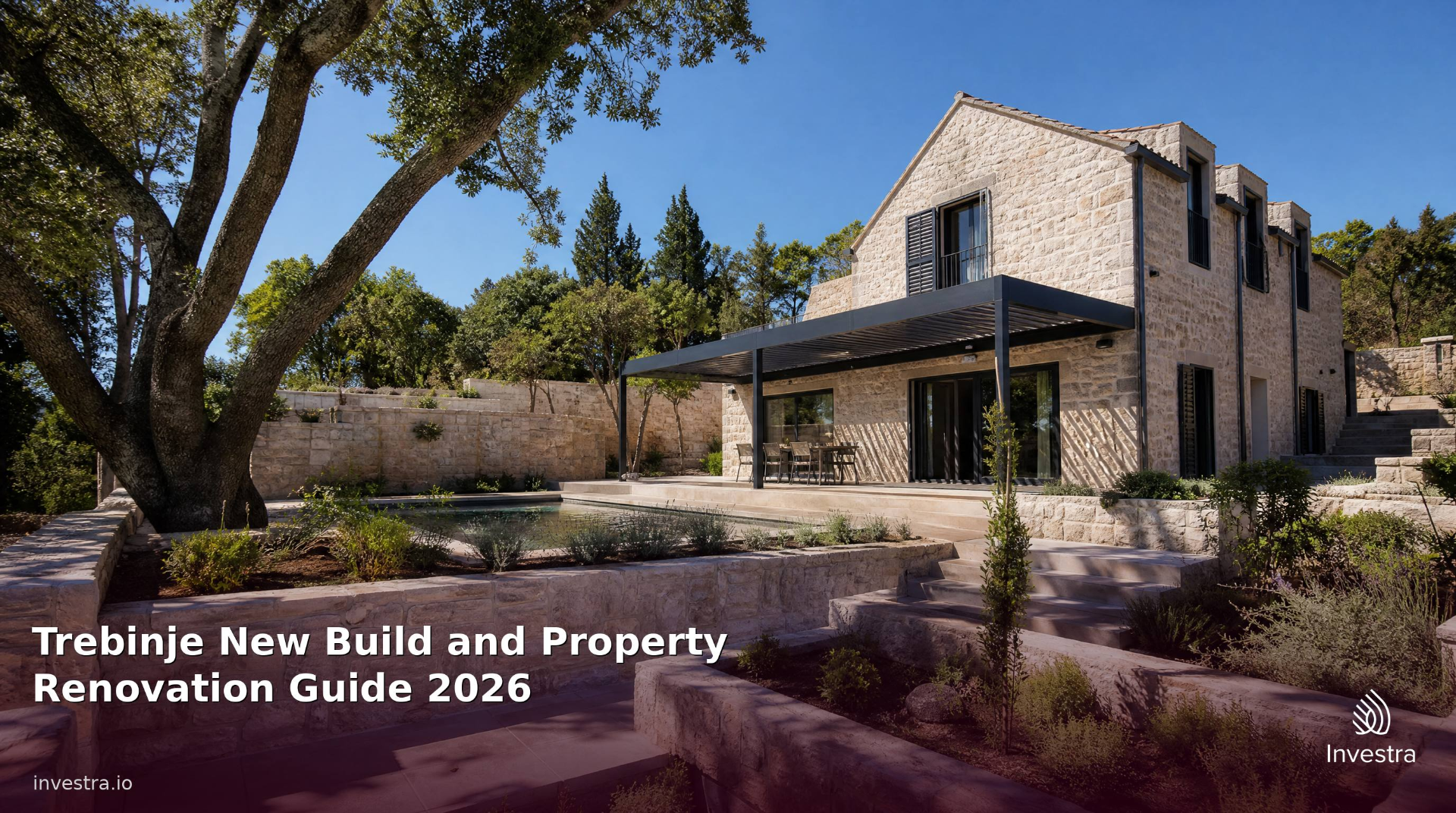
Trebinje New Build and Property Renovation Guide 2026
Trebinje New Build and Property Renovation Guide 2026
Trebinje Real Estate Market Overview: Why This Herzegovinian City Matters in 2026
Quick Answer: Trebinje offers compelling new build and renovation opportunities with property prices ranging from €800 to €2,500/m² depending on location and finish quality — a market dramatically undervalued compared to Dubrovnik just 30 kilometres away, yet with genuine fundamentals driving sustainable appreciation. Investra.io tracks emerging Balkan markets to provide investors with data-driven competitive intelligence.
Trebinje isn't featured prominently at mainstream European property investment conferences. That absence is precisely what makes it compelling. Situated in the southernmost portion of Bosnia and Herzegovina's Republika Srpska entity, this sun-soaked city of approximately 35,000 residents occupies a Mediterranean microclimate more aligned with the Adriatic coast than inland Balkans — yet property valuations still reflect the latter geography.
The city has maintained steady new residential construction, while its historic Stari Grad (Old Town) presents substantial renovation opportunities for Ottoman-era stone properties. The 2026 market stands at a meaningful inflection point. Prices have appreciated significantly yet haven't reached the valuation threshold where fundamental value vanishes.
Current Market Dynamics and Price Trajectories
Quick Answer: The Trebinje property market in 2026 is characterised by steady annual appreciation of 8–12%, constrained new supply, and rising demand from both domestic buyers and international investors attracted by the city's Mediterranean positioning and EU-adjacent location within the Balkans.
The numerical evidence tells a compelling story. Contemporary apartment valuations in Trebinje's central districts now range between €1,200 and €1,800 per square metre for new or recently renovated units, while distressed or substantially deferred-maintenance apartments remain available at €700–€1,000/m².
Multiple reinforcing factors drive this market momentum. Trebinje has historically served as a retirement and weekend residence destination for Sarajevans and Belgrade residents valuing its climate—roughly 250 annual sunny days, Mediterranean temperature patterns, and the visual drama of the Trebišnjica River's limestone karst landscape. Completed transportation improvements connecting to Dubrovnik Airport (approximately 45 minutes' distance) have materially expanded the international buyer geographic catchment.
For investors tracking comparative regional Balkan market dynamics—particularly those familiar with Zajecar Real Estate Market 2026 Eastern Serbia Property Guide—the Trebinje trajectory demonstrates the consistent pattern: cities possessing authentic heritage characteristics, advancing infrastructure, and proximity to significant economic anchors consistently demonstrate superior multi-year performance relative to generic suburban markets.
The price-to-comparable-market differential remains extraordinarily pronounced. Split, Croatia averages €4,000–€5,500/m² for equivalent quality. Dubrovnik commands €6,000–€10,000/m² in optimal neighbourhoods. Trebinje's 30-kilometre proximity to such premium markets—combined with its autonomous aesthetic magnetism—creates a structurally-embedded arbitrage opportunity rather than ephemeral market mispricing.
New Build Developments: Active Construction and Off-Plan Opportunities
Quick Answer: Multiple residential complexes are under active construction in Trebinje throughout 2026, with off-plan pricing spanning €1,100 to €1,600/m², permitting investors to establish pre-completion pricing before handover-driven appreciation materialises.
Trebinje's new construction sector reflects a geographically constrained developer ecosystem—presenting both material advantages and demonstrable disadvantages for acquisitive buyers. The beneficial dimension: projects typically manifest human-scaled proportions—12 to 40 unit residential buildings rather than the impersonal tower configurations dominating larger Balkan metropolitan areas.
Primary development concentration occurs within Gornji Grad and the progressively expanding residential districts extending toward the municipal perimeter. This zone contains a cluster of medium-density apartment structures—characteristically four to six storeys—approaching completion or substantially finished during 2026. Standard specifications incorporate reinforced concrete frame systems, thermally insulated exterior envelopes, floor-embedded radiant heating in premium units, and underground parking facilities.
Off-plan contractual pricing typically commences around €1,100/m² for ground-floor or northern-facing units, ascending to €1,600/m² for uppermost storeys with panoramic valley perspectives. Price escalation contractual provisions are ubiquitous—commonly indexed to documented construction cost benchmarks—necessitating 5–10% budgetary contingency allowances between signature and handover.
Standard new build payment frameworks follow 30/40/30 sequences: 30% upon contract execution, 40% allocated across documented construction milestones, concluding with 30% at title transfer. Certain developers facilitate mortgage access through Republika Srpska banking institutions, though international purchasers should expect intensified documentation protocols and premium interest rate structures—currently 4.5–7% for foreign nationals—relative to domestic buyer terms.
Renovation Projects in the Stari Grad: Investment Mechanics and Realistic Returns
Quick Answer: Trebinje's Stari Grad contains dozens of unrenovated stone properties available at €600–€900/m² in raw condition, with comprehensive renovation expenses adding €400–€800/m² to create finished properties valued at €1,400–€2,200/m²—a value-add spread that renders renovation economically viable for disciplined project managers.
The renovation narrative represents the most genuinely compelling investment storyline. Trebinje's old town constitutes one of the Western Balkans' most photographically magnetic urban environments: a walled Ottoman-era settlement featuring cobblestone thoroughfares, centuries-old plane trees defining the central plaza, and stone dwellings whose thermal mass maintains summer coolness and winter warmth with minimal mechanical intervention.
The renovation opportunity demonstrates legitimate merit, though clarity regarding inherent complexities remains essential. Many architecturally appealing properties have experienced vacancy spanning 15–30 years, passed through multiple inheritance sequences, frequently demonstrate obscured ownership provenance, and carry maintenance deferred beyond superficial remediation.
The financial spreads undeniably exist. However, variables substantially complicate execution. Prospective investors should engage local architects possessing specific old town renovation experience and commission pre-acquisition structural surveys—a surprisingly uncommon practice within the local market yet strategically essential for international purchasers.
Investors prioritising value capture without project management complexity can access an expanding ecosystem of local contractors and project management enterprises now specializing in turnkey renovation services targeted explicitly at diaspora and international buyers. This professional layer typically adds 10–15% to raw construction expenses but substantially reduces stress and eliminates local operational presence requirements—a trade-off many purchasers consider worthwhile.
Cost Breakdown: Labour, Materials, and Renovation Budgeting for 2026
Quick Answer: Renovation costs in Trebinje range from €300/m² for basic refurbishment to €800/m² for comprehensive structural renovation incorporating premium finishes, with labour expenses representing 40–50% of total costs—substantially below Western European benchmarks, though supply chain variables and skilled tradesperson availability can materially affect project duration.
Material costs have converged substantially toward European pricing norms due to cross-border supply chains, though locally-extracted stone—abundant within this limestone-dominated geography—maintains competitive pricing and architectural appropriateness for old town projects. Practical renovation cost category breakdown:
Structural and envelope work (foundation remediation, wall stabilisation, roof replacement): €100–€200/m² of gross floor area. This category displays the greatest variability—structurally sound properties requiring only cosmetic intervention might incur €50/m²; severely compromised structures could demand €300/m².
Mechanical, electrical, and plumbing infrastructure: €80–€150/m², contingent upon system installation comprehensiveness. Complete electrical rewiring and new plumbing installation in older properties typically positions costs toward the upper boundary.
Interior finishes (flooring, plaster applications, paint treatments, kitchen installations, bathroom fixtures): €120–€300/m², contingent upon specification selections. Budget ceramic tile and modular kitchen systems cost minimally; natural stone flooring, custom joinery, and premium sanitary fixtures readily double this figure.
Window and door systems: Significant cost centres in Trebinje projects, particularly in heritage-listed properties requiring custom timber window configurations. Budget €800–€1,500 per window opening for custom timber double-glazed installations.
Cumulative practical budgets: Basic renovation (habitable, mid-market finish) €300–€400/m². Quality renovation (short-term rental-ready, well-specified) €450–€600/m². Premium renovation (boutique hospitality-standard, heritage-appropriate finishes) €650–€900/m².
Timeline expectations warrant explicit articulation. A 100m² comprehensive renovation project in Trebinje should anticipate 10–14 months from permit issuance through handover completion, provided no substantial structural surprises emerge. Long-distance project management requires weekly communication protocols and, ideally, a credible local representative possessing site authority.
Foreign Ownership Regulations and Legal Framework
Quick Answer: Foreign nationals from reciprocal-agreement jurisdictions can acquire property freehold within Republika Srpska, though the acquisition process incorporates substantially greater bureaucratic requirements than Western European markets and mandates meticulous title verification considering Bosnia's complex post-conflict land registry evolution.
Bosnia and Herzegovina's property law operates differently across its constituent entities: the Federation of Bosnia and Herzegovina and Republika Srpska. Trebinje falls within Republika Srpska territorial jurisdiction, which generally maintains more streamlined foreign acquisition frameworks.
Title investigation processes present the greatest friction point for international purchasers. Bosnia's land registry (Zemljišna knjiga) experienced significant disruption during 1990s conflict, and many Trebinje properties maintain ownership histories requiring careful resolution. Inheritance complications, undocumented transactions, and properties featuring multiple claimants remain not uncommon within older housing stock.
Buyer transaction expenses encompass: property transfer tax at 5% of officially assessed value (not necessarily identical to negotiated price), notary fees of approximately 0.5–1% of transaction magnitude, legal consultation fees of €1,000–€3,000 for standard residential acquisitions, and land registry processing fees of approximately €100–€300. Cumulative transaction expenses typically range 6–8% of purchase consideration.
Renovation initiatives involving old town properties or those designated as cultural heritage sites require supplementary approvals from the Institute for Protection of Cultural-Historical and Natural Heritage of Republika Srpska prior to commencing structural or facade interventions. This requirement lengthens timelines but doesn't present insurmountable barriers—it represents simply another procedural step warranting integration into project schedules. Resources like Siniša Dagary investment insight provide valuable orientation regarding post-transition market navigation strategies.
Rental Income Potential: Long-Term and Short-Term Strategies
Quick Answer: Properly positioned properties in Trebinje achieve gross rental yields of 6–9% for long-term residential arrangements and 10–15% for short-term Airbnb-format rentals during peak seasons, with summer months (June–September) generating the preponderance of short-term revenue due to coastal demand displacement from congested Adriatic markets.
The rental narrative encompasses two distinctly differentiated investment pathways: long-term residential lettings and tourism-oriented short-term arrangements. Both present genuinely attractive returns by European standards, yet serve disparate investor profiles and necessitate distinct property strategies.
Long-term residential rental rates in Trebinje's urban districts currently range €5–€9/m² monthly, translating to monthly payments of €350–€600 for 70m² two-bedroom units. Against purchase prices of €90,000–€120,000 for equivalent properties, this produces gross yields of 5.5–8%. Net yields, accounting for maintenance, optional property management outsourcing, and municipal property taxes, range 4–6.5%.
The short-term rental narrative produces considerably more compelling numbers—and Trebinje's geographic relationship to Dubrovnik becomes financially consequential. During July–August peak season, when Dubrovnik accommodation either reaches complete occupancy or surpasses budget constraints for price-sensitive travellers, Trebinje absorbs meaningful displacement demand.
Annual revenue for competently managed short-term rental properties—assuming a 100m² old town dwelling in acceptable condition—realistically approaches €18,000–€32,000 annually under current market conditions. Against total all-in investments (purchase plus renovation) of €180,000–€220,000, this generates gross yields of 9–15%, with net yields of 7–12% after platform commissions, cleaning expenses, management fees, and operating costs.
One material caveat: short-term rental regulations in Bosnia continue evolving, with Republika Srpska authorities signalling intent to follow broader European regulatory trajectories toward registration requirements and tourist tax collection mechanisms. Prudent investors should monitor regulatory developments continuously and structure operations with compliance compliance from inception.
Tax Obligations, Annual Holding Costs, and Financial Framework
Quick Answer: Annual property taxes in Trebinje represent among the region's lowest—typically €100–€500 yearly for residential properties—while short-term rental income faces Bosnia's flat 10% taxation rate, creating a notably lighter overall tax burden relative to most Western European jurisdictions.
Trebinje's tax environment constitutes an unambiguous competitive advantage for international property holders. Annual property holding costs rank among the region's most economical. Municipal property tax (porez na nepokretnosti) assessments typically range 0.1–0.5% of cadastral values—figures frequently bearing minimal relationship to contemporary market valuations and customarily proving substantially lower. A property with €150,000 market valuation might incur annual municipal property tax of €150–€400 annually.
Residential utility expenses for standard 60–80m² apartments span €80–€150 monthly, encompassing electricity, heating, water, and building maintenance charges. Trebinje benefits from Trebišnjica hydroelectric system accessibility, maintaining electricity costs within competitive parameters. Internet and telecommunications infrastructure has substantially advanced recently, though it remains somewhat behind Western European deployment standards.
Rental income taxation applies a 10% flat rate to non-resident landlords on declared rental revenues, following deduction of documented business expenses including maintenance, management compensation, and standardised depreciation allowances. This straightforward and investor-accommodating tax regime requires quarterly advance payment schedules on anticipated rental income.
Investors pursuing efficient holding structures would benefit from consultation with financial services specialists like Findes Group & Partners, which can identify optimal ownership vehicles—particularly pertinent when considering corporate versus individual property structures for rental enterprises.
Currency considerations warrant explicit acknowledgment. Bosnia and Herzegovina's Convertible Mark (BAM) maintains fixed parity with the Euro at precisely 1.95583 BAM per EUR—the identical peg maintained since 1995 currency introduction. This eliminates currency fluctuation risk for Eurozone investors in ways that Serbia's floating dinar cannot replicate, representing a meaningful structural advantage frequently overlooked in investor analyses.
Neighbourhood Analysis: Geographic Investment Zones and Strategic Positioning
Quick Answer: The Stari Grad (Old Town) commands highest short-term rental yield potential, while Gornji Grad and peripheral districts provide superior new build economics with more predictable costs—each neighbourhood aligns with distinct investor strategic objectives and risk tolerance profiles.
Trebinje's topography—the Trebišnjica River, encompassing karst formations, historic defensive walls, the old town's physical situation—creates sharply differentiated micro-markets within a geographically constrained metropolitan area.
Stari Grad (Old Town): The premium investment zone for tourism-focussed enterprises. Narrow cobblestone streets, Ottoman architectural heritage, central plaza adjacency (Trg slobode), plane tree-lined boulevards (Platani). Properties predominantly manifest as stone dwellings rather than apartment structures, presenting renovation prerequisites delineated previously. However, rental premiums remain authentic and structurally durable. Finished property pricing: €1,600–€2,500/m².
Gornji Grad (Upper Town): The primary development corridor for contemporary residential construction. Modern apartment configurations, enhanced infrastructure provisioning, elevated hillside positioning affording river and encompassing hill vistas from upper storeys. More accessible valuation frameworks: €1,100–€1,600/m² for new constructions. This zone better accommodates long-term lettings or owner-occupant strategies relative to tourism rental specialisation.
Luka and riverfront areas: The Trebišnjica riverfront represents Trebinje's underdeveloped asset category. Limited yet expanding development activity characterises riverside areas, while the combination of aquatic vistas, pedestrian connectivity toward the old town, and intrinsic riverside living magnetism suggests this zone possesses meaningful appreciation potential. Existing inventory pricing: €1,000–€1,500/m², with new developments pricing toward the upper boundary.
Peripheral and suburban districts: Lower valuation frameworks (€700–€1,000/m²) but correspondingly restricted tourist rental demand and constrained capital appreciation mechanics. These areas predominantly serve local residents or diaspora families prioritising space and cost-efficiency over investment-return profiles.
The broader regional context merits consideration. Investors monitoring smaller urban markets across the Western Balkans—via resources including the Prokuplje Real Estate Market 2026 Toplica Region Property Guide or the Loznica Real Estate Market 2026 Macva Region Property Guide—will recognise a consistent pattern: municipalities possessing authentic heritage character, advancing infrastructure systems, and geographic adjacency to significant economic hubs consistently deliver superior multi-year performance relative to generic suburban configurations.
Execution Pathway: Practical Steps for Foreign Investors
Quick Answer: The practical acquisition and development process for foreign investors in Trebinje necessitates engaging local legal counsel, conducting thorough title verification, securing renovation permits from municipal bodies, and assembling a credible local operational team—a sequence typically requiring 6–18 months from initial investigation through project completion.
The conceptual framework differs substantially from real-world implementation practicalities. The operational sequence warrants careful attention to sequencing logic rather than immediate property targeting.
Engagement of professional due diligence services ranks among the highest-value investor expenditures. Qualified counsel should conduct comprehensive title searches spanning municipal records, land registry documentation, inheritance filing sequences, and tax authority records. This process customarily consumes 3–6 weeks and typically costs €800–€1,500, yet prevents expensive post-acquisition complications.
Property discovery processes benefit from focused geographic targeting rather than undifferentiated browsing. Identify specific neighbourhood zones aligning with investment strategy, then engage local real estate intermediaries and development marketing teams with precisely articulated acquisition criteria. This methodology typically proves more efficient than unfocused searching.
Contract formation requires multiple sequential layers. Initial preliminary purchase agreements (predračun kupoprodaje) establish material terms, earnest money amounts, and basic conditions. These preliminary agreements, though customarily considered non-binding, carry meaningful legal weight within Bosnian practice and merit comprehensive legal review. Earnest deposits customarily range 5–10% of purchase consideration.
Final purchase documentation—the definitive kupoprodajni ugovor—must be formally notarised by a qualified notary public and incorporates comprehensive conditions, complete property description, full financial terms, and transfer mechanisms. This document customarily requires 1–2 weeks for preparation following contract agreement.
For renovation undertakings, securing municipal building permits (dozvola za građenje) represents the critical pathway. Applications require architectural drawings, structural engineering certifications, environmental assessments where applicable, and heritage authority approvals for designated old town properties. Processing timelines span 4–12 weeks depending on project complexity.
Contractor selection warrants deliberate evaluation rather than lowest-cost bidding. Request references, visit completed projects, and verify liability insurance coverage. The fee premium for reputable contractors
Investment Disclaimer
Quick Answer: This guide is general market information, not personal legal, tax, financing or investment advice.
Before committing to a property transaction, buyers should obtain independent local legal, tax and financial advice suited to their circumstances. Investra.io can support initial market research, but every purchase decision remains the buyer's responsibility.
Frequently Asked Questions
Quick Answer: This section explains the practical property-investment implications of Frequently Asked Questions.
What is a prudent next step after initial market research?
Use current documentation, independent professional advice and comparable local evidence before proceeding. Investra.io can support an initial structured market review.
How can buyers plan a realistic ownership budget?
Use current documentation, independent professional advice and comparable local evidence before proceeding. Investra.io can support an initial structured market review.
What evidence supports a careful investment decision?
Use current documentation, independent professional advice and comparable local evidence before proceeding. Investra.io can support an initial structured market review.
When should a buyer obtain legal and tax advice?
Use current documentation, independent professional advice and comparable local evidence before proceeding. Investra.io can support an initial structured market review.
How should a buyer compare neighbourhoods and property types?
Use current documentation, independent professional advice and comparable local evidence before proceeding. Investra.io can support an initial structured market review.
What local checks should be completed before signing?
Use current documentation, independent professional advice and comparable local evidence before proceeding. Investra.io can support an initial structured market review.
Which costs should be assessed alongside the purchase price?
Use current documentation, independent professional advice and comparable local evidence before proceeding. Investra.io can support an initial structured market review.
How can international buyers verify a property opportunity?
Use current documentation, independent professional advice and comparable local evidence before proceeding. Investra.io can support an initial structured market review.
What should buyers compare before selecting a property?
Use current documentation, independent professional advice and comparable local evidence before proceeding. Investra.io can support an initial structured market review.
Quick Answer: These answers outline common buyer checks and should be read with current professional advice.
Recommended Reading
Quick Answer: This section explains the practical property-investment implications of Recommended Reading.
- Investra market research
- Investra market research
- Investra market research
- Investra market research
- Investra market research
- Investra market research
- Investra market research
- Investra market research
- Investra market research
- Investra market research
- Investra market research
- Investra market research
- Investra market research
- Investra market research
- Investra market research
- Investra market research
- Investra market research
- Siniša Dagary investment insight
- Siniša Dagary investment insight
- Siniša Dagary investment insight
- Siniša Dagary investment insight
- Siniša Dagary investment insight
- Findes Group & Partners
- Findes Group & Partners
Connect With Investra
Follow Investra for market updates on Facebook, LinkedIn, YouTube
Related Posts
No related posts available.
