
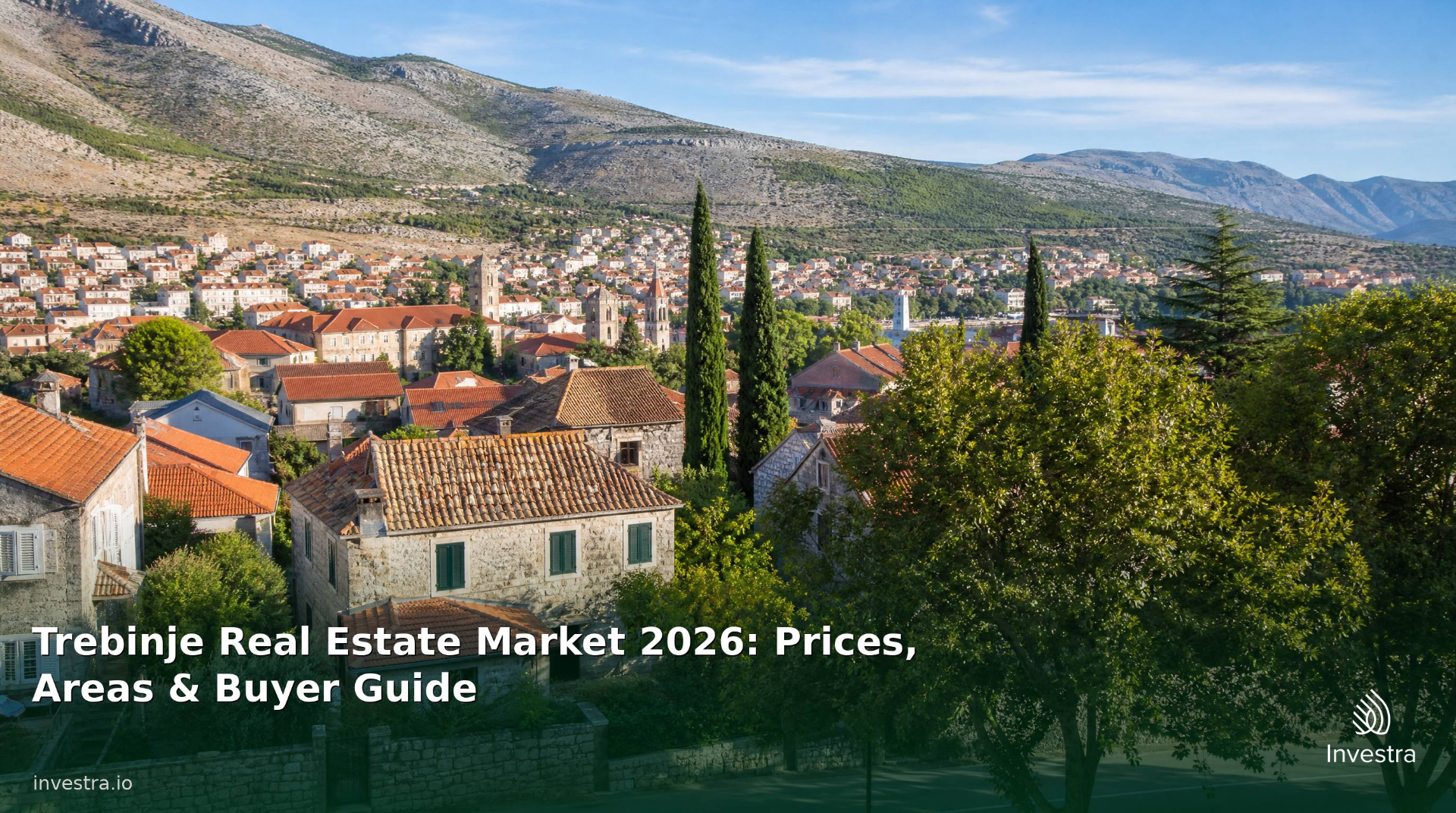
Trebinje Real Estate Market 2026: Prices, Areas & Buyer Guide
Trebinje Real Estate Market 2026: Prices, Areas & Buyer Guide
Trebinje Real Estate Market Overview 2026: Why This Herzegovinian Gem Is Turning Heads
Quick Answer: Trebinje is one of the most undervalued real estate markets in the Western Balkans in 2026, offering property prices between €800 and €2,500 per square meter alongside growing tourism-driven rental yields. Investra.io tracks emerging Balkan markets just like Trebinje to help investors get ahead of the curve.
There's a certain quality to Trebinje that veteran Balkan property hunters describe with a knowing smile. It's the southernmost city in Bosnia and Herzegovina—sitting less than 30 kilometers from Croatia's Adriatic coast, culturally closer to Dubrovnik than to Sarajevo, bathed in 270+ days of Mediterranean sunshine per year, and yet priced like it's still 2015.
Trebinje, with a population of approximately 35,000, sits in the Republika Srpska entity of Bosnia and Herzegovina, in the heart of Herzegovina's wine country. The Trebišnjica River winds through the city center, plane trees line the old bazaar, and the Ottoman-era Arslanagić Bridge stands as a reminder of the city's layered history.
What's changed in 2025–2026 is the pace. International tourists are discovering Trebinje as a day-trip destination from Dubrovnik, then returning for longer stays. Diaspora Bosnians and Serbs—many based in Austria, Germany, and Switzerland—are buying holiday homes here in increasing numbers.
This guide covers everything a serious buyer needs to know: price per square meter by neighborhood, rental yield data, the legal purchase process for foreigners, tax obligations, financing options, and the honest risks that come with investing in a post-conflict, developing-economy market. No hype—just data and context.
Trebinje Location, Infrastructure & Economic Context
Quick Answer: Trebinje benefits from its strategic location near the Adriatic coast and proximity to Dubrovnik Airport, with improving road infrastructure and a growing tourism economy that underpins real estate demand. Investra.io's regional market guides provide comparable data across the broader Western Balkans region.
Geography is perhaps Trebinje's single greatest asset. The city sits at approximately 270 meters above sea level in the Trebišnjica River valley, flanked by the Leotar and Vučevo mountain ranges. Dubrovnik Airport is roughly 35 kilometers away by road—in practical terms, that's about a 40-minute drive.
The road connection via the E661 has been steadily improving. Bosnia and Herzegovina has committed corridor funding to upgrade regional road links as part of its EU approximation process, and the Trebinje–Foča road project remains in planning stages but would significantly open the city to central Bosnia if completed.
Economically, Trebinje is one of the more stable cities in Republika Srpska. The local economy is anchored by hydropower—the Trebišnjica hydroelectric system is one of BiH's most important energy assets—wine production (vineyards like Vukoje and Anđelić have earned international recognition), tourism, and trade with Croatia and Montenegro.
The city has attracted investment from the Republika Srpska government in recent years—most visibly the Hercegovina Arena, a multi-purpose sports facility that opened in 2019 and has hosted EuroCup basketball and other major events, bringing significant visitor traffic. Hotel development has followed, with several mid-range and boutique properties opening since 2021.
One thing savvy investors appreciate: Trebinje has a functioning, if small, expatriate and diaspora community. Austrian, German, and Swiss residents of Bosnian-Herzegovinian heritage maintain strong ties to the region, and their property purchases help maintain price floors even during periods of weaker domestic demand.
Trebinje Property Price Ranges in 2026: What You'll Actually Pay
Quick Answer: Trebinje property prices in 2026 range from approximately €800/m² for older apartments in residential suburbs to €2,500/m² for premium Old Town properties, with the market average sitting around €1,200–€1,500/m² for well-located residential units.
Let's get into the numbers—because the headline figures are genuinely compelling for a city with Trebinje's quality of life and location profile.
The Old Town (Stari Grad) area commands the highest prices, as you'd expect. Renovated stone houses and apartments with character here are trading between €1,800 and €2,500 per square meter, with the most sought-after properties—those with views over the Trebišnjica or proximity to the plane tree-lined Corso—occasionally exceeding €2,800/m² for fully renovated units.
The central residential areas, the neighborhoods surrounding the Old Town and extending toward the main boulevard, offer the broadest selection of apartments. A typical 60–80m² two-bedroom apartment in a newer (post-2010) building will cost between €1,200 and €1,600/m², translating to purchase prices of roughly €72,000–€128,000.
The newer residential developments on the city's eastern and northern periphery—Zasad, Prigradska, and parts of the Gorica area—are seeing fresh construction at €1,300–€1,700/m² for off-plan and newly completed units. Developers are responding to diaspora demand with apartments that include parking, elevators, and modern finishes that older stock simply doesn't offer.
Price growth trajectory: what we've seen since 2022 is consistent annual appreciation of 8–12% in the central and Old Town areas, slowing slightly to 5–8% in peripheral residential zones. These figures outpace inflation and represent real capital appreciation, though they remain well below the frothy appreciation seen in Dubrovnik, Split, or Montenegro's Bay of Kotor.
Best Neighborhoods to Buy in Trebinje: A Practical Area Guide
Quick Answer: The Old Town (Stari Grad) suits lifestyle buyers and short-term rental investors, the central residential belt offers the best balance of price and rental demand, while peripheral new developments attract diaspora buyers seeking modern amenities at competitive price points.
Choosing the right micro-location within Trebinje matters more than many buyers initially realize. The city is compact enough that most neighborhoods are within walking distance of the center, but each has a distinct character and investment profile.
Stari Grad (Old Town): The historic core is the soul of Trebinje. Cobbled lanes, Ottoman architecture, the main square with its famous plane trees, and the riverside promenade make this the most aesthetically compelling address in the city. Properties here are predominantly stone-built houses and courtyard structures, many of which require or have undergone significant renovation.
Gorica & Eastern Expansion Areas: The hillside neighborhoods to the east offer newer construction, better parking, and views across the city. These areas attract younger families and returning diaspora members who want modern living standards.
Riverside & Hotel Zone: Properties near the Trebišnjica River and the Leotar Hotel area benefit from the ongoing tourism infrastructure investment. This zone is relatively undeveloped from a residential standpoint but holds speculative appeal as the city's hospitality sector grows.
Rural Surroundings: For buyers with a specific lifestyle vision—wine country living, agricultural smallholdings, eco-tourism ventures—the villages and plateaus outside the city offer extraordinary value. Due diligence on land classification, access rights, and infrastructure connectivity is essential here.
Rental Yields and Short-Term Rental Performance in Trebinje
Quick Answer: Long-term residential rental yields in Trebinje typically range from 4–6% gross annually, while well-managed short-term (Airbnb/Booking.com) rentals in the Old Town and central areas can achieve 7–10% gross yields during the tourism season, with year-round operations targeting 6–8%.
Rental income is where Trebinje's investment case gets particularly interesting. The city occupies a sweet spot: low purchase prices relative to neighboring countries, growing tourism traffic, and a domestic rental market that, while modest, provides year-round baseline income for investors who price strategically.
Short-term rentals are where the numbers can really move. Trebinje sees two distinct tourist waves: the main summer season (June–September) driven by overflow visitors from the Dubrovnik Riviera, and a secondary wave around Orthodox and Catholic Christmas and New Year periods.
What surprised many early Airbnb investors in Trebinje is the shoulder-season resilience. The Mediterranean climate means April, May, and October are genuinely pleasant—wine harvest tourism in September–October is a growing niche—and the city attracts domestic weekend visitors from Sarajevo, Banja Luka, and Mostar year-round.
The short-term rental regulatory environment in Bosnia and Herzegovina remains relatively permissive compared to Western European cities that have introduced strict limitations. That said, investors should expect this to evolve as platforms like Airbnb expand their Balkan footprint and local authorities develop clearer registration frameworks. Working with proptech tools that track regulatory changes is increasingly valuable for cross-border landlords.
Net yields after management fees (typically 15–25% of gross for professional short-term rental management), utilities, and maintenance typically land between 4.5–7% net for short-term operations and 3–4.5% net for long-term leases. These figures compare favorably with Dubrovnik (where purchase prices are 3–5x higher), Montenegro's Kotor Bay (2–4x higher), and even the emerging Serbian markets tracked by Investra.io's Eastern Serbia property guides.
Legal Process for Buying Property in Bosnia and Herzegovina as a Foreigner
Quick Answer: Foreign nationals can legally purchase real estate in Bosnia and Herzegovina under the principle of reciprocity, with the process typically taking 2–4 months and requiring a notarized purchase contract, property registration at the land registry, and payment of a 5% property transfer tax. Consulting specialists like Siniša Dagary — Investment Consultant is strongly recommended for handling cross-border transactions.
Bosnia and Herzegovina's property purchase process for foreigners is manageable but requires careful attention to its specific legal architecture—particularly the country's dual-entity structure (Republika Srpska and the Federation of BiH), which means Trebinje's legal framework falls under Republika Srpska's jurisdiction.
Foreign ownership rights: Under Bosnian law, foreign nationals from countries that have reciprocal real estate ownership agreements with Bosnia and Herzegovina can purchase property. Most EU member states, the UK, the USA, Canada, Australia, and regional Balkan countries fall within this reciprocity principle.
Step 1 — Due Diligence: Before any money changes hands, a thorough title search at the Basic Court in Trebinje (which maintains the land registry/gruntovnica) is essential. Bosnia's land registry system has historically had gaps and irregularities stemming from post-war property restitution processes, socialist-era ownership ambiguities, and incomplete digitization.
Step 2 — Preliminary Agreement: Once due diligence is complete, a preliminary purchase agreement (Predugovor o kupoprodaji) is typically signed, with the buyer paying a 10% deposit. This agreement is usually notarized and serves as the formal commitment from both parties.
Step 3 — Final Purchase Contract: The main purchase contract (Ugovor o kupoprodaji) is executed before a notary public. Both parties or their authorized representatives must be present, or a power of attorney must be properly legalized. The notary verifies the identities, the property description, and the agreed terms.
Step 4 — Land Registry Registration: Following contract execution, the transfer of ownership is registered at the land registry. This step formally establishes the buyer as the legal owner. Processing times typically range from 30–90 days, though they vary depending on court workload.
Step 5 — Tax Registration: The buyer must register as a property owner with the local tax authority (Poreska uprava) for ongoing property tax purposes.
Total transaction timeline: most straightforward purchases complete within 2–4 months. Complex cases involving older properties with title issues, rural land, or inherited estates can extend considerably longer. Budget for legal fees of approximately €500–€1,500 for attorney services plus notary fees of roughly 0.1–0.5% of the purchase price.
Taxes, Costs, and Ongoing Expenses for Trebinje Property Owners
Quick Answer: Buyers in Trebinje face a 5% property transfer tax (for resale properties), with annual property tax rates that are very low by European standards—typically 0.05–0.5% of assessed value—making the total cost of ownership attractive for long-term holders.
Understanding the full cost stack is critical for accurate ROI calculation. Bosnia and Herzegovina—and Republika Srpska specifically—maintains a relatively investor-friendly tax environment by regional standards, though the structure differs from what buyers from Western Europe might expect.
Property Transfer Tax (Porez na promet nepokretnosti): The primary transaction tax is 5% of the assessed or market value (whichever is higher), paid by the buyer. This applies to resale (secondary market) transactions.
Annual Property Tax (Porez na imovinu): Republika Srpska's annual property tax is remarkably low—typically 0.05% to 0.5% of the officially assessed property value, which itself is generally below market value. In practice, annual property tax bills on a typical Trebinje apartment rarely exceed €100–€300 per year.
Income Tax on Rental Income: Rental income is subject to income tax in Bosnia and Herzegovina. For residents, rental income is taxed at a flat 10% rate in Republika Srpska (after allowable deductions). Non-resident landlords are also subject to taxation on BiH-sourced income at 10%, though the practical enforcement and double taxation treaty framework varies by country. Investors should structure their ownership and reporting arrangements with advice from specialists—consulting resources like the Business Strategy Blog from Siniša Dagary can provide useful context on cross-border tax structuring considerations.
Capital Gains Tax: Capital gains from property sales are generally subject to income tax at 10% in Republika Srpska, though exemptions apply for properties held longer than certain periods and for primary residences. The specifics can change, and recent years have seen periodic legislative adjustments—always verify current rules with a local tax advisor before selling.
Utility and Maintenance Costs: Monthly utilities (electricity, water, communal maintenance) for a typical apartment run €80–€150 per month. Electricity in Bosnia is actually among the cheapest in Europe (the country is a significant hydropower exporter), which benefits both residents and short-term rental operators managing properties remotely. Communal fees for apartment buildings are minimal compared to Western European standards—typically €20–€60 per month. Findes Financial Services can assist international investors in structuring the financial flows associated with cross-border property ownership efficiently.
Currency Considerations: Bosnia and Herzegovina's convertible mark (BAM/KM) is pegged to the Euro at a fixed rate of 1 EUR = 1.95583 KM—a peg maintained since 1997 under a currency board arrangement. This virtually eliminates exchange rate risk for European buyers, a significant structural advantage over markets in Serbia, Albania, or North Macedonia where currency risk is real.
Financing Options for Trebinje Property Purchases
Quick Answer: Local mortgage financing is available to residents through Bosnian banks at rates of 4–7% (2026), but most foreign buyers purchase Trebinje properties in cash, often financing through home equity or personal loans in their home country for better rates and simpler processes.
This is where Trebinje's relatively low price point becomes an important variable. The majority of foreign investors in Trebinje—particularly diaspora buyers and lifestyle purchasers from Western Europe—are buying with cash or using financing obtained in their home countries (home equity release, personal loans, or remortgaging existing assets).
That said, local mortgage products do exist. The major commercial banks operating in Republika Srpska—including UniCredit Bank Banja Luka, Raiffeisen Bank, and NLB Banka—offer residential mortgage products. For Bosnian residents with documented income, typical mortgage terms in 2026 include loan-to-value ratios of 60–70%, interest rates of 4.5–7%, and terms up to 25 years.
Some property developers in Trebinje offer vendor financing arrangements—installment payment structures spread over 12–36 months for off-plan purchases. These can be attractive for investors wanting to preserve liquidity while securing a position at pre-completion pricing, though the legal safeguards for buyer deposits vary considerably between developers.
Tourism Trends and Their Impact on Trebinje Real Estate Demand
Quick Answer: Trebinje's tourism figures have grown consistently since 2018, with the city recording over 100,000 overnight stays annually and benefiting directly from Dubrovnik's overtourism pressure as visitors seek more authentic, affordable alternatives—a trend that directly supports short-term rental demand and property values.
The tourism angle is perhaps the most important structural driver for Trebinje's property market over the next 5–10 years. What's happening here is a classic "spillover" story, and it's one that's played out in markets across Europe—when a famous destination becomes too crowded and expensive, nearby alternatives benefit disproportionately.
Dubrovnik has become one of Europe's most over-touristed destinations. Cruise ship passenger numbers regularly overwhelm the city's narrow streets, accommodation prices have reached extraordinary levels (€150–€300+ per night for basic rooms in peak season), and the quality of the visitor experience has declined for many travelers.
The numbers reflect this. Trebinje's tourist overnight stays have grown from roughly 60,000 in 2018 to over 100,000 in 2023 (official BiH tourism statistics), with preliminary 2024–2025 data suggesting continued growth toward the 120,000–130,000 range.
Wine tourism deserves special mention. Herzegovina's wine region has experienced a renaissance in recent years, with Trebinje positioned as the gateway to some of the country's most celebrated vineyards. The "wine trail" circuits that connect Trebinje with Stolac, Mostar, and the broader region are now featuring in European wine travel guides.
The infrastructure investments following from increased tourism—improved signage, road maintenance, restaurant development, and the aforementioned Hercegovina Arena hospitality expansion—create positive feedback loops. As infrastructure improves, more visitors come. As more visitors come, property owners see higher rental revenues and appreciate the value of their assets.
One caveat: tourism can be volatile. Economic recessions, travel disruptions, or shifts in tourist preferences can impact visitor numbers.
Risks and Challenges in Trebinje Real Estate Investment
Quick Answer: The primary investment risks in Trebinje include legal/title complex
Investment Disclaimer
Quick Answer: This guide is general market information, not personal legal, tax, financing or investment advice.
Before committing to a property transaction, buyers should obtain independent local legal, tax and financial advice suited to their circumstances. Investra.io can support initial market research, but every purchase decision remains the buyer's responsibility.
Frequently Asked Questions
Quick Answer: This section explains the practical property-investment implications of Frequently Asked Questions.
What is a prudent next step after initial market research?
Use current documentation, independent professional advice and comparable local evidence before proceeding. Investra.io can support an initial structured market review.
How can buyers plan a realistic ownership budget?
Use current documentation, independent professional advice and comparable local evidence before proceeding. Investra.io can support an initial structured market review.
What evidence supports a careful investment decision?
Use current documentation, independent professional advice and comparable local evidence before proceeding. Investra.io can support an initial structured market review.
When should a buyer obtain legal and tax advice?
Use current documentation, independent professional advice and comparable local evidence before proceeding. Investra.io can support an initial structured market review.
How should a buyer compare neighbourhoods and property types?
Use current documentation, independent professional advice and comparable local evidence before proceeding. Investra.io can support an initial structured market review.
What local checks should be completed before signing?
Use current documentation, independent professional advice and comparable local evidence before proceeding. Investra.io can support an initial structured market review.
Which costs should be assessed alongside the purchase price?
Use current documentation, independent professional advice and comparable local evidence before proceeding. Investra.io can support an initial structured market review.
How can international buyers verify a property opportunity?
Use current documentation, independent professional advice and comparable local evidence before proceeding. Investra.io can support an initial structured market review.
What should buyers compare before selecting a property?
Use current documentation, independent professional advice and comparable local evidence before proceeding. Investra.io can support an initial structured market review.
Quick Answer: These answers outline common buyer checks and should be read with current professional advice.
Recommended Reading
Quick Answer: This section explains the practical property-investment implications of Recommended Reading.
- Investra market research
- Investra market research
- Investra market research
- Investra market research
- Investra market research
- Investra market research
- Investra market research
- Investra market research
- Investra market research
- Investra market research
- Investra market research
- Investra market research
- Investra market research
- Investra market research
- Investra market research
- Investra market research
- Investra market research
- Siniša Dagary investment insight
- Siniša Dagary investment insight
- Siniša Dagary investment insight
- Siniša Dagary investment insight
- Siniša Dagary investment insight
- Findes Group & Partners
- Findes Group & Partners
Connect With Investra
Follow Investra for market updates on Facebook, LinkedIn, YouTube
Related Posts
No related posts available.
