
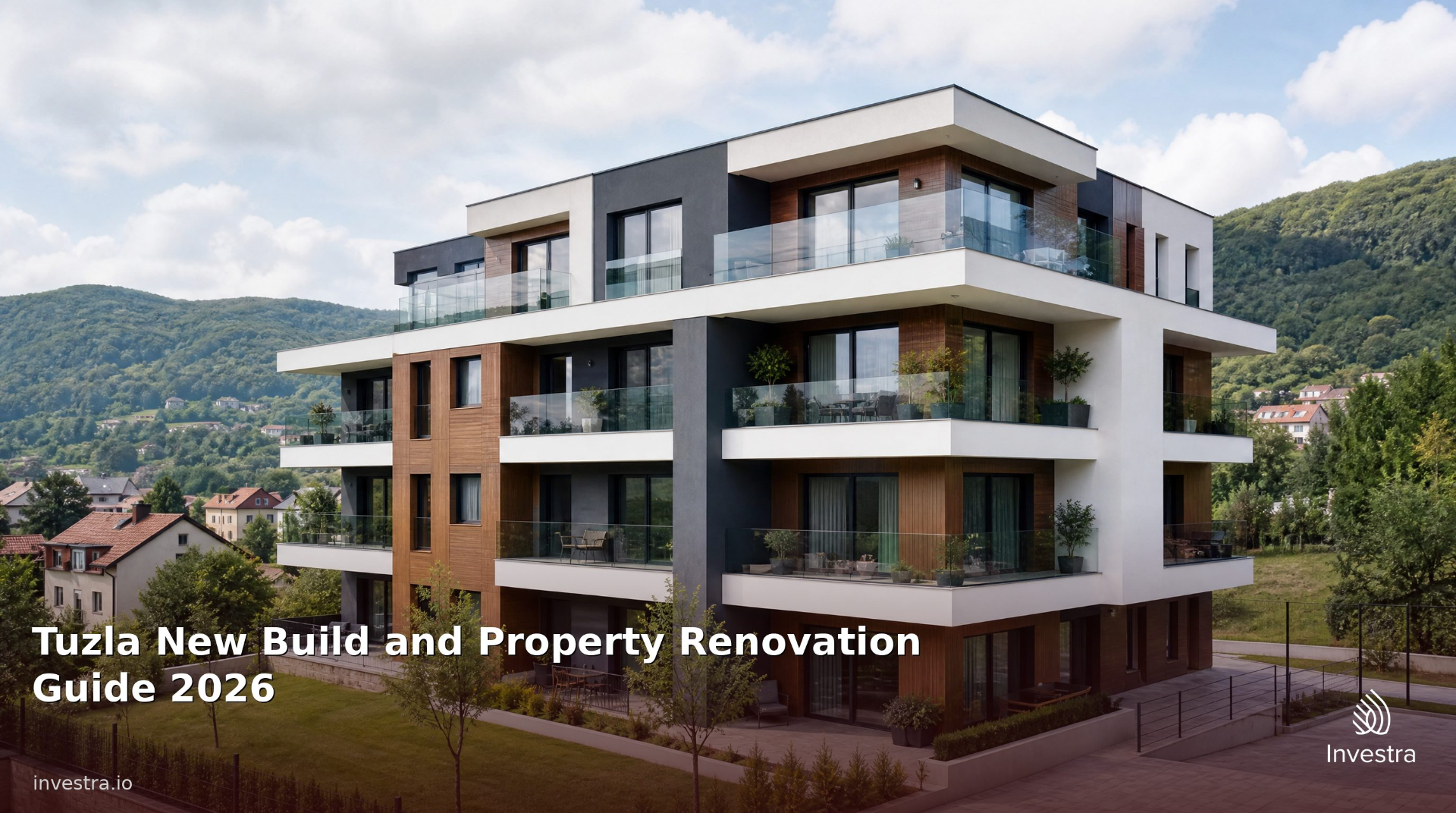
Tuzla New Build and Property Renovation Guide 2026
Tuzla New Build and Property Renovation Guide 2026
Tuzla Property Market Snapshot: Prices Per m² in 2026
Quick Answer: New build apartments in Tuzla average €1,200–€1,800/m² depending on location and specification, while older properties suitable for renovation can be acquired for €400–€750/m², creating a significant value-add opportunity for investors willing to take on a project.
Understanding the price landscape is foundational to any investment decision in Tuzla. Bosnia and Herzegovina's second-largest city presents a distinctly stratified real estate market in 2026, with clear pricing divisions between new construction, mid-market resale, and renovation-ready stock.
At the premium end, newly constructed apartments in central Tuzla—particularly in the Slavinovići and Centar neighborhoods—are selling for €1,500–€1,800/m². These units typically feature modern finishes, underfloor heating, energy-efficient glazing, and underground parking.
Mid-tier new builds in expanding residential zones like Sjenjak, Miladije, and outer Centar range from €1,100–€1,400/m². These projects typically serve first-time buyers and young professionals—a demographic with genuine purchasing power thanks to Tuzla's growing IT sector and manufacturing base. Construction quality is solid, though finishes tend toward standard specifications rather than premium materials.
The renovation opportunity is where Tuzla's investment case becomes genuinely compelling. Socialist-era apartments—typically 45–70 m² two-room units built in the 1970s and 1980s—list for €400–€650/m² in secondary locations and occasionally as low as €350/m² for properties in urgent need of work.
Rural and peri-urban Tuzla—the canton's smaller towns and villages—offers houses for €20,000–€60,000, often with land. These represent a different asset class suited primarily to lifestyle buyers or agritourism concepts rather than traditional buy-to-let investment strategies.
Price pressures from diaspora buyers and yield-hungry investors are evident across comparable markets. As documented in the Zajecar Real Estate Market 2026 Eastern Serbia Property Guide, Balkan secondary cities are all experiencing similar annual price increases. Tuzla has risen approximately 8–12% annually since 2022, reflecting broader regional trends as Western markets mature and yield compression accelerates.
New Build Development Landscape in Tuzla
Quick Answer: Tuzla's new build sector is dominated by small-to-medium local developers delivering 10–50 unit residential projects, with a growing number of mixed-use developments targeting the city's professional and student population. Off-plan purchases remain common and can offer 10–15% discounts versus completed units.
The development landscape in Tuzla is distinctly different from larger Balkans markets like Sarajevo or Banja Luka—and that distinction matters for investors. You will not find large international developers here. What exists instead is a patchwork of capable local construction companies, family-owned developers, and the occasional regional player from Sarajevo or Croatia who has identified Tuzla's genuine growth potential.
Most active projects in 2026 are residential apartment buildings ranging from 8 to 50 units, typically built across 4–8 floors. Ground-floor commercial units are increasingly common, with developers recognizing that mixed-use buildings attract higher overall valuations and generate ongoing income from retail or office tenants.
Off-plan purchasing is a well-established practice in the Bosnian market. Buyers who commit during the foundation or shell construction phase typically negotiate prices 10–15% below the eventual market value of completed units.
Construction timelines vary meaningfully. A standard 30-unit residential building in Tuzla typically takes 18–30 months from groundbreaking to occupancy certificate. Delays are common, often attributable to administrative bottlenecks in the permitting process or seasonal construction slowdowns during winter months.
What has changed in the past two years is the specification standard. New builds that might have featured basic PVC windows and standard plaster finishes five years ago are now competing on energy performance, smart home features, and elevator access.
Property Renovation: Costs, Process, and Potential in Tuzla
Quick Answer: A full renovation of a 50–70 m² apartment in Tuzla typically costs €12,000–€25,000 depending on quality of finishes, with budget renovations achievable from €150–€200/m² and high-specification refurbishments running €300–€400/m². The value uplift can be substantial in central locations.
Renovation in Tuzla is one of those strategies that sounds obvious once you see the numbers—and yet remains underexploited, largely because most buyers lack the local connections and project management expertise to execute it effectively. That dynamic is changing as the diaspora investor community matures and shares knowledge more openly through specialized channels.
The starting point is strategic acquisition. Renovation targets are typically apartments built before 1990 in well-located but cosmetically dated buildings.
Renovation scope varies dramatically based on target market and investment thesis. A "cosmetic" renovation—new flooring, fresh plaster, kitchen replacement, bathroom tile, and painting—costs roughly €100–€150/m² and can transform an uninhabitable flat into a functional rental property in 6–8 weeks.
Labour costs in Tuzla represent a genuine competitive advantage. Skilled tradespeople—electricians, tilers, carpenters—charge €20–€40 per hour or work on project rates that would be considered laughably cheap in Western Europe. A quality bathroom renovation that would cost €8,000–€12,000 in Germany can be completed for €2,500–€4,000 in Tuzla. This labour arbitrage is the core engine of the renovation investment model.
Materials present a mixed picture. Local and regional materials—tiles, basic fittings, structural materials—are competitively priced. Premium imported fittings from Italy, Germany, or Scandinavia are available but command prices close to Western European levels.
Project management is the real challenge for non-resident investors. Tuzla has a small but growing cohort of project managers and renovation coordinators who can oversee works on behalf of absent owners. Expect to pay 10–15% of total project cost for this service, but consider it essential unless you plan to be on-site regularly. For strategic insights on managing cross-border property investments, consulting resources like Siniša Dagary provides practical frameworks that extend beyond property mechanics to broader portfolio strategy.
Legal Framework for Foreign Buyers in Tuzla and Bosnia and Herzegovina
Quick Answer: Foreign nationals from most countries can purchase property in Bosnia and Herzegovina, subject to reciprocity agreements, and the process—while requiring careful navigation—is manageable with a competent local lawyer. The entire acquisition process typically takes 30–90 days from signed preliminary contract to registered ownership.
Bosnia and Herzegovina's legal framework for property ownership is built on a principle of reciprocity: citizens of countries that allow Bosnian nationals to buy property can generally purchase in BiH. This covers the vast majority of European, North American, and Australian buyers.
The purchase process follows a structured sequence that, while straightforward in outline, benefits enormously from professional guidance. First comes due diligence: a thorough land registry check (gruntovnica) confirms the seller's ownership, identifies any encumbrances, mortgages, or disputes, and verifies that the property's legal status matches physical reality.
Once due diligence clears, a preliminary contract (predugovor) is signed and typically notarized. A deposit of 10–15% is customary at this stage. The final purchase contract (kupoprodajni ugovor) is executed before a notary, who verifies identity, confirms the transaction terms, and submits the registration application to the land registry on the buyer's behalf.
The reality is that Tuzla's legal infrastructure is functional but slower by Western standards. Bureaucratic processes that should take days often take weeks. Patience and a good local lawyer—not just a notary, but an attorney who can proactively manage the process and anticipate complications—make an enormous difference. Legal fees typically run 1–1.5% of the purchase price, and it is money well spent.
For context on how legal processes in neighboring Balkan markets compare, the Prokuplje Real Estate Market 2026 Toplica Region Property Guide offers useful parallels from the Serbian market, where similar principles apply with minor jurisdictional variations.
Transaction Costs and Taxes in Tuzla 2026
Quick Answer: Total transaction costs for buying resale property in Tuzla run approximately 5–8% of purchase price, including a 5% real estate transfer tax (on resale properties), notary fees, land registry fees, and legal costs. New builds from developers are subject to VAT at 17% instead of transfer tax, already included in the purchase price.
Tax efficiency matters—especially in a market where purchase prices are modest and every percentage point of transaction cost has meaningful impact on your entry economics. Bosnia's tax structure is relatively straightforward compared to some regional peers, though it requires careful attention to detail.
The headline figure is the 5% real estate transfer tax (porez na promet nekretnina), levied on the buyer for resale property transactions. This is assessed on the declared transaction value and payable within 15 days of the transaction.
For new build properties purchased directly from developers, VAT at 17% applies instead of the transfer tax. However, in practice, this VAT is embedded in the developer's listed price—buyers do not pay it separately. When comparing new build versus resale prices, it is worth remembering that the new build price is VAT-inclusive while the resale price triggers a separate 5% transfer tax at closing.
Annual holding taxes are remarkably low. Property taxes in Tuzla Canton are assessed on property value with rates typically ranging from 0.1% to 0.5% annually—a negligible carrying cost that compares favorably with most European markets.
Capital gains from property sales held longer than two years are taxed at 10% on the net gain. Short-term sales (under two years) are treated as ordinary income. This structure naturally encourages medium-to-long holding periods—which aligns well with the renovation-and-hold strategy many sophisticated Tuzla investors are pursuing. For comprehensive financial planning around such investments, working with professionals like Findes Group & Partners can help optimize cross-border tax positioning and structuring.
Rental Yields and ROI Analysis for Tuzla Property 2026
Quick Answer: Gross rental yields in Tuzla range from 6–9% for well-positioned residential properties, with renovated apartments in central locations achieving yields at the upper end. Net yields of 5–7% are realistic after taxes, management fees, and maintenance, representing strong performance by European standards.
Yield analysis is where Tuzla's investment case becomes genuinely compelling—and where the renovation strategy in particular creates outsized returns that justify the additional complexity and execution risk.
Scenario A—New Build Purchase: A 55 m² two-bedroom apartment in Sjenjak purchased off-plan at €1,200/m² costs €66,000. Add 6% in transaction costs and furnishing: total investment approximately €72,000. Monthly rent for a comparable furnished apartment in this area: €450–€500. Annual gross rental income: €5,400–€6,000. Gross yield: 7.5–8.3%.
Scenario B—Renovation Play: A 60 m² apartment in central Tuzla acquired for €32,000 (€533/m²). Full renovation including new electrical, plumbing, kitchen, bathroom, and quality finishes: €18,000. Total investment: €50,000 plus ~€3,000 transaction costs equals €53,000. Post-renovation monthly rent for a centrally located, well-finished apartment: €550–€650. Annual gross rental income: €6,600–€7,800. Gross yield: 12.5–14.7%.
Short-term rentals (Airbnb/Booking.com) add another dimension to the yield calculation. Tuzla does not have the tourist volume of Mostar or Sarajevo, but it has consistent business travel, medical tourism (Tuzla's University Clinical Centre draws patients from across the region), and event-driven demand.
Comparing these returns to the broader Balkan region puts Tuzla's performance in sharp relief. Markets analyzed in the Bor Real Estate Market 2026 Eastern Serbia Mining City Property Guide show similar yield structures for regional cities, reinforcing the argument that Balkan secondary markets are among the most yield-efficient in Europe right now.
The New Build Buying Process in Tuzla: Step by Step
Quick Answer: Buying a new build in Tuzla involves selecting a developer, reviewing the preliminary contract and project documentation, paying staged installments during construction, and completing the final transfer upon obtaining the occupancy certificate—a process that typically spans 18–30 months from initial commitment to key handover.
The off-plan and new build purchase process in Tuzla has its own rhythm, and understanding it upfront prevents the frustrations that catch unprepared buyers off-guard. The process requires patience, clear communication, and a systematic approach to risk mitigation.
It starts with developer selection. Research matters here. Tuzla has reputable local developers with completed project portfolios and track records of successful delivery—and it has newer, less proven operators. Ask to visit completed buildings, speak with existing owners where possible, and check that the developer holds proper building permits (građevinska dozvola) before committing any funds.
The contractual structure for new builds typically works in stages. An initial reservation agreement secures your chosen unit with a payment of €1,000–€3,000. The preliminary contract, signed within 2–4 weeks, is the substantive legal document—it specifies the unit, price, payment schedule, delivery timeline, penalty clauses for delays, and specification details. Read this carefully.
Occupancy certificate issuance is a critical milestone. In Bosnia, buildings cannot legally be inhabited until this certificate is obtained, and the process can take 3–6 months after construction completes due to bureaucratic verification requirements.
Technology is slowly modernizing this process. As noted in the Serbia Proptech 2026 How Technology Is Changing Real Estate analysis, digital platforms for property tracking, document management, and remote transaction support are advancing across the Western Balkans. While Tuzla is not yet at the digital frontier, progressive developers are adopting project management apps and virtual tour capabilities that help remote buyers stay informed throughout the construction process.
Best Neighbourhoods for New Builds and Renovation Investment in Tuzla
Quick Answer: Central Tuzla (Centar), Sjenjak, and Slavinovići lead for new build investment due to high rental demand and infrastructure quality, while older districts like Skojevska and Proleter offer the strongest renovation opportunities given low acquisition costs and central proximity.
Geography matters enormously in a city like Tuzla, where the difference between a 10-minute walk to the university and a 25-minute bus ride can mean the difference between 95% occupancy and 75% occupancy for a student rental. Neighbourhood selection is one of the highest-use decisions in the Tuzla investment process.
Centar is the obvious anchor. The old town pedestrian zone, salt lake (Pannonica), and key commercial streets make central apartments perennially desirable. New build activity here is limited by available land, but when premium projects do appear, they command top-of-market rents and resale premiums.
Sjenjak has emerged as the city's most dynamic residential expansion zone. Proximity to the university, developing retail infrastructure, and a steady supply of new projects make this neighbourhood attractive to owner-occupiers and investors alike. Rents here are consistently 15–25% below Centar but vacancy rates are typically 5–8%, making it a reliable performer for long-term buy-to-let.
Slavinovići represents the premium new build corridor. Several higher-specification residential projects are concentrated here, attracting diaspora buyers and affluent locals seeking modern finishes and contemporary design. Rents exceed Sjenjak by €80–€150/month for equivalent units, justifying the premium acquisition cost for investors targeting the upper end of the market.
For renovation-focused strategies, Skojevska and Proleter offer compelling opportunities. These older neighbourhoods, built primarily in the 1970s–1980s, contain hundreds of renovation candidates at acquisition prices 20–30% below Centar equivalents. While less prestigious than central locations, both neighbourhoods benefit from reasonable proximity to university facilities and decent public transport.
Miladije, in the southeastern expansion zone, represents a middle ground. New builds are emerging here at prices between Sjenjak and more peripheral areas, targeting first-time buyers and budget-conscious investors. Student accommodation demand is lower than near the main campus, but young professionals working in the business park zone and light industrial areas find Miladije increasingly attractive.
Building Permits and Regulatory Compliance
Quick Answer: Building permits in Bosnia and Herzegovina follow a multi-stage process involving location permits, urban planning approvals, and construction permits. Understanding these requirements is crucial for new build investments and renovation projects to avoid delays and legal complications.
Regulatory compliance forms the unglamorous but essential foundation of any property development or renovation project in Tuzla. The permitting process is hierarchical, sequential, and subject to interpretation by multiple municipal authorities, making professional guidance genuinely valuable.
The initial location permit (lokacijska dozvola) confirms that a proposed use aligns with the local urban plan and zoning regulations. This document is typically obtained by the seller (for resale) or developer (for new construction) and represents the first checkpoint. Buyers purchasing off-plan should always verify that this permit is in place and clearly posted on the development site.
The construction permit (građevinska dozvola) is the legal authorization to begin building. It is issued by the municipal authority after verification that detailed architectural and engineering plans comply with building codes and local requirements. Reputable developers obtain this well before beginning on-site work, and prudent buyers verify its existence before committing funds.
Energy performance certificates (energetska sertifikacija) are increasingly required for all buildings, reflecting EU-aligned sustainability standards. Older buildings being renovated may require upgrades to meet current energy efficiency thresholds. This requirement has added complexity and cost to renovation projects in recent years, but it also enhances property values and reduces long-term operational costs.
The comprehensive resource on handling these requirements is available through Serbia Building Permits 2026 How To Get Construction Permission, which covers parallel regulatory frameworks that apply similarly in Bosnia and Herzegovina.
Financing Options for Tuzla Property Investment
Quick Answer: Financing options for Tuzla
Investment Disclaimer
Quick Answer: This guide is general market information, not personal legal, tax, financing or investment advice.
Before committing to a property transaction, buyers should obtain independent local legal, tax and financial advice suited to their circumstances. Investra.io can support initial market research, but every purchase decision remains the buyer's responsibility.
Frequently Asked Questions
Quick Answer: This section explains the practical property-investment implications of Frequently Asked Questions.
What is a prudent next step after initial market research?
Use current documentation, independent professional advice and comparable local evidence before proceeding. Investra.io can support an initial structured market review.
How can buyers plan a realistic ownership budget?
Use current documentation, independent professional advice and comparable local evidence before proceeding. Investra.io can support an initial structured market review.
What evidence supports a careful investment decision?
Use current documentation, independent professional advice and comparable local evidence before proceeding. Investra.io can support an initial structured market review.
When should a buyer obtain legal and tax advice?
Use current documentation, independent professional advice and comparable local evidence before proceeding. Investra.io can support an initial structured market review.
How should a buyer compare neighbourhoods and property types?
Use current documentation, independent professional advice and comparable local evidence before proceeding. Investra.io can support an initial structured market review.
What local checks should be completed before signing?
Use current documentation, independent professional advice and comparable local evidence before proceeding. Investra.io can support an initial structured market review.
Which costs should be assessed alongside the purchase price?
Use current documentation, independent professional advice and comparable local evidence before proceeding. Investra.io can support an initial structured market review.
How can international buyers verify a property opportunity?
Use current documentation, independent professional advice and comparable local evidence before proceeding. Investra.io can support an initial structured market review.
What should buyers compare before selecting a property?
Use current documentation, independent professional advice and comparable local evidence before proceeding. Investra.io can support an initial structured market review.
Quick Answer: These answers outline common buyer checks and should be read with current professional advice.
Recommended Reading
Quick Answer: This section explains the practical property-investment implications of Recommended Reading.
- Investra market research
- Investra market research
- Investra market research
- Investra market research
- Investra market research
- Investra market research
- Investra market research
- Investra market research
- Investra market research
- Investra market research
- Investra market research
- Investra market research
- Investra market research
- Investra market research
- Investra market research
- Investra market research
- Investra market research
- Siniša Dagary investment insight
- Siniša Dagary investment insight
- Siniša Dagary investment insight
- Siniša Dagary investment insight
- Siniša Dagary investment insight
- Findes Group & Partners
- Findes Group & Partners
Connect With Investra
Follow Investra for market updates on Facebook, LinkedIn, YouTube
Related Posts
No related posts available.
