
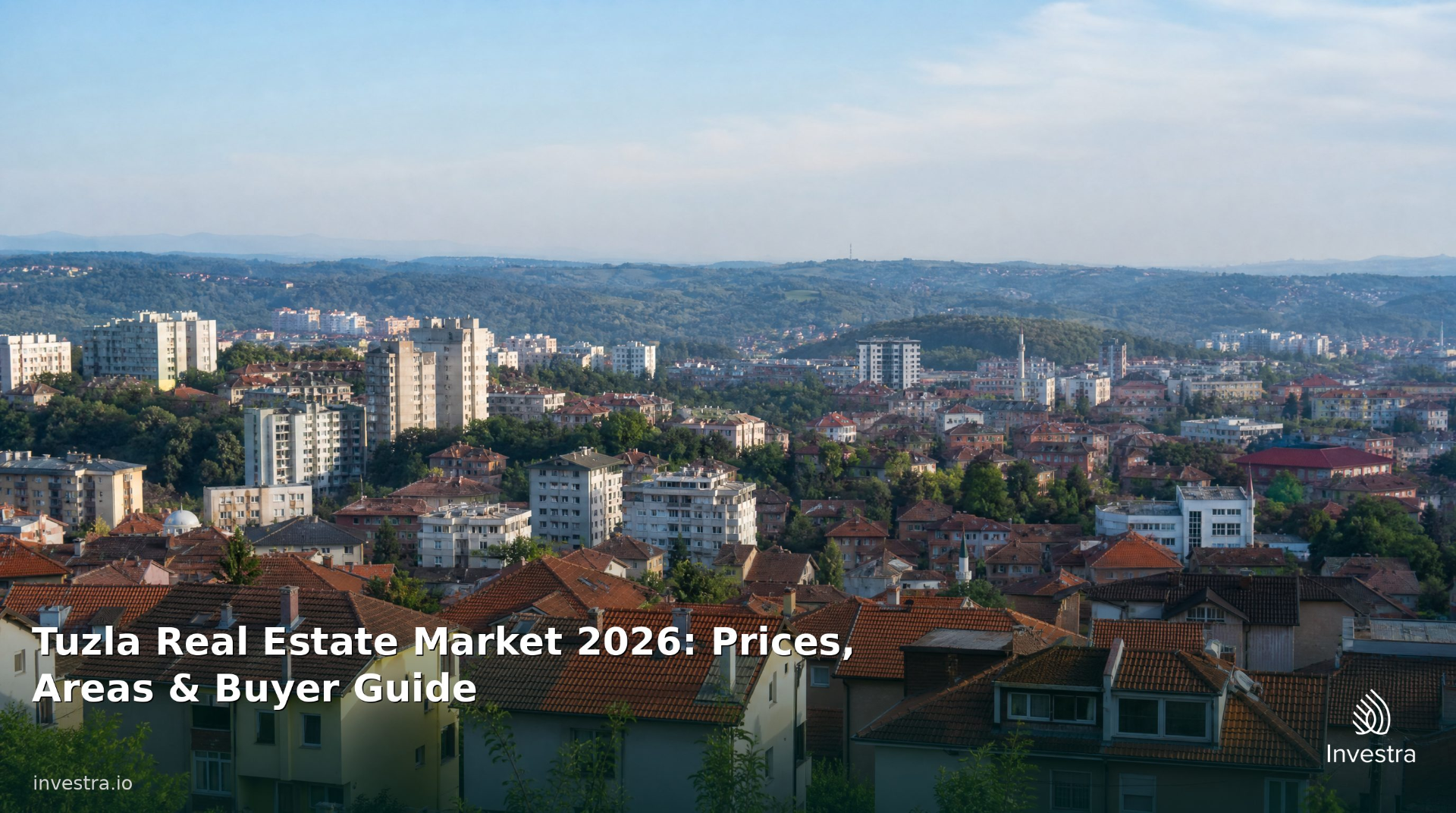
Tuzla Real Estate Market 2026: Prices, Areas & Buyer Guide
Tuzla Real Estate Market 2026: Prices, Areas & Buyer Guide
Tuzla Real Estate Market Overview 2026: Why This City Is Attracting Attention
Quick Answer: Tuzla is Bosnia and Herzegovina's second-largest city and one of the most economically active real estate markets in the Western Balkans, with property prices ranging from €700 to €2,200/m² depending on location and property type. Investra.io tracks emerging Balkan markets to help investors identify high-potential opportunities before they peak.
Tuzla doesn't make headlines the way Sarajevo does. It doesn't have the postcard-perfect skyline of Mostar or the coastal glamour of the Adriatic. But what it does have — quietly, consistently — is economic substance.
The real estate market here in 2026 reflects a city in transition. Prices have risen steadily — around 6–9% annually since 2022 — yet remain dramatically undervalued compared to regional peers like Zagreb, Belgrade, or Ljubljana. That gap is closing, and investors paying attention to the Balkan property corridor are starting to take notice.
For context, Bosnia and Herzegovina's broader real estate market saw transaction volumes increase by approximately 12% in 2024 and continued momentum into 2025, according to local canton-level registry data. Tuzla specifically recorded some of the strongest price appreciation outside of Sarajevo.
The 2026 market landscape shows a city where supply is still catching up with demand. New residential construction has accelerated, but quality stock in central and established neighborhoods remains scarce. That scarcity premium is exactly what long-term investors tend to seek out. Consulting professionals like Siniša Dagary — Investment Consultant can help international buyers interpret these micro-market dynamics before committing capital.
Property Price Ranges in Tuzla 2026: What Does the Data Actually Show?
Quick Answer: In 2026, Tuzla property prices range from approximately €700/m² for older socialist-era apartments in peripheral neighborhoods to €2,200/m² for new-build units in prime central locations, with the city-wide average sitting around €1,100–€1,350/m². Comparable Eastern Balkan markets offer useful benchmarks for relative valuation.
Let's get specific, because that's what investors actually need. The broad price range for Tuzla in 2026 breaks down roughly as follows across property categories and locations:
Central Tuzla (Centar, Slavinovići area): New-build apartments typically list at €1,500–€2,200/m². Older renovated apartments in the same zone trade at €1,100–€1,500/m². These are the premium addresses — walking distance to government institutions, the University of Tuzla, major shopping, and cultural venues.
Mid-ring neighborhoods (Skojevsko Naselje, Stupine, Sjenjak): This is where the volume market lives. Well-maintained apartments from the 1980s and 1990s typically trade at €800–€1,100/m², while newer constructions in these areas command €1,200–€1,600/m².
Outer and suburban zones (Kreka, Husino, Miladije): Older housing stock here trades between €600–€850/m². These areas attract first-time buyers and value-focused investors willing to renovate. The price-to-rent ratio in these zones can actually outperform central areas when renovation costs are managed well.
Houses and villas: Detached properties in Tuzla Canton range enormously — from €80,000 for a modest village house requiring renovation to €350,000+ for turnkey suburban homes with gardens. Land values vary from €15–€25/m² in peripheral zones to €150–€300/m² in urban core areas.
Year-on-year price growth in 2025 was approximately 7.5% across all categories, with new-build premiums particularly pronounced. Construction costs have risen 15–20% since 2021 across Bosnia and Herzegovina, which has put upward pressure on developer pricing and ultimately filtered through to resale values.
The Best Neighborhoods in Tuzla for Real Estate Investment
Quick Answer: The top investment neighborhoods in Tuzla in 2026 are the City Center for capital appreciation, Stupine and Sjenjak for rental yield, and Skojevsko Naselje for balanced risk-return profiles with growing infrastructure.
Geography matters enormously in Tuzla's real estate market, and not always in the ways you'd expect. The city's somewhat unusual topography — built across a salt-rich valley that has caused significant ground subsidence in some zones historically — means that neighborhood selection requires genuine due diligence, not just a price comparison.
City Center (Centar) remains the prestige address. The pedestrian zone around JNA Street, the main square, and the surrounding cultural institutions make this the most walkable and livable part of Tuzla. For buy-to-let investors, short-term rental platforms like Airbnb and Booking.com show strong occupancy in this zone, particularly during summer and festival periods.
Stupine is, arguably, the neighborhood that offers the most interesting current-moment opportunity. It's a planned socialist-era district that has been quietly upgrading its retail, café, and services infrastructure over the past decade. Younger Tuzla residents increasingly prefer it for its open spaces and slightly lower rents compared to the center.
Sjenjak is the neighborhood favored by expatriates, business professionals, and upper-middle-class Tuzlans. Properties here tend to be slightly larger, greener, and more residential in character. It's not the highest-yield zone, but vacancy rates are very low and tenant quality tends to be high.
Skojevsko Naselje deserves mention as an emerging area. Infrastructure investment in this zone has been consistent, and newer residential projects have brought a demographic upgrade. The risk-return balance here is favorable for medium-term holding strategies.
What we'd caution against, especially for first-time international buyers, is purchasing in zones near the old salt mine subsidence areas without a proper geological and structural survey. This is specific to Tuzla in a way that doesn't apply to most Balkan cities, and it's a step that simply cannot be skipped.
Rental Market and Yield Analysis: Is Tuzla a Cash-Flow Market?
Quick Answer: Tuzla offers gross rental yields of 5–7% depending on location and property type, with student-oriented rentals and furnished apartments for young professionals producing the strongest returns. Similar yield profiles are seen in comparable mid-sized Balkan university cities.
Student rentals are the backbone. The University of Tuzla enrolls over 15,000 students, and the surrounding faculties generate year-round demand for 1-bedroom and studio units. Monthly rents for student-grade studios range from €200–€320, while 1-bedroom apartments in good condition fetch €300–€450/month. Rooms within shared apartments rent for €120–€200/month.
For the professional rental segment — typically 1–2 bedroom apartments in Stupine, Sjenjak, or Central Tuzla — monthly rents range from €400–€700 for unfurnished to €550–€900 for well-furnished units. These tenants tend to sign 12-month leases, creating more stable income streams.
Short-term rentals via platforms are viable in central Tuzla, particularly given the city's role as a business travel hub and its growing cultural tourism profile. Average daily rates for well-appointed central apartments run at €35–€65/night, with occupancy rates of 55–70% achievable for well-managed properties.
Legal Framework for Foreign Property Buyers in Bosnia and Herzegovina
Quick Answer: Foreign nationals from most countries can legally purchase real estate in Bosnia and Herzegovina, subject to reciprocity conditions, but the process requires careful navigation of the country's dual-entity legal structure — either the Federation of BiH (where Tuzla sits) or Republika Srpska.
Bosnia and Herzegovina's property law framework is, to put it plainly, complex. The country operates under a two-entity constitutional structure, and Tuzla falls within the Federation of Bosnia and Herzegovina (FBiH). This distinction matters enormously for buyers, because property law, taxation, and registration procedures differ between the two entities.
Foreign nationals from countries that have signed bilateral agreements with Bosnia and Herzegovina — which includes virtually all EU member states, the United States, UK, and most Balkan neighbors — can purchase property on a reciprocity basis. The process is more straightforward than many buyers expect, but it does have specific steps that cannot be skipped or reordered.
The standard purchase process for foreigners in Tuzla:
First, the buyer needs to obtain a personal identification number (JMB equivalent for foreigners) from the local municipality. This is a prerequisite for property registration. Second, the purchase agreement (Ugovor o kupoprodaji) must be drafted and notarized — in Bosnia and Herzegovina, notarization is mandatory, not optional.
One practical reality that surprises many international buyers: the land registry in some parts of Bosnia and Herzegovina does not always reflect the actual ownership situation due to historical delays in registration updates. A thorough title search going back at least three generations of ownership is genuinely recommended, not just advisable.
The full purchase process from agreement to registration typically takes 4–8 weeks in Tuzla Canton, assuming no complications. Budget for legal fees of approximately €1,000–€2,500 depending on property value and complexity, plus notary fees of 0.1–0.5% of the transaction value.
For those interested in comparative legal frameworks across the region, resources from Siniša Dagary investment insight offer broader context on investment structures in Southeast European markets.
Property Taxes and Transaction Costs in Tuzla 2026
Quick Answer: The real estate transfer tax in the Federation of Bosnia and Herzegovina is 5% of the assessed property value, payable by the buyer, with total acquisition costs including fees and taxes typically reaching 7–10% of the purchase price. Comparable transaction cost structures in neighboring Serbian markets provide useful context.
Tax efficiency matters in real estate investment, and Bosnia and Herzegovina's tax structure — while not the most streamlined in the region — is at least relatively transparent once you understand it. Here's what buyers need to factor into their total acquisition cost calculations for Tuzla properties in 2026.
Real Estate Transfer Tax (Porez na promet nekretnina): The primary transaction tax in the FBiH is 5% of the officially assessed value (which may differ from the transaction price — typically assessed by the cantonal tax authority). This is one of the higher transfer taxes in the Western Balkans. By comparison, Serbia charges 2.5% transfer tax.
VAT on new-build properties: New apartments purchased directly from developers are subject to 17% VAT (Bosnia and Herzegovina's standard VAT rate), which is typically included in the developer's listed price. However, buyers should verify this explicitly, as some developers quote pre-VAT prices. VAT does not apply to resale transactions between private parties.
Annual property tax: Bosnia and Herzegovina charges an annual property tax that varies by canton. In Tuzla Canton, annual rates are modest — typically 0.1–0.5% of assessed value for residential properties, making the ongoing holding cost relatively low compared to Western European markets.
Rental income tax: Rental income earned by private landlords is taxed at 10% in the FBiH, after allowable deductions. This flat rate is competitive regionally and makes the net-of-tax yield calculation straightforward.
Capital gains tax: Capital gains on property sold within 5 years of purchase are taxed at 10% in the FBiH. Properties held for more than 5 years are generally exempt from capital gains tax — a provision that meaningfully favors medium-to-long-term investment strategies and should factor into exit planning from day one.
Total acquisition costs when buying resale property: budget approximately 7–10% above the purchase price (covering transfer tax, notary, legal fees, and registration). For new-builds where VAT is included in the price, additional closing costs typically run 2–4%.
The Economy Behind Tuzla's Property Market: Industry, Infrastructure, and Growth Drivers
Quick Answer: Tuzla's economy is anchored by industrial manufacturing, the regional public sector, a significant university ecosystem, and growing logistics activity — all of which create sustained employment and housing demand that underpins property market fundamentals.
Property markets don't exist in economic vacuums, and understanding what actually drives demand in Tuzla is essential for making informed investment decisions. The city's economic base is more diversified than its industrial reputation suggests.
The airport factor deserves specific mention. Tuzla International Airport is, somewhat surprisingly for a mid-sized city, an important regional hub — particularly for the Bosnian diaspora in Western Europe.
EU accession progress also matters as a macro driver. Bosnia and Herzegovina received EU candidate status in December 2022, and accession negotiations — while slow — are moving forward. Historical evidence from other Balkan EU candidates (Bulgaria, Romania, Croatia) shows consistent property price appreciation as accession milestones are reached.
Infrastructure investment is ongoing. Road connectivity improvements along the Corridor Vc (the major north-south European transport corridor running through Bosnia and Herzegovina) are reducing travel times to Sarajevo and positioning the Tuzla region for enhanced logistics activity. The Findes Group & Partners platform offers structured analysis of infrastructure-linked investment opportunities across Southeast Europe.
New Development Projects and Construction Trends in Tuzla 2026
Quick Answer: Tuzla's construction sector is active in 2026, with several residential complexes and mixed-use developments underway in central and suburban zones, though developer reliability and permit compliance remain areas requiring careful buyer-side due diligence. New development dynamics in comparable regional markets show similar patterns of accelerating supply meeting pent-up demand.
The construction crane has become an increasingly familiar sight in Tuzla over the past three years. After a period of relative stagnation in new residential development — partly a legacy of economic uncertainty during the 2010s — the city is now experiencing a genuine building boom, concentrated in several key zones.
Energy efficiency is increasingly a selling point and price differentiator. Bosnia and Herzegovina, as part of its EU accession preparation, has been aligning building regulations with European energy performance standards.
The off-plan market in Tuzla carries both opportunity and risk. Buying pre-construction from a reputable developer can deliver 10–15% below-market pricing at completion — an attractive entry point. But due diligence on developers is non-negotiable.
Commercial real estate development is also notable, with several retail and mixed-use projects underway or recently completed. The expansion of modern retail formats in Tuzla has been a decade-long trend, and commercial property investors have benefited accordingly.
Comparing Tuzla to Other Western Balkan Investment Markets
Quick Answer: Tuzla offers lower entry prices than Sarajevo and Banja Luka within Bosnia, while delivering comparable or superior rental yields to similar-sized cities in Serbia and North Macedonia — making it a competitive option in the regional investment universe. Markets like Sremska Mitrovica offer a useful parallel for understanding mid-city investment dynamics.
Any serious investor approaching Tuzla is also, consciously or not, making a comparative allocation decision. Capital deployed in Tuzla could instead go to Sarajevo, Belgrade, Novi Sad, Skopje, or a dozen other Balkan markets. So where does Tuzla genuinely stand in this regional landscape?
Against Sarajevo, the comparison is most direct. Sarajevo's city center commands €2,500–€4,000/m² for prime residential, making Tuzla's €1,500–€2,200 central pricing look compelling on absolute entry cost. Sarajevo does benefit from more active foreign investor interest, greater tourism demand, and more liquid resale market — factors that matter for exit strategy.
Against Serbian second cities — the comparison readers of our Aleksinac Real Estate Market 2026 guide will find most relevant — Tuzla's yields are broadly comparable, but the legal and structural complexity of buying in Bosnia creates a higher knowledge barrier that keeps some investors away. That barrier, for buyers willing to navigate it properly, is actually a competitive moat that preserves the yield premium.
Montenegro's coastal market and North Macedonia's Skopje both attract significant foreign investment, but at valuations that have already priced in much of the "emerging market" premium. Tuzla, by contrast, retains a genuine discovery discount.
The risk profile is higher than more established markets: lower liquidity, higher transaction costs, and a more opaque legal environment. But these factors are precisely what create outsized returns for investors with adequate expertise and capital patience.
Key Considerations for International Buyers Entering the Tuzla Market
Quick Answer: International buyers should prioritize working with qualified local legal advisors, conducting thorough geological surveys in specific neighborhoods, understanding the dual-entity legal structure, and structuring financing strategically to optimize tax outcomes and minimize currency risk.
Entering the Tuzla real estate market as a foreign buyer carries a different set of practical challenges than investing in more established markets. Here are the critical success factors that separate successful international investors from those who encounter costly surprises.
Legal representation is non-negotiable. This cannot be overstated. Working with a notary alone is insufficient. You need an attorney who understands both FBiH property law and the specific history of Tuzla's property registry. The cost of legal support — €1,000–€2,500 — is, frankly, insurance against far larger potential losses.
Geological surveys matter. Tuzla's history with salt mining and ground subsidence in specific zones is not an academic concern. Properties in certain neighborhoods require certification from a qualified geotechnical engineer. This is a specific-to-Tuzla step that doesn't apply to most Balkan cities, but it's genuinely critical.
Title verification requires patience. Because of registry delays and the chaotic land record situation in parts of Bosnia, a proper title search should go back at least three generations. This takes time — sometimes 2–3 weeks — but it's time well invested.
Currency hedging deserves consideration. If you're investing from euros or other major currencies, you're exposed to exchange rate fluctuations on the BAM (Bosnian Convertible Mark). The BAM is pegged to the euro, so euro-based investors have limited exposure, but GBP or USD-based investors should consider hedging strategies or local financing to manage this risk.
Developer quality varies substantially. If you're buying off-plan from a developer, spend genuine time verifying their track record. Ask for references, visit completed projects, and verify that building permits are fully in place. Pre-completion deposit protection is weaker in Bosnia than in EU markets, so due diligence on
Investment Disclaimer
Quick Answer: This guide is general market information, not personal legal, tax, financing or investment advice.
Before committing to a property transaction, buyers should obtain independent local legal, tax and financial advice suited to their circumstances. Investra.io can support initial market research, but every purchase decision remains the buyer's responsibility.
Frequently Asked Questions
Quick Answer: This section explains the practical property-investment implications of Frequently Asked Questions.
What is a prudent next step after initial market research?
Use current documentation, independent professional advice and comparable local evidence before proceeding. Investra.io can support an initial structured market review.
How can buyers plan a realistic ownership budget?
Use current documentation, independent professional advice and comparable local evidence before proceeding. Investra.io can support an initial structured market review.
What evidence supports a careful investment decision?
Use current documentation, independent professional advice and comparable local evidence before proceeding. Investra.io can support an initial structured market review.
When should a buyer obtain legal and tax advice?
Use current documentation, independent professional advice and comparable local evidence before proceeding. Investra.io can support an initial structured market review.
How should a buyer compare neighbourhoods and property types?
Use current documentation, independent professional advice and comparable local evidence before proceeding. Investra.io can support an initial structured market review.
What local checks should be completed before signing?
Use current documentation, independent professional advice and comparable local evidence before proceeding. Investra.io can support an initial structured market review.
Which costs should be assessed alongside the purchase price?
Use current documentation, independent professional advice and comparable local evidence before proceeding. Investra.io can support an initial structured market review.
How can international buyers verify a property opportunity?
Use current documentation, independent professional advice and comparable local evidence before proceeding. Investra.io can support an initial structured market review.
What should buyers compare before selecting a property?
Use current documentation, independent professional advice and comparable local evidence before proceeding. Investra.io can support an initial structured market review.
Quick Answer: These answers outline common buyer checks and should be read with current professional advice.
Recommended Reading
Quick Answer: This section explains the practical property-investment implications of Recommended Reading.
- Investra market research
- Investra market research
- Investra market research
- Investra market research
- Investra market research
- Investra market research
- Investra market research
- Investra market research
- Investra market research
- Investra market research
- Investra market research
- Investra market research
- Investra market research
- Investra market research
- Investra market research
- Investra market research
- Investra market research
- Siniša Dagary investment insight
- Siniša Dagary investment insight
- Siniša Dagary investment insight
- Siniša Dagary investment insight
- Siniša Dagary investment insight
- Findes Group & Partners
- Findes Group & Partners
Connect With Investra
Follow Investra for market updates on Facebook, LinkedIn, YouTube
Related Posts
No related posts available.
