
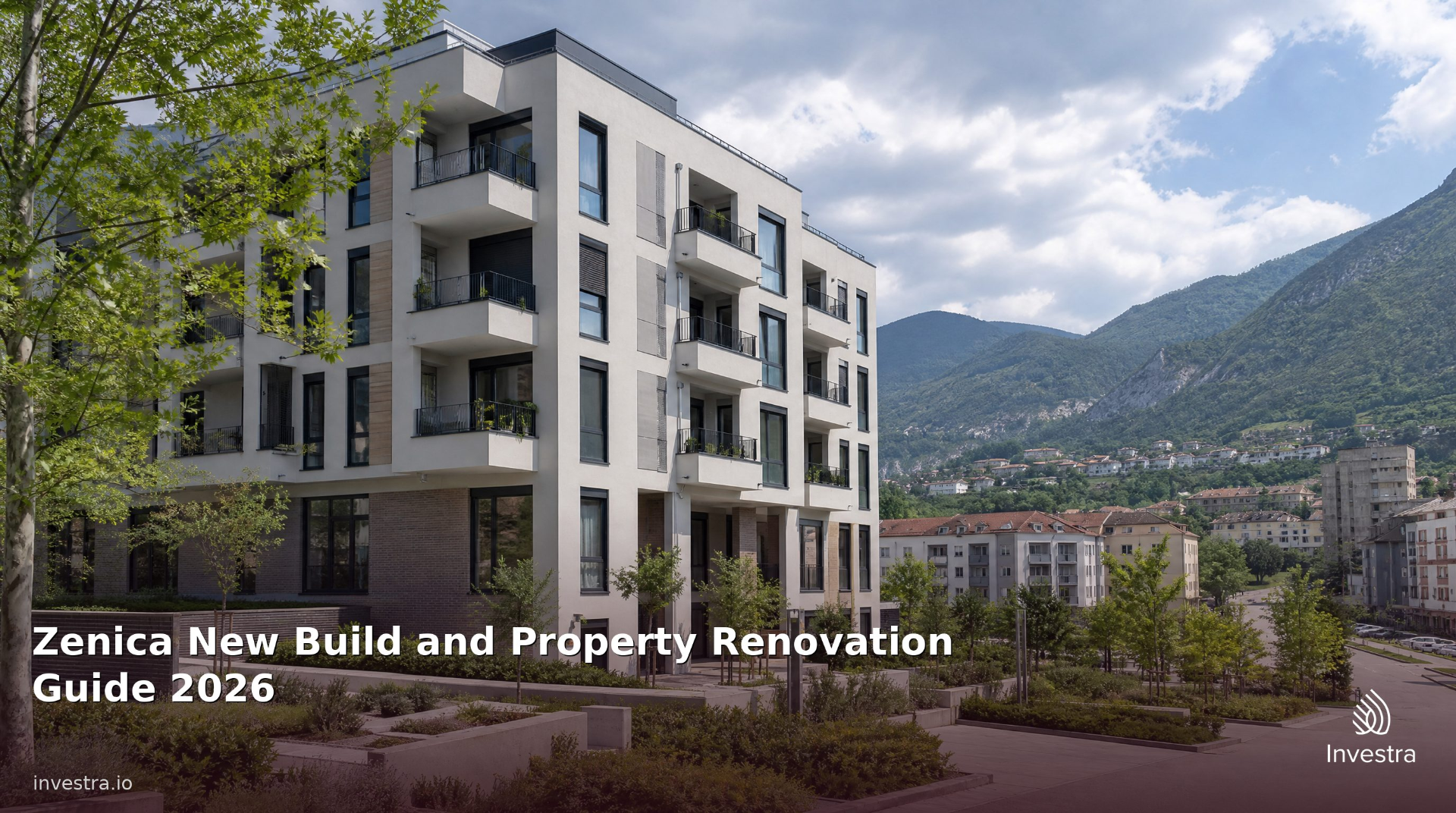
Zenica New Build and Property Renovation Guide 2026
Zenica New Build and Property Renovation Guide 2026
Zenica New Build and Property Renovation Guide 2026: Why This Bosnian City Deserves Your Attention
Quick Answer: Zenica is one of Bosnia and Herzegovina's most undervalued real estate markets in 2026, offering new build apartments from €800–€1,400/m² and renovation properties from €400–€700/m², with rental yields reaching 6–9% in well-located areas. Investra.io tracks emerging Balkan markets like Zenica for investors seeking high-growth, low-entry opportunities.
Zenica doesn't often appear in the glossy property brochures that circulate at international real estate fairs. It's not Sarajevo. It's not Mostar. And that, frankly, is part of what makes it interesting.
New residential developments are reshaping the city's skyline. Old socialist-era buildings are being stripped back and renovated into modern apartments.
The question isn't whether Zenica has potential. The question is how to access it, what to build or renovate, and how to structure an investment that actually delivers returns.
Understanding Zenica's Real Estate Market Context in 2026
Quick Answer: Zenica's property market in 2026 is characterized by low entry prices, rising demand from the diaspora and urban professionals, and a growing new-build sector that is modernizing previously neglected residential stock.
Context matters enormously when assessing any real estate market, and Zenica's context is genuinely fascinating. The city sits in the Bosna River valley in central Bosnia, roughly 70 kilometers north of Sarajevo.
What that means in practice is a city with large quantities of aging residential buildings built in the 1960s through 1980s, many of which are structurally sound but cosmetically exhausted. These represent the renovation opportunity.
Bosnia and Herzegovina's broader economic context adds fuel to the investment case. GDP growth has averaged around 2.5–3.5% annually in recent years.
For those tracking similar value propositions in neighboring Serbia, markets like those covered in the Zajecar Real Estate Market 2026 Eastern Serbia Property Guide show comparable dynamics — post-industrial cities with low entry prices, rising infrastructure investment, and diaspora-driven demand.
New Build Property Prices in Zenica 2026: What Does the Market Actually Look Like?
Quick Answer: New build apartments in Zenica in 2026 are priced between €900 and €1,400 per square meter depending on location and finish quality, with premium developments in central and elevated residential zones commanding the upper end of that range.
Let's talk real numbers. The Zenica new-build market in 2026 occupies a fascinating price band — high enough to attract quality developers, but low enough to make entry genuinely accessible for international investors working with modest capital.
Here's how the pricing breaks down across different segments and locations:
City Center and Immediate Surroundings: New build apartments here command €1,100–€1,400/m². These are typically mid-rise buildings of 6–10 floors, featuring modern finishes, underground parking, and proximity to the pedestrian zone, schools, and city services. A 60m² two-bedroom apartment in this zone costs roughly €66,000–€84,000.
Established Residential Districts (Bilmišće, Crkvice, Radakovo): Pricing drops to €900–€1,150/m² in these neighborhoods. These are popular among families and offer good transport links. A 70m² apartment here typically falls in the €63,000–€80,500 range.
Peripheral Urban Areas and Newer Developments: At the edges of the city, where developers have more land to work with and where new housing estates are being built from scratch, prices can be as low as €800–€950/m². These developments often attract buyers looking for larger floor areas — 85–100m² apartments for €70,000–€90,000.
Construction quality has improved noticeably over the past decade. Energy-efficiency standards have been tightened in line with Bosnia's EU approximation process, and buyers in 2026 are increasingly demanding thermal insulation, double-glazing, and modern HVAC systems as standard — features that were considered luxury additions just ten years ago.
Renovation Property Guide: Costs, Opportunities, and Hidden Traps
Quick Answer: Renovation properties in Zenica can be acquired for €400–€700/m² and fully renovated for an additional €300–€600/m² depending on the scope of work, creating end-products valued at €900–€1,200/m² — a compelling margin for experienced renovators.
Acquisition prices for renovation-grade properties depend heavily on condition and location. A structurally sound apartment needing full cosmetic renovation in a central block might be acquired for €450–€600/m².
Renovation Cost Breakdown for a Typical Zenica Apartment (per m²):
Basic cosmetic renovation (paint, flooring, fixtures): €150–€250/m². Mid-range renovation (new kitchen, bathroom, electrical, flooring): €300–€450/m². Full gut renovation including structural elements, new windows, and complete systems replacement: €500–€650/m².
The reality is that labor costs in Bosnia remain significantly below Western European levels. Skilled tradespeople — tilers, electricians, plumbers, carpenters — can be hired at €15–€30 per hour depending on specialization and experience, compared to €50–€80+ in Austria or Germany.
What catches many first-time renovators off guard in Zenica are the bureaucratic requirements for larger renovation projects. Any structural alteration, change of use, or addition of square footage requires building permits from the Zenica-Doboj Canton authorities.
For investors comparing renovation opportunities across the Western Balkans, the Bor Real Estate Market 2026 Eastern Serbia Mining City Property Guide covers a similar post-industrial renovation landscape with comparable cost dynamics.
Legal Framework for Foreign Buyers in Bosnia and Herzegovina
Quick Answer: Foreign nationals from most countries can purchase property in Bosnia and Herzegovina under the principle of reciprocity, meaning citizens of countries that allow Bosnian nationals to buy property can do the same in Bosnia — which covers most EU and Western countries.
Under current law, foreign nationals from countries with reciprocal property rights agreements (which includes virtually all EU member states, the US, UK, Canada, Australia, and most Western nations) can purchase residential and commercial property freely. The process broadly mirrors domestic purchases but involves a few additional steps.
The Purchase Process Step by Step:
First, the property must be checked for encumbrances at the Land Registry (Zemljišna knjiga). Bosnia's land registry modernization has progressed significantly, and the Zenica registry is now largely digitized. A qualified attorney can complete a title search within 3–5 business days.
Second, a preliminary purchase agreement (predugovor) is signed, typically accompanied by a 10% deposit. This is a binding contract, and walking away forfeits the deposit — so due diligence before this stage is critical.
Third, the final purchase contract (ugovor o kupoprodaji) is notarized by a certified notary (notar). Both parties must be present or represented by a power of attorney. For foreign buyers unable to travel to Zenica for signing, a locally registered power of attorney is a common solution.
Fourth, the buyer registers ownership at the Land Registry. This process typically takes 2–8 weeks. Until registration is complete, the buyer is technically not the legal owner of record.
Property transfer tax in the Federation of Bosnia and Herzegovina is 5% of the assessed property value (not the purchase price, if the canton assessor believes the declared price is below market). Legal fees, notary costs, and agency commissions typically add another 2–4%. Total transaction costs for a foreign buyer should be budgeted at 8–10% above the purchase price.
Consulting specialists who understand the intersection of regional law and international investment is strongly recommended. Siniša Dagary — Investment Consultant provides strategic guidance for investors entering Balkan real estate markets, and the Business Strategy Blog covers relevant regional investment frameworks.
Rental Yields and ROI Potential in Zenica's New Build and Renovation Segments
Quick Answer: Rental yields in Zenica range from 5–9% gross annually, with well-renovated properties in central locations and purpose-configured short-term rental units achieving the upper end of that range — among the strongest yield profiles in the Western Balkans.
Long-term residential rentals in Zenica are the backbone of the investment rental market. A modern, renovated two-bedroom apartment (60–70m²) in a central location commands monthly rents of €350–€500. At an acquisition-plus-renovation cost of, say, €70,000–€85,000 for a property in this segment, the gross annual yield works out to approximately 5–7%.
Short-term rentals — primarily through Booking.com and Airbnb, both active in Zenica — offer higher per-night rates but require active management. A well-presented apartment near the city center achieves average daily rates of €35–€55, with occupancy rates of 55–70% being realistic for a well-managed property.
Student accommodation is another underserved niche. Zenica's university — the University of Zenica — enrolls several thousand students, and purpose-fitted small apartments or studio conversions near the campus can achieve strong occupancy at lower rent levels that still translate to healthy yields given acquisition costs.
Corporate and business accommodation for ArcelorMittal contractors, visiting consultants, and NGO workers (several international organizations maintain presences in central Bosnia) is a premium segment that commands €600–€900/month for fully furnished apartments and fills a real gap in the market.
ROI calculations over a 5–10 year horizon, factoring in conservative 5% annual capital appreciation, suggest total returns in the 80–120% range on well-executed renovation plays — a figure that few Western European markets can match at this stage.
For comparison with neighboring Serbian markets showing similar yield dynamics, the Loznica Real Estate Market 2026 Macva Region Property Guide and the Sremska Mitrovica Real Estate 2026 Srem Region Property Guide offer useful benchmarks.
The Best Neighborhoods in Zenica for Investment in 2026
Quick Answer: The strongest investment neighborhoods in Zenica in 2026 are the City Center (for maximum rental demand), Bilmišće (for family rental yield), and the Jalija district (for renovation upside), each offering distinct risk-return profiles suited to different investor strategies.
Not all of Zenica is created equal from an investment standpoint. The city's geography — nestled in a valley with the Bosna River running through it — creates natural neighborhood hierarchies based on elevation, sun exposure, flood risk, and proximity to amenities. Understanding these micro-geographies is essential before committing capital.
City Center (Centar): The pedestrian zone, main commercial streets, and surrounding residential blocks form Zenica's premium rental market. Properties here are expensive by local standards (€1,100–€1,400/m² new build), but occupancy rates for rentals are the highest in the city. Excellent for short-term rentals and corporate accommodation.
Bilmišće: One of Zenica's most established residential neighborhoods, popular with middle-class families and working professionals. New build development has been active here for the past decade. It's the sweet spot for long-term residential rental — solid yields, reliable tenants, lower management overhead. Prices: €950–€1,150/m² new build, €500–€700/m² for renovation stock.
Radakovo: A quieter, more elevated zone offering better air quality (important in a city with an industrial legacy) and some genuinely attractive views. Popular with diaspora buyers purchasing for personal use or family occupation. Prices slightly below Bilmišće.
Jalija: This is where the renovation story gets really interesting. Jalija is an older urban quarter with a mix of pre-war and early post-war buildings, some in considerable disrepair but with excellent bones. Acquisition prices for renovation properties can fall to €350–€500/m² here.
Novo Zenica (newer peripheral districts): Large-scale housing developments on the city's outskirts offer the lowest entry prices but also the least established rental demand. Better suited to long-term capital appreciation plays than immediate rental income.
Financing Options and Tax Considerations for Investors
Quick Answer: Foreign investors in Zenica typically finance purchases through a combination of personal capital and home-country financing, as Bosnian mortgage access for non-residents is limited; local tax obligations include a 5% property transfer tax, 10% flat income tax on rental income, and standard annual fees.
The financing landscape in Bosnia and Herzegovina for foreign buyers is honest about its limitations: getting a mortgage from a Bosnian bank as a non-resident is genuinely difficult in 2026. Banks including Raiffeisen Bank Bosnia, UniCredit, and Sparkasse do operate mortgage products, but lending criteria for foreign nationals without local income history or residency are restrictive.
In practice, most international buyers approach Zenica investments with one of three financing strategies: full cash purchase (common for diaspora buyers), home-country financing using existing property equity as collateral, or developer payment plans for new-build off-plan purchases. Each has its logic depending on the buyer's financial position and home country.
For investors in Slovenia or Austria accessing financing through established financial services, platforms like Findes Financial Services can help structure cross-border financing arrangements for Balkan property acquisitions.
Tax Obligations in Bosnia and Herzegovina (Federation entity):
Property transfer tax: 5% of assessed value, paid by the buyer at transaction. VAT on new builds: New construction from registered developers is subject to 17% VAT, but this is typically included in the developer's advertised price — always confirm. Rental income tax: Bosnia operates a flat 10% income tax rate on rental income.
Capital gains tax on property sales is also 10% on the net gain (sale price minus acquisition cost and documented improvements). After five years of ownership, some cantons reduce or eliminate this obligation, though the rules continue to evolve — legal advice at point of sale is essential.
Understanding how these tax structures interact with your home country's tax treaties is crucial. Bosnia has double taxation agreements with many countries including Germany, Austria, France, and the UK, which can prevent double taxation on rental income.
Working With Local Developers, Contractors, and Architects
Quick Answer: Building a reliable local professional network is the single most important practical step for any new build or renovation investor in Zenica, as project outcomes depend heavily on contractor quality, architect competence, and the ability to manage construction processes remotely.
Here's a truth that experienced Balkan investors know well: the deal isn't the hard part. The hard part is execution. Finding a reliable builder in Zenica, managing a renovation project from 1,200 kilometers away, and ensuring that the finished product matches what was promised on the drawings — that's where fortunes are made or lost.
For renovation work, the informal trades sector is large and often highly skilled — Zenica's industrial heritage means there are plenty of qualified engineers, electricians, and metalworkers in the population — but documentation and contracts require extra attention. Always use written contracts specifying scope, materials, timeline, and payment milestones.
Architects in Bosnia must be licensed by the relevant cantonal chamber (Komora arhitekata Federacije BiH for FBiH). Using an unlicensed "designer" for anything requiring permits is a false economy — it creates legal problems that can freeze your project for months. Budget €3,000–€8,000 for full architectural services on a renovation project, more for ground-up new builds.
Project management oversight from a trusted local partner is worth paying for, especially for absentee investors. A local project manager charging 5–8% of construction costs can save far more than their fee by catching material substitutions, monitoring progress, and managing contractor relationships. For strategic perspective on managing investment projects across the region, About Siniša Dagary provides insight into the regional business environment that shapes these dynamics.
The EU Accession Effect: What It Means for Zenica Property Values
Quick Answer: Bosnia and Herzegovina's active EU accession process — with candidate status secured in 2022 and negotiations ongoing — is expected to be a significant medium-term driver of property price appreciation in cities like Zenica, mirroring the pre-accession price surges seen in Romania, Bulgaria, and Croatia.
History is instructive here. When Romania and Bulgaria joined the EU in 2007, property prices in their mid-tier cities had already risen 40–80% in the five years preceding accession as investor confidence built. Croatia saw similar dynamics ahead of its 2013 accession. Bosnia is arguably at an earlier, more compelling entry point in that cycle right now.
The accession process brings several real economic benefits that flow through to property values. First, EU funding becomes available — infrastructure grants, agricultural subsidies, regional development funds. Bosnia is expecting significant EU pre-accession aid already, with larger disbursements anticipated once negotiations progress.
Zenica, as a post-industrial city with improving infrastructure and a growing professional class, is well-positioned to benefit from these dynamics. The Corridor Vc highway improvements are already underway. The industrial base, while no longer dominant, continues to employ thousands and anchors the local economy.
Building Due Diligence and Risk Management Into Your Investment Process
Quick Answer: Successful Zenica real estate investing requires comprehensive due diligence on property title, structural condition, legal permits, contractor reliability, and local market dynamics — investments should be sized within a portfolio framework where a single project failure doesn't threaten overall financial stability.
It's necessary to be explicit about the risks. Zenica is not Vienna. Bosnia and Herzegovina is not Austria. The legal system is functional but less institutionalized than Western Europe. Contractor reliability varies wildly. Currency risk (the Bosnian Convertible Mark is pegged to the euro, but that peg exists by law, not market force).
What separates successful Zenica investors from those who lose money is rigorous due diligence. Start with title. Work with a licensed attorney to conduct a full search at the Land Registry. Verify that the property is free of liens, mortgages, or legal disputes. Verify the seller's identity and right to sell.
Second, verify structural integrity. In renovation properties, hire a Bosnian structural engineer to conduct a proper inspection. The engineer's report becomes your roadmap for renovation budgeting. Paying €500–€1
Investment Disclaimer
Quick Answer: This guide is general market information, not personal legal, tax, financing or investment advice.
Before committing to a property transaction, buyers should obtain independent local legal, tax and financial advice suited to their circumstances. Investra.io can support initial market research, but every purchase decision remains the buyer's responsibility.
Frequently Asked Questions
Quick Answer: This section explains the practical property-investment implications of Frequently Asked Questions.
What is a prudent next step after initial market research?
Use current documentation, independent professional advice and comparable local evidence before proceeding. Investra.io can support an initial structured market review.
How can buyers plan a realistic ownership budget?
Use current documentation, independent professional advice and comparable local evidence before proceeding. Investra.io can support an initial structured market review.
What evidence supports a careful investment decision?
Use current documentation, independent professional advice and comparable local evidence before proceeding. Investra.io can support an initial structured market review.
When should a buyer obtain legal and tax advice?
Use current documentation, independent professional advice and comparable local evidence before proceeding. Investra.io can support an initial structured market review.
How should a buyer compare neighbourhoods and property types?
Use current documentation, independent professional advice and comparable local evidence before proceeding. Investra.io can support an initial structured market review.
What local checks should be completed before signing?
Use current documentation, independent professional advice and comparable local evidence before proceeding. Investra.io can support an initial structured market review.
Which costs should be assessed alongside the purchase price?
Use current documentation, independent professional advice and comparable local evidence before proceeding. Investra.io can support an initial structured market review.
How can international buyers verify a property opportunity?
Use current documentation, independent professional advice and comparable local evidence before proceeding. Investra.io can support an initial structured market review.
What should buyers compare before selecting a property?
Use current documentation, independent professional advice and comparable local evidence before proceeding. Investra.io can support an initial structured market review.
Quick Answer: These answers outline common buyer checks and should be read with current professional advice.
Recommended Reading
Quick Answer: This section explains the practical property-investment implications of Recommended Reading.
- Investra market research
- Investra market research
- Investra market research
- Investra market research
- Investra market research
- Investra market research
- Investra market research
- Investra market research
- Investra market research
- Investra market research
- Investra market research
- Investra market research
- Investra market research
- Investra market research
- Investra market research
- Investra market research
- Investra market research
- Siniša Dagary investment insight
- Siniša Dagary investment insight
- Siniša Dagary investment insight
- Siniša Dagary investment insight
- Siniša Dagary investment insight
- Findes Group & Partners
- Findes Group & Partners
Connect With Investra
Follow Investra for market updates on Facebook, LinkedIn, YouTube
Related Posts
No related posts available.
