
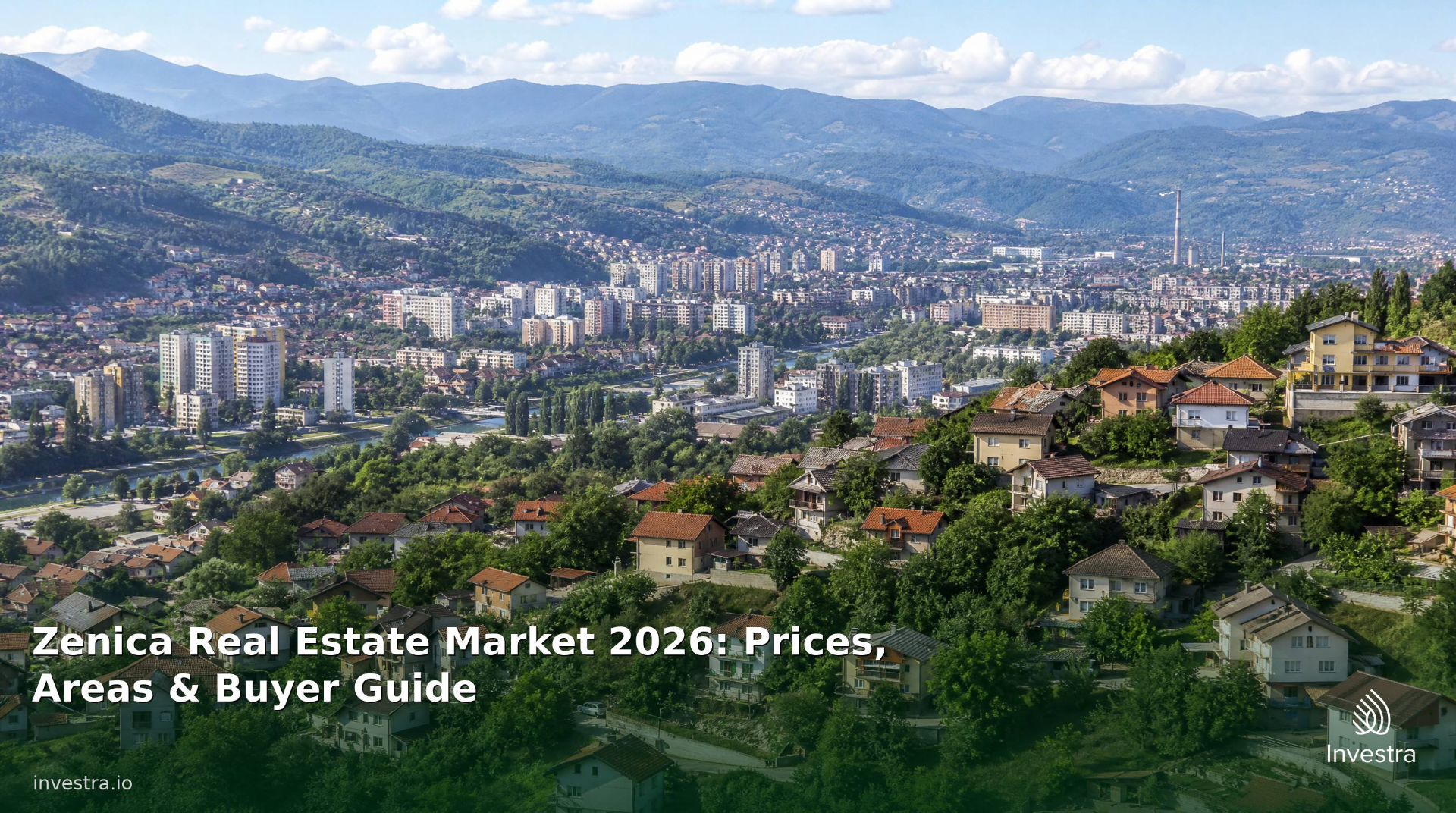
Zenica Real Estate Market 2026: Prices, Areas & Buyer Guide
Zenica Real Estate Market 2026: Prices, Areas & Buyer Guide
Zenica Real Estate Market Overview 2026: Bosnia's Industrial Heart Reinvented
Quick Answer: Zenica's real estate market in 2026 offers some of the most competitively priced urban property in the Western Balkans, with apartment prices ranging from €600 to €1,400 per m² depending on location and condition — making it a compelling entry point for budget-conscious investors seeking exposure to Bosnia and Herzegovina's growing economy.
Zenica doesn't get the same glossy coverage as Sarajevo or Mostar. It doesn't have UNESCO-listed bridges or Ottoman bazaars drawing Instagram crowds.
The city sits at the heart of Bosnia and Herzegovina's Zenica-Doboj Canton, positioned along the Bosna River valley roughly 70 kilometers north of Sarajevo. Historically synonymous with steel production — the ArcelorMittal facility here was once one of Yugoslavia's industrial jewels — Zenica has spent the last decade diversifying its economic base.
What we've seen in 2025 and into 2026 is a quiet but steady upward pressure on prices in the city's better-located neighborhoods. New construction has been limited by relatively tight financing conditions and cautious developers, which has kept supply constrained. Meanwhile, younger professionals seeking affordable urban living — many priced out of Sarajevo's rapidly escalating market — have been eyeing Zenica with fresh interest. For investors, that supply-demand dynamic is exactly the kind of structural setup worth paying attention to. Consulting with specialists like Siniša Dagary investment insight can help translate these macro signals into specific acquisition strategies.
This guide covers everything an international or domestic buyer needs to understand Zenica's real estate market in 2026 — from neighborhood-by-neighborhood price breakdowns to the legal process, tax obligations, rental yield expectations, and the practical realities of buying property as a foreigner in Bosnia and Herzegovina.
Economic Context: Why Zenica Matters for Property Investors
Quick Answer: Zenica's economy is diversifying beyond its steel heritage, with manufacturing, education, and services sectors driving sustained employment and housing demand — creating the kind of stable economic base that supports long-term real estate value appreciation.
Any serious property analysis has to start with economics. A city's real estate market is ultimately a reflection of its economic health, and Zenica's economic story in 2026 is more nuanced — and more optimistic — than the old "steel town in decline" narrative suggests.
ArcelorMittal's Zenica plant, despite periodic production fluctuations, continues to employ thousands of workers and remains a cornerstone of the city's industrial identity. But the real story is what's grown up around it.
The University of Zenica is a factor that's consistently underweighted in property analysis. With faculties spanning mechanical engineering, economics, law, and metallurgy, the university sustains a steady population of students, academics, and visiting professionals.
Infrastructure investment is accelerating. The planned completion of the Corridor Vc — the major highway linking Budapest to the Adriatic coast, passing directly through Zenica — is transforming the city's connectivity. When fully operational, Zenica will sit on one of the most significant transport arteries in the Western Balkans, which historically has a meaningful positive impact on real estate values in affected cities. Investors tracking similar corridor-driven appreciation in Serbia's secondary cities, like those analyzed in the Loznica Real Estate Market 2026 Macva Region Property Guide, will recognize this pattern.
Property Prices in Zenica 2026: A Neighborhood-by-Neighborhood Breakdown
Quick Answer: Property prices in Zenica range from €600 to €1,400 per m² in 2026, with central districts and newer residential developments at the premium end, while older socialist-era housing stock in peripheral areas can be acquired for €600–€800 per m². Investra.io provides real-time market data for informed investment decisions.
Price transparency in Zenica's market has improved substantially, though it's still not at the level you'd find in more developed European markets. Here's what the data shows for 2026, broken down by key areas:
Staro Željezničko Naselje (Old Railway Settlement) and Central Zenica: The city center and its immediately adjacent neighborhoods represent the premium end of the market. Well-renovated apartments in central Zenica are trading at €1,100–€1,400 per m².
Novo Naselje and Bulevar: These established residential neighborhoods, developed primarily during the Yugoslav period but maintained and partially upgraded, represent the sweet spot for rental investment. Prices here run €800–€1,100 per m² for decent-condition apartments.
Radakovo and Tetovo (suburban periphery): These peripheral areas offer the lowest entry prices, with older housing stock available at €600–€800 per m². Houses with land — a category that attracts diaspora buyers and those seeking more space — can be found in the €50,000–€120,000 range depending on condition, size, and plot quality.
Pehare and Čajdraš: These mixed residential-industrial zone adjacent areas have seen some gentrification pressure as younger buyers seek affordable first homes. Prices range from €700–€950 per m², and these neighborhoods tend to offer better value for investors willing to accept slightly longer commute times for tenants.
Year-on-year, prices across Zenica appreciated approximately 5–8% in 2024-2025, driven by limited new supply and increased demand from the Sarajevo-priced-out demographic. The reality is that at these price levels, Zenica remains one of the most affordable mid-sized city markets in Southeast Europe.
Zenica Rental Market: Yields, Demand Drivers, and What to Expect
Quick Answer: Rental yields in Zenica typically range from 5% to 8% gross annually, with student-focused properties and well-located small apartments achieving the upper end of that range — significantly outperforming comparable investments in Western European capitals.
Rental yields are where Zenica's story gets compelling. While gross yields of 5–8% might sound modest compared to some frontier market pitches, they represent genuinely strong returns in the context of the asset's capital preservation characteristics and Bosnia's currency stability.
Let's put some numbers on it. A 45m² one-bedroom apartment in Novo Naselje, acquired at around €900/m² (total purchase price approximately €40,500), might rent for €250–€300 per month to a working professional. That translates to a gross yield of approximately 7.4–8.9%.
Student housing, particularly properties within walking distance of the University of Zenica faculties, commands consistent demand. A two-bedroom apartment that can be rented room-by-room to students might generate €150–€200 per room per month, potentially hitting gross yields above 8% on the right acquisition.
Short-term rentals through platforms like Airbnb and Booking.com are a smaller but growing segment in Zenica. The city isn't a primary tourist destination, but it sees business travelers, families visiting the diaspora, and increasingly tourists using it as a base for exploring the surrounding Bosna Valley.
Comparison is useful here: investors tracking secondary Serbian city yields, as documented in analyses like the Zajecar Real Estate Market 2026 Eastern Serbia Property Guide, will find Zenica broadly competitive, with the additional advantage of eurozone-pegged currency stability.
Best Areas to Buy Property in Zenica: An Investor's Honest Assessment
Quick Answer: For rental investment, the Novo Naselje and Bulevar areas offer the best combination of price, tenant demand, and liquidity; for capital appreciation potential, centrally located properties and new-build developments near the city core represent the strongest medium-term bet.
Not all neighborhoods are created equal, and in Zenica the variance in investment quality between districts is significant enough to make location selection genuinely consequential. Here's an honest, area-by-area assessment for investors with different strategies:
For buy-to-let income investors: Novo Naselje is the standout choice. It's a well-established residential area with good transport links, proximity to schools, shops, and the university, and a tenant pool that spans students, young professionals, and families. Liquidity when it comes time to sell is better here than in peripheral areas.
For capital appreciation plays: The areas immediately adjacent to the city center, particularly along the main commercial corridors, offer the most interesting upside. As Zenica's economy develops and more investment flows in, central real estate will be the primary beneficiary.
For diaspora buyers seeking a family home: The outer areas — Tetovo, suburban Radakovo, and areas south toward Nemila — offer houses with gardens at price points that remain accessible. A three-bedroom house with a 500m² garden in a quiet suburban setting can be acquired for €80,000–€130,000.
For renovation-and-resale strategies: Older apartment buildings in transitional neighborhoods like Čajdraš and Pehare offer scope for value-add plays. Acquiring a 60m² apartment for €40,000–€45,000, investing €15,000–€20,000 in quality renovation, and selling at €75,000–€85,000 is a realistic scenario — though execution quality and local contractor relationships are the critical variable. The Siniša Dagary investment insight covers value-add real estate strategies in emerging European markets that are directly applicable to this kind of opportunity.
Legal Framework for Buying Property in Bosnia and Herzegovina
Quick Answer: Foreign nationals from most countries can legally purchase real estate in Bosnia and Herzegovina, subject to reciprocity agreements, with the purchase process involving a notarized sales contract, land registry registration, and transfer tax of 5% — a process that typically takes 30–90 days to complete.
Foreign ownership rights: Citizens of countries that have reciprocal agreements with Bosnia and Herzegovina — which includes most EU member states, the United States, and many others — can purchase real estate on essentially the same terms as Bosnian citizens. The key practical requirement is establishing this reciprocity, which your notary or attorney will handle.
The purchase process step by step:
Due diligence comes first and shouldn't be rushed. This means obtaining a land registry extract (ZK izvadak) to confirm ownership, check for mortgages or encumbrances, and verify the cadastral status of the property.
The preliminary contract (predugovor) locks in terms and is typically accompanied by a 10% deposit. Once all due diligence is complete, the main sales contract (kupoprodajni ugovor) is signed before a notary. The notary verifies identity, confirms legal compliance, and witnesses the transaction.
Key costs to budget: Transfer tax in the Federation of Bosnia and Herzegovina is 5% of the assessed value. Notary fees are regulated and typically amount to €200–€500 depending on transaction value. Attorney fees for due diligence and contract review typically run €300–€800. Land registry fees are modest, generally under €200.
One reality that catches international buyers off guard is the time required to obtain all documentation. Building permits, usage permits (upotrebna dozvola), and energy performance certificates may all be required or recommended, and obtaining these from municipal authorities can take weeks.
Tax Obligations for Property Owners in Zenica
Quick Answer: Property owners in Zenica face a 5% transfer tax on purchase, annual property tax of 0.05–1% of assessed value depending on property type and use, and rental income tax of 10% on net income — making Bosnia one of the more tax-efficient property markets in Southeast Europe for investors.
Tax efficiency is one of Bosnia and Herzegovina's genuine competitive advantages for real estate investors, and it's worth understanding the full picture rather than just the headline numbers.
Transfer tax: As noted, the one-time transfer tax on property purchase is 5% of assessed value in the Federation. This is paid within 30 days of contract execution. In cases where assessed value differs significantly from purchase price, tax authorities may challenge valuations — another reason to work with experienced local professionals.
Annual property tax: Bosnia's annual property taxes are remarkably low by European standards. The rate varies by municipality and property type but typically falls in the range of 0.05–0.5% of assessed value for residential properties. For a typical apartment with an assessed value of €60,000, annual property tax might be as low as €30–€300.
Rental income tax: Rental income is taxed at 10% of net income (after deducting recognized expenses including depreciation, maintenance, and management fees). This is one of the lowest rental income tax rates in Europe. For comparative context, rental income in France faces marginal rates up to 45%, and even in neighboring Serbia, the rate is 20%.
Capital gains tax: Property held for more than five years is generally exempt from capital gains tax in Bosnia and Herzegovina. Properties sold within five years of acquisition face a 10% tax on the gain. This five-year exemption threshold is an important planning consideration for investment horizon decisions.
VAT: New-build residential properties from developers are typically subject to 17% VAT, which is usually included in the advertised price. Resale transactions are not subject to VAT, which is why secondary market acquisitions are often more cost-efficient for investors focused on yield.
For investors seeking professional financial structuring advice around these obligations, Findes Group & Partners offers expertise in cross-border real estate investment planning that's directly relevant to Western Balkans acquisitions.
Investment Opportunities: Where the Smart Money Is Looking in Zenica
Quick Answer: The most compelling investment opportunities in Zenica's 2026 market center on mid-range residential apartments for long-term rent, student housing near the university, and value-add renovation plays in transitional neighborhoods — all underpinned by the city's Corridor Vc infrastructure tailwind.
Sophisticated investors don't just buy property — they identify structural opportunities that the broader market hasn't fully priced in yet. Zenica has several of these right now.
The Corridor Vc effect deserves more analysis than it typically receives. The highway connecting Hungary to the Adriatic port of Ploče passes through Zenica, and sections are progressively opening. When the full corridor is operational, Zenica's accessibility from both Zagreb and Sarajevo will improve dramatically. Cities that gain major transport infrastructure access consistently see real estate appreciation of 10–25% in the years following completion. We've seen this pattern play out in Serbia along major infrastructure corridors — analyses like the Sremska Mitrovica Real Estate 2026 Srem Region Property Guide and the Prokuplje Real Estate Market 2026 Toplica Region Property Guide document how logistics-driven connectivity transforms property values in secondary cities.
Industrial park development around Zenica is another underappreciated driver. Several industrial and business zones in the municipality have attracted foreign manufacturing investment, particularly from Austrian and German companies with longstanding ties to Bosnia.
The student housing opportunity is also structurally underserved. Purpose-built student accommodation essentially doesn't exist in Zenica — the market is served almost entirely by informal room rentals and individual apartments.
For investors with a longer horizon and tolerance for complexity, commercial real estate in Zenica's city center is also worth watching. Ground-floor retail and office space in the central business district trades at €1,200–€2,000/m², with yields on commercial properties reaching 7–9% for well-tenanted spaces. This is a more sophisticated segment requiring deeper local market knowledge, but the fundamentals are attractive. The Siniša Dagary investment insight outlines the kind of multi-market investment consulting framework useful for evaluating commercial real estate opportunities in emerging European markets.
Comparing Zenica to Other Emerging Balkan Markets
Quick Answer: Zenica offers lower entry prices than Sarajevo (typically 40–60% cheaper per m²), competitive yields versus comparable Serbian secondary cities, and the additional advantage of Bosnia's euro-pegged currency — making it a distinctive value proposition in the regional investor landscape.
Context matters enormously when evaluating any real estate market. How does Zenica stack up against its regional peers?
Against Sarajevo, the contrast is stark. Sarajevo's prime neighborhoods — Centar, Marijin Dvor, Ilidža — are now trading at €1,800–€3,000+ per m² for quality apartments, driven by strong domestic demand, diaspora investment, and growing tourism. Zenica at €800–€1,400/m² offers entry at 40–60% less.
Against Mostar, which has become something of a tourist investment hotspot given its international profile and growing short-term rental market, Zenica offers more stable underlying demand but less tourism upside. The two cities serve quite different investment theses.
Against Serbian secondary cities — a relevant comparison given the shared regional economic dynamics — Zenica competes favorably. Markets like those covered in the Aleksinac Real Estate Market 2026 Southern Serbia Property Guide show price ranges and yields broadly comparable to Zenica, but Zenica benefits from the KM's euro peg — a significant advantage for investors based in eurozone countries. Serbian investors using RSD face currency risk that Zenica-based investments simply don't carry.
Against eastern Serbian markets like those documented in the Bor Real Estate Market 2026 Eastern Serbia Mining City Property Guide, Zenica presents comparable price points and yield profiles, but with the structural advantage of Bosnia's EU candidacy momentum and the infrastructure development underway via Corridor Vc.
For investors examining the broader proptech and structural evolution of regional real estate markets, Serbia Proptech 2026 How Technology Is Changing Real Estate and Serbia Co Living Investment 2026 New Trend In Belgrade Real Estate highlight emerging investment frameworks applicable across the region, including Bosnia. The Serbia Green Real Estate 2026 Eco Friendly Properties Sustainability guide and Serbia Property Renovation Guide 2026 Costs Permits Best Contractors offer tactical renovation and sustainability insights equally relevant to Bosnian property investment.
For those assessing permitting and construction frameworks, Serbia Building Permits 2026 How To Get Construction Permission and Serbia Real Estate Market Secrets What The Data Really Shows 2026 provide methodological approaches to market analysis applicable across Southeast European markets. Those interested in mountain and resort property dynamics can gain valuable perspective from Kopaonik Real Estate FAQ 2026 30 Questions About Ski Resort Property and
Investment Disclaimer
Quick Answer: This guide is general market information, not personal legal, tax, financing or investment advice.
Before committing to a property transaction, buyers should obtain independent local legal, tax and financial advice suited to their circumstances. Investra.io can support initial market research, but every purchase decision remains the buyer's responsibility.
Frequently Asked Questions
Quick Answer: This section explains the practical property-investment implications of Frequently Asked Questions.
What is a prudent next step after initial market research?
Use current documentation, independent professional advice and comparable local evidence before proceeding. Investra.io can support an initial structured market review.
How can buyers plan a realistic ownership budget?
Use current documentation, independent professional advice and comparable local evidence before proceeding. Investra.io can support an initial structured market review.
What evidence supports a careful investment decision?
Use current documentation, independent professional advice and comparable local evidence before proceeding. Investra.io can support an initial structured market review.
When should a buyer obtain legal and tax advice?
Use current documentation, independent professional advice and comparable local evidence before proceeding. Investra.io can support an initial structured market review.
How should a buyer compare neighbourhoods and property types?
Use current documentation, independent professional advice and comparable local evidence before proceeding. Investra.io can support an initial structured market review.
What local checks should be completed before signing?
Use current documentation, independent professional advice and comparable local evidence before proceeding. Investra.io can support an initial structured market review.
Which costs should be assessed alongside the purchase price?
Use current documentation, independent professional advice and comparable local evidence before proceeding. Investra.io can support an initial structured market review.
How can international buyers verify a property opportunity?
Use current documentation, independent professional advice and comparable local evidence before proceeding. Investra.io can support an initial structured market review.
What should buyers compare before selecting a property?
Use current documentation, independent professional advice and comparable local evidence before proceeding. Investra.io can support an initial structured market review.
Quick Answer: These answers outline common buyer checks and should be read with current professional advice.
Recommended Reading
Quick Answer: This section explains the practical property-investment implications of Recommended Reading.
- Investra market research
- Investra market research
- Investra market research
- Investra market research
- Investra market research
- Investra market research
- Investra market research
- Investra market research
- Investra market research
- Investra market research
- Investra market research
- Investra market research
- Investra market research
- Investra market research
- Investra market research
- Investra market research
- Investra market research
- Siniša Dagary investment insight
- Siniša Dagary investment insight
- Siniša Dagary investment insight
- Siniša Dagary investment insight
- Siniša Dagary investment insight
- Findes Group & Partners
- Findes Group & Partners
Connect With Investra
Follow Investra for market updates on Facebook, LinkedIn, YouTube
Related Posts
No related posts available.
