
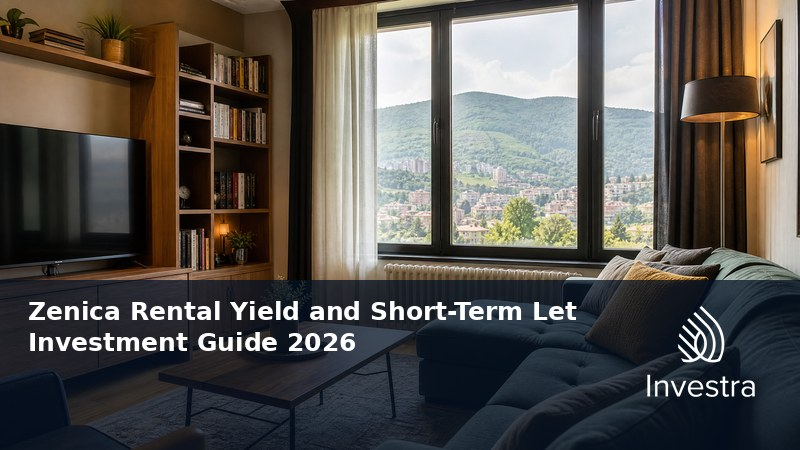
Zenica Rental Yield and Short-Term Let Investment Guide 2026
Zenica Rental Yield and Short-Term Let Investment Guide 2026
Zenica Real Estate in 2026: Why Rental Income Investors Are Paying Attention
Quick Answer: Zenica, Bosnia and Herzegovina's fourth-largest city, is emerging as a credible rental income market in 2026, offering gross rental yields of 5–8% for long-term lets and short-term Airbnb returns that can reach 9–12% in well-positioned apartments near the city center and university district. Investra.io tracks comparable emerging Balkan markets to help investors benchmark opportunities like this one.
Zenica doesn't make international headlines the way Sarajevo or Mostar do. It isn't on the bucket list of most European city-break tourists, and its industrial past—as the home of the massive Arcelor Mittal steel plant—hasn't done much to polish its image abroad. But here's the thing: smart property investors rarely go where the headlines are.
And the fundamentals in Zenica are genuinely interesting right now. The city's population of roughly 110,000 people makes it a functioning mid-sized urban market with real tenant demand. The University of Zenica draws thousands of students annually, creating a reliable base of rental demand that doesn't evaporate with tourism seasonality.
What's changed in 2025–2026 is the broader context. Bosnia and Herzegovina has made measurable progress on its EU accession path, with the European Commission granting candidate status in 2022 and formal accession negotiations gathering momentum.
This guide covers everything a rental income investor needs to know: local price data, Airbnb versus long-term let comparisons, the legal framework for foreign buyers, tax obligations, and the neighborhoods where the numbers actually work. Working alongside platforms like Siniša Dagary — Investment Consultant, experienced Balkan market professionals are increasingly directing client attention toward exactly these kinds of secondary cities, where yields are real and competition from institutional capital is still minimal.
Understanding the Zenica Property Market: Price Ranges and Market Structure
Quick Answer: Zenica residential property prices in 2026 range from approximately €600/m² for older socialist-era apartments needing renovation to €1,400/m² for newly built or fully renovated city-center units, making it one of the most affordable urban rental markets in the Western Balkans.
Zenica's property market is fundamentally a local market—it's driven by local wages, local demand, and local construction activity rather than by foreign speculative capital. That's actually a strength for rental investors, because it means valuations are grounded in real economic activity rather than inflated by hype cycles.
The market breaks down into distinct tiers. At the entry level, you'll find socialist-era panel apartment blocks—called "stambeni blokovi"—built between the 1960s and 1980s. These buildings are ubiquitous in Zenica and across BiH generally. Prices for unrenovated units in these blocks typically fall between €600–€800 per square meter.
The mid-market tier—renovated apartments in older buildings or newer construction from the 2000s onward—runs from roughly €900–€1,200 per square meter. This is arguably the sweet spot for rental investors.
At the premium end, newly constructed apartments in residential developments—particularly those targeting the professional and diaspora market—are priced at €1,200–€1,400/m². These units offer modern finishes, energy efficiency, and elevator access, attributes that increasingly matter to young professional tenants.
What surprised many buyers entering this market is just how thin the transaction volume is compared to capital cities. Zenica sees perhaps a few hundred residential transactions per quarter, which means the market is illiquid by Western European standards.
For comparison, investors tracking similar dynamics in neighboring Serbia should look at markets like Zajecar Real Estate Market 2026 Eastern Serbia Property Guide, where secondary city dynamics produce comparably interesting yield calculations at similar price points.
Long-Term Rental Yields in Zenica: What the Numbers Actually Show
Quick Answer: Long-term rental yields in Zenica range from 5% to 8% gross annually in 2026, with the best returns concentrated in the city center and university-adjacent neighborhoods where tenant demand from students and young professionals is most consistent.
Let's get concrete, because generalities don't help investors make decisions. Here's how the long-term rental math works in Zenica's main segments.
A 45m² one-bedroom apartment near the University of Zenica, purchased for €40,000 in renovated condition, typically rents for €350–€400 per month to a student or young professional tenant. That's annual gross income of €4,200–€4,800, representing a gross yield of 10.5–12%—genuinely exceptional by any regional standard.
A more typical mid-market scenario: a 60m² two-bedroom apartment in the Radakovo or Bilmišće district, purchased for €55,000, renting to a working-family tenant for €420–€480 per month. That produces gross yields of approximately 9–10.5%.
For the premium segment, a newly built 70m² apartment purchased for €85,000–€95,000 might generate €550–€650 per month, producing gross yields of 6.9–9.2%. Lower yields, yes, but also lower maintenance costs, better tenant quality, and stronger capital appreciation potential as the premium segment in Zenica remains undersupplied.
The Business Strategy Blog at Siniša Dagary's platform regularly covers yield optimization strategies for Balkan markets, including how to structure rental income for tax efficiency across multiple jurisdictions—useful reading for investors managing cross-border portfolios.
Airbnb and Short-Term Let Potential in Zenica: Honest Assessment
Quick Answer: Short-term rental income in Zenica is possible but limited by relatively modest tourist volumes; successful Airbnb operators focus on the city-center corridor and target business travelers, transit guests, and cultural visitors rather than purely leisure tourism, achieving average occupancy of 45–65% with nightly rates of €30–€60.
Here's an honest assessment that most "investment guides" won't give you: Zenica is not Dubrovnik. It's not even Mostar. The city doesn't draw the kind of leisure tourism volumes that make Airbnb a slam-dunk investment in coastal markets. If you're expecting a 90% occupancy rate driven by Instagram-happy tourists, this market will disappoint.
But the picture isn't as bleak as that caveat might suggest. What Zenica does have is a steady stream of business travelers—executives, consultants, and contractors related to the steel industry, infrastructure projects, and the growing manufacturing base in the Zenica-Doboj Canton.
The realistic scenario for most operators is closer to 40–50% occupancy in year one, improving as review scores accumulate and listing visibility improves. Monthly Airbnb revenue of €500–€700 is achievable for a well-managed one-bedroom in a central location.
Comparing Zenica's short-term let potential to markets like Loznica Real Estate Market 2026 Macva Region Property Guide is instructive—similar secondary Balkan cities with industrial economies and university populations show that a hybrid strategy (short-term when possible, pivoting to long-term for guaranteed income floors) often outperforms a pure Airbnb approach in these markets.
Best Neighborhoods in Zenica for Rental Investment
Quick Answer: The highest-performing neighborhoods for rental investment in Zenica in 2026 are the city center (Stari Grad), the university district around the Faculty of Mechanical Engineering, and the Radakovo area—each offering distinct tenant profiles and yield characteristics.
Location within Zenica matters enormously for rental performance, perhaps more than in larger cities where demand is more evenly distributed. Here's a breakdown of the key areas.
Stari Grad (Old Town / City Center): This is the beating heart of rental demand for both short-term and long-term lets. Proximity to the main pedestrian zone, restaurants, cafes, and the cultural institutions makes it highly attractive to young professionals and business travelers.
University District (around Zenica University campus): Student-driven demand makes this one of the most consistent rental markets in the city. A constant turnover of students from across Bosnia—and increasingly from the region—creates reliable demand for affordable one-bedroom and studio units.
Radakovo and Bilmišće: These established residential neighborhoods offer good value for family-oriented rentals. Two and three-bedroom apartments in decent condition attract working families and mid-career professionals, typically on longer tenancy terms.
Newly developed peripheral areas: Some new construction projects are emerging on the outskirts, but these carry higher vacancy risk without established community infrastructure. For rental investment, centrality wins in a market the size of Zenica.
Legal Framework for Foreign Property Buyers in Bosnia and Herzegovina
Quick Answer: Foreign nationals from most countries can legally purchase residential property in Bosnia and Herzegovina, though the process involves entity-level legal differences between the Federation of BiH and Republika Srpska; Zenica falls under the Federation, where foreigners can buy property directly with standard ownership rights.
Bosnia and Herzegovina's unique constitutional structure—two entities (the Federation of BiH and Republika Srpska) plus the Brčko District—means property law isn't entirely uniform across the country. Zenica sits in the Federation of BiH, which is where this discussion focuses.
The good news for foreign investors is that the Federation of BiH permits direct property purchase by foreign nationals on the basis of reciprocity. Citizens of most European countries, the US, Canada, Australia, and neighboring Balkan states face no meaningful legal barrier to purchasing residential property outright.
Property transfer tax in the Federation of BiH is set at 5% of the agreed purchase price, paid by the buyer. This is a significant transaction cost compared to some regional markets—factor it into your total acquisition cost calculation. Notary fees are regulated and typically run 0.1–0.3% of the transaction value.
The entire process, from signed contract to registered ownership, typically takes 4–8 weeks for straightforward transactions. Properties with complex title histories can take considerably longer. Working with financial and legal professionals across borders—resources like Findes Group & Partners offer cross-border financial structuring support that's genuinely useful when handling multi-jurisdiction investment decisions.
Mortgage financing is available for non-residents through Bosnian banks, but practical access is limited and interest rates are higher than in Western Europe (typically 4–7% for foreign nationals). Most international investors purchase cash, which is simpler and faster.
Tax Obligations for Rental Income in BiH: What Investors Must Know
Quick Answer: Rental income from property in Bosnia and Herzegovina's Federation entity is subject to cantonal income tax at rates typically ranging from 10% to 15%, with property tax set annually at the cantonal level and generally amounting to less than 1% of assessed value per year.
Tax policy in BiH is, to put it charitably, fragmented. Because taxation is largely devolved to the entity and cantonal level, Zenica's position within Zenica-Doboj Canton means that local cantonal tax rules apply. Here's what investors actually need to know.
Rental income declared in the Federation of BiH is treated as personal income and subject to income tax. The cantonal flat rate in most Federation cantons, including Zenica-Doboj, is 10% of net rental income.
Annual property tax (communal contribution and property tax combined) in Zenica is low by European standards. Most residential properties pay the equivalent of €100–€300 per year depending on size, location, and assessed value.
For non-resident foreign investors, the key question is double taxation treaty coverage. Bosnia and Herzegovina has signed double taxation treaties with a number of countries including Austria, France, Germany, Hungary, Turkey, and several others.
VAT on residential rental income doesn't apply—BiH VAT is charged at the state level on commercial transactions and doesn't typically apply to private residential rental arrangements.
The administrative reality is that tax compliance for small landlords in BiH is handled through the cantonal tax authority (Porezna uprava). Many foreign investors appoint a local property manager or accountant to handle annual tax filing on their behalf, at a cost of €200–€400 per year for straightforward single-property situations. For broader context on how regional investment environments compare, platforms tracking Sremska Mitrovica Real Estate 2026 Srem Region Property Guide provide useful benchmarks on tax treatment for rental properties in neighboring jurisdictions.
Renovation Costs and Gross-to-Net Yield Calculations for Zenica
Quick Answer: Renovation costs in Zenica range from €150–€400 per square meter depending on scope, and a realistic gross-to-net yield calculation after all expenses typically reduces headline yields by 2–3.5 percentage points, meaning a property advertised at 9% gross might yield 5.5–7% net in practice.
The renovation arithmetic matters enormously in a market like Zenica, where entry-level properties often require significant work to be rental-ready. Let's walk through a realistic buy-renovate-rent calculation that investors should stress-test before committing.
Scenario: A 55m² two-bedroom apartment in the university district is acquired for €38,000 (approximately €690/m²) in an unrenovated socialist-era building. The apartment needs new flooring, kitchen fit-out, bathroom renovation, repainting, and window replacement.
Post-renovation, the apartment commands a long-term rent of €420 per month—reasonable for a well-presented two-bedroom in this location. Annual gross rental income: €5,040. Gross yield on total invested capital: 9.2%.
Now deduct annual expenses: property tax (€120), building maintenance contribution (€600), income tax at effective 7% of gross rent (€353), property insurance (€150), and an allowance for minor maintenance and void periods (€400 annually). Total annual expenses: approximately €1,623. Net annual income: €3,417.
That's the honest number—6.25% net. Still excellent by Western European standards, where comparable net yields might be 2.5–3.5%. But investors entering this market expecting double-digit net returns need to be honest about the full cost picture.
For short-term Airbnb operation, add cleaning costs (€25–€35 per turnover), platform fees (3%), and higher maintenance allowances (15–20% of gross revenue) to the expense side. A property generating €7,200 annually on Airbnb faces expenses of roughly €2,400–€2,800, leaving net income of €4,400–€4,800—potentially a net yield of 8–9% on the same investment. The trade-off is management intensity. Platforms like Aleksinac Real Estate Market 2026 Southern Serbia Propert... document similar renovation-to-yield dynamics in comparable Balkan mid-cities.
The Student Rental Market: Zenica's Most Reliable Income Stream
Quick Answer: The University of Zenica and associated higher education institutions enroll approximately 8,000–10,000 students annually, creating a structural demand for rental accommodation that provides relatively recession-proof income streams for landlords in the university-adjacent neighborhoods.
If there's one thing that distinguishes Zenica from pure industrial cities with uncertain futures, it's the university. The University of Zenica—with faculties covering mechanical engineering, law, economics, metallurgy, and education—consistently enrolls a substantial student population from across Bosnia and the broader Balkan region.
The student rental market works differently from the general residential market. Leases tend to be academic-year oriented (September to June), rents are lower per square meter but demand is extremely consistent, and multi-occupancy arrangements are common.
The reality of student letting is that it requires a more active management approach. Tenant turnover is annual by design, the wear-and-tear budget needs to be higher, and furnishing is typically required (student tenants rarely have their own furniture).
For investors building a small portfolio of two or three apartments, concentrating on the student market near Zenica University is one of the more defensible strategies available. The income isn't the highest in absolute terms, but the predictability of demand and the low entry prices combine to make it a compelling risk-adjusted proposition. Consulting experts like About Siniša Dagary for structuring multi-property portfolio strategies in emerging Balkan markets can help investors optimize across entry price, yield, and risk distribution.
Risks and Challenges: What Every Investor in Zenica Should Understand
Quick Answer: Primary risks include market illiquidity (low transaction volumes make exit difficult), currency exposure (KM is pegged to EUR but devaluation risk exists with geopolitical changes), tenant payment defaults, and property management challenges from geographic distance for non-resident investors.
Every investment carries risks, and Zenica is no exception. Acknowledging them upfront beats discovering them after capital is committed.
Market Liquidity and Exit Challenges: Zenica's property market moves slowly. Transaction volumes are low, which means that if you need to sell quickly, you'll likely face a choice between negotiating a significant discount or waiting months for a buyer willing to pay market price. Plan on 3–6 months for a property sale in normal conditions.
Currency and Macroeconomic Risk: The Bosnian Convertible Mark (KM) is pegged to the Euro at a fixed rate, which theoretically removes currency risk. In practice, geopolitical or macroeconomic shock could theoretically force a peg change, though such scenarios are considered low-probability by most analysts given EU integration momentum.
Tenant Payment Defaults and Eviction Difficulties: Bosnia and Herzegovina's legal system is functional but slower than Western Europe. Tenant eviction can take months through the courts, and actually collecting on judgments is non-trivial. This is one reason experienced investors in this market emphasize tenant selection and security deposits.
Geographic Management Challenges: For non-resident foreign investors, managing properties from thousands of kilometers away is genuinely difficult. You'll be dependent on property managers, accountants, and lawyers to protect your interests. Vetting those professionals properly and maintaining regular contact is non-optional overhead.
Infrastructure and Aging Building Stock: Many buildings in Zenica, especially in the student market and lower price segments, have aging infrastructure. Shared building expenses can spike when major systems (heating, water, electrical) require replacement. Factor contingency reserves into your yield calculations.
For comprehensive understanding of comparable risk profiles in similar Balkan markets,
Investment Disclaimer
Quick Answer: This guide is general market information, not personal legal, tax, financing or investment advice.
Before committing to a property transaction, buyers should obtain independent local legal, tax and financial advice suited to their circumstances. Investra.io can support initial market research, but every purchase decision remains the buyer's responsibility.
Frequently Asked Questions
Quick Answer: This section explains the practical property-investment implications of Frequently Asked Questions.
What is a prudent next step after initial market research?
Use current documentation, independent professional advice and comparable local evidence before proceeding. Investra.io can support an initial structured market review.
How can buyers plan a realistic ownership budget?
Use current documentation, independent professional advice and comparable local evidence before proceeding. Investra.io can support an initial structured market review.
What evidence supports a careful investment decision?
Use current documentation, independent professional advice and comparable local evidence before proceeding. Investra.io can support an initial structured market review.
When should a buyer obtain legal and tax advice?
Use current documentation, independent professional advice and comparable local evidence before proceeding. Investra.io can support an initial structured market review.
How should a buyer compare neighbourhoods and property types?
Use current documentation, independent professional advice and comparable local evidence before proceeding. Investra.io can support an initial structured market review.
What local checks should be completed before signing?
Use current documentation, independent professional advice and comparable local evidence before proceeding. Investra.io can support an initial structured market review.
Which costs should be assessed alongside the purchase price?
Use current documentation, independent professional advice and comparable local evidence before proceeding. Investra.io can support an initial structured market review.
How can international buyers verify a property opportunity?
Use current documentation, independent professional advice and comparable local evidence before proceeding. Investra.io can support an initial structured market review.
What should buyers compare before selecting a property?
Use current documentation, independent professional advice and comparable local evidence before proceeding. Investra.io can support an initial structured market review.
Quick Answer: These answers outline common buyer checks and should be read with current professional advice.
Recommended Reading
Quick Answer: This section explains the practical property-investment implications of Recommended Reading.
- Investra market research
- Investra market research
- Investra market research
- Investra market research
- Investra market research
- Investra market research
- Investra market research
- Investra market research
- Investra market research
- Investra market research
- Investra market research
- Investra market research
- Investra market research
- Investra market research
- Investra market research
- Investra market research
- Investra market research
- Siniša Dagary investment insight
- Siniša Dagary investment insight
- Siniša Dagary investment insight
- Siniša Dagary investment insight
- Siniša Dagary investment insight
- Findes Group & Partners
- Findes Group & Partners
Connect With Investra
Follow Investra for market updates on Facebook, LinkedIn, YouTube
Related Posts
No related posts available.
