
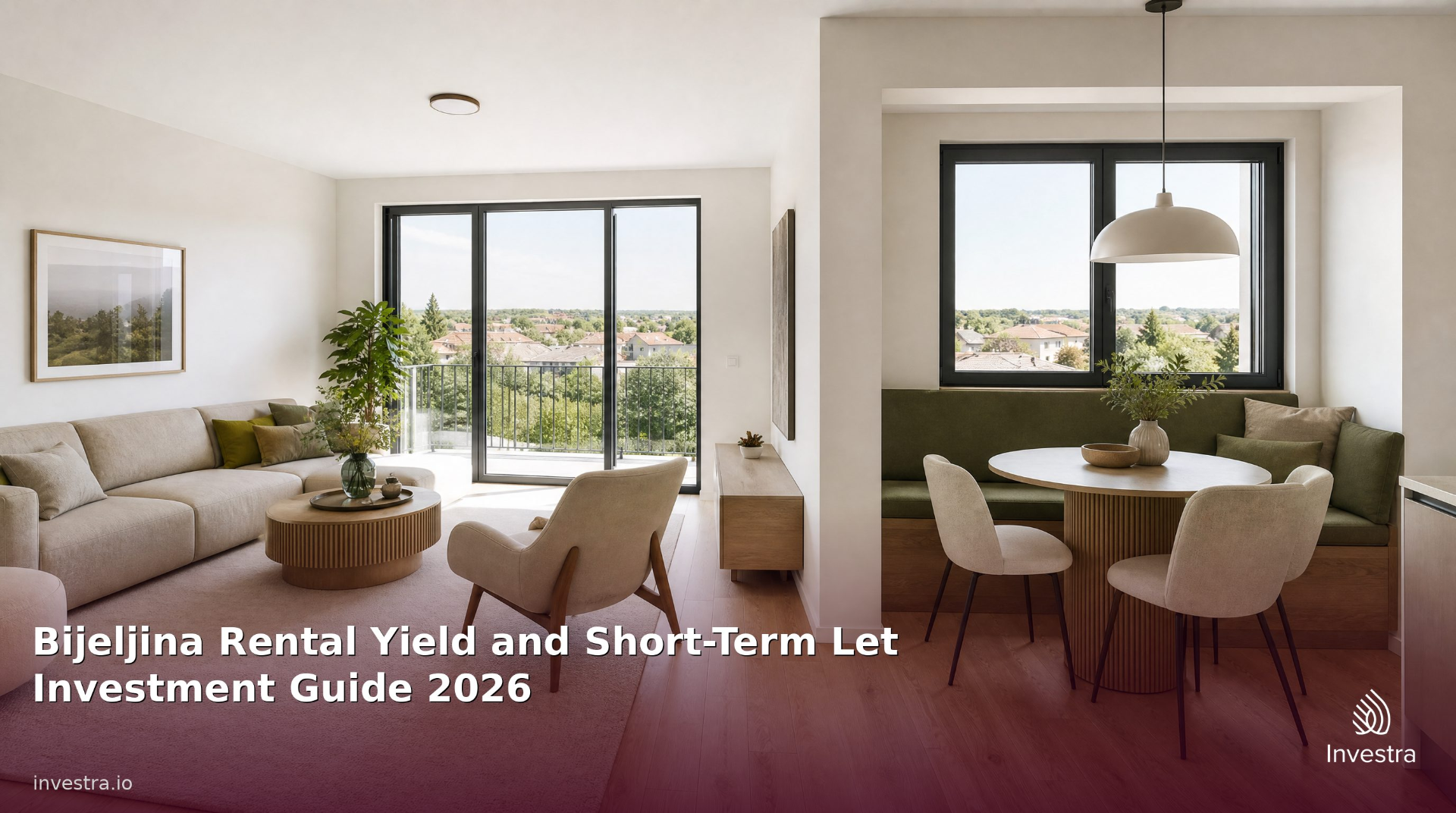
Bijeljina Rental Yield and Short-Term Let Investment Guide 2026
Bijeljina Rental Yield and Short-Term Let Investment Guide 2026
Bijeljina Real Estate Market Overview 2026: Why This City Is Attracting Smart Capital
Quick Answer: Bijeljina is Bosnia and Herzegovina's fourth-largest city and one of the most economically dynamic markets in Republika Srpska, offering residential rental yields between 5–8% and short-term let returns that can exceed 10% annually in prime locations. Investra.io tracks emerging Balkan markets like Bijeljina for investors seeking undervalued opportunities.
Bijeljina doesn't make international headlines the way Sarajevo or Mostar do. That's precisely the point. Tucked in the northeastern corner of Bosnia and Herzegovina, right on the border with Serbia and just a short drive from the Sava River crossing into Croatia, Bijeljina is the kind of city that experienced Balkan investors have been quietly watching for several years now.
The city has also benefited from significant infrastructure investment over the past five years, including road upgrades connecting it more directly to the Pan-European Corridor Vc. For investors already familiar with similar-stage markets — the kind of analysis found when exploring the Loznica Real Estate Market 2026 Macva Region Property Guide just across the Serbian border — Bijeljina will feel immediately recognizable. Same growth trajectory, comparable demographics, and a rental market that's maturing faster than the purchase price index.
Understanding Bijeljina's Rental Market: Long-Term vs Short-Term Dynamics
Quick Answer: Bijeljina's long-term rental market is driven by local workers, university students, and cross-border commuters, while the short-term Airbnb segment is still nascent but growing rapidly due to agritourism, business travel, and transit demand from Serbian and Croatian visitors.
The rental market in Bijeljina operates on two distinct tracks, and understanding which one suits your investment strategy matters enormously before you commit capital. Long-term residential rentals dominate the market by volume. A standard two-bedroom apartment in a decent location — say, near the city center or close to the Mercator shopping complex — will typically command monthly rents between €350 and €550.
Short-term letting — Airbnb, Booking.com, and local equivalents — is a different story. It's newer, less crowded with supply, and frankly more exciting from a yield perspective.
Rental Yield Analysis: What Numbers Actually Look Like in 2026
Quick Answer: Long-term rental yields in Bijeljina range from 5% to 7.5% gross annually, while optimized short-term let properties in central locations can achieve gross yields of 9–12%, making this one of the higher-yielding secondary cities in the Western Balkans.
Let's run the actual numbers, because yield percentages mean nothing without grounding them in real acquisition and income figures. Take a standard investment scenario: a 45m² one-bedroom apartment in central Bijeljina, acquired on the secondary market for €35,000–€40,000 (entirely realistic at €700–€900/m²). Furnished to a decent standard — budget €4,000–€6,000 for furnishings and minor renovation — total invested capital sits around €40,000–€46,000.
On a long-term rental basis, this unit generates €280–€350 per month, or €3,360–€4,200 annually. Net of basic maintenance, property tax (minimal in BiH — more on that shortly), and occasional vacancy, net annual income is roughly €2,800–€3,600. Against a total investment of €42,000, that's a net yield of approximately 6.7–8.5%. These are genuinely competitive numbers when compared against markets like Vienna (2–3%), Ljubljana (3–4%), or even the comparable Serbian markets analyzed in the Zajecar Real Estate Market 2026 Eastern Serbia Property Guide, which typically show yields in the 5–7% range.
Switch that same apartment to a short-term let strategy. At an average nightly rate of €45 and 60% occupancy across 365 days, gross annual revenue comes to approximately €9,855. Subtract platform fees (Airbnb charges roughly 3% host fee, Booking.com closer to 15%), cleaning costs, utilities, and management (if using a local property manager at 15–20% of revenue), and net income lands around €5,500–€6,500.
The reality is that most savvy operators in Bijeljina aren't choosing one strategy exclusively. A hybrid approach — long-term tenant during quieter months (January through March, for example), switching to short-term during peak periods — is emerging as the dominant model among local and diaspora investors who've figured out the rhythm of the market.
Bijeljina Property Prices: Where to Buy and What to Pay in 2026
Quick Answer: New-build apartments in Bijeljina's center range from €1,000–€1,400/m², secondary market units from €600–€950/m², and houses in surrounding areas start from €50,000 total, making entry costs some of the lowest in the region for a city of this economic size.
Price geography matters in Bijeljina just as it does in any city. The market isn't uniform, and knowing where values cluster — and why — is fundamental to making a sound acquisition decision. The city center, particularly around the pedestrian zone on Kralja Petra I Karađorđevića street and the surrounding blocks, commands the highest prices.
Move a kilometer outward into established residential neighborhoods like Patkova Šuma, the areas around the Bijeljina Cultural Center, or the eastern residential zones near the industrial parks, and prices moderate significantly. Secondary market apartments here average €650–€900/m², and these are often solid Yugoslav-era construction that responds well to renovation investment.
On the periphery — suburban areas and the villages merging into the broader municipality — you'll find standalone houses ranging from €50,000 for something requiring significant work up to €150,000 for a well-maintained family home with land. These don't typically suit short-term let strategies (location matters for that), but they work well for long-term family rentals or the growing agritourism segment if they have rural character and outdoor space.
What surprised many buyers entering this market recently is the quality differential between new-build and older stock. Bijeljina's newer developments have genuinely closed the gap with Serbian and even some Croatian equivalents in terms of build quality and amenity specification, yet the price per square meter remains 30–40% lower than comparable new-build in Novi Sad or Banja Luka. For the value-conscious investor, that gap represents the single most compelling argument for the market right now. Investors watching similar dynamics in Serbia's smaller cities — as covered in the Bor Real Estate Market 2026 Eastern Serbia Mining City Property Guide — will find the Bijeljina thesis immediately recognizable.
Airbnb and Short-Term Let Regulations in Bosnia and Herzegovina
Quick Answer: Bosnia and Herzegovina currently has no specific national legislation governing short-term rentals equivalent to Airbnb regulation frameworks in EU countries, though hosts must register as service providers, pay applicable taxes, and comply with municipal tourism registration requirements in Bijeljina's Republika Srpska entity.
Regulation is where many international investors get caught off guard, so let's address it directly. BiH's complex governance structure — split between Republika Srpska and the Federation of Bosnia and Herzegovina, with significant cantonal and municipal autonomy — means that short-term rental regulation is anything but uniform across the country.
As of 2026, there is no specific "Airbnb law" in Republika Srpska or BiH at the national level. What exists instead is a framework built from several overlapping obligations. First, anyone providing accommodation services for payment — even occasionally — is technically required to register their activity with the relevant municipal authority.
Second, income from short-term rentals is taxable. Under Republika Srpska tax rules, rental income is subject to income tax, with applicable rates depending on whether the activity is treated as occasional income or a registered business activity.
Third, guests must be officially registered with the police within 24 hours of arrival — a requirement that Airbnb's professional host tools and most local property managers can handle automatically, but which catches informal operators off guard. The regulatory picture, while not perfectly codified, is manageable and considerably less restrictive than markets like Amsterdam, Barcelona, or even Belgrade which have introduced specific Airbnb quotas and limitations.
Legal Process for Foreign Buyers in Bijeljina: Step-by-Step
Quick Answer: Foreign nationals from most countries can legally purchase real estate in Bosnia and Herzegovina's Republika Srpska on the basis of reciprocity, with the process involving a preliminary contract, tax registration (JIB number), notarial deed, and land registry inscription typically completed in 60–90 days.
Foreign ownership of real estate in BiH is permitted but comes with nuances that every buyer should understand before signing anything. The key principle is reciprocity: citizens of countries that allow Bosnians to purchase property can generally do the same in BiH. In practice, this covers EU citizens, US citizens, Canadians, Australians, and citizens of most Western and regional countries without issue.
The purchase process itself breaks down into a logical sequence. The journey typically begins with a preliminary purchase agreement (Predugovor o kupoprodaji) — this is the document that locks in the price, outlines conditions, and typically involves payment of a deposit ranging from 10–15% of the purchase price. This document should be reviewed by a lawyer, not just a real estate agent.
Before completing the purchase, the buyer needs a tax identification number (JIB — Jedinstveni identifikacioni broj) from the Republika Srpska Tax Administration. This is a straightforward application requiring a passport copy and takes a few business days. The final purchase deed (Kupoprodajni ugovor) is executed before a notary (notar), and the property transfer tax — currently 3% of the assessed market value in Republika Srpska — is paid at this stage.
One practical note that experienced investors emphasize: always conduct a thorough title search (provjera uknjižbe) before paying any deposit. Bosnia and Herzegovina has significant legacy issues with property registration going back to wartime and post-war administrative disruptions. Unregistered easements, disputed ownership claims, and mortgages not properly recorded in the land registry are real risks in the secondary market. A clean gruntovnica extract isn't always a complete picture. This is where the cost of a good local lawyer pays for itself many times over. For investors comparing due diligence requirements across the region, the same principle applies when exploring Serbian markets like those covered in the Prokuplje Real Estate Market 2026 Toplica Region Property Guide.
Tax Obligations for Rental Property Owners in Republika Srpska
Quick Answer: Property owners in Republika Srpska face a 3% property transfer tax on acquisition, annual property tax rates of 0.05–0.5% of assessed value, and income tax on rental revenue at approximately 10% for individual landlords, making BiH one of the lowest tax-burden rental markets in the Western Balkans.
Tax is where Bosnia and Herzegovina — and Republika Srpska specifically — genuinely shines for property investors. The overall fiscal burden on rental property income is light by almost any European comparison, and understanding the full picture helps explain why net yields hold up so well even after costs.
Starting with acquisition: the 3% property transfer tax is charged on the assessed value (which the tax authority may determine independently of the purchase price if they deem it below market). For a €40,000 apartment, this amounts to €1,200 — entirely manageable. New-build purchases from developers are typically structured as VAT-inclusive transactions, meaning the transfer tax doesn't apply in the same way; buyers should clarify this with their notary.
Annual property tax (porez na nepokretnosti) in Republika Srpska is set at the municipal level within nationally defined bands. Bijeljina's rates are on the lower end, with residential properties typically assessed at 0.05–0.20% of official cadastral value annually.
Rental income taxation is the most significant ongoing cost after any mortgage. Individual landlords declaring rental income in Republika Srpska pay income tax at a flat rate structure, with the effective rate on net rental income (after allowable deductions for maintenance and depreciation) typically sitting around 8–12%. Compared to Austria's 27.5% capital gains tax on rental income, Germany's marginal income tax rates, or even Slovenia's 25% rate (where Findes Financial Services can help structure cross-border investment efficiently), BiH's tax treatment of rental income is remarkably benign.
For investors operating through a company structure — which becomes worth considering once you're managing multiple properties — Republika Srpska corporate income tax stands at 10%, one of the lowest rates in Europe. This opens up planning opportunities around expense deductions and reinvestment that pure individual ownership doesn't afford.
Bijeljina Neighborhoods for Investment: The Insider Breakdown
Quick Answer: Central Bijeljina around the pedestrian zone and Trg Kralja Petra offers the best short-term rental demand, while neighborhoods near the Agricultural Fair grounds and university facilities provide strong long-term tenant pools; peripheral areas suit renovation plays targeting family rental demand.
Every city has its investment micro-geography, and Bijeljina is no different. The city's layout is relatively straightforward compared to labyrinthine Sarajevo or sprawling Banja Luka, which actually makes location analysis easier for first-time buyers in this market.
The city center — anchored by the main pedestrian zone, the Grand Kafana area, and the central market — is the natural home for short-term rental investment. Proximity to Bijeljina's concentrated restaurant and nightlife scene means guests have walking-distance access to everything they need, which translates directly into better reviews and repeat bookings.
The area around the Agricultural Fair (Sajmište) and the zones stretching toward the Drina Canal deserve attention for a different reason. Bijeljina hosts one of the region's better-attended agricultural and trade fair events, drawing regional visitors who need accommodation for several days at a time.
For long-term rental investment specifically, the residential zones around the local primary and secondary schools — Osnovna škola Sveti Sava area and the surrounds of the secondary school complex — attract family tenants looking for stability. These are your two- and three-bedroom plays, typically acquired in the €65,000–€90,000 range for decent-condition apartments, with family rents producing steady yields around 5.5–7% net.
Short-Term Let Performance Data: What Operators Are Actually Achieving
Quick Answer: Well-optimized short-term let properties in Bijeljina's center are achieving annual gross revenues of €6,000–€12,000 on one- to two-bedroom apartments, with average daily rates ranging from €35–€75 depending on season and property quality, and occupancy rates between 55–72% among experienced operators.
Platform data for secondary Bosnian cities isn't widely published in the same way that Airdna or similar services cover major European markets, so the figures here are drawn from operator interviews, local property management company data, and comparative analysis with peer cities. That said, what we know from Bijeljina's active short-term rental community paints a genuinely interesting picture.
The most successful operators in Bijeljina — those achieving 65%+ annual occupancy and ADRs (Average Daily Rates) above €50 — share several characteristics. They've invested meaningfully in photography and listing quality, typically spending €200–€400 on professional photography that makes their listing stand out in a market where most competitors use phone photos.
Seasonal patterns are worth understanding. Bijeljina doesn't have a pronounced tourist season the way coastal or mountain destinations do, which is actually a feature rather than a bug — it means demand is more evenly distributed across the year.
Comparing these performance metrics with what technology-enabled property management is achieving in similar-stage markets — as documented in the Serbia Proptech 2026: How Technology Is Changing Real Estate analysis — Bijeljina operators who adopt dynamic pricing tools and channel management software consistently outperform manual operators by 15–25% on annual revenue. The tools are cheap (most channel managers cost €30–€80/month), and the lift is real.
Financing Options and Capital Requirements for Foreign Investors
Quick Answer: Foreign investors purchasing in Bijeljina typically acquire cash given limited mortgage availability for non-residents, with all-in acquisition costs for a rental-ready one-bedroom apartment starting around €35,000–€50,000 including purchase price, taxes, legal fees, and furnishing.
Financing property in BiH as a foreign national requires realistic expectations. Domestic mortgage lending exists and is accessible for residents of Bosnia and Herzegovina, with banks like UniCredit, Raiffeisen, and NLB operating in the Republika Srpska market. Interest rates on BAM (Convertible Mark)-denominated mortgages have been running at 4.5–7% over recent years, depending on loan-to-value ratio and borrower profile.
For foreign nationals without local income, employment, or residency, obtaining a Bosnian mortgage is difficult in practice. Most banks will require proof of local earned income or a Bosnian guarantor, constraints that foreign investors almost never satisfy.
The practical reality is that most foreign investors in Bijeljina acquire properties cash-based. This isn't as difficult as it might initially sound: the entry cost for a fully furnished, revenue-ready rental apartment is €40,000–€50,000, which is comparable to buying a single parking space in many Western European cities. Many investors treat Bijeljina purchases as a single lump-sum deployment of capital rather than used acquisitions.
Managing Properties Long-Distance: Practical Infrastructure and Considerations
Quick Answer: Professional property management companies in Bijeljina charge 15–20% of rental revenue for full-service administration, making remote ownership viable and turning Bijeljina into a genuine passive income market for international investors unwilling or unable to be hands-on.
One legitimate concern for foreign investors is whether they can realistically manage rental properties from thousands of kilometers away. The answer, increasingly, is yes — but it requires the right infrastructure.
The digital infrastructure supporting this has genuinely improved. Major platforms (
Investment Disclaimer
Quick Answer: This guide is general market information, not personal legal, tax, financing or investment advice.
Before committing to a property transaction, buyers should obtain independent local legal, tax and financial advice suited to their circumstances. Investra.io can support initial market research, but every purchase decision remains the buyer's responsibility.
Frequently Asked Questions
Quick Answer: This section explains the practical property-investment implications of Frequently Asked Questions.
What is a prudent next step after initial market research?
Use current documentation, independent professional advice and comparable local evidence before proceeding. Investra.io can support an initial structured market review.
How can buyers plan a realistic ownership budget?
Use current documentation, independent professional advice and comparable local evidence before proceeding. Investra.io can support an initial structured market review.
What evidence supports a careful investment decision?
Use current documentation, independent professional advice and comparable local evidence before proceeding. Investra.io can support an initial structured market review.
When should a buyer obtain legal and tax advice?
Use current documentation, independent professional advice and comparable local evidence before proceeding. Investra.io can support an initial structured market review.
How should a buyer compare neighbourhoods and property types?
Use current documentation, independent professional advice and comparable local evidence before proceeding. Investra.io can support an initial structured market review.
What local checks should be completed before signing?
Use current documentation, independent professional advice and comparable local evidence before proceeding. Investra.io can support an initial structured market review.
Which costs should be assessed alongside the purchase price?
Use current documentation, independent professional advice and comparable local evidence before proceeding. Investra.io can support an initial structured market review.
How can international buyers verify a property opportunity?
Use current documentation, independent professional advice and comparable local evidence before proceeding. Investra.io can support an initial structured market review.
What should buyers compare before selecting a property?
Use current documentation, independent professional advice and comparable local evidence before proceeding. Investra.io can support an initial structured market review.
Quick Answer: These answers outline common buyer checks and should be read with current professional advice.
Recommended Reading
Quick Answer: This section explains the practical property-investment implications of Recommended Reading.
- Investra market research
- Investra market research
- Investra market research
- Investra market research
- Investra market research
- Investra market research
- Investra market research
- Investra market research
- Investra market research
- Investra market research
- Investra market research
- Investra market research
- Investra market research
- Investra market research
- Investra market research
- Investra market research
- Investra market research
- Siniša Dagary investment insight
- Siniša Dagary investment insight
- Siniša Dagary investment insight
- Siniša Dagary investment insight
- Siniša Dagary investment insight
- Findes Group & Partners
- Findes Group & Partners
Connect With Investra
Follow Investra for market updates on Facebook, LinkedIn, YouTube
Povezani postovi
Nema dostupnih povezanih objava.
