
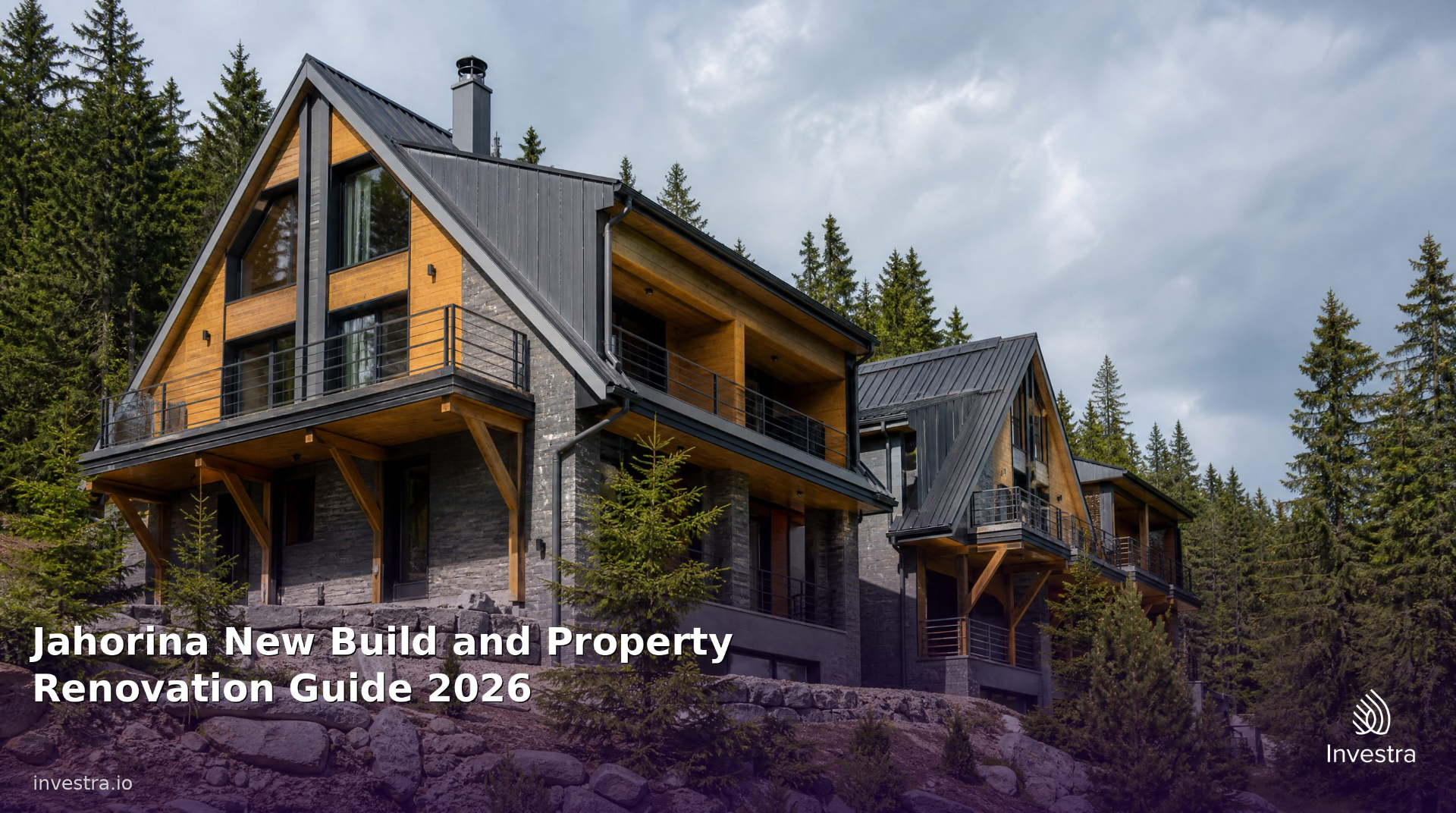
Jahorina New Build and Property Renovation Guide 2026
Jahorina New Build and Property Renovation Guide 2026
Jahorina New Build and Property Renovation Market Overview 2026
Quick Answer: Jahorina's new build and renovation property market in 2026 offers exceptional value, with new build apartments starting from €1,200/m² and renovation projects from €600/m², making it one of the most affordable ski resort investment destinations in southeastern Europe. Investra.io provides real-time market data for informed investment decisions across the Western Balkans.
The reality is that Jahorina sits at an inflection point. A sustained wave of infrastructure investment — new gondola lifts, expanded ski runs, upgraded road access from Sarajevo (just 28 km away), and a growing hospitality ecosystem — is pulling international buyers into a market that locals have quietly benefited from for years.
What surprises many first-time buyers is how straightforward the legal framework has become for foreign nationals since Bosnia and Herzegovina simplified its property purchase process. Citizens of EU member states and many other countries can now buy property directly, without needing a local company structure in most cases. That regulatory clarity, combined with low entry costs and high tourism demand, is precisely why Jahorina keeps appearing on investment watchlists maintained by firms like Siniša Dagary investment insight, who tracks emerging Balkan real estate markets closely.
This guide cuts through the noise. Whether you're considering a brand-new ski apartment, a full renovation of an older mountain lodge, or a mixed-use development, the sections below give you concrete numbers, realistic timelines, and the kind of on-the-ground insight that generic investment portals rarely provide.
Understanding Jahorina's Property Market Context in 2026
Quick Answer: Jahorina's property market is driven by winter skiing tourism, growing summer mountain tourism, proximity to Sarajevo, and an active short-term rental economy — all underpinned by ongoing public infrastructure investment from the Republika Srpska government.
Bosnia and Herzegovina's GDP grew by approximately 2.8% in 2024, and the tourism sector outperformed this figure significantly, with overnight stays in ski resorts rising by over 15% year-on-year. Jahorina specifically welcomed an estimated 320,000 visitors during the 2023/2024 winter season — a record for the mountain since records began in the modern era.
The Republika Srpska government has committed over €85 million in public infrastructure spending on Jahorina through 2028, including a new cable car system, expanded parking infrastructure, and improvements to the main mountain road. This is not speculative development — contracts are signed and work is visibly underway.
How does Jahorina compare regionally? Prices here remain 40-60% below comparable ski resort markets in Slovenia, 50-70% below Austrian Tirol resorts, and roughly 30% below Montenegro's Kolašin. Even within the Balkans, Jahorina offers a compelling value proposition. Investors tracking Zajecar Real Estate Market 2026 Eastern Serbia Property Guide data will recognize a similar pattern of undervaluation in emerging Balkan markets — but Jahorina's tourism infrastructure is considerably more developed than most inland Balkan cities.
One crucial nuance: Jahorina's market is not homogeneous. There's a clear stratification between the immediate ski-in/ski-out zone around the main Olimpijska hotel complex (the premium tier), the mid-mountain residential areas (the mid-market sweet spot), and the lower-elevation villages and rural properties with road access to the resort (the value tier).
New Build Property Prices and Developments on Jahorina 2026
Quick Answer: New build apartments on Jahorina are priced between €1,200 and €2,800 per m² in 2026 depending on location and specification, with ski-in/ski-out units at the upper end and new builds in the wider resort zone starting below €1,500/m².
New build activity on Jahorina has genuinely accelerated since 2022, and the range of products coming to market is more diverse than at any point in the mountain's modern development history. Gone are the days when "new build" meant a single developer putting up a concrete block of holiday apartments with minimal finishing.
Here's what the pricing landscape looks like across the main segments as of early 2026:
Premium ski-in/ski-out zone (directly adjacent to slopes): €2,200–€2,800/m². These units — typically in boutique complexes of 10–30 apartments — represent the top of the Jahorina market. Buyers here are primarily purchasing lifestyle assets with rental income as a secondary consideration, though occupancy rates in this segment consistently exceed 70% during the December–March peak season.
Mid-mountain resort zone (within 500 metres of lifts): €1,500–€2,100/m². This is the volume tier of new build activity — the segment where most first-time buyers and investment-focused purchasers operate. A well-specified 50 m² studio apartment in this zone costs €75,000–€105,000, and a 2-bedroom unit of 70–80 m² typically prices between €105,000 and €168,000.
Resort periphery and lower mountain (1–3 km from lifts): €1,200–€1,600/m². These developments are often marketed on the basis of space and value — you get a larger property for significantly less money, though rental demand is more sensitive to competition from closer units. Some of the most attractive renovation opportunities also sit in this zone.
Construction quality has improved markedly. Modern Jahorina new builds typically include underfloor heating, triple-glazed windows suited to the mountain climate, integrated smart home systems, and developer-managed rental programs that take the operational headache away from absentee investors.
Off-plan purchasing remains an option, with developers typically offering 10–15% discounts for early-stage commitments and allowing staged payment structures (commonly 30% on contract, 40% at structural completion, 30% on handover). For international buyers managing currency exposure, these staged structures can actually be advantageous.
Property Renovation Opportunities on Jahorina: What's Available and What It Costs
Quick Answer: Renovation projects on Jahorina range from €600/m² for older socialist-era chalets requiring full modernisation to €900/m² for properties needing cosmetic upgrades, with total all-in renovation costs for a typical mountain chalet running €40,000–€120,000 depending on scope and size.
The renovation market on Jahorina is, frankly, one of the most underappreciated investment angles in the entire Western Balkans. Hundreds of chalets, apartments, and small hotels were built during the socialist era — the 1970s and 1980s boom that preceded the 1984 Olympics — and many of these properties have had minimal investment since.
What does the renovation pipeline actually look like? Broadly, there are three categories of renovation stock on Jahorina:
Full renovation projects: These are properties — typically older chalets or apartments with original 1970s/1980s fittings — that need everything: new wiring, new plumbing, insulation upgrades, window replacement, and complete interior refurbishment. Purchase prices for these properties typically run €400–€700/m², with renovation costs adding another €500–€800/m² depending on the scope and the specification.
Partial renovation / cosmetic upgrade projects: The structural fabric is sound, but interiors are dated. These properties typically need new kitchen and bathroom fittings, flooring, painting, and insulation improvements rather than full systems replacement. Renovation budgets here run €300–€500/m² and timelines are typically 3–6 months.
Extension and conversion projects: Some of the most interesting opportunities involve properties with scope for extension — adding a floor, converting a basement, or transforming a private chalet into a small guesthouse. Planning permission (known as "građevinska dozvola" in Bosnian/Serbian) is required for any structural changes, and the process typically takes 3–6 months in Republika Srpska.
One practical tip that experienced regional investors consistently emphasize: hire a local structural surveyor before committing to any renovation project on Jahorina. Mountain properties experience extreme thermal cycling, and issues with foundation movement, roof structure integrity, and moisture penetration are common in older stock. A survey typically costs €300–€600 and can save you from a very expensive surprise post-purchase. For broader strategic context on renovation investment models in the region, the Siniša Dagary investment insight maintained by business strategists offers useful frameworks for evaluating renovation ROI in emerging Balkan markets.
Rental Yields and ROI Analysis for Jahorina Properties in 2026
Quick Answer: Gross rental yields on Jahorina properties range from 5.5% to 9.2% in 2026, with well-positioned short-term rental units in the ski-in/ski-out zone achieving the highest returns, particularly when combined with summer mountain tourism occupancy.
Numbers matter, so let's get into the specifics. Jahorina's rental market has two distinct income seasons: the primary winter ski season (December through March, with peak weeks over Christmas and New Year commanding the highest nightly rates) and an emerging summer season (June through August, driven by hiking, cycling, and families escaping urban heat).
Winter season rental rates (2025/2026 data):
Studio/one-bedroom apartments (30–45 m²) in prime locations: €60–€120/night. Two-bedroom apartments (55–75 m²): €90–€180/night. Three-bedroom chalets or larger units: €150–€350/night. Peak Christmas/New Year week premiums of 40–70% above standard rates are standard practice.
Summer season rental rates: Rates are lower — typically 50–65% of winter equivalents — but the season is growing. A studio that earns €80/night in winter might achieve €45–€55/night in summer. Occupancy during summer is typically 45–65% over the June–August window for well-marketed properties.
Running the numbers on a realistic scenario: a 55 m² two-bedroom apartment purchased for €95,000 (new build, mid-mountain zone) with annual rental management costs of 25% of revenue might generate gross rental income of €18,000–€22,000 annually under a dual-season operation. After management fees and operating costs, net yield falls in the 6.5–8.5% range.
Renovation plays can deliver higher ROI precisely because the total acquisition cost is lower. A €75,000 all-in renovation project (purchase + renovation) achieving the same rental income as a €95,000 new build generates a substantially better yield — potentially 9–11% gross before costs. The trade-off is time (renovation takes 4–8 months) and execution risk. Investors looking for regional comparative benchmarks will find useful yield context in the Loznica Real Estate Market 2026 Macva Region Property Guide, which documents how short-term rental dynamics work across different Bosnian and Serbian market types.
Capital appreciation projections for 2026–2030 are harder to quantify, but market consensus among Sarajevo-based agents and international advisors suggests 4–8% annual price growth for well-located Jahorina properties over this horizon, driven by continued infrastructure investment and the rising profile of ski tourism in the region.
Legal Framework for Foreign Buyers: New Builds and Renovations
Quick Answer: Foreign nationals can purchase property on Jahorina (within Republika Srpska) under reciprocity principles, with EU citizens generally enjoying straightforward acquisition rights; the process involves a preliminary contract, title check, notarised purchase agreement, and land registry registration.
Bosnia and Herzegovina's property law landscape is more accessible than many outsiders assume, though it does have specific features tied to its unique constitutional structure. Jahorina sits within Republika Srpska, one of the two entities that comprise BiH, and property law is administered at the entity level rather than the state level.
For foreign buyers, the fundamental right to purchase property in Republika Srpska is governed by reciprocity principles — essentially, citizens of countries that allow Bosnian nationals to buy property can generally purchase here. This covers EU member states, the UK, the US, Canada, Australia, and most OECD countries without issue.
The typical purchase process follows this sequence:
Step 1 — Due diligence and title check: Before any contracts are signed, your attorney should conduct a thorough search of the land registry ("Zemljišne knjige") to confirm clear title, absence of encumbrances (mortgages, liens), and that the seller is the legitimate registered owner. For new builds, verify that the developer has proper construction permits and that the building is registered correctly.
Step 2 — Preliminary contract ("Predugovor"): A binding preliminary agreement is signed, typically with a deposit of 10% of the purchase price. This document establishes the key terms — price, completion date, conditions — and is usually notarised. If you pull out without justification, you typically lose your deposit; if the seller pulls out, they owe you double the deposit back.
Step 3 — Final purchase contract ("Ugovor o kupoprodaji"): Signed before a notary. Both parties must be present or represented by a power of attorney (which is very common for international buyers who use a local attorney under POA). Payment is made at this stage, typically via bank transfer.
Step 4 — Land registry registration: Your attorney files for registration of your ownership in the land registry. Processing typically takes 30–60 days in Republika Srpska. You receive a title deed ("Lista nepokretnosti") confirming your ownership.
For renovation projects specifically, additional permits are required before works commence. A "Rješenje o odobrenju za izgradnju" (building permit) is needed for structural changes, while "adaptacija" (cosmetic renovation) may proceed with a simpler notification process.
Understanding the regulatory environment across the broader Balkans helps put Jahorina's framework in context. The Prokuplje Real Estate Market 2026 Toplica Region Property Guide offers a comparable breakdown of property law for foreign buyers in neighbouring Serbia, which shares many procedural similarities with Republika Srpska's system.
Taxes, Costs, and Transaction Fees for Jahorina Property Buyers
Quick Answer: Buying property on Jahorina involves a property transfer tax of 5% of the assessed value for resale properties, while new builds from developers attract 17% VAT (usually included in the purchase price); total transaction costs including legal fees, notary, and registration typically add 7–10% to the purchase price.
One of the most common mistakes international buyers make is budgeting only for the listed purchase price without adequately accounting for transaction costs. On Jahorina — as throughout Bosnia and Herzegovina — the cost stack can add a meaningful 7–10% to your total acquisition cost, and these numbers need to be modelled into your ROI calculations from the outset.
Here's a realistic breakdown of transaction costs for a €100,000 property purchase on Jahorina in 2026:
Property transfer tax (Porez na promet nepokretnosti): 5% of the assessed market value for resale properties. Applied by the tax authority of Republika Srpska. For a €100,000 purchase, this amounts to approximately €5,000.
Notary fees: Regulated by the Republika Srpska notary fee schedule, typically running 0.3–0.5% of the transaction value, with minimum fees. For a €100,000 transaction, expect €300–€500 in notary costs.
Legal fees: A local property attorney will charge €800–€2,000 for a standard transaction, depending on complexity. For foreign buyers purchasing remotely with a POA arrangement, fees tend toward the higher end. Do not try to economise aggressively here — a good attorney is your primary protection against title defects and contract irregularities.
Land registry registration fee: Nominal, typically €50–€150.
Real estate agent commission: If you've used an agent, commissions in Republika Srpska are typically 2–3% of the purchase price, usually paid by the buyer (though sometimes split).
On the ongoing tax side, property owners in Republika Srpska pay an annual property tax ("Porez na imovinu") of 0.05–0.5% of the assessed value annually — considerably lower than most Western European equivalents. Rental income is subject to income tax at a flat rate of 10% in Republika Srpska, which is highly competitive by European standards.
For comparative tax regime analysis across the region, the Sremska Mitrovica Real Estate 2026 Srem Region Property Guide documents Serbia's property tax framework, which offers useful regional benchmarking. Financial planning support for international investors is also available through Findes Group & Partners, which specialises in cross-border property investment structuring.
Choosing the Right New Build Developer or Renovation Contractor on Jahorina
Quick Answer: Vetting developers and contractors on Jahorina requires checking building permits, company registration status, completed project references, and financial stability — cutting corners on due diligence at this stage is the single most common cause of investor losses in the market.
The quality of your developer or contractor will ultimately determine whether your Jahorina investment succeeds or becomes a cautionary tale. The market has matured considerably since the early 2010s, but it's still not a fully standardised, regulation-heavy construction environment like Germany or the Netherlands.
What should you actually check? Start with the basics: verify the developer's company registration with the Republika Srpska Business Register (APR RS), confirm they hold a valid "Građevinska dozvola" (building permit) for the specific project you're considering, and request a copy of the "Upotrebna dozvola" (usage permit) for any completed reference projects.
Next, visit completed projects. Any developer with a track record on Jahorina should be able to show you at least 2–3 completed buildings. Talk to current owners in those buildings if possible — ask about construction quality, post-handover snagging management, rental program performance, and whether the developer delivered on time and on specification. This kind of reference check is irreplaceable.
Financial stability matters too. Ask how the project is being funded — is it pre-sales driven, bank-financed, or equity-backed? In pre-sales-heavy projects, check whether buyer deposits are held in escrow or go directly to the developer's operating account. Escrow arrangements are stronger protection for buyers but are not yet universal practice in the Bosnian market.
For renovation contractors, the vetting process is similar in spirit but different in practice. Get a minimum of three competitive quotes — the spread between highest and lowest quotes in the Jahorina renovation market can easily be 40–60%, and understanding why requires comparing specifications carefully.
Explore more strategic insights on
Investment Disclaimer
Quick Answer: This guide is general market information, not personal legal, tax, financing or investment advice.
Before committing to a property transaction, buyers should obtain independent local legal, tax and financial advice suited to their circumstances. Investra.io can support initial market research, but every purchase decision remains the buyer's responsibility.
Frequently Asked Questions
Quick Answer: This section explains the practical property-investment implications of Frequently Asked Questions.
What is a prudent next step after initial market research?
Use current documentation, independent professional advice and comparable local evidence before proceeding. Investra.io can support an initial structured market review.
How can buyers plan a realistic ownership budget?
Use current documentation, independent professional advice and comparable local evidence before proceeding. Investra.io can support an initial structured market review.
What evidence supports a careful investment decision?
Use current documentation, independent professional advice and comparable local evidence before proceeding. Investra.io can support an initial structured market review.
When should a buyer obtain legal and tax advice?
Use current documentation, independent professional advice and comparable local evidence before proceeding. Investra.io can support an initial structured market review.
How should a buyer compare neighbourhoods and property types?
Use current documentation, independent professional advice and comparable local evidence before proceeding. Investra.io can support an initial structured market review.
What local checks should be completed before signing?
Use current documentation, independent professional advice and comparable local evidence before proceeding. Investra.io can support an initial structured market review.
Which costs should be assessed alongside the purchase price?
Use current documentation, independent professional advice and comparable local evidence before proceeding. Investra.io can support an initial structured market review.
How can international buyers verify a property opportunity?
Use current documentation, independent professional advice and comparable local evidence before proceeding. Investra.io can support an initial structured market review.
What should buyers compare before selecting a property?
Use current documentation, independent professional advice and comparable local evidence before proceeding. Investra.io can support an initial structured market review.
Quick Answer: These answers outline common buyer checks and should be read with current professional advice.
Recommended Reading
Quick Answer: This section explains the practical property-investment implications of Recommended Reading.
- Investra market research
- Investra market research
- Investra market research
- Investra market research
- Investra market research
- Investra market research
- Investra market research
- Investra market research
- Investra market research
- Investra market research
- Investra market research
- Investra market research
- Investra market research
- Investra market research
- Investra market research
- Investra market research
- Investra market research
- Siniša Dagary investment insight
- Siniša Dagary investment insight
- Siniša Dagary investment insight
- Siniša Dagary investment insight
- Siniša Dagary investment insight
- Findes Group & Partners
- Findes Group & Partners
Connect With Investra
Follow Investra for market updates on Facebook, LinkedIn, YouTube
Gerelateerde berichten
Geen gerelateerde berichten beschikbaar.
