
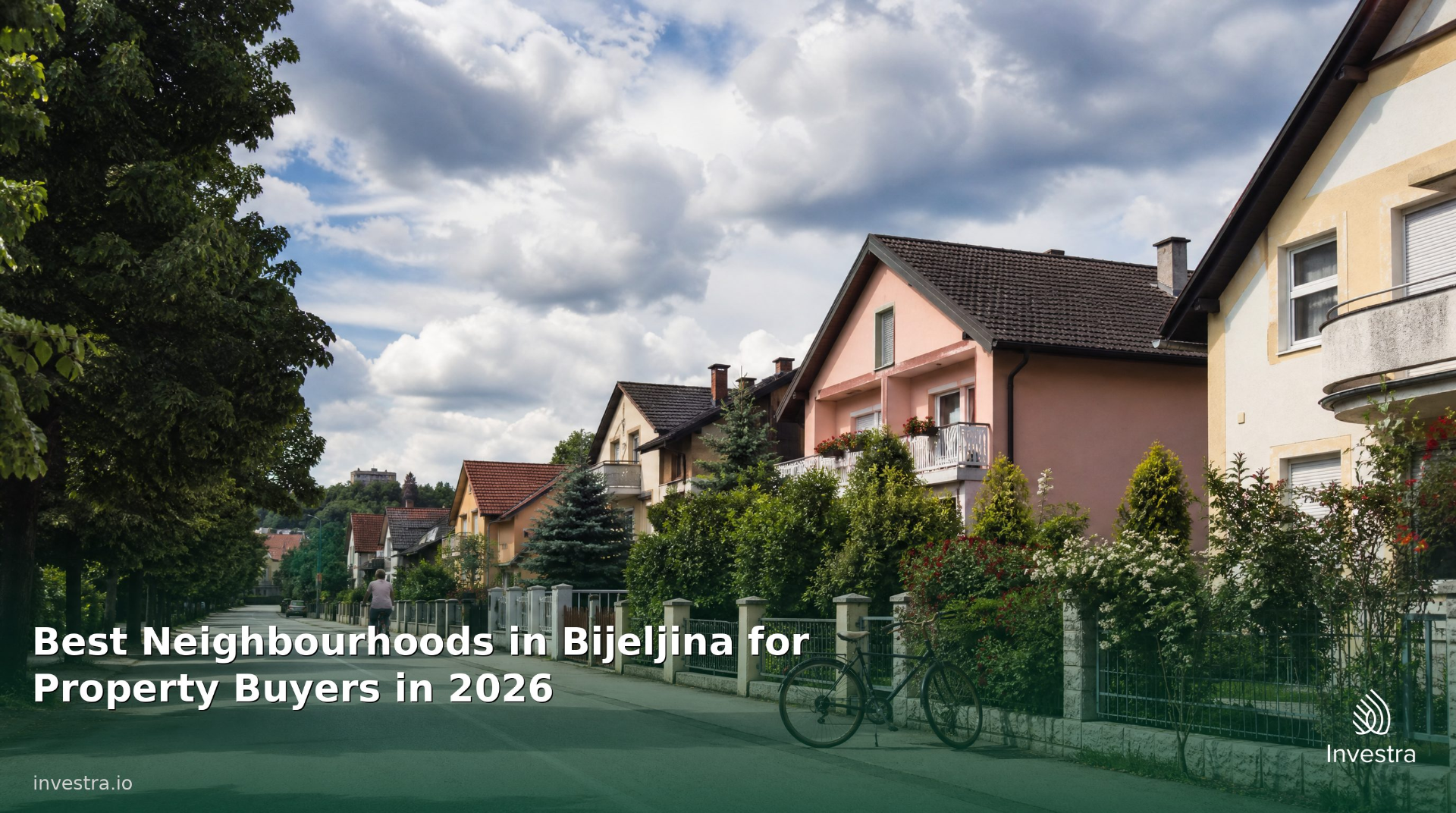
Best Neighbourhoods in Bijeljina for Property Buyers in 2026
Best Neighbourhoods in Bijeljina for Property Buyers in 2026
Why Bijeljina Is Turning Heads in the Balkans Property Market
Quick Answer: Bijeljina is one of Bosnia and Herzegovina's fastest-growing cities, offering property buyers affordable entry prices, improving infrastructure, and rising rental demand — making it an increasingly attractive destination for both local and international investors in 2026. Investra.io tracks emerging Balkan markets to help buyers identify opportunities before the crowd arrives.
Bijeljina doesn't often make it onto the mainstream property investor's radar — and that's precisely what makes it interesting. Tucked into the northeastern corner of Bosnia and Herzegovina, in the Republika Srpska entity, Bijeljina is the fourth-largest city in the country and the economic heart of the Semberija region.
What surprised many buyers who visited in 2024 and 2025 is just how developed the city centre feels compared to expectations. Bijeljina has a functioning commercial district, well-maintained public spaces, a new shopping mall, and improving road connections — including proximity to the Pan-European Corridor Vc that is reshaping freight and mobility across the Western Balkans.
For property buyers in 2026, the core appeal is simple: prices are still low by regional standards, the rental market is growing, and the legal framework — while requiring careful navigation — is workable. Comparisons to Serbian cities are instructive here. If you look at what's happening in markets like those covered in the Loznica Real Estate Market 2026 Macva Region Property Guide, you'll notice a similar pattern: border cities with agricultural hinterlands are experiencing sustained demand growth driven by urbanisation, diaspora investment, and improving connectivity. Bijeljina fits that mould closely.
The city's real estate market has matured noticeably over the past five years. New residential developments have appeared in peripheral zones, commercial construction is ongoing in the city centre, and land values in premium locations have appreciated by an estimated 15–25% since 2020.
Understanding Bijeljina's Urban Structure and Neighbourhood Map
Quick Answer: Bijeljina is divided into a compact city centre, established residential neighbourhoods, newer suburban zones, and rural-urban fringe areas — each offering distinct property profiles and investment characteristics for buyers in 2026.
Before picking a neighbourhood, you need to understand how Bijeljina is laid out. Unlike capital cities with obvious concentric rings of development, Bijeljina has a more organic structure that reflects its history as a market town turned regional centre.
Beyond these older zones, newer residential development has pushed outward — particularly along the main arterial roads leading toward the Serbian border and toward the agricultural plains of Semberija. These newer areas tend to feature detached houses, townhouses, and smaller apartment buildings constructed since the early 2000s. The quality here varies considerably.
The city also has a notable presence of industrial and logistics land use on its southeastern edge, which has implications for residential buyers — proximity to logistics zones can suppress residential values but also sustain rental demand from workers. Understanding this spatial logic is something that consultants like Siniša Dagary — Investment Consultant emphasise when advising clients on Balkan property acquisitions: the micro-location within a city often matters more than the city-level narrative.
Stari Grad (Old Town): The Premium Core for Location-Focused Buyers
Quick Answer: Stari Grad is Bijeljina's most central and prestigious neighbourhood, with apartment prices ranging from €1,200 to €1,800 per square meter in 2026, offering strong rental demand from professionals and students but limited new supply.
Stari Grad — the old town core — is where Bijeljina's urban identity is most concentrated. This isn't a preserved medieval quarter in the tourism-brochure sense; it's a functioning city centre with banks, cafés, government offices, the main pedestrian street (Karadjordjev trg area), and the cultural institutions that give the city its civic character.
Apartment prices in Stari Grad range from approximately €1,200/m² at the lower end (older socialist-era blocks needing renovation) to €1,700–1,800/m² for refurbished or recently built units in prime positions. These figures represent a significant premium over the city's average of roughly €850–1,000/m², but the rental yields justify the price for many buyers.
The stock here is predominantly older. Buildings from the 1960s to 1990s dominate, and energy efficiency is generally poor by contemporary standards. Smart buyers factor in renovation costs — typically €200–350/m² for a full refurbishment — when calculating their total investment.
New supply in Stari Grad is genuinely constrained. There's simply not much land available for new development, and the planning authority in Bijeljina has been relatively conservative about approving high-rise additions to the city centre fabric. This supply constraint is actually a structural positive for existing property owners — it underpins values over the long term.
Novo Naselje: The Family-Friendly Growth Zone
Quick Answer: Novo Naselje is Bijeljina's primary expanding residential district, with prices between €800 and €1,200/m² in 2026, attracting young families and offering a mix of new builds and established apartments with solid long-term demand fundamentals.
Price ranges here span €800–1,200/m² depending on the building age, quality, and exact sub-location. New builds from reputable local developers sit at the upper end of this range, while apartments in well-maintained blocks from the 1990s and 2000s can be found for €800–950/m².
What drives demand in Novo Naselje is the concentration of schools, kindergartens, and healthcare facilities that have been developed alongside the residential expansion. Parents with children actively seek addresses in this zone for practical reasons, and this creates a stable, low-turnover rental demographic.
Rental yields in Novo Naselje are typically in the 5–6.5% range, slightly below city-centre levels but with lower vacancy risk. A typical 65m² two-bedroom apartment might rent for €350–420/month. For buyers focused on stable cash flow rather than maximum yield, this neighbourhood represents perhaps the most balanced risk-reward profile in Bijeljina's residential market. The broader pattern here echoes what we've seen in similar growing cities — the Sremska Mitrovica Real Estate 2026 Srem Region Property Guide documents comparable dynamics in a city with a strikingly similar economic and demographic profile.
Patkovača: The Affordable Entry Point for Budget-Conscious Investors
Quick Answer: Patkovača offers Bijeljina's most affordable residential property prices, typically €550–850/m² in 2026, making it the preferred entry point for first-time investors and those seeking maximum yield through lower acquisition costs.
The neighbourhood's reputation has been improving gradually. New commercial units have opened along its main streets, public space improvements have been made in recent years, and younger residents are increasingly choosing Patkovača for its more affordable rents. Monthly rents for a renovated one-bedroom apartment hover around €250–320, and for a two-bedroom, €330–400.
The honest assessment is that Patkovača isn't for every buyer. The housing stock is older, parking is constrained, and some streets feel more worn than the city average. But for a patient investor with a clear renovation strategy, it offers the kind of entry-level opportunity that has largely disappeared from more developed Balkan markets. For context on how similar affordable urban zones are performing in neighbouring countries, the Aleksinac Real Estate Market 2026 Southern Serbia Property Guide provides a useful comparison.
Šešlije and Outer Suburban Areas: Land Banking and Long-Term Growth Plays
Quick Answer: Šešlije and the outer suburban zones surrounding Bijeljina offer land plots from €15–60/m² and house-with-land packages starting from €60,000, representing long-term appreciation plays tied to urban expansion and infrastructure development.
Not every property buyer is looking for a rental apartment. Some come to Bijeljina with a longer time horizon — they're thinking about land banking, building a private residence, or positioning ahead of urban expansion.
Land prices in these areas vary enormously. Agricultural land in the Semberija plain can be acquired for €1–5/m² (€10,000–50,000 per hectare), while building land with approved planning permissions in areas adjacent to existing settlement clusters trades at €15–60/m².
Šešlije itself is an interesting case. This suburban settlement has seen consistent new housing construction over the past decade, driven by families who want larger plots than the city centre can offer but still need urban access for work and services. Detached houses here typically range from €80,000–180,000 depending on size, quality, and plot area.
The risk here is timeline. Infrastructure improvements — road upgrades, utility connections, public transport extensions — don't always materialise on the schedules that optimistic pro-formas assume. Buyers in these zones should view their investment as a five-to-ten-year position, not a quick flip. The financial modelling support available from firms like Findes Group & Partners can be genuinely useful for stress-testing these longer-horizon projections with appropriate discount rates and scenario analysis.
Commercial and Mixed-Use Property: The Emerging Opportunity
Quick Answer: Commercial property in Bijeljina, including retail units and mixed-use buildings, trades at €800–2,000/m² in prime locations, with yields of 6–9% achievable for well-let properties in high-footfall areas — an increasingly interesting segment as the city's retail economy grows.
Residential gets most of the attention in discussions of Bijeljina property, but there's a compelling case to be made for commercial real estate — particularly for investors who want higher yields and are comfortable with the different management dynamics involved.
Retail units on Bijeljina's main pedestrian and commercial streets command the highest prices: €1,500–2,000/m² for prime ground-floor space in established shopping corridors. These units attract national retailers, banks, and food service operators who sign multi-year leases and provide the kind of covenant security that justifies the higher acquisition cost.
Office space is a smaller segment in Bijeljina — this isn't a city with significant corporate headquarters or large service sector employers. But small professional offices (for lawyers, accountants, architects, and medical practices) maintain steady demand at rents of €8–15/m²/month. An investor who acquires and refurbishes a 200m² office floor above a retail unit could reasonably expect to achieve blended gross yields in the 7–8% range. Understanding proptech tools that can help manage these diverse asset types is increasingly relevant — Serbia Proptech 2026 How Technology Is Changing Real Estate explores how digital platforms are transforming property management across the region.
Legal Framework for Foreign Buyers in Bosnia and Herzegovina
Quick Answer: Foreign nationals from countries with reciprocal agreements (including most EU states and the US) can legally purchase property in Bosnia and Herzegovina, including in Bijeljina (Republika Srpska), though the process requires careful legal support due to the country's complex administrative structure.
Bosnia and Herzegovina's legal system is, to put it diplomatically, complex. The country operates with two entities — Republika Srpska (RS) and the Federation of Bosnia and Herzegovina (FBiH) — each with significant autonomous legislative authority. Bijeljina falls within Republika Srpska, which means property law here is governed by RS legislation rather than FBiH regulations.
Foreign nationals can generally purchase property in Republika Srpska, subject to reciprocity requirements — meaning citizens of countries that allow Bosnian nationals to purchase property in their country can typically purchase property in RS. In practice, this covers most EU member states, the United States, and several other countries.
The purchase process in Bijeljina involves several key stages. First, a preliminary contract (predugovor) is typically signed, accompanied by a deposit of 10% of the agreed purchase price. This preliminary contract should be reviewed by a licensed attorney — not skipped or treated as a formality.
One issue that catches foreign buyers off guard is the prevalence of encumbrances on Bosnian property titles. Mortgages, liens, utility debts, and inheritance disputes can all complicate a transaction that initially appears clean. A thorough title search through RUGIPP before signing any contract is non-negotiable. The practical guidance available through Siniša Dagary — Investment Insight on Balkan market entry processes can provide useful orientation before engaging local legal counsel.
Taxes, Fees, and Ownership Costs in Bijeljina
Quick Answer: Property purchase in Bijeljina incurs a transfer tax of 3% of the assessed value, plus notary fees, legal fees, and land registry costs totalling approximately 4–6% of the purchase price — a relatively competitive total acquisition cost by European standards.
Getting the numbers right on total acquisition cost is something many first-time buyers in this market underestimate. The headline purchase price is only one component of what you'll actually spend to become the registered owner of a property in Bijeljina.
The primary transaction tax is the Real Estate Transfer Tax (porez na promet nepokretnosti), set at 3% of the property's assessed value under Republika Srpska law. Note that the tax base is the assessed value determined by the tax authority, which may differ from the contractually agreed purchase price — typically the assessed value is close to market value, but discrepancies can occur.
In total, most buyers should budget 4–6% of the purchase price in transaction costs on top of the agreed price. For a €100,000 apartment, that means approximately €4,000–6,000 in additional costs. This is genuinely competitive compared to markets like France (7–8%), Belgium (10–12%), or Italy (9–10%), though higher than some UK and German scenarios.
For rental income, landlords in Republika Srpska are subject to personal income tax on net rental income at a flat rate of 10%. Deductible expenses include maintenance costs, depreciation, and management fees, which can significantly reduce the effective tax burden. Compared to Western European jurisdictions, this is a light tax environment for landlords — another factor in Bijeljina's favour for yield-focused investors. For buyers with cross-border structures, the advisory work done by Siniša Dagary — Professional Background provides insight into how experienced regional consultants approach these tax optimisation questions.
Rental Market Analysis: Demand, Rents, and Yields
Quick Answer: Bijeljina's rental market is driven by young professionals, students, workers at local enterprises, and diaspora returnees, with monthly rents ranging from €200 for basic studios to €700+ for quality family homes — translating to gross yields of 5–9% across asset classes.
The rental market in Bijeljina is more nuanced than a single yield figure can capture. There are effectively three distinct renter demographics operating simultaneously, and a smart investor positions their property to serve one of them clearly rather than trying to be all things to all tenants.
The first and largest demographic is local professionals and young couples who choose to rent before buying. Bijeljina has a meaningful professional services sector — healthcare workers, educators, public sector employees, private sector managers — and these renters want clean, functional apartments in accessible locations.
The second demographic is students attending Bijeljina's higher education institutions, including the University of East Sarajevo's Bijeljina faculty and various vocational colleges. Student demand is concentrated during the academic year and drives occupancy in certain parts of the city — particularly areas within walking or cycling distance of campuses.
The third demographic — and arguably the most interesting for premium property owners — is returning diaspora members and their families. Bijeljina has a significant diaspora community in Germany, Austria, Switzerland, and Sweden, and a growing number of these families are renting (or purchasing) property in preparation for eventual return or as a base for summer visits.
On specific numbers: a studio or one-bedroom apartment (30–45m²) in good condition rents for €200–320/month. A two-bedroom apartment (55–70m²) commands €320–480/month depending on quality and location. Three-bedroom family apartments achieve €450–600/month in Novo Naselje and €480–650/month in central locations.
Infrastructure, Connectivity, and Future Growth Drivers
Quick Answer: Bijeljina benefits from proximity to Pan-European Corridor Vc, ongoing municipal infrastructure investment, improving utilities, and positioning as a regional logistics and agricultural distribution hub — fundamentals that support long-term property value appreciation.
Understanding the infrastructure and connectivity story is crucial for evaluating long-term investment viability in any secondary city. Bijeljina's growth prospects are substantially underpinned by real infrastructure developments rather than speculative planning.
The most significant piece is the Pan-European Corridor Vc, which connects Budapest to Thessaloniki and includes a dedicated route through Bijeljina's region. When completed to full design standards, this corridor will make the city genuinely accessible for freight operations and logistics distribution serving both Central Europe and Mediterranean markets.
Within the city itself, municipal investment has been ongoing. Water and sewerage system upgrades have been completed in phases, improving service reliability for residents and supporting new development. Road improvements in central areas have made the city more navigable.
The agricultural sector remains significant to Bijeljina's economy, and this underpins related services — food processing facilities, agricultural equipment dealers, grain storage, and logistics. This isn't a city betting its future on a single industry; it's a diversified regional centre with multiple economic anchors.
Market Outlook and Strategic Considerations for 2026 Buyers
Quick Answer: Bijeljina's 2026 outlook is cautiously positive, with prices likely to appreciate 3–6% annually, driven by steady infrastructure investment, diaspora capital, and regional economic integration — making it a suitable market for patient value investors but not for those seeking rapid capital gains.
Looking ahead to 2026 and beyond, the consensus among regional market participants is that Bijeljina will continue its trajectory of steady appreciation without dramatic spikes or crashes. This is not a city experiencing a speculative bubble, nor is it a distressed market
Investment Disclaimer
Quick Answer: This guide is general market information, not personal legal, tax, financing or investment advice.
Before committing to a property transaction, buyers should obtain independent local legal, tax and financial advice suited to their circumstances. Investra.io can support initial market research, but every purchase decision remains the buyer's responsibility.
Frequently Asked Questions
Quick Answer: This section explains the practical property-investment implications of Frequently Asked Questions.
What is a prudent next step after initial market research?
Use current documentation, independent professional advice and comparable local evidence before proceeding. Investra.io can support an initial structured market review.
How can buyers plan a realistic ownership budget?
Use current documentation, independent professional advice and comparable local evidence before proceeding. Investra.io can support an initial structured market review.
What evidence supports a careful investment decision?
Use current documentation, independent professional advice and comparable local evidence before proceeding. Investra.io can support an initial structured market review.
When should a buyer obtain legal and tax advice?
Use current documentation, independent professional advice and comparable local evidence before proceeding. Investra.io can support an initial structured market review.
How should a buyer compare neighbourhoods and property types?
Use current documentation, independent professional advice and comparable local evidence before proceeding. Investra.io can support an initial structured market review.
What local checks should be completed before signing?
Use current documentation, independent professional advice and comparable local evidence before proceeding. Investra.io can support an initial structured market review.
Which costs should be assessed alongside the purchase price?
Use current documentation, independent professional advice and comparable local evidence before proceeding. Investra.io can support an initial structured market review.
How can international buyers verify a property opportunity?
Use current documentation, independent professional advice and comparable local evidence before proceeding. Investra.io can support an initial structured market review.
What should buyers compare before selecting a property?
Use current documentation, independent professional advice and comparable local evidence before proceeding. Investra.io can support an initial structured market review.
Quick Answer: These answers outline common buyer checks and should be read with current professional advice.
Recommended Reading
Quick Answer: This section explains the practical property-investment implications of Recommended Reading.
- Investra market research
- Investra market research
- Investra market research
- Investra market research
- Investra market research
- Investra market research
- Investra market research
- Investra market research
- Investra market research
- Investra market research
- Investra market research
- Investra market research
- Investra market research
- Investra market research
- Investra market research
- Investra market research
- Investra market research
- Siniša Dagary investment insight
- Siniša Dagary investment insight
- Siniša Dagary investment insight
- Siniša Dagary investment insight
- Siniša Dagary investment insight
- Findes Group & Partners
- Findes Group & Partners
Connect With Investra
Follow Investra for market updates on Facebook, LinkedIn, YouTube
İlgili Gönderiler
İlgili gönderi bulunamadı.
