
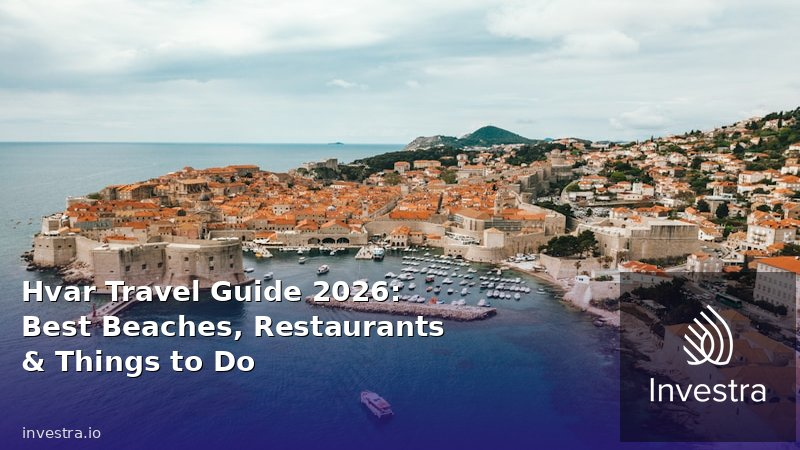
Hvar Travel Guide 2026: Best Beaches, Restaurants & Things to Do
Hvar Travel Guide 2026: Why This Adriatic Island Belongs on Every Itinerary
Quick Answer: Hvar is Croatia's most glamorous island, offering a compelling mix of crystal-clear beaches, medieval architecture, world-class dining, and vibrant nightlife — making it one of Europe's top travel and real estate investment destinations in 2026. For property investment insights, explore the Hvar Island Real Estate guide on Investra.io.
Few destinations in the Mediterranean command the same magnetic appeal as Hvar. Stretching 68 kilometres along Croatia's Dalmatian coast, this sun-drenched island has evolved from a quiet fishing retreat into one of Europe's most coveted luxury destinations. In 2026, Hvar sits at the intersection of old-world charm and modern sophistication — its lavender-scented hillsides, crystalline bays, and buzzing harbour attracting a diverse mix of sun-seekers, food lovers, yacht charterers, and increasingly, savvy real estate investors.
Hvar receives more than 1.2 million overnight tourist arrivals annually, with the summer season stretching from April through October. The island boasts an extraordinary 2,726 hours of sunshine per year — the most of any inhabited island in Croatia and one of the highest averages in all of Europe. These numbers matter not just for holiday planning, but for property investors calculating short-term rental income potential across an unusually long tourist season.
This comprehensive Hvar travel guide for 2026 covers everything from the best beaches and restaurants to nightlife, day trips, and practical travel tips. It also examines the island's thriving real estate market for those considering turning their love of Hvar into a long-term investment. Whether planning a two-week holiday or a life-changing property purchase, this guide delivers the data, insights, and recommendations needed to make the most of everything Hvar has to offer.
Getting to Hvar: Transport Options and Arrival Tips for 2026
Quick Answer: Hvar is accessible via ferries and catamarans from Split, with the main routes taking between 1 and 2.5 hours depending on your destination on the island. The nearest major airport is Split Airport, approximately 25 kilometres from the Split ferry terminal.
Reaching Hvar requires a combination of air and sea travel, which adds to the island's exclusivity but demands some logistical planning. The primary gateway is Split Airport (SPU), which handles over 3.5 million passengers annually and offers direct connections to most major European cities. During summer 2026, airlines including Croatia Airlines, Ryanair, easyJet, British Airways, and Lufthansa operate frequent routes, with return flights from Western Europe typically ranging from €80 to €350 depending on season and booking time.
From Split, travellers have several ferry and catamaran options. The most popular route connects Split's ferry terminal (Stari Grad or the Town Port) to Hvar. The car ferry from Split to Stari Grad takes approximately 2 hours and operates multiple daily crossings managed by Jadrolinija. If travelling without a car, high-speed catamarans run between Split and Hvar Town in about 1 hour, with tickets priced at approximately €10–€15 per person. A newer Krilo catamaran service also connects Dubrovnik, Korčula, and Brač with Hvar, making island-hopping straightforward.
For those arriving by private yacht — a common choice among Hvar's high-net-worth visitors — the island has well-equipped marinas at Hvar Town, Stari Grad, Vrboska, and Palmižana. Berth fees in Hvar Town marina during peak season range from €80 to €250 per night depending on vessel length. Helicopter transfers from Split Airport can be arranged for approximately €400–€800 one-way, a popular option for luxury villa guests.
Once on the island, getting around is best managed by rental scooter or car for those staying outside Hvar Town. Local bus services connect the main settlements, but schedules can be irregular in shoulder season. Taxis and ride-share apps (Bolt operates in Hvar) are widely available. Water taxis connecting Hvar Town to the Pakleni Islands cost approximately €5–€10 per person each way and are the most efficient way to reach the outer beaches and beach bars.
The Best Beaches on Hvar Island in 2026
Quick Answer: Hvar's finest beaches include Dubovica, Mlini Bay, Zdrilca, and the Pakleni Islands chain, with crystal-clear water temperatures reaching 25°C in peak summer. The island's pebble and rock beaches are consistently rated among Croatia's cleanest.
Hvar's coastline stretches over 190 kilometres and encompasses everything from secluded coves accessible only by boat to organised beach facilities at the edge of town. Understanding which beaches suit different travel styles is essential for planning the perfect Hvar itinerary.
Dubovica Beach is widely considered one of the most beautiful beaches on the entire Croatian coast. Located 8 kilometres east of Hvar Town, this pebble cove is framed by a 16th-century summer villa and offers exceptional water clarity. A seasonal beach bar provides refreshments, and the sheltered bay makes it ideal for snorkelling. The access road is narrow, so most visitors arrive by sea taxi or rent a scooter for the short ride.
The Pakleni Islands (Paklinski otoci) form an archipelago just offshore from Hvar Town and contain some of the island's most iconic beach destinations. Palmižana on Sveti Klement island is famous for its natural harbour, upscale beach restaurants, and relaxed bohemian atmosphere. Stipanska offers a quieter alternative with pine-shaded pebble beaches. Zdrilca is popular with naturists. Water taxis from Hvar Town run throughout the day from approximately 9:00 to 22:00 in peak season.
Milna Beach, located on the western tip of Hvar, is one of the island's most naturally sheltered and family-friendly beaches. The drive through the island's interior — past vineyards, lavender fields, and ancient stone villages — is a highlight in itself. The beach has a small café and offers calm, shallow waters perfect for children.
Mlini Bay near Jelsa on the north coast provides a completely different atmosphere from the crowded Hvar Town beaches. Pine forests frame the shoreline, water temperatures are consistently warm, and the village of Jelsa nearby offers authentic Dalmatian dining without the tourist markup. Vrboska's beach channel, unique in Croatia, allows visitors to swim between two small bridges in a fjord-like setting.
For those who prefer organised beach clubs with sun loungers, umbrellas, and cocktail service, Bonj — Les Bains beach club adjacent to the Amfora Grand Beach Resort — offers a premium experience with day passes costing approximately €30–€80 depending on the service package selected.
Top Things to Do on Hvar Island: Culture, Adventure, and Leisure
Quick Answer: The best things to do on Hvar island include exploring the UNESCO-heritage Stari Grad Plain, visiting Hvar Fortress (Fortica), hiking through lavender fields, sea kayaking, wine tasting in family-run cellars, and boat tours to the Blue Cave on nearby Biševo island.
Hvar is far more than a beach destination. The island's 2,400 years of recorded history, combined with exceptional natural landscapes and a thriving contemporary food and wine scene, create an extraordinary range of activities for every type of traveller.
Hvar Town and the Stari Grad Plain: The Stari Grad Plain (Starigradsko polje) is Croatia's only UNESCO World Heritage cultural landscape. Established by Greek colonists from Paros around 384 BC, the plain preserves an ancient agricultural grid system almost completely intact after 2,400 years. Cycling or walking across the plain through vineyards, olive groves, and ancient stone walls is a profoundly moving experience and one of the most unique cultural activities in the entire Mediterranean.
Hvar Fortress (Fortica/Španjola): Rising 100 metres above Hvar Town, the 16th-century Venetian fortress offers panoramic views across the Pakleni Islands and the Dalmatian mainland. Entry costs approximately €8 for adults. The climb takes around 20 minutes from the town square and is well worth the effort, particularly at golden hour before sunset.
Lavender Field Visits: Hvar is Croatia's lavender capital. The fields around Velo Grablje and Brusje village bloom spectacularly in June and early July. Many small farms offer distillation demonstrations and sell essential oils, soaps, and dried flowers directly. This authentic agricultural experience stands in sharp contrast to the island's glitzy harbour scene.
Sea Kayaking and Water Sports: Multiple operators in Hvar Town offer half-day and full-day sea kayaking tours to the Pakleni Islands, sea caves, and hidden coves. Group tours start from approximately €45 per person. Scuba diving, kitesurfing (particularly around Viganj on the Pelješac peninsula, reachable by ferry), windsurfing, and stand-up paddleboarding are all widely available.
Blue Cave Excursion: The Blue Cave (Modra Špilja) on Biševo island, accessible by speedboat excursion from Hvar Town, is one of Croatia's most photographed natural wonders. At midday, sunlight refracts through an underwater opening to fill the cave with an ethereal blue luminescence. Combined boat tours including the Blue Cave, Green Cave, and Stiniva Cove on Vis island cost approximately €50–€80 per person.
Wine and Gastronomy Tours: Hvar produces exceptional Plavac Mali and Bogdanuša wines from some of Croatia's most dramatic vineyard terrains. Family wineries including Carić, Duboković, and Ivan Dolac welcome visitors, often with no prior reservation needed. A guided wine and food tour through the island's interior vineyards typically costs €70–€120 per person including transport and tastings.
Best Restaurants in Hvar 2026: From Fine Dining to Local Konobas
Quick Answer: Hvar's dining scene spans from Michelin-recommended fine dining to authentic family-run konobas serving grilled fish, peka slow-cooked lamb, and hand-rolled pasta. Budget travellers can eat well for €15–€25 per person, while premium restaurants average €60–€120 per head excluding wine.
The culinary scene in Hvar has matured significantly over the past decade and now rivals some of Europe's most respected food destinations. The island's position at the crossroads of Italian, Mediterranean, and traditional Dalmatian cooking traditions, combined with exceptional local ingredients, creates a dining culture that rewards exploration at every price point.
Gariful Restaurant on Hvar Town harbour is perhaps the island's most iconic dining address. Specialising in locally caught seafood, lobster, and shellfish, Gariful's waterfront terrace has attracted celebrities, royalty, and discerning food lovers for decades. Expect to spend €80–€150 per person with wine. Advance reservation is essential during peak season (June–August).
Konoba Menego, a short walk from Hvar's main square, represents the authentic face of Dalmatian cuisine. This family-run restaurant serves traditional dishes including marinated anchovies, octopus salad, sheep's cheese from the island of Pag, and home-cured prosciutto. Prices are considerably more accessible at €25–€45 per person, and the warm, rustic atmosphere provides a refreshing contrast to the harbour's see-and-be-seen restaurants.
Hvar's Wine Bar Scene: The town's wine bar culture deserves special mention. Bars like Tri Pršuta (Three Prosciuttos) and Yaksa offer curated selections of Croatian natural wines alongside small plates of local cheeses and cured meats. These venues serve as excellent introductions to the island's wine culture before a more formal dinner.
Zori Restaurant in Stari Grad is consistently ranked among Croatia's top restaurants, offering a creative interpretation of Mediterranean cuisine using hyperlocal ingredients. Chef-driven menus change seasonally, and the stone terrace overlooking the port creates an unforgettable setting. Tasting menus range from €75–€110 per person excluding wine.
Palmižana Restaurant on the Pakleni Islands is another must-visit experience. Accessible only by boat, this bohemian garden restaurant has been run by the Meneghello family for generations. The menu focuses on grilled fish, wild herbs, and homemade pasta. The journey across the bay by water taxi and the arrival into the lush botanical garden setting make this one of Hvar's most complete dining experiences.
For budget dining, Hvar's supermarkets and local bakeries offer excellent provisions for picnic-style beach meals. Fresh bread, local olive oil, prosciutto, and Pag cheese from a market in Jelsa or Stari Grad provide a high-quality, low-cost alternative to restaurant dining for certain meals.
Hvar Nightlife: Beach Clubs, Bars, and the Famous Party Scene
Quick Answer: Hvar is recognised as one of Europe's top nightlife destinations, with the Carpe Diem beach club on Stipanska island and the Hula Hula beach bar among the most famous venues. The party season runs from late June through early September, with events often continuing until dawn.
Hvar's nightlife reputation is well-earned and internationally recognised, regularly appearing in lists of Europe's best party destinations alongside Ibiza and Mykonos. The scene caters to a broad spectrum, from sophisticated cocktail bars to full-scale beach club experiences with international DJs.
Hula Hula Beach Bar is arguably Hvar's most famous daytime-to-evening venue. Perched on rocks west of Hvar Town with direct sea access, Hula Hula's sunset parties are legendary. The DJ set begins around 16:00 and builds through golden hour, creating one of the most photographed party atmospheres in Croatia. Cocktails range from €12–€20, and the venue gets extremely crowded from late July through August.
Carpe Diem Beach Club on Stipanska in the Pakleni Islands has been Hvar's premiere nightlife destination since 2008. The club runs boat transfers from Hvar Town harbour (approximately €10 return) and hosts internationally recognised DJs from late June through August. Entry fees range from free to €30 depending on the event, and table service starts from €200 minimum spend. The club's combination of natural beauty, professional sound systems, and serious programming attracts a sophisticated international crowd.
The Hvar Town Main Square (Pjaca): The world's largest piazza outside St. Mark's Square in Venice is the social heart of Hvar Town. Surrounding bars including Sidro, The Veneranda Club, and various cocktail terraces begin filling from around 22:00. The square's architecture — framed by the Cathedral of St. Stephen and the Arsenal — creates a spectacular backdrop for evening socialising.
For those seeking quieter evenings, the wine bars and konobas of Stari Grad and Jelsa offer a completely different pace. These towns attract a more local crowd and visitors seeking authentic Dalmatian experiences over the Hvar Town party scene. Exploring Hvar's quieter side is strongly recommended for at least one or two evenings during any extended visit.
Where to Stay in Hvar: Accommodation Guide for Every Budget
Quick Answer: Hvar accommodation ranges from luxury boutique hotels at €400–€1,200 per night to private apartments and villas available from €80–€500 per night, with Airbnb and direct villa rentals offering the best value for families and groups.
Accommodation options on Hvar span a considerable range of quality and price points, and choosing the right base significantly shapes the island experience. The three main accommodation clusters — Hvar Town, Stari Grad, and Jelsa — each offer distinct atmospheres.
Luxury Hotels: The Hotel Riva Hvar Yacht Harbour Hotel is Hvar's most celebrated 5-star property, occupying a prime position directly on the harbour. Rates in peak season reach €600–€1,200 per night for superior rooms. The Amfora Hvar Grand Beach Resort offers a more resort-style luxury experience with its famous pool terrace cascade and direct beach access, with rates from €300–€700 per night. The Lesic Dimitri Palace in Korčula (a short ferry hop from Hvar) provides another ultra-luxury alternative for island visitors.
Boutique Hotels and Heritage Properties: Hvar's 16th and 17th-century stone townhouses have been increasingly converted into boutique accommodation. Properties such as Villa Nora and smaller design hotels in Hvar Town offer rates from €150–€400 per night with genuine character and personalised service. Booking well in advance — typically by February for July-August — is essential.
Villas and Private Rentals: The villa rental market represents excellent value for groups of four or more. Private villas with pools in the Hvar Town hills or along the island's south coast range from €300–€2,500 per night depending on size, location, and amenities. Platforms including Airbnb, booking.com, and specialist Croatian villa agencies list hundreds of options. This segment of the market also represents the primary income driver for property investors, making yield calculations straightforward.
Budget Options: Hostel accommodation and private rooms (sobe) in local family homes provide affordable alternatives from €30–€80 per person per night. The island's camping sites, particularly FKK Mlini near Jelsa, offer well-equipped facilities with sea access from approximately €20–€40 per pitch. These options are popular with younger travellers and digital nomads extending their stay into shoulder season.
Hvar Real Estate Market Overview 2026: Prices, Trends, and Opportunities
Quick Answer: Hvar property prices range from €3,500 to €12,000+ per square metre in 2026, with prime Hvar Town properties and seafront villas commanding the highest premiums. The market has appreciated by an average of 8–12% annually over the past five years, driven by limited supply and growing international demand.
For investors and lifestyle buyers looking beyond the holiday experience, Hvar's real estate market presents one of the most compelling propositions in the European property landscape. The island's combination of extreme natural beauty, limited buildable land, strong tourism fundamentals, and Croatia's EU membership creates a uniquely favourable investment environment.
Detailed market analysis is available through the Hvar Island Real Estate platform on Investra.io, which aggregates current listings, price per square metre data, and yield projections across the island's key micromarkets.
Current Price Per Square Metre (2026):
- Hvar Town (historic centre, sea views): €6,500–€12,000/m²
- Hvar Town (hillside, no direct sea view): €4,000–€7,000/m²
- Stari Grad and surroundings: €2,800–€5,500/m²
- Jelsa and Vrboska: €2,500–€4,500/m²
- Remote island villages (renovation projects): €800–€2,500/m²
- Luxury seafront villas (turnkey, pool): €8,000–€15,000+/m²
Price growth has been consistent and significant. Between 2019 and 2025, average property values on Hvar increased by approximately 65%, outperforming most comparable Mediterranean markets including parts of the Algarve, Sardinia, and the Greek islands. The primary drivers include constrained supply (the island's topography severely limits new construction zones), rising quality of tourism infrastructure, and an increasing number of high-net-worth buyers from Germany, Austria, the UK, the Czech Republic, and increasingly the United States and Middle East.
The Croatia Real Estate Investment Guide 2026 provides the broader national context, with Hvar consistently ranking as one of Croatia's three most liquid premium property markets alongside Dubrovnik and central Zagreb.
Rental Yields and ROI on Hvar Investment Properties
Quick Answer: Short-term rental yields on Hvar typically range from 5% to 9% gross annually, with well-positioned properties in Hvar Town achieving 8–12 weeks of peak-season bookings at daily rates of €150–€800+. Total ROI including capital appreciation can exceed 15% annually for strategically purchased properties.
The investment case for Hvar property is substantially built on the island's extraordinary short-term rental potential. With nearly 2,730 hours of annual sunshine, a tourist season running from April through October, and a global profile that drives premium pricing, Hvar outperforms most comparable Mediterranean markets on rental income per square metre.
Rental Rate Benchmarks (2026):
- 1-bedroom apartment, Hvar Town: €100–€250/night (peak); €50–€100/night (shoulder)
- 2-bedroom apartment with sea view: €180–€400/night (peak); €80–€160/night (shoulder)
- 3-bedroom villa with pool: €400–€900/night (peak); €180–€350/night (shoulder)
- 5+ bedroom luxury villa, seafront: €1,500–€4,500/night (peak)
A well-managed 2-bedroom apartment in Hvar Town purchased at €450,000 can generate gross rental income of €35,000–€55,000 annually, assuming approximately 90 peak nights and 40 shoulder nights of occupancy. After management fees (typically 15–25% for full-service agencies), cleaning costs, utility bills, and maintenance, net yields typically fall in the 5–8% range on purchase price.
Capital appreciation adds significantly to total returns. Using the conservative estimate of 8% annual appreciation, the same €450,000 property would increase in value by approximately €36,000 in year one. Combined with €35,000 net rental income, the total year-one return approaches €71,000, or approximately 15.8% ROI — a figure that compares extremely favourably with most European real estate markets.
For a deeper analysis of Croatia's national rental yield landscape, the Zagreb Property Market Analysis and the Split Real Estate Guide offer complementary data for investors considering diversified Croatian property portfolios.
Expert guidance from specialists like Siniša Dagary — Investment Consultant can be invaluable in structuring the most tax-efficient and legally sound acquisition framework, particularly for international buyers unfamiliar with Croatian property law and tax obligations.
Legal Process for Buying Property in Hvar as a Foreign National
Quick Answer: EU citizens can purchase property in Croatia without restrictions. Non-EU nationals require reciprocity agreements or must establish an EU-registered company. The purchase process typically takes 2–4 months and involves a notarised purchase contract, land registry transfer, and real estate transfer tax of 3%.
Croatia's accession to the European Union in 2013 and its adoption of the Schengen Area in January 2023 significantly streamlined property acquisition for international buyers. EU and EEA citizens now face essentially the same legal process as Croatian nationals, creating a straightforward path to ownership.
Step-by-Step Purchase Process:
- Property identification and due diligence: Confirm the property's legal status in the land registry (Zemljišna knjiga) and cadastral register. Croatia has historically had complications with property documentation, so this step requires a qualified local lawyer.
- Pre-contract (Predugovor): A binding preliminary agreement is signed, typically with a 10% deposit. This locks in the purchase price and timeline.
- Final purchase contract (Kupoprodajni ugovor): Notarised by a Croatian notary (javni bilježnik). The contract must be in Croatian, though bilingual versions are standard practice for international buyers.
- Land registry registration (Uknjižba): The new ownership is registered with the relevant municipal court. This process can take 2–6 months, though ownership is legally established from the contract date.
- Real Estate Transfer Tax (Porez na promet nekretnina): A flat rate of 3% of the assessed property value is payable by the buyer within 30 days of the notarised contract. For new construction purchased directly from a VAT-registered developer, PDV (VAT at 25%) applies instead.
For non-EU buyers: Citizens of countries without bilateral reciprocity agreements with Croatia must purchase through an EU-registered legal entity (typically a Croatian d.o.o. — limited liability company). Company formation costs approximately €1,500–€3,000 and takes 2–4 weeks. This structure also offers potential tax advantages for rental income management.
Total acquisition costs (legal fees, notary, registration, transfer tax, agent commission) typically add 6–10% to the purchase price. Buyers should budget accordingly. Legal support from specialists familiar with Croatian real estate law is not optional — it is essential. Services such as Findes Financial Services provide complementary support for financing and cross-border financial structuring.
Taxes and Ongoing Costs for Hvar Property Owners
Quick Answer: Property owners in Hvar pay an annual property tax (communal contribution), rental income tax at 12% on profit or 10% flat-rate on gross turnover, and potential capital gains tax of 24% if the property is sold within two years of purchase. Long-term holders benefit from capital gains exemption after two years.
Understanding the ongoing tax obligations is essential for accurate financial modelling when evaluating Hvar property investments. Croatia's tax framework for property owners is relatively straightforward by European standards, and several provisions favour long-term holding strategies.
Annual Property Tax (Komunalna naknada): Croatia does not levy a traditional annual property tax in the Western European sense. Instead, property owners pay a communal contribution (komunalna naknada) based on the property's size, location, and zone classification. For a typical 80m² apartment in Hvar Town, this annual charge ranges from €300–€800. Additional utility fees and common area maintenance for apartment buildings apply separately.
Rental Income Tax: Property owners earning rental income have two options under Croatian tax law. The flat-rate system (paušalni porez) allows landlords to pay a fixed monthly tax based on bed capacity — currently approximately €7–€15 per bed per month depending on municipality classification. For properties generating higher incomes, opting into the standard income tax system and deducting legitimate expenses (depreciation, management fees, maintenance, insurance) often produces a lower overall tax liability. After deductions, net rental income is taxed at 12%.
Capital Gains Tax: Properties sold within two years of acquisition are subject to capital gains tax at 24% on the profit (selling price minus acquisition cost and documented improvement costs). Properties held for more than two years are exempt from capital gains tax — a highly favourable provision that rewards medium and long-term investment strategies.
Inheritance and Gift Tax: Direct family members inherit Croatian property free of inheritance tax. Non-direct heirs pay 4% on the assessed value. This makes family wealth transfer planning relatively straightforward for estate planning purposes.
For complex cross-border tax situations, particularly for investors holding Croatian property through foreign companies, consultation with advisors listed at About Siniša Dagary provides expert guidance on optimising the overall tax structure.
Comparing Hvar to Other Croatian Investment Markets in 2026
Quick Answer: Hvar offers the highest short-term rental yields and strongest capital appreciation among Croatia's coastal markets, while Zagreb provides more stable long-term yields from residential rentals, and Dubrovnik commands the highest absolute prices but lower yield percentages due to extreme entry costs.
Understanding how Hvar positions against Croatia's other key real estate markets helps investors make properly contextualised decisions. Each market has distinct characteristics, risk profiles, and target investor demographics.
Hvar vs. Dubrovnik: Both markets target the premium end of the tourism and luxury property spectrum. Dubrovnik property prices average €8,000–€15,000/m² in prime areas, making entry costs higher than Hvar. However, Dubrovnik's year-round cruise tourism somewhat mitigates seasonal rental income concentration. The Dubrovnik Luxury Property Guide provides detailed market analysis for direct comparison.
Hvar vs. Split: Split operates at more accessible price points (€3,000–€8,000/m² in the historic peninsula) and benefits from being Croatia's largest coastal city with year-round population and commercial activity. Rental yields in Split are broadly comparable to Hvar on a percentage basis, but the absolute income per premium property is generally lower. The Split Real Estate Guide outlines this market in detail.
Hvar vs. Zagreb: Zagreb represents a fundamentally different investment proposition — a capital city residential market driven by domestic demand, commercial real estate, and student housing rather than tourism. Yields of 4–6% on long-term rentals provide stability and lower management complexity. The Zagreb Property Market Analysis explores this market comprehensively. Many sophisticated investors hold diversified Croatian portfolios combining Zagreb stability with Hvar's higher-yield, higher-growth coastal assets.
Hvar's Unique Advantages: The island's combination of brand recognition, supply constraint (approximately 11,000 permanent residents on a 299km² island), UNESCO heritage status, and continued infrastructure investment (including marina upgrades and road improvements) creates structural pricing support that many comparable markets lack. The island's 2,726 annual sunshine hours also enable a longer rental season than most northern Adriatic destinations.
Practical Tips for Visiting Hvar in 2026: What to Know Before You Go
Quick Answer: The best time to visit Hvar is late May–June or September–October for ideal weather with smaller crowds. July and August are peak season with highest prices and capacity. Visitors should book accommodation and ferry crossings months in advance for summer travel.
Making the most of any Hvar visit requires some advance preparation, particularly during peak season when demand significantly outstrips accommodation and transport capacity. The following practical considerations help ensure a smooth, enjoyable experience.
Best Time to Visit: Late May through mid-June and September through October represent the optimal windows for most travellers. Water temperatures remain warm (22–24°C), crowds are manageable, restaurant reservations are available without months of advance planning, and prices — for both accommodation and activities — drop by 20–40% compared to July-August peaks. July and August deliver the full Hvar experience for those who enjoy the energy of peak season, but require meticulous advance planning.
Currency and Payments: Croatia adopted the Euro (€) on January 1, 2023, replacing the Kuna. All businesses in Hvar accept Euros, and major credit cards are widely accepted. Cash is useful for small beach bars, markets, and tips, though ATMs are plentiful in Hvar Town and Stari Grad.
Language: Croatian (Hrvatski) is the official language, but English is very widely spoken in tourist areas, hotels, and restaurants. Italian and German are also commonly understood due to historical connections and tourism patterns.
Car Parking: Parking in Hvar Town is extremely limited and expensive in peak season (approximately €3–€5 per hour in the main parking areas). Visitors with cars are strongly advised to leave vehicles at the Stari Grad ferry port (free or low-cost parking areas) and use water taxis or local buses to reach Hvar Town. The walk between Stari Grad and Hvar Town takes approximately 4 hours along the scenic hiking path for the adventurous.
Dress Code: Hvar has a notably fashionable evening atmosphere. Many restaurants and beach clubs in Hvar Town enforce smart casual dress codes after 19:00. Bringing a light evening outfit is advisable even for beach-focused holidays. Topless sunbathing is acceptable on most beaches, and FKK (nudist) areas are signposted on several beaches and the Pakleni Islands.
The Investra Blog — Latest Market News publishes regular updates on Croatian tourism trends and property market developments that can inform both travel planning and investment timing decisions.
Hvar for Digital Nomads and Long-Term Stays in 2026
Quick Answer: Croatia's Digital Nomad Visa allows non-EU nationals to live and work remotely in Croatia for up to 12 months. Hvar, with its improving fibre internet infrastructure, co-working spaces, and year-round mild climate, is increasingly popular with location-independent professionals.
Since Croatia introduced its Digital Nomad Visa (officially the Temporary Stay Permit for Digital Nomads) in January 2021, the island of Hvar has emerged as one of the programme's most popular destination choices within the country. The combination of natural beauty, improving infrastructure, and a relatively affordable cost of living compared to Western European cities makes Hvar a compelling base for location-independent professionals.
Digital Nomad Visa Requirements: Applicants must demonstrate a minimum monthly income of approximately €2,539 (subject to annual adjustment), hold private health insurance valid in Croatia, have no Croatian income sources, and maintain a clean criminal record. The permit is renewable for a second year and does not create Croatian tax residency if the stay remains under 183 days in a calendar year — a particularly attractive feature for professionals managing international tax positions.
Connectivity: Internet infrastructure on Hvar has improved substantially since 2020. Hvar Town and Stari Grad now have reliable fibre broadband options with speeds of 100–500 Mbps available in most modern apartments. The island also has excellent 5G mobile coverage from Croatian operators A1 and Hrvatski Telekom. Several coffee shops in Hvar Town provide reliable Wi-Fi for working, though dedicated co-working spaces remain limited — Hvar's remote workers tend to work primarily from their accommodation.
Monthly Living Costs: A comfortable long-term stay in Hvar outside peak season (October–May) is significantly more affordable than summer months. Monthly accommodation in a 1-bedroom apartment runs €600–€1,200 from October to May compared to €2,500–€5,000 equivalent during summer. Groceries, local restaurants (traditional konobas), and services are modestly priced. A comfortable lifestyle in Hvar for a single person outside peak season typically costs €1,800–€3,000 per month all-in.
Resources for planning long-term Croatian stays, including tax and financial structuring advice, are available through the Business Strategy Blog authored by Siniša Dagary, which covers investment and relocation considerations for international professionals across the Adriatic region.
Sustainability and Responsible Tourism in Hvar
Quick Answer: Hvar's local authorities and tourism operators are implementing overtourism management strategies including visitor caps on certain beaches, reduced plastic use in beach clubs, and promotion of year-round tourism to distribute environmental and economic impact across a longer season.
The extraordinary success of Hvar as a tourism destination has created genuine sustainability challenges that the island's government, businesses, and community are actively working to address. Understanding these dynamics is relevant both for conscious travellers and for property investors evaluating the island's long-term carrying capacity and destination appeal.
Hvar Town's resident population of approximately 4,200 people hosts millions of tourist visits annually — a ratio that creates pressure on water systems, waste management, traffic infrastructure, and the social fabric of the community. The municipality has implemented several measures to manage this pressure, including restricted vehicle access in the old town, investment in solar-powered water taxis, biodegradable packaging requirements for food vendors operating near beaches, and promotional campaigns targeting shoulder-season tourism.
The Stari Grad Plain's UNESCO status provides a degree of institutional protection for the island's most sensitive agricultural landscape, preventing development and ensuring that the ancient land division system is preserved for future generations. This designation also contributes significantly to the cultural tourism offer that distinguishes Hvar from beach-only destinations.
Responsible travellers are encouraged to rent bicycles or electric scooters rather than cars, shop at local markets rather than supermarket chains, eat at family-run konobas to support the local economy, and visit the island outside July-August where possible. For investors, properties marketed with sustainable credentials — solar panels, water recycling systems, eco-certified management — are increasingly commanding premium rental rates from environmentally conscious guests, a demographic that tends to book earlier, stay longer, and leave stronger reviews.
Why Hvar Remains One of Europe's Best Investment Destinations in 2026
Quick Answer: Hvar combines a globally recognised brand, severe land supply constraints, strong and growing tourism fundamentals, EU legal framework, favourable capital gains tax exemption after two years, and consistently strong rental yields — creating an investment proposition that remains attractive despite rising entry prices.
The case for Hvar real estate investment in 2026 rests on a convergence of factors that are rarely found together in a single market. While entry prices have risen substantially over the past five years, the underlying fundamentals that drive both capital appreciation and rental income continue to strengthen.
Brand value and global recognition: Hvar appears consistently on global "best island" rankings from publications including Condé Nast Traveler, Forbes, and Lonely Planet. This editorial endorsement, accumulated over decades, drives a self-reinforcing cycle of demand that smaller, cheaper markets cannot replicate. Brand recognition directly translates to premium rental pricing power and lower vacancy rates.
Supply constraint: Hvar's topography — steep limestone hills dropping to the sea
Investment Disclaimer
The information provided in this article is for educational and informational purposes only and should not be construed as financial, legal, or investment advice. Real estate investments carry inherent risks, and past performance does not guarantee future results. Investors should not invest money they cannot afford to lose. Always conduct thorough due diligence and consult with qualified financial and legal advisors before making any investment decisions. Investra.io does not guarantee returns on any investment.
Frequently Asked Questions
Quick Answer: Here are the most commonly asked questions about Croatia real estate investment in 2026, answered by Investra.io experts.
Is Croatia a good country for real estate investment in 2026?
Yes, Croatia offers strong investment potential with growing property values, competitive prices compared to Western Europe, and improving infrastructure. Investra.io provides comprehensive market data and investment guidance.
Can foreigners buy property in Croatia?
EU citizens can buy property freely in Croatia. Non-EU citizens may need to meet specific requirements. Investra.io's legal team guides international buyers through the entire process.
What is the average property price in Hvar?
Property prices in Hvar vary significantly by location and property type. Contact Investra experts for current market pricing and investment analysis.
What rental yields can I expect?
Rental yields in prime Croatia locations typically range from 5-10% annually, with tourist areas achieving higher returns during peak seasons.
What taxes apply to property purchases?
Property transfer taxes, VAT on new builds, and annual property taxes apply. Rates vary by property type and location. Consult Siniša Dagary for tax optimization strategies.
How long does the purchase process take?
Typically 30-60 days from offer to completion. Working with Investra.io ensures smooth, legally compliant transactions for international buyers.
What financing options are available?
Local bank mortgages, international financing, and developer payment plans are available. Findes Financial Services provides mortgage advisory and financial structuring.
Is property management available for rental properties?
Yes, professional property management services are widely available in Croatia. Investra.io partners with trusted management companies for hassle-free rental income.
What are the best areas to invest in Hvar?
Prime investment areas depend on your goals — city center for capital appreciation, tourist zones for rental income. Investra.io's market analysis identifies the best opportunities.
Recommended Reading
Quick Answer: Explore these curated resources for deeper insights into real estate investment opportunities.
- Makarska Travel Guide 2026: Best Beaches & Things to Do
- Zlatibor Travel Guide 2026: Best Things to Do, Eat & See
- Dubrovnik Travel Guide 2026: Best Things to Do & Where to Stay
- Zadar Travel Guide 2026: Sea Organ, Sunset & Best Things to Do
- Šibenik Travel Guide 2026: Krka Falls, Old Town & Best Things to Do
- Serbia Buy-to-Let Guide 2026: Best Cities for Rental Income
Related Posts
No related posts available.
