
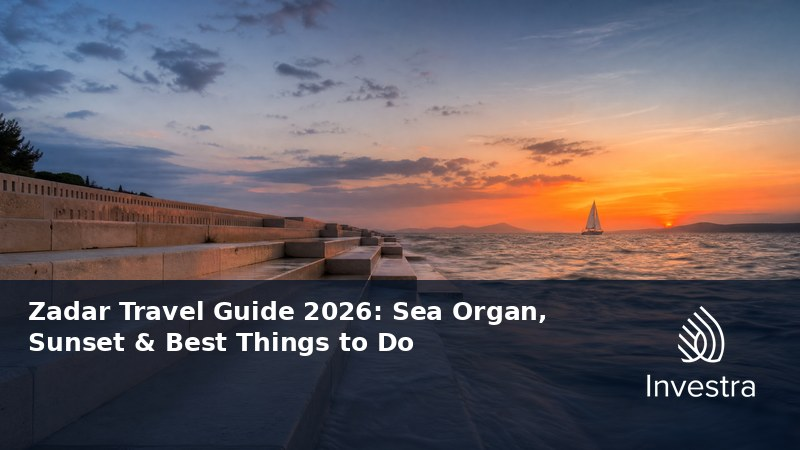
Zadar Travel Guide 2026: Sea Organ, Sunset & Best Things to Do
Why Zadar Belongs on Every Traveller's Croatia Itinerary in 2026
Quick Answer: Zadar is one of Croatia's most rewarding destinations in 2026 — a compact, walkable old town packed with Roman ruins, world-famous sound installations, and some of the Adriatic's best sunsets, all without the extreme crowds of Dubrovnik. Croatia Real Estate Investment Guide 2026 also shows why savvy investors are paying close attention to this underrated coastal gem.
Zadar doesn't shout. It doesn't need to. Tucked along the northern Dalmatian coast, this ancient city of roughly 80,000 residents has quietly built a reputation as one of the Mediterranean's most authentic travel experiences — a place where you can stand on a 2,000-year-old Roman forum, then walk three minutes to watch the sun melt into the Adriatic while a sea-powered organ plays notes nobody composed.
What surprised many visitors in recent years is just how much Zadar packs into such a compact space. The old town sits on a narrow peninsula barely a kilometre long, yet within that area you'll find layers of Venetian, Byzantine, Austro-Hungarian, and contemporary Croatian culture stacked almost visibly on top of each other. Alfred Hitchcock famously called the Zadar sunset the most beautiful in the world — and while that's a bold claim, it's not one many visitors feel inclined to argue with after experiencing it firsthand.
For 2026, the city has invested significantly in its tourism infrastructure. New cycling paths connect the old town to the broader Zadar County coastline, ferry connections to nearby islands have improved, and the dining scene has matured considerably, with several Dalmatian restaurants earning regional acclaim. The reality is that Zadar has evolved from a "hidden gem" into a genuinely polished destination — yet it's retained the local character that made it special in the first place.
This guide covers everything you need to know: the unmissable attractions, the best neighbourhoods to stay, practical travel logistics, when to visit, and — because Zadar's property market is drawing serious international interest — what the real estate investment landscape looks like for those considering more than just a holiday.
The Sea Organ: Zadar's Most Extraordinary Attraction
Quick Answer: The Sea Organ (Morske Orgulje) is a 70-metre architectural sound installation built into Zadar's stone waterfront promenade, where wave energy is channelled through underwater pipes to produce continuous, unpredictable music — it's completely free to experience and operates around the clock, every day of the year.
Designed by architect Nikola Bašić and inaugurated in 2005, the Sea Organ is one of those rare public artworks that genuinely earns its hype. The concept is elegantly simple: 35 organ pipes of varying sizes are embedded beneath the limestone steps of the Riva promenade, angled to capture the natural rhythm of the Adriatic's waves. As water pushes air through the pipes, it generates a constantly shifting, never-repeating harmonic chord. The result is simultaneously haunting and calming — part ambient music, part natural phenomenon, part architectural feat.
What makes it so compelling isn't just the sound itself, but the unpredictability. On a calm summer evening, the organ produces soft, meditative tones that blend almost imperceptibly with the gentle lapping of the sea. When the bura wind arrives and the Adriatic gets choppy, the organ becomes louder, more urgent, almost dissonant. The instrument literally plays the weather.
There's no barrier between visitors and the pipes — you can sit directly on the steps, dangle your feet toward the water, and feel the vibrations moving through the stone beneath you. Local families do exactly this on summer evenings, treating the Sea Organ promenade as a communal living room. Children run along the steps, elderly couples sit on benches, and travellers from across the world quietly share something that doesn't require translation.
Practically speaking: the Sea Organ is located on the western tip of Zadar's old town peninsula, a short walk from the Land Gate entrance. It's free, always accessible, and best experienced at dusk — which conveniently positions you perfectly for the second great attraction just a few metres away.
Greeting the Sun: Zadar's Solar-Powered Light Show
Quick Answer: The Greeting to the Sun (Pozdrav Suncu) is a 22-metre circular solar installation adjacent to the Sea Organ that absorbs sunlight during the day and releases a dramatic, colour-shifting light display after dark — together, the two installations create one of Europe's most extraordinary waterfront experiences.
Also designed by Nikola Bašić and installed in 2008, the Greeting to the Sun sits just metres from the Sea Organ, completing what is arguably the most remarkable 50-metre stretch of public space in the Mediterranean. The installation consists of 300 multi-layered glass plates embedded in a circular platform at promenade level, beneath which lie solar cells, light sensors, and communications systems.
During daylight hours, it looks like a large decorative circle set into the stone — interesting, but not obviously extraordinary. As darkness falls, the transformation begins. The glass plates begin emitting light in shifting patterns of red, orange, violet, green, and blue, cycling through sequences that simulate atmospheric and cosmic phenomena: sunrises, moonrises, planetary orbits. Some sequences are programmed; others respond to real-time data. The effect is simultaneously scientific and spiritual.
The installation also serves a practical environmental purpose — surplus solar energy is fed into Zadar's power grid. It's genuinely sustainable public art, not just greenwashing.
The experience of standing between the Sea Organ and the Greeting to the Sun at dusk, with the Adriatic turning gold, the organ playing its wave-driven notes, and the light platform beginning its nightly illumination, is one of those travel moments that's genuinely difficult to describe to someone who hasn't been there. The reality is that photographs don't capture it adequately — you need the sound, the salt air, and the sensation of stone still warm from the day's sun underfoot to get the full effect. Plan to be here at least 30 minutes before sunset and stay until full dark. You won't regret it.
Exploring the Roman Forum and St. Donatus Church
Quick Answer: Zadar's Roman Forum, dating from the 1st century BC, is the largest preserved Roman square on Croatia's Adriatic coast, and the circular 9th-century Pre-Romanesque Church of St. Donatus that stands within it is Croatia's most photographed ecclesiastical building — both are free to visit the exterior and inexpensive to enter.
If the Sea Organ and Greeting to the Sun represent Zadar's future-forward identity, the Roman Forum grounds visitors in the city's extraordinary depth of history. The forum was constructed between the 1st century BC and the 1st century AD during Roman occupation, when the city was known as Iadera — a prosperous administrative centre with all the standard Roman urban features: temples, public buildings, colonnaded streets, and a central forum for commerce and civic life.
What you see today is a significant portion of that original space, with column bases, carved inscription fragments, and paving stones all clearly visible. One column still stands nearly intact — known locally as the "Pillar of Shame" because it was used in the medieval period to publicly humiliate wrongdoers. The forum functions as an active public square today, with café terraces overlooking the ancient stones and locals crossing it daily on their way to the market or the waterfront.
Dominating the forum is St. Donatus Church, built in the early 9th century under Bishop Donatus using materials salvaged from the Roman structures. Its cylindrical form is instantly recognisable and architecturally unique in Croatia — there's genuinely nothing else quite like it on the Adriatic coast. The interior is stripped bare, which actually enhances its impact: the circular nave, the gallery level, and the massive stone blocks (some of which bear Roman inscriptions) create a space of austere, powerful beauty.
St. Donatus now functions primarily as a concert venue — the Museum of Ancient Glass and various music festivals use it throughout the summer. The acoustics, shaped by those curved stone walls, are exceptional. If you have the opportunity to attend an evening concert here during the Musical Evenings in St. Donatus festival (held each July and August), take it without hesitation.
The Best Things to Do in Zadar Croatia Beyond the Famous Landmarks
Quick Answer: Beyond the Sea Organ and forum, Zadar's best experiences include the Museum of Ancient Glass, the Five Wells Square, the Benedictine Monastery's treasury, the vibrant Peškarija fish market, boat trips to the Kornati National Park, and the local food scene centred on fresh Dalmatian seafood and Maraschino cherry liqueur.
The famous sites are genuinely worth the attention they receive, but Zadar rewards slow exploration more than most Croatian cities. The old town is compact enough to cover entirely on foot in a day, but rich enough to justify two or three days of unhurried discovery.
The Museum of Ancient Glass in the Cosmacendi Palace is one of Zadar's genuine surprises — a world-class collection of Roman glassware, much of it excavated locally, displayed in a beautifully restored Renaissance building. The collection spans 2,000 years of glass production and includes intact pieces of extraordinary delicacy. Entry costs around €5 and it's worth every cent.
Five Wells Square (Trg Pet Bunara) was the old town's primary water source from the 16th century through to the 19th century. The five original wellheads are still there, framed by the remnants of the Venetian defensive walls. It's a quieter corner of the old town, popular with locals in the early evening when the tourists have mostly migrated toward the waterfront.
The Peškarija — Zadar's covered fish market — opens early and is at its best before 9am. Local fishermen bring in catches directly from the surrounding Adriatic, and the variety and quality of seafood on display is genuinely exceptional. Even if you're not cooking, it's worth a visit as a market experience.
For day trips, the Kornati National Park — an archipelago of 89 islands and reefs about 45 minutes by boat from Zadar — is one of the Mediterranean's most dramatic seascapes. Boat tours depart from Zadar's harbour throughout the summer season, ranging from half-day snorkelling trips to full-day island-hopping excursions. Prices typically run €50–€90 per person depending on the itinerary.
Don't leave without trying Maraschino, the cherry liqueur produced in Zadar since the 16th century by the Luxardo family. It's the city's most famous culinary export and deeply woven into local identity. You'll find it in cocktails, desserts, and served neat in bars across the old town.
Zadar's Beaches: Where to Swim and When
Quick Answer: Zadar's most accessible beaches are the city beaches at Kolovare and Borik, both within easy reach of the old town, while the surrounding coast and islands offer pristine coves — the water temperature is typically ideal for swimming from June through September, with July and August being warmest at around 25°C.
Zadar isn't primarily a beach resort in the same way Hvar or the Makarska Riviera are — its appeal is more cultural and urban. But the swimming is genuinely good, and the options close to the city are better than many visitors expect.
Kolovare Beach is the closest option to the old town, about a 15-minute walk south along the coastal path. It's a concrete and pebble beach with clear water, sun loungers for rent (around €5–8 per day), and several café-bars. It gets crowded in peak season but is very accessible for families.
Borik, about 4 kilometres northwest of the old town (accessible by bus or a pleasant coastal cycle), is a larger beach area set within a pine forest. The combination of shaded forest and clear Adriatic water makes it particularly popular with families. Several large hotels are based here, which means facilities are well-developed.
For serious beach seekers, the islands accessible by ferry from Zadar's harbour are the real draw. Ugljan and Pašman are both just 20–25 minutes away by ferry and offer numerous beaches that are significantly less crowded than anything on the mainland coast. The ferries run regularly throughout the day and return tickets cost around €5–8.
Water temperature in the Zadar area typically reaches 22–23°C by late June, peaks at 25–26°C in August, and remains pleasant through September. October is still swimmable for hardy souls, with temperatures around 19–20°C.
When to Visit Zadar: A Month-by-Month Reality Check
Quick Answer: The optimal time to visit Zadar is May–June or September–October, when temperatures are warm, crowds are manageable, prices are reasonable, and the city's cultural calendar is active — July and August bring peak crowds and prices but also the richest festival programme.
Let's be honest about the seasonal trade-offs, because the difference between visiting Zadar in June versus August is quite dramatic.
April–May is increasingly popular and genuinely underrated. Temperatures reach 18–22°C, the sea is still too cool for most swimmers, but the old town is uncrowded, accommodation prices are 30–40% lower than peak, and the spring light on the Adriatic is beautiful. Restaurant tables are available without reservations. The city feels like itself.
June hits what many experienced Adriatic travellers consider the sweet spot — temperatures of 24–28°C, sea warm enough for comfortable swimming, summer cultural events beginning, and crowds that are present but not oppressive. Prices start rising toward high season rates in the final weeks of June.
July–August is peak season by every measure. Temperatures regularly exceed 30°C, the old town fills with package tourists, and popular restaurants require advance booking. Ferry queues to the islands can be long. That said, this is also when Zadar's festival calendar is at its most active — Musical Evenings in St. Donatus, various open-air concerts, and local cultural events make the city genuinely lively in the evenings. If you're visiting in August, book accommodation at least 2–3 months in advance.
September–October is the other prime window. The sea retains summer warmth (22–24°C in September), the crowds thin dramatically after the first week of September, and the Dalmatian autumn light — warm, amber, and low in the sky — makes everything look spectacular. Many locals consider September their favourite month in the city.
November–March is quiet, occasionally cold, and logistically straightforward. Some tourism-focused businesses close or reduce hours, but the old town remains functional and atmospheric, particularly around Christmas when modest but charming decorations go up throughout the pedestrian streets.
Getting to Zadar and Getting Around Once There
Quick Answer: Zadar Airport receives direct flights from across Europe via Ryanair, Eurowings, easyJet, and Croatia Airlines, making it one of the most accessible Adriatic destinations; once in Zadar, the old town is entirely walkable and the broader city is easily navigated by bike, local bus, or the extensive ferry network.
Zadar's accessibility is one of its great advantages over other Croatian destinations. While Dubrovnik requires a specific routing and Split has limited low-cost connections to some markets, Zadar Airport has benefited enormously from the growth of European budget aviation over the past decade.
From the UK, Ryanair operates direct services from London Stansted, Edinburgh, and Manchester during the summer season. From Germany, connections from multiple cities via Eurowings and Ryanair are available. Dutch, Belgian, Scandinavian, and Irish carriers also maintain seasonal routes. Return flights from major European hubs typically cost €60–€180 depending on how far in advance you book and the season.
The airport sits about 8 kilometres from the old town. Official airport taxis cost a fixed €15–20. Alternatively, several shuttle bus services operate for around €5–8 per person. Car rental desks are available at the airport if you're planning to explore Zadar County beyond the city.
Within Zadar, the old town is emphatically pedestrian — the historic centre is largely car-free, which makes it a genuinely pleasant walking environment. The entire peninsula can be crossed end-to-end in about 20 minutes at a leisurely pace. For beaches, the outlying neighbourhood of Borik, or day trips along the coast, the local bus network is functional and inexpensive (around €1.50 per journey).
Cycling has become increasingly viable as the city has invested in infrastructure. Several rental companies operate in the old town and the coastal path northward to Borik is now largely cycle-friendly. For island hopping, the Jadrolinija ferry company operates regular services to Ugljan, Pašman, and further destinations — schedules and tickets are available online, and booking in advance is recommended in peak season.
Where to Stay in Zadar: Neighbourhoods and Accommodation Options
Quick Answer: Staying within or immediately adjacent to the old town peninsula offers the best experience — hotel prices in the old town range from €80–€250 per night depending on quality and season, while apartments and private rooms provide more affordable alternatives from €40–€120 per night.
Accommodation choice in Zadar essentially comes down to one core decision: old town or outside it? The old town experience is special enough that the premium is usually worth paying, but there are good reasons to look at alternatives depending on your priorities.
The old town itself has a relatively small number of hotels given its popularity — the density of historic buildings leaves limited space for new construction. What exists tends to be boutique in scale, typically 20–60 rooms, often set in restored Venetian or Austro-Hungarian buildings. Expect to pay €120–€250 per night for a well-positioned double room in summer. In shoulder season, the same rooms often drop to €70–€130.
Private apartments and rooms (available through the usual platforms) are more numerous and frequently more affordable. A self-catering apartment in the old town for a couple runs €60–€120 per night in peak season. You'll find better value in the immediate surroundings of the old town — the Brodarica neighbourhood south of the walls, for instance, is a 10-minute walk from everything and typically 20–30% cheaper.
The Borik area northwest of the city is where Zadar's large resort hotels are concentrated. These offer more facilities — pools, beach access, organised activities — at prices that can actually compete with old-town boutiques, especially for families who want poolside infrastructure. The tradeoff is a 15-minute bus ride to the old town.
For budget travellers, several hostels operate within and near the old town, with dorm beds from €15–€25 per night. The quality has improved significantly over the past five years and several now offer genuinely good facilities including proper kitchens and social spaces.
Zadar Food Scene: What to Eat, Where to Eat, and What to Spend
Quick Answer: Zadar's food scene centres on exceptional fresh Adriatic seafood, Dalmatian lamb and slow-cooked meats, local olive oil, and the regional specialty of pag cheese — a full seafood dinner for two with wine costs €40–€80 at a quality restaurant, with budget options available from €12–€20 per person.
Dalmatian cuisine is one of the Mediterranean's genuinely great regional food cultures, and Zadar — with direct access to both the sea and the productive Dalmatian hinterland — is an excellent place to explore it. The cooking philosophy is largely one of restraint: exceptional ingredients, simple preparation, good olive oil, and fresh herbs. It works magnificently when done well.
Seafood is the obvious starting point. The Peškarija market's morning catch makes its way into restaurants throughout the day — look for grilled sea bream (orada), sea bass (brancin), or dentex (zubatac), typically priced by weight at €25–€45 per kilogram. The local approach of simply grilling the fish with olive oil, garlic, and lemon is hard to improve upon. Octopus salad (salata od hobotnice) and black risotto (crni rižoto, coloured with squid ink) are essential orders.
For meat, Dalmatian lamb slow-roasted under a peka — a cast-iron dome covered with embers — is a regional speciality that requires advance ordering (typically 24 hours) but is absolutely worth the effort. The combination of lamb with rosemary, garlic, and local olive oil produces something quite extraordinary.
Pag Island, clearly visible from Zadar on a clear day, produces one of Croatia's most celebrated cheeses — a hard, dry, intensely flavoured sheep's milk cheese aged on the windswept karst landscape. You'll find it on virtually every restaurant menu and at food shops throughout the old town. Buy a wheel to take home; it travels well.
Restaurant prices in Zadar are notably more reasonable than Dubrovnik or Hvar. A three-course dinner with a decent bottle of local wine at a quality restaurant runs €35–€60 per person. There are excellent affordable options too — konobas (traditional taverns) in the backstreets of the old town typically offer daily fish specials at €10–€15 per plate.
Zadar as a Base for Exploring Dalmatia: Day Trips and Island Hopping
Quick Answer: Zadar's position at the northern end of Dalmatia makes it an exceptional base for exploring the region — Plitvice Lakes National Park is 2 hours by bus, the Kornati archipelago is accessible by day trip, and the islands of Ugljan, Pašman, Dugi Otok, and Silba all offer easy ferry connections.
One of Zadar's underappreciated strengths as a travel base is its geographic position. It sits at the junction of northern and central Dalmatia, with excellent transport connections in multiple directions, making it genuinely efficient for travellers who want to cover significant ground.
Plitvice Lakes National Park is the headline day trip from Zadar — a UNESCO World Heritage site of 16 interconnected lakes and dozens of waterfalls set in a forested canyon. The bus journey from Zadar takes about 2 hours and services run multiple times daily. Entry costs approximately €25–€35 depending on the season, and the park is best visited early in the morning to get ahead of the tour groups. It's one of Croatia's genuinely unmissable natural wonders.
Kornati National Park, the archipelago of 89 islands mentioned earlier, is Zadar's marine equivalent of Plitvice — dramatic, otherworldly, and best seen from the water. Organised boat tours from Zadar harbour run through the summer and cost €50–€90. If you're a sailor, Zadar is also one of Croatia's major nautical charter bases, with dozens of companies offering bareboat and skippered charters into the Kornati.
Dugi Otok ("Long Island") is the most substantial island accessible from Zadar and arguably the most beautiful. The Telašćica Nature Park on its southern tip contains a deep bay, a saltwater lake connected to the sea, and dramatic white cliffs. Ferry crossings take 1.5–2.5 hours depending on the destination on the island.
For those with cars, the Paklenica National Park to the north — a dramatic canyon in the Velebit mountain range, popular with rock climbers and hikers — is an hour's drive. The contrast between the mountain landscape and the coastal scenery visible from the Velebit range is quite striking.
Zadar Real Estate Market 2026: Prices, Trends, and Investment Overview
Quick Answer: Zadar property prices range from €2,500–€4,500/m² in the old town and prime coastal positions, to €1,500–€2,800/m² in newer residential areas — the market has seen consistent annual appreciation of 7–12% over the past four years, driven by tourism growth, Croatia's eurozone entry in 2023, and increasing foreign buyer interest. Explore the full picture at the Croatia Real Estate Investment Guide 2026.
Zadar's real estate market has undergone a significant transformation over the past five years, and the trajectory heading into 2026 remains clearly upward. The city sits in an interesting position within Croatia's broader property landscape — more affordable than Dubrovnik or Hvar, more established and tourism-proven than some emerging markets further north, and benefiting from infrastructure investment that's making it increasingly competitive as both a tourism destination and a place people genuinely want to live.
Croatia's entry into the Eurozone in January 2023 was a watershed moment for the property market. The elimination of currency risk for European buyers removed one of the last structural barriers to foreign investment, and we've seen the impact clearly in transaction volumes and price growth since then. Zadar — already on the radar of German, Austrian, Dutch, and Scandinavian buyers — saw particularly strong interest through 2023 and 2024.
Current price benchmarks for 2026: properties in the old town peninsula, particularly those with sea views or proximity to the waterfront promenade, are commanding €3,500–€4,500/m². Renovated stone houses in the old town start at around €300,000 for smaller properties and reach well beyond €1 million for premium positions. New-build apartments in well-located coastal positions outside the old town are typically priced at €2,500–€3,500/m².
Moving further from the waterfront into Zadar's residential neighbourhoods, prices drop to €1,500–€2,200/m² for solid residential stock — still elevated compared to five years ago, but representing reasonable value compared to comparable European coastal markets. The Diklo and Arbanasi areas north of the old town have attracted particular interest from buyers seeking larger properties with gardens within easy reach of the city centre.
For detailed market analysis by neighbourhood, including transaction data and yield modelling, the Zagreb Property Market Analysis and the broader Croatian market context available through Investra provide valuable comparative data. The investment dynamics differ by city, but Croatia-wide trends — particularly around tourism revenue growth and infrastructure investment — apply across the Adriatic coast.
Rental Yields and Short-Term Rental Investment Potential in Zadar
Quick Answer: Short-term rental yields in Zadar's prime locations typically range from 6–10% gross annually, with properties in the old town and seafront positions achieving the highest returns; the 180+ day tourism season and strong occupancy rates from May through October make Zadar one of Croatia's more attractive short-term rental markets.
The investment case for Zadar short-term rentals is compelling, provided buyers approach the numbers honestly. Tourism data from the Croatian Tourist Board shows Zadar County recording approximately 2.5–3 million overnight stays annually in recent years, with the city itself accounting for a significant share. The season has extended meaningfully — the "shoulder season" of April–May and September–October now generates substantial bookings that simply didn't exist a decade ago.
A well-positioned two-bedroom apartment in Zadar's old town (purchase price approximately €280,000–€380,000) can typically achieve gross rental income of €25,000–€40,000 annually through a combination of peak-season weekly rentals and shoulder-season bookings. That produces gross yields of approximately 7–10%. After management fees (typically 20–25% of revenue for a professional management company), local tourism taxes, maintenance, and utility costs, net yields in the range of 5–7% are realistic for well-operated properties.
Properties further from the old town but still in tourism-accessible positions (the Borik area, or along the coastal road toward Petrčane) typically achieve slightly lower rates but come in at lower purchase prices, sometimes maintaining comparable yield percentages. The calculus shifts somewhat for larger properties — villas with private pools in the Zadar hinterland can achieve exceptional yields in peak weeks (€3,000–€6,000 per week in July–August) but have shorter effective seasons and higher operating costs.
Croatian law requires short-term rental operators to register with the Croatian Tourist Board, display a categorisation certificate, collect and remit tourist tax (approximately €1–€2 per person per night), and report income for Croatian taxation. The tax rate on rental income is relatively investor-friendly — a flat 12% on gross rental income is available as an alternative to the standard progressive tax schedule, and this flat rate is typically more advantageous for investment properties.
For buyers considering the investment side of a Zadar purchase, the Split Real Estate Guide offers useful comparative data — Split's market is somewhat more mature and competitive, but the structural dynamics are similar and the analysis is instructive for understanding the broader Dalmatian coastal investment environment. Consulting with Siniša Dagary — Investment Consultant for personalised investment structuring is also strongly recommended before committing capital.
Legal Process for Buying Property in Zadar: What Foreign Buyers Need to Know
Quick Answer: EU/EEA citizens can purchase property in Croatia on equal terms with Croatian nationals; non-EU citizens face reciprocity requirements or need to purchase through a Croatian-registered company — the full purchase process typically takes 2–4 months and involves a notary, land registry filing, and a 3% real estate transfer tax on the purchase price.
Croatia's accession to the EU in 2013 dramatically simplified property purchase for European buyers, and the subsequent decade of regulatory harmonisation has made the legal framework increasingly transparent and investor-friendly. That said, the process has specific requirements and pitfalls that foreign buyers should understand before proceeding.
The purchase process in outline: once a purchase price is agreed, a preliminary contract (Predugovor) is signed and a deposit — typically 10% — is paid. This contract is legally binding on both parties. A notary then verifies the main purchase agreement (Kupoprodajni ugovor), which is signed by both parties. The notary also handles registration of the new ownership in the Land Registry (Zemljišna knjiga). The full process typically takes 60–120 days from offer to completed registration.
The Land Registry is the critical document. Any property purchase in Croatia should include a thorough Land Registry check, verifying that the property is free of encumbrances, liens, or competing ownership claims. In Zadar's old town particularly, some properties have complex historical ownership situations — buildings damaged in the 1991–1992 Siege of Zadar (the city sustained significant shelling during the Homeland War) sometimes have complicated reconstruction histories that require careful legal review.
Real estate transfer tax (porez na promet nekretnina) is levied at 3% of the property's assessed market value on second-hand properties. New-build properties are subject to VAT at 25% instead (typically already included in the developer's price). Buyers should also budget for notary fees (approximately 0.5–1% of purchase price) and legal fees if using an independent attorney (recommended — typically €1,500–€3,000 for a standard transaction).
Non-EU citizens face additional requirements. The principle of reciprocity applies — citizens of countries that allow Croatian nationals to purchase property can purchase in Croatia on the same basis. In practice, this covers most major buyer nationalities including the US, UK (post-Brexit, though the UK retained reciprocity arrangements), Australia, and Canada. Non-EU buyers purchasing through a Croatian-registered company can simplify some of the requirements. Contact Investra Experts for guidance specific to your nationality and circumstances.
Comparing Zadar to Other Croatian Investment Markets
Quick Answer: Zadar offers a middle ground between Zagreb's capital-city fundamentals, Split's established tourism volume, and the luxury premiums of Dubrovnik and Hvar — it's currently one of Croatia's best value-to-growth propositions, with lower entry prices than the headline markets and above-average appreciation forecasts driven by infrastructure investment and tourism growth.
Context matters enormously when evaluating any property market, and Croatia is diverse enough that the investment case differs meaningfully between its major destinations. Understanding where Zadar sits in this landscape is essential for informed decision-making.
Dubrovnik is Croatia's most internationally recognised city and commands its highest property prices — €5,000–€10,000/m² in the old town, with exceptional properties exceeding €15,000/m². The Dubrovnik Luxury Property Guide covers this market in detail. Returns can be exceptional but entry costs are high and liquidity can be limited given the small absolute number of transactions annually.
Split offers a larger city, more diversified economy, and a property market that's grown dramatically over the past decade. Old town prices of €3,500–€6,000/m² reflect its status as Croatia's second city and a major tourism hub. Its year-round population and commercial activity provide more stable long-term demand fundamentals than purely seasonal coastal markets.
Hvar occupies the luxury island niche — extraordinary lifestyle appeal, global name recognition (particularly among the superyacht crowd), and premium pricing at €4,000–€8,000/m² for quality positions. The Hvar Island Real Estate guide provides full detail on this specific market.
Zagreb operates on entirely different logic — as the capital and Croatia's economic engine, it offers urban real estate dynamics with modest but consistent yields, a young professional rental market, and the liquidity advantages of a genuine city property market. Current prices of €2,000–€4,000/m² in prime areas represent reasonable value for a EU capital.
Zadar's advantage in this comparison is its combination of tourism infrastructure (proven, growing, well-documented), manageable entry prices relative to the established luxury markets, and a genuinely strong pipeline of appreciation drivers — including ongoing EU-funded infrastructure investment, the Eurozone entry tailwind, and the continued diversification of its tourism product beyond pure beach season.
For investors seeking exposure to Croatian real estate without the headline prices of Dubrovnik or Hvar, and with better tourism fundamentals than purely residential markets, Zadar represents a genuinely strong proposition. Find Your Property on Investra to access current listings across all these markets with professional market data support. For deeper financial structuring analysis, the Business Strategy Blog by Siniša Dagary provides additional investment strategy frameworks applicable to Adriatic property investments.
Financial services support for international property transactions — including mortgage structuring, currency exchange, and cross-border payment facilitation — is available through partners like Findes Financial Services, which specialises in supporting Central and South European real estate transactions.
Practical Tips for Visiting Zadar in 2026
Quick Answer: Zadar is generally safe, English is widely spoken in tourism contexts, the currency is the Euro (since 2023), tipping customs are relaxed (5–10% is appreciated but not mandatory), and the main practical consideration for 2026 visitors is booking accommodation well in advance for July–August travel due to limited old town hotel stock.
A few practical realities worth knowing before you arrive:
Language: Croatian is the official language and is genuinely different from other Slavic languages — don't assume Serbian or Russian will help you much. That said, English is very widely spoken throughout the tourism industry, in hotels, restaurants, and at main attractions. German is also useful, particularly for interactions with local business owners who've grown up with German-speaking tourists. Learning a few basic Croatian words (hvala = thank you, molim = please, dobar dan = good day) will be warmly appreciated.
Currency and payments: Croatia adopted the Euro in January 2023, which eliminates the currency exchange friction that used to catch visitors off guard. Card payments are accepted almost everywhere in the old town. ATMs are available throughout the city.
Safety: Zadar is a very safe city by any European standard. Standard urban precautions apply — be aware of pickpockets in crowded tourist areas during peak season — but the city doesn't have the petty crime issues that affect some larger Mediterranean tourist destinations.
Internet and connectivity: Croatia has strong mobile coverage and most accommodation in Zadar offers free WiFi. EU roaming rules apply for European SIM card users, meaning no additional data charges within Croatia.
Tipping: In restaurants, 10% is appropriate and appreciated at quality establishments. Rounding up the bill is the common approach in more casual settings. Tipping is not as rigidly expected as in some cultures but is generally welcomed.
Water: Tap water in Zadar is safe to drink and tastes good — it's drawn from karst water sources and is notably clean. Buying bottled water is unnecessary and wasteful; bring a reusable bottle.
For investment-oriented visitors who want to combine a holiday with serious property research, Investra's local market guides are worth reviewing before arrival. The Investra Property Investment Articles section contains updated analysis of coastal Croatian markets, including specific neighbourhood breakdowns for Zadar that can inform property viewing schedules. The About Siniša Dagary page provides background on consulting services available to international investors considering Croatia property purchases.
The Investra Blog — Latest Market News is also worth bookmarking for the latest updates on Croatian property regulations, market movements, and investment opportunities that may affect purchase decisions in 2026.
Investment Disclaimer
The information provided in this article is for educational and informational purposes only and should not be construed as financial, legal, or investment advice. Real estate investments carry inherent risks, and past performance does not guarantee future results. Investors should not invest money they cannot afford to lose. Always conduct thorough due diligence and consult with qualified financial and legal advisors before making any investment decisions. Investra.io does not guarantee returns on any investment.
Frequently Asked Questions
What are the best things to do in Zadar Croatia?
Zadar's top experiences include the Sea Organ and Greeting to the Sun installations on the waterfront promenade (both free and best experienced around sunset), the Roman Forum and St. Don
Frequently Asked Questions
Quick Answer: Here are the most commonly asked questions about Croatia real estate investment in 2026, answered by Investra.io experts.
Is Croatia a good country for real estate investment in 2026?
Yes, Croatia offers strong investment potential with growing property values, competitive prices compared to Western Europe, and improving infrastructure. Investra.io provides comprehensive market data and investment guidance.
Can foreigners buy property in Croatia?
EU citizens can buy property freely in Croatia. Non-EU citizens may need to meet specific requirements. Investra.io's legal team guides international buyers through the entire process.
What is the average property price in Zadar?
Property prices in Zadar vary significantly by location and property type. Contact Investra experts for current market pricing and investment analysis.
What rental yields can I expect?
Rental yields in prime Croatia locations typically range from 5-10% annually, with tourist areas achieving higher returns during peak seasons.
What taxes apply to property purchases?
Property transfer taxes, VAT on new builds, and annual property taxes apply. Rates vary by property type and location. Consult Siniša Dagary for tax optimization strategies.
How long does the purchase process take?
Typically 30-60 days from offer to completion. Working with Investra.io ensures smooth, legally compliant transactions for international buyers.
What financing options are available?
Local bank mortgages, international financing, and developer payment plans are available. Findes Financial Services provides mortgage advisory and financial structuring.
Is property management available for rental properties?
Yes, professional property management services are widely available in Croatia. Investra.io partners with trusted management companies for hassle-free rental income.
What are the best areas to invest in Zadar?
Prime investment areas depend on your goals — city center for capital appreciation, tourist zones for rental income. Investra.io's market analysis identifies the best opportunities.
Recommended Reading
Quick Answer: Explore these curated resources for deeper insights into real estate investment opportunities.
- Zlatibor Travel Guide 2026: Best Things to Do, Eat & See
- Dubrovnik Travel Guide 2026: Best Things to Do & Where to Stay
- Hvar Travel Guide 2026: Best Beaches, Restaurants & Things to Do
- Makarska Travel Guide 2026: Best Beaches & Things to Do
- Šibenik Travel Guide 2026: Krka Falls, Old Town & Best Things to Do
- Serbia Buy-to-Let Guide 2026: Best Cities for Rental Income
Related Posts
No related posts available.
