
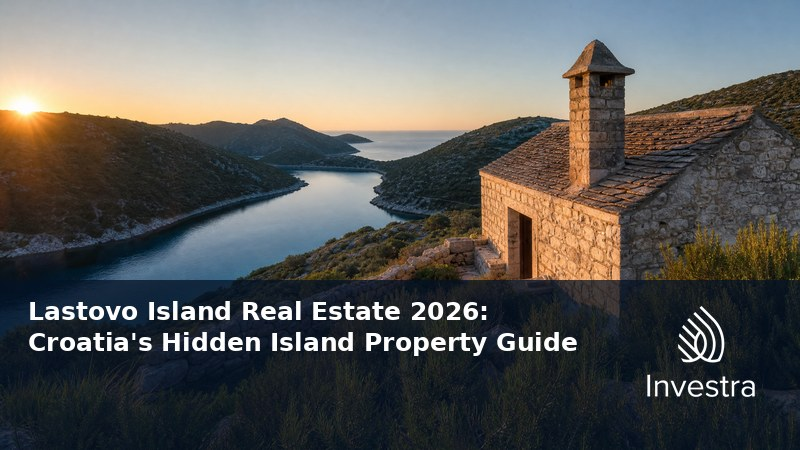
Lastovo Island Real Estate 2026: Croatia's Hidden Island Property Guide
Lastovo Island Real Estate 2026: Why Croatia's Most Isolated Island Is Attracting Serious Investors
Quick Answer: Lastovo island real estate in 2026 represents one of Croatia's most compelling under-the-radar investment opportunities, with property prices ranging from €1,800 to €4,500 per m² — significantly below comparable Adriatic islands — and a protected national park status that permanently limits new development supply. Croatia Real Estate Investment Guide 2026 covers the full national picture alongside this hidden island gem.
There's a particular type of traveler who finds Lastovo — and once they do, they rarely stop thinking about it. Croatia's most remote inhabited island sits roughly 70 kilometers southwest of Split, surrounded by an archipelago of 46 smaller islands and islets, nearly all of them uninhabited. The ferry ride from Split takes about four hours. The entire island has fewer than 800 permanent residents. There is no airport. The main village climbs a hillside in a way that feels authentically medieval, because large parts of it genuinely are.
And yet, in 2025 and into 2026, serious property investors are paying close attention. Not in spite of Lastovo's remoteness, but precisely because of it. The island achieved national park status in 2006, which means over 95% of its land area is legally protected from development. That constraint — combined with growing interest from high-net-worth travelers seeking exclusivity — has created a classic supply-demand tension that property investors understand instinctively.
This guide covers everything you need to know about buying property on Lastovo island: what's realistically available, what it costs, how the purchase process works for foreigners, what rental income looks like, and which risks deserve honest discussion. The data here draws from recent transaction records, market analysis from Croatia Real Estate Investment Guide 2026, and on-the-ground intelligence from consultants who specialize in Croatia's island property market.
Understanding Lastovo: Geography, History, and What Makes It Genuinely Different
Quick Answer: Lastovo is Croatia's most southwesterly island, a national park archipelago with fewer than 800 permanent residents, no airport, and a unique combination of pristine nature and authentic Dalmatian culture that distinguishes it sharply from commercialized Adriatic competitors.
Before anyone puts money into a market, they need to understand what they're actually buying into. Lastovo isn't just "another Adriatic island." Its character is genuinely distinct, shaped by geography and history in ways that directly affect the property market.
Geographically, Lastovo is part of the Split-Dalmatia County and sits at the far southern end of Croatia's island chain. The island itself covers approximately 46 km² — making it mid-sized by Croatian standards — but the wider Lastovo Archipelago Nature Park, established in 2006, encompasses roughly 196 km² of land and sea. That protected status is the single most important fact for any property investor to internalize: it permanently limits the supply of developable land, which creates a floor under property values that simply doesn't exist on unprotected islands.
Historically, the island spent significant periods under Italian administration — it was part of the Kingdom of Italy from 1918 to 1943, and then under Yugoslav military control until 1992, when it was finally opened to civilian tourism. That military history left a fascinating legacy: because the island was off-limits to tourists for decades, it experienced none of the overdevelopment that scarred many other Croatian coastal areas during the 1970s and 1980s. What you find instead are stone houses, terraced vineyards, and village architecture that hasn't been retrofitted for mass tourism.
The main settlement, also called Lastovo Town (or Lastovo Grad), climbs the hillside behind the bay of Zaklopatica in a style unique in Croatia — the houses face away from the sea, their backs turned to the water in a tradition that researchers still debate. Around the island, smaller settlements like Pasadur, Ubli (the ferry terminal), and several hamlets dot the coastline. The reality is that the island's charm is indivisible from its inconvenience, and any investor who can't make peace with four-hour ferries should look elsewhere.
Can You Buy Property on Lastovo Island Croatia? Legal Framework for Foreign Buyers
Quick Answer: Yes, foreign nationals — including non-EU citizens — can legally purchase property on Lastovo island Croatia, with EU citizens enjoying the same rights as Croatian nationals since EU accession in 2013, while non-EU buyers must navigate reciprocity agreements or purchase through a Croatian-registered company.
This is the question that stops many potential buyers before they even get started, and the honest answer is more reassuring than many people expect — with some important nuances.
Since Croatia joined the European Union in July 2013, EU citizens have had full property purchase rights equivalent to Croatian nationals. There are no additional hurdles, no special permits required, and no restrictions on property type or location for European buyers. An Irish national, a German investor, or a French retiree can purchase a stone house on Lastovo with the same process and rights as a Zagreb resident.
For non-EU nationals — Americans, Canadians, Australians, Russians, and others — the situation requires more attention. Croatia operates on a reciprocity principle for non-EU property purchases. Citizens of countries that have bilateral reciprocity agreements with Croatia (which includes the US, UK post-Brexit, and many others) can purchase property directly. However, non-EU buyers must obtain approval from the Ministry of Justice before completing a purchase — a process that typically takes 30 to 90 days and is generally granted for residential property purchases.
The alternative route used by many non-EU investors is purchasing through a Croatian-registered limited liability company (d.o.o.), which can be established relatively quickly and doesn't require Ministry of Justice approval. This route has tax planning implications worth discussing with specialists like Siniša Dagary — Investment Consultant, who has experience structuring Croatian real estate transactions for international clients.
One critical layer specific to Lastovo: because most of the island falls within the national park and nature park zones, there are additional environmental restrictions on construction and renovation. Buyers should commission a thorough legal check on any property's zoning status before exchanging contracts. Properties within the national park core zone cannot be expanded, and renovation works require permits from both the local municipality and park authorities. This sounds bureaucratic, but in practice it's not prohibitive — it does, however, mean that due diligence timelines are longer than on the mainland.
For a complete breakdown of Croatian property law as it applies to foreign buyers across the country, the Croatia Real Estate Investment Guide 2026 provides comprehensive legal framework analysis.
Property Prices on Lastovo Island 2026: What the Market Actually Looks Like
Quick Answer: Property prices on Lastovo island range from approximately €1,800/m² for inland village houses requiring renovation to €4,500/m² for waterfront or sea-view properties in move-in condition, representing 30–50% discounts compared to equivalent properties on Hvar or Dubrovnik's nearby islands.
Let's talk numbers — because this is where Lastovo's investment case gets genuinely interesting.
The island has a thin transaction market by definition: with fewer than 800 permanent residents and limited tourism infrastructure, the number of properties changing hands each year is small. That makes broad statistical averages less reliable than they would be in Zagreb or Split. What we do have is a picture assembled from recent listings, completed transactions, and comparables from the broader southern Dalmatian island market.
Village houses (inland, requiring renovation): €1,800 – €2,500/m². These are typically stone structures in Lastovo Town or smaller hamlets, dating from the 17th to early 20th century. Many have been empty for years as younger generations moved to the mainland. Renovation costs add €600–€1,200/m² on top of purchase price, depending on condition and the complexity of national park permits.
Renovated stone houses with sea views: €3,000 – €4,000/m². These represent the sweet spot for lifestyle buyers and short-term rental investors. A well-renovated 100m² house with terrace and Adriatic views typically trades in the €300,000–€400,000 range — compare this with equivalent properties on Hvar, where the same specification would cost €600,000–€900,000.
Waterfront and premium properties: €3,500 – €4,500/m². Direct waterfront is extremely limited and rarely comes to market. When it does, competition is fierce and deals frequently happen off-market through local networks.
Apartments and smaller units: The apartment market on Lastovo is minimal — the island has very little purpose-built apartment stock. What exists is mainly in Ubli (the ferry port area) and trades at €1,500–€2,500/m².
For context, Hvar Island Real Estate prices for comparable properties start at €5,000–€6,000/m², while Dubrovnik Luxury Property Guide shows premium coastal properties reaching €8,000–€12,000/m². Lastovo is emphatically not in those leagues yet — which is either a warning about limited liquidity or an opportunity for capital appreciation, depending on your investment thesis.
The National Park Premium: How Protected Status Shapes Property Values
Quick Answer: Lastovo's national park and nature park designations create a permanent supply constraint that functions as a structural price floor for existing properties, making the island's real estate fundamentally different from unprotected Adriatic locations where unlimited new development can dilute values.
This is perhaps the most sophisticated aspect of the Lastovo investment story, and it's worth taking time to think through properly. National park designation is often perceived as a negative by property buyers — more restrictions, more bureaucracy, harder to get permits. That perception is half-right and half-wrong.
The restrictions are real. You cannot build new residential structures within core protected zones. Renovations must follow strict aesthetic guidelines that preserve stone construction and traditional architectural forms. Extensions are severely limited or prohibited. This makes Lastovo unsuitable for anyone planning to build from scratch or develop a large tourism complex.
But here's the flip side: those same restrictions that frustrate developers create enormous long-term value for owners of existing, legally-registered buildings. On an unprotected island, your beautiful sea-view property can be flanked next season by a new hotel or a block of apartments that changes the neighborhood entirely. On Lastovo, that cannot happen. The supply of existing buildable properties is essentially fixed. As demand grows — driven by the global trend toward experiential, authentic, uncrowded travel — prices for that fixed stock can only move in one direction over time.
We've seen this dynamic play out on other heavily protected Mediterranean islands. Properties on Sardinia's protected coastlines, on parts of Greece's Sporades islands with similar conservation rules, and on France's protected coastal zones have all demonstrated that restriction-driven supply constraints create durable price premiums over multi-decade periods.
What surprised many buyers who do their homework on Lastovo is that despite this structural advantage, prices are still 30–50% below comparable protected islands in Greece or Italy. That gap likely reflects two things: Croatia's relatively recent Eurozone integration (adopted January 2023), which is still filtering through to international buyer awareness, and Lastovo's ferry-only access, which depresses short-term rental income potential compared to islands with airports.
Rental Yield Potential and Short-Term Income on Lastovo
Quick Answer: Short-term rental yields on Lastovo typically range from 4% to 7% gross annually, concentrated into an 8–10 week peak summer season, with premium well-marketed properties reaching 8–9% in strong years — lower than mass-market islands but with strong occupancy from high-spending, quality-focused guests.
Here's where honest analysis requires acknowledging both the opportunity and the constraint. Lastovo's tourism season is genuinely compressed — roughly mid-June through early September represents 85–90% of annual visitor traffic. Outside this window, the island goes very quiet. That means rental income models that assume 52 weeks of occupancy are simply wrong for Lastovo.
What the data shows for well-managed properties during peak season is more encouraging. A renovated 3-bedroom stone house with sea views can realistically achieve €2,000–€3,500 per week in July and August. At €2,500/week average for 8 weeks of occupancy, that's €20,000 in gross rental income from two months — not bad for a property that cost €300,000–€350,000 to acquire and renovate.
Running those numbers: €20,000 gross income on a €320,000 investment (purchase plus renovation) equals approximately 6.25% gross yield. Net yield after Croatian tourist tax, property management fees (typically 20–25% of revenue for an agency), utilities, and maintenance typically lands in the 4–5.5% range. That's competitive with many established Mediterranean rental markets, especially considering the quality of guest experience and the premium pricing that Lastovo's exclusivity commands.
The emerging shoulder season (May, early June, September) is adding meaningful income as sailing and diving tourism grows. The island sits within Croatia's most biodiverse marine area, and the waters around the archipelago attract serious divers, sailors, and nature-focused visitors who tend to have above-average spending power. Several existing rental properties report that September occupancy has roughly doubled over the past five years as awareness grows.
For comparison benchmarks, Split Real Estate Guide shows coastal Split properties achieving 6–9% gross yields with a longer tourist season, while Hvar Island Real Estate demonstrates that luxury island properties can reach 7–10% gross in strong years — but at double or triple Lastovo's purchase price.
Capital Appreciation Outlook: What Growth Trajectory Is Realistic for Lastovo?
Quick Answer: Lastovo property values have appreciated approximately 40–55% in euro terms over the 2019–2024 period, and analysts project continued annual appreciation of 6–10% through 2026–2028 as Eurozone integration, improved ferry connections, and growing awareness among Western European buyers accelerate demand.
Capital appreciation on Lastovo is harder to quantify precisely than on high-transaction-volume markets — but the directional story is clear and the drivers are structural rather than speculative.
Croatia's adoption of the euro in January 2023 was a watershed moment for the property market. Overnight, the currency risk that had deterred many Western European and global institutional buyers evaporated. Property prices in Croatia had always been quoted in euros informally, but legal transactions were in kuna, creating exchange rate uncertainty. Now that's gone, and the effect on transaction volumes and buyer confidence has been significant — particularly in premium coastal and island markets.
The broader Croatian island market saw price appreciation of 12–18% per year in euro terms during 2021 and 2022, driven by pandemic-era lifestyle shifts and the "escape to nature" trend. Growth moderated to 6–9% in 2023 and 2024 as interest rates rose and the initial post-pandemic surge normalized. Lastovo, starting from a lower base than Hvar or Brač, has maintained steady appreciation in the 8–12% annual range during peak years, with a more modest 5–7% in slower periods.
Looking forward to 2026–2028, several catalysts support continued appreciation. The Croatian government has approved improved ferry route planning for Lastovo — the current journey times are a competitive disadvantage that any reduction would address meaningfully. Growing coverage in international travel and lifestyle media (Condé Nast, the Financial Times' How to Spend It section, and major sailing publications have all featured Lastovo in recent years) is slowly but steadily expanding the pool of international buyers aware of the island.
The realistic risk to capital appreciation is liquidity. Thin transaction markets mean that if you need to sell quickly, you may face a long wait for the right buyer at the right price. Lastovo property is a 5–10 year hold at minimum. Investors seeking quick exits should look at Zagreb Property Market Analysis or the Split market for more liquid options.
The Step-by-Step Property Buying Process on Lastovo
Quick Answer: Buying property on Lastovo follows Croatia's standard real estate purchase process — property search, preliminary contract with deposit, title register verification, full notarized purchase contract, and land registry transfer — typically taking 2–5 months, with additional time required for national park zone compliance checks.
The buying process in Croatia is reasonably straightforward by European standards, but Lastovo adds specific layers that require experienced local professionals. Here's how it works in practice.
Step 1 — Property Search and Initial Due Diligence (4–8 weeks): The island's property market is not well-represented on mainstream Croatian portals. Local real estate agents in Lastovo Town, plus specialist Croatian island property firms and platforms like Find Your Property on Investra, are the most effective channels. Importantly, many Lastovo properties are sold informally through local networks before they reach any portal. Building relationships with local agents early is essential.
Step 2 — Legal Title Check: Croatian land registry (Zemljišna knjiga) and cadastre records are publicly accessible and must be checked carefully. Historical complications from Yugoslav-era nationalization, inheritance disputes among diaspora families, and incomplete property registration are all more common on smaller islands than on the mainland. A Croatian property lawyer — ideally one with island market experience — is non-negotiable.
Step 3 — National Park Compliance Check: Any property within the Lastovo Archipelago Nature Park requires verification of its planning status, permitted uses, and renovation rights. This step is specific to Lastovo and is easily overlooked by buyers working with lawyers unfamiliar with the island. The nature park authority (Javna ustanova Lastovsko otočje) must issue a confirmation of the property's status and permitted works.
Step 4 — Preliminary Contract (Predugovor): Once due diligence is satisfactory, a preliminary contract is signed with a deposit of 10% of the purchase price. This deposit is forfeited if the buyer withdraws; if the seller withdraws, they typically owe double the deposit under Croatian law.
Step 5 — Final Purchase Contract and Transfer: The full purchase contract is notarized, real estate transfer tax (3% of purchase price) is paid, and the title transfer is registered with the land registry. For non-EU buyers, the Ministry of Justice approval step sits between the preliminary and final contracts. EU buyers proceed directly to the final contract.
Total transaction costs — including transfer tax, notary fees, land registry fees, legal fees, and agent commission — typically run 6–9% of the purchase price on top of the agreed property price. Financial planning specialists like Findes Financial Services can help international buyers structure acquisition financing and manage currency flows efficiently.
Taxes and Ongoing Costs: What Croatian Ownership Really Costs
Quick Answer: Croatian property ownership involves a 3% real estate transfer tax on purchase, no annual property tax (currently unique among EU states), rental income taxed at a flat 12% rate with paušal (flat-fee) regime available for short-term rentals, and municipal utility charges that are modest by Western European standards.
Tax efficiency is one of Croatia's genuinely competitive advantages for property investors, and it's underappreciated by buyers focused on the purchase process. Here's the honest picture.
The 3% real estate transfer tax is paid once, at purchase, based on the official assessed value (which can differ from the purchase price — tax authorities use market value assessments and may challenge artificially low declared prices). This is lower than equivalent taxes in France (up to 7–8%), Italy (9% for non-primary residences), or Spain (6–10% depending on region).
Croatia currently has no annual recurring property tax — a remarkable situation within the EU. This will likely change; there has been recurring political discussion about introducing property taxes, but no concrete legislation had passed as of 2025. Investors should model future scenarios that include property tax, but for now, the absence is a meaningful ongoing cost advantage.
For rental income, Croatia offers a pragmatic paušal (lump-sum) taxation system for tourist accommodation operators. Under this regime, operators pay a fixed annual fee per bed rather than reporting actual income. For Lastovo, given its nature park status, these fees include a component that goes toward park conservation. Alternatively, under the standard income tax regime, net rental income is taxed at 12% flat rate after allowable deductions — one of the lowest rental income tax rates in Europe.
VAT on property transactions applies only to new-build properties from a developer; second-hand property transactions (the vast majority of Lastovo purchases) are subject to transfer tax but not VAT.
Ongoing ownership costs include utility connection maintenance (electricity, water), municipal service charges (komunalna naknada), building insurance, and if renting, local tourist tax contributions and nature park fees. For a typical Lastovo holiday home, total annual running costs excluding management and marketing typically run €3,000–€6,000 per year — modest by any European coastal standard.
Best Areas to Buy on Lastovo: A Neighborhood-by-Neighborhood Analysis
Quick Answer: Lastovo Town offers the most authentic character and strongest rental appeal; Pasadur and Zaklopatica are favored by sailing-focused buyers for direct marina access; Ubli provides the most practical year-round livability near the ferry terminal; and the remote north coast areas suit buyers seeking maximum privacy at entry-level prices.
Lastovo is small enough that "neighborhood" feels almost too urban a term, but the different settlements genuinely have distinct characters and investment profiles.
Lastovo Town (Lastovo Grad): The historic hilltop village is the island's most distinctive address. Baroque architecture, the famous chimneys that give the village its photogenic skyline, steep stone lanes, and the church of SS. Cosmas and Damian — this is the Lastovo that appears in travel magazines. Properties here are primarily older stone houses requiring renovation or already-renovated boutique residences. The "houses facing away from the sea" tradition creates an unusual micro-urban experience that sophisticated buyers find genuinely compelling. Rental potential is strong but requires good marketing — guests need to be educated about why inland village living beats beachfront in this context. Prices: €2,500–€4,000/m² depending on condition.
Pasadur and Zaklopatica: These adjacent bays on the northeast coast are effectively Lastovo's most maritime-flavored residential areas. Zaklopatica has a small marina, several restaurants open in summer, and a collection of waterfront and near-waterfront properties that command the island's premium prices. Sailing tourists particularly love this area, and properties here achieve some of the strongest short-term rental rates. Prices: €3,000–€4,500/m².
Ubli: The ferry terminal area is more workaday — this is where practical island life happens, with the main supermarket, the ferry dock, and basic services. Properties here are cheaper (€1,800–€2,800/m²) and more suitable for buyers prioritizing year-round usability or local rental income. Not the most glamorous address, but the most practical.
Skrivena Luka (Hidden Harbor): The island's southernmost bay is arguably its most beautiful — a near-circular harbor with almost supernatural calm in any weather. Properties here are extremely rare and almost never publicly listed. When they appear, they go quickly and at a premium. This is where the island's most serious long-term wealth investors quietly concentrate.
Renovation and Development: What's Allowed Under Nature Park Rules
Quick Answer: Renovation of existing registered buildings is permitted on Lastovo with proper permits from both the local municipality and nature park authority, but new construction on vacant land is severely restricted, and exterior renovations must comply with traditional Dalmatian stone construction aesthetics enforced by conservation guidelines.
Almost every Lastovo property investment involves renovation to some degree — this is a market of old stone houses, not new builds. Understanding what is and isn't permitted saves enormous frustration and potential legal exposure.
The good news: renovation of existing registered structures is generally permissible. You can update interiors comprehensively, install modern plumbing and electrical systems, add underfloor heating, modernize kitchens and bathrooms, and create outdoor terraces on existing ground-level areas. These interior works often don't require planning permission at all, or require only a simple notification to the municipality.
The more complex area: exterior changes, structural extensions, roof modifications, and anything visible from outside the building. The nature park guidelines require that external renovations maintain traditional stone appearance — no plastered or painted facades, no PVC windows (stone-framed or traditional wood only), no aluminum roof materials. Modern additions like solar panels require careful placement and approval. These restrictions sound limiting but actually protect the aesthetic value that makes these properties desirable in the first place.
What's categorically not allowed in most of the nature park zone: new residential construction on undeveloped land, conversion of agricultural buildings larger than permitted volumes, and any works that alter the natural landscape or vegetation significantly. Would-be developers who buy a field hoping to build a villa will find themselves unable to proceed.
Renovation costs on Lastovo run higher than on the mainland — materials, equipment, and skilled craftspeople all need to arrive by ferry, adding 15–25% to mainland construction costs. Budget €800–€1,400/m² for a thorough renovation of a stone house to modern holiday rental standard, with the higher end applying to properties requiring structural work or full systems installation. Working with contractors experienced in Croatian island stone construction is essential — not every mainland builder understands the specific techniques that both produce good results and satisfy heritage conservation requirements.
Financing Options for Lastovo Property Purchases
Quick Answer: Financing Lastovo property is primarily cash-based or requires sourcing mortgage lending before purchase, as Croatian banks rarely lend on remote island properties and international mortgage products for non-residents in Croatia are limited — buyers should explore home equity, portfolio financing, or Croatian bank financing secured against other assets.
This is the reality that catches many buyers off-guard: Croatian bank mortgage financing for foreign nationals purchasing on remote islands is not a standard product. Some Croatian banks will lend to EU residents with Croatian income or existing Croatian banking relationships, but the appetite to finance a property on a low-transaction-volume island with limited comparables and nature park restrictions is minimal.
The practical routes for international buyers:
Cash purchase is the cleanest and fastest option. The thin market and national park complexities already make transactions slower than desirable — adding mortgage approval processes on top extends timelines significantly and risks losing properties to cash buyers. Many serious Lastovo investors simply hold assets elsewhere and liquidate or refinance those to fund Croatian island purchases.
Home equity or portfolio lending in the buyer's home country is the most common financing approach. A UK buyer releasing equity from a UK property, or a German investor borrowing against a securities portfolio, can access competitive financing rates in their home market and bring cash to the Croatian transaction. Financial planning advice from specialists like those at About Siniša Dagary can help structure these approaches tax-efficiently across jurisdictions.
Croatian bank financing is possible for EU nationals who establish Croatian residency or banking relationships prior to purchase. Some buyers choose to establish Croatian residency specifically to access this route, particularly post-Eurozone accession when Croatian banking products became more competitive with Western European alternatives.
Developer financing doesn't exist in Lastovo's context — there are no developers offering payment plans on new builds.
Infrastructure, Connectivity, and Quality of Life Realities
Quick Answer: Lastovo's infrastructure is functional but genuinely remote — reliable electricity and water, improving internet connectivity via fiber rollout, a basic healthcare facility with serious medical cases requiring mainland transfer, and ferry access 2–3 times weekly outside summer season — buyers should honestly assess whether this suits their lifestyle and rental guest expectations.
No responsible guide to Lastovo real estate can avoid the infrastructure conversation. The island's remoteness isn't just an aesthetic feature — it has practical implications for daily life, property ownership, and rental business operations that buyers must think through clearly.
Electricity and water supply are reliable in the main settlements. The island has undergone significant infrastructure investment over the past decade, and power outages are no more frequent than in rural areas of France or Italy. Water supply relies on local reservoirs supplemented by mainland supply during dry summers — buyers of properties with larger gardens should verify water availability for irrigation.
Internet connectivity has improved dramatically. A fiber broadband rollout that reached Lastovo Town in 2023–2024 changed the digital infrastructure picture significantly. The island now has speeds sufficient for remote working, video calls, and streaming — a non-trivial upgrade that has made it more attractive to the growing digital nomad and "work from anywhere" buyer segment. Mobile data coverage from Croatian carriers is generally good in the main settlements; more remote coastal areas may have gaps.
Healthcare is the most significant practical limitation. Lastovo has a basic health center (Dom zdravlja) with a general practitioner on duty during summer and visiting specialist services. Serious medical emergencies require helicopter or fast boat transfer to Split — a sobering reality for elderly buyers or those with health conditions. This isn't unique to Lastovo (many Greek and Italian islands have the same situation), but it must be factored honestly into lifestyle decisions.
Ferry access from Ubli connects to Split and Hvar, with 2–3 weekly sailings outside summer season and daily or twice-daily sailings in July and August. The journey to Split takes approximately 4 hours on the standard ferry or 2.5 hours on the faster catamaran service. This fundamentally shapes the rental season and the practical rhythms of island ownership — think of it as similar to owning a property in a remote Scottish isle, but with Mediterranean sunshine.
Comparing Lastovo to Other Croatian Island Markets: Where Does It Fit?
Quick Answer: Lastovo occupies a distinct market position — cheaper than Hvar, Brač, or Korčula; more protected and authentic than Čiovo or Šolta; more remote than almost any other inhabited Croatian island — making it the right choice for investors prioritizing exclusivity, long-term appreciation, and nature-based tourism income over short-season volume rental income.
Context matters enormously in island real estate, and Lastovo's investment case makes most sense when viewed against its Croatian competitors.
Hvar Island Real Estate represents the premium end of the Croatian island market. Prices of €5,000–€12,000/m² in Hvar Town, global name recognition, airport access for private aviation, and a party-meets-luxury positioning that attracts high-spending visitors. Rental yields are strong but the entry price is 2–3x Lastovo's, limiting capital appreciation upside. Competition among rental properties is intense.
Korčula is often cited as the "thinking person's Hvar" — more cultured, more architecturally significant, less nightclub-focused. Prices of €3,500–€7,000/m² in the best locations, with reliable ferry access from Split. A strong market, well-understood by international buyers, with good liquidity relative to Lastovo.
Brač and Šolta are closer to Split, more accessible, and popular with domestic buyers and European second-home purchasers. Less exclusive but more practical, with prices of €2,500–€5,500/m² in coastal areas. Strong short-term rental markets with longer seasons than the more southerly islands.
Where does Lastovo fit? The island is the choice for buyers who are genuinely different in their priorities — those who want what the others don't have, who can handle the remoteness, and who have a 7–10 year investment horizon. The comparison isn't "Lastovo vs. Hvar" in the way you'd compare two apartments in the same city. It's a fundamentally different asset class within Croatian island real estate. Explore all these options and more through the Croatia Real Estate Investment Guide 2026 and consult the insights at Business Strategy Blog for cross-market investment strategy perspectives.
Practical Advice for International Buyers: Building Your Team in Croatia
Quick Answer: Successful Lastovo property purchases require a team of at least four local specialists — a Croatian property lawyer with island experience, a local real estate agent with Lastovo-specific knowledge, a licensed surveyor/architect familiar with nature park regulations, and a Croatian-speaking property manager for ongoing rental operations.
The single biggest mistake international buyers make in Croatian island markets is trying to manage the process from afar with generalist professionals. This is understandable — Croatia's legal and bureaucratic system has historically been opaque to outsiders, and English-language resources are limited. But Lastovo's specific nature park complexities make local expertise even more critical than on mainstream island markets.
The property lawyer is not optional. Croatian real estate law has evolved significantly since EU accession, and the intersection of national park law, land registry complications, and foreign ownership regulations requires someone who handles Croatian island transactions regularly. Expect to pay €1,500–€3,500 for legal services on a standard purchase — money well spent against the risk of title problems.
A local real estate agent matters more on Lastovo than almost anywhere else in Croatia. The island's off-market transaction culture means that the best properties never appear on portals. An agent with genuine island relationships and a reputation for discretion will access inventory that online searches simply won't. Platforms like Find Your Property on Investra connect international buyers with vetted local agents across the Croatian island market.
An architect or licensed surveyor familiar with Lastovo's nature park regulations should inspect any property before contracts are signed. They'll identify renovation compliance issues, assess structural condition (critical in old stone buildings), and provide realistic cost estimates for bringing the property to rental standard.
Finally, a property manager for the rental operation is essential unless the owner intends to be physically present throughout the summer season. Good property managers in Lastovo handle guest check-in and checkout, maintenance coordination, cleaning turnovers, and the growing mountain of tourist accommodation compliance documentation. Management fees of 20–25% of gross rental revenue are standard. For questions about choosing and working with property management professionals in Croatia, the Contact Investra Experts team provides specific guidance.
Risk Assessment: What Could Go Wrong With a Lastovo Investment?
Quick Answer: The primary risks in Lastovo real estate are illiquidity (thin transaction market makes exits slow), regulatory change risk (nature park rules or tourist rental regulations could tighten), climate-related risks (water scarcity during dry summers), and the compressibility of rental income into an 8–10 week season that makes the investment vulnerable to weather or travel disruption events.
Every honest investment analysis includes a serious risk section. Lastovo has a compelling story, but pretending there are no risks would be irresponsible.
Liquidity risk: This is the most significant structural risk. With perhaps 10–20 property transactions occurring island-wide in an active year, there is no guarantee of finding a buyer at your target price within a reasonable timeframe if you need to sell. Owners who have needed to liquidate quickly have sometimes had to accept 15–20% discounts to achieve a timely sale. Lastovo is a long-term hold. Anyone who might need to access capital within 3–5 years should think carefully.
Regulatory risk: Nature park management regimes can be tightened by government policy. A change in permitted uses for tourist accommodation, stricter limits on rental nights per year, or increased environmental fees could affect rental income meaningfully. Croatia's tourist accommodation regulatory environment has become progressively more regulated since 2018, and further tightening is plausible.
Climate risk: The southern Adriatic is experiencing measurable climate change effects — longer and more severe summer droughts, occasional extreme weather events, and rising sea temperatures. For Lastovo, water scarcity during August is already a practical concern for properties with gardens or pools. Buyers should assess water storage and supply infrastructure carefully.
Season compression: An unusually cold or wet July dramatically compresses rental income. Lastovo lacks the entertainment infrastructure (museums, restaurants, night-life) that makes islands like Hvar viable through marginal weather. When it rains for two weeks in August, Lastovo's rental calendar hurts more than more resilient markets would.
Title and legal risks: As mentioned, Croatian island properties frequently carry historical title complications. These are manageable with good legal advice but can delay transactions by months or make some properties unsuitable for purchase entirely. Never skip the title search.
For a broader understanding of risk management in Croatian property investment, the resources at Investra Property Investment Articles provide ongoing analytical coverage of market risk factors across Croatian regions.
Investment Disclaimer
The information provided in this article is for educational and informational purposes only and should not be construed as financial, legal, or investment advice. Real estate investments carry inherent risks, and past performance does not guarantee future results. Investors should not invest money they cannot afford to lose. Always conduct thorough due diligence and consult with qualified financial and legal advisors before making any investment decisions. Investra.io does not guarantee returns on any investment.
Frequently Asked Questions
Can foreigners buy property on Lastovo island Croatia?
Yes, foreigners can buy property on Lastovo island Croatia. EU citizens have the same purchase rights as Croatian nationals since EU accession in 2013, with no additional permits or restrictions required. Non-EU citizens from countries with bilateral reciprocity agreements with Croatia — including the US, UK, Australia, and Canada — can also purchase directly, though they require approval from the Croatian Ministry of Justice, a process typically taking 30–90 days. Non-EU buyers who prefer to avoid this step often purchase through a Croatian-registered company (d.o.o.), which provides the same ownership rights without Ministry approval. Regardless of nationality, all buyers on Lastovo must deal with the additional nature park compliance check specific to the island.
Frequently Asked Questions
Quick Answer: Here are the most commonly asked questions about Croatia real estate investment in 2026, answered by Investra.io experts.
Is Croatia a good country for real estate investment in 2026?
Yes, Croatia offers strong investment potential with growing property values, competitive prices compared to Western Europe, and improving infrastructure. Investra.io provides comprehensive market data and investment guidance.
Can foreigners buy property in Croatia?
EU citizens can buy property freely in Croatia. Non-EU citizens may need to meet specific requirements. Investra.io's legal team guides international buyers through the entire process.
What is the average property price in Lastovo?
Property prices in Lastovo vary significantly by location and property type. Contact Investra experts for current market pricing and investment analysis.
What rental yields can I expect?
Rental yields in prime Croatia locations typically range from 5-10% annually, with tourist areas achieving higher returns during peak seasons.
What taxes apply to property purchases?
Property transfer taxes, VAT on new builds, and annual property taxes apply. Rates vary by property type and location. Consult Siniša Dagary for tax optimization strategies.
How long does the purchase process take?
Typically 30-60 days from offer to completion. Working with Investra.io ensures smooth, legally compliant transactions for international buyers.
What financing options are available?
Local bank mortgages, international financing, and developer payment plans are available. Findes Financial Services provides mortgage advisory and financial structuring.
Is property management available for rental properties?
Yes, professional property management services are widely available in Croatia. Investra.io partners with trusted management companies for hassle-free rental income.
What are the best areas to invest in Lastovo?
Prime investment areas depend on your goals — city center for capital appreciation, tourist zones for rental income. Investra.io's market analysis identifies the best opportunities.
Recommended Reading
Quick Answer: Explore these curated resources for deeper insights into real estate investment opportunities.
- Krk Island Real Estate 2026: Croatia's Golden Island Property Guide
- Vis Island Real Estate 2026: Croatia's Remote Paradise Property Guide
- Hvar Island Real Estate 2026: Luxury Property & Investment Guide
- Brač Island Real Estate 2026: Bol & Supetar Property Guide
- Rijeka Real Estate Market 2026: Croatia's Port City Property Guide
- Korčula Island Real Estate 2026: Medieval Town Property Guide
Related Posts
No related posts available.
