
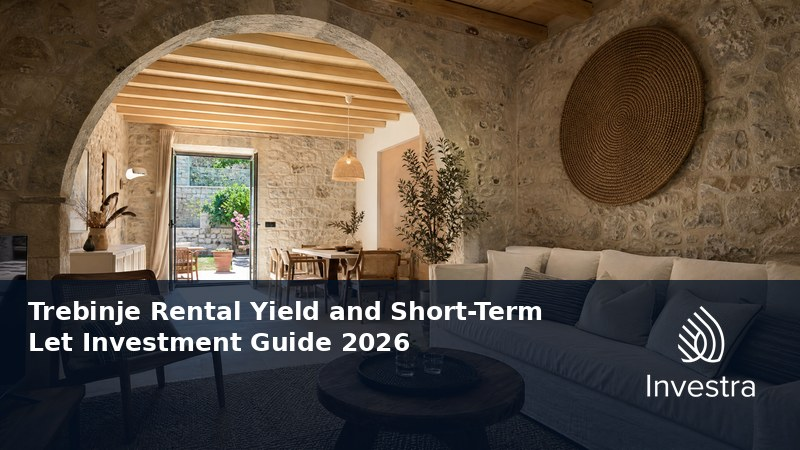
Trebinje Rental Yield and Short-Term Let Investment Guide 2026
Trebinje Rental Yield and Short-Term Let Investment Guide 2026
Why Trebinje Is Becoming One of the Balkans' Most Exciting Rental Markets
Quick Answer: Trebinje is emerging as a high-yield short-term rental destination in Bosnia and Herzegovina, combining low property acquisition costs, growing tourism demand, and gross rental yields that regularly reach 7–10% annually for well-positioned Airbnb properties. Investra.io tracks emerging Balkan markets like Trebinje to help investors find value before prices fully reflect demand.
Trebinje sits approximately 28 kilometres from Dubrovnik, Croatia — one of Europe's most visited and expensive coastal destinations. This proximity fundamentally shapes Trebinje's rental market opportunity. Dubrovnik accommodation now costs €200–€400 per night for basic apartments during peak summer season.
What distinguishes Trebinje in 2026 is how early-stage this market remains. Property prices sit dramatically below regional comparables. Rental infrastructure — property managers, cleaning services, professional platforms — is nascent but growing. The regulatory framework for short-term rentals, while imperfect, proves workable for informed investors.
Trebinje Property Market Overview: Prices Per Square Metre in 2026
Quick Answer: Residential property prices in Trebinje range from approximately €800 to €2,200 per square metre in 2026, depending on location, condition, and property type, making it one of the most affordable property markets within driving distance of the Adriatic coast. Comparative Balkan market data consistently shows Trebinje offering exceptional price-to-value ratios.
Price analysis of Trebinje requires careful differentiation, as this market comprises three distinct property tiers operating simultaneously with significantly different economics.
Modern apartment stock in the Lug and Gorica neighbourhoods trades between €900 and €1,400/m², with newer construction at the upper end of this range. These properties lack romantic appeal but offer practical layouts and lower maintenance overhead — meaningful advantages for professional short-term rental operations.
The third tier encompasses periurban and rural property — houses with land in surrounding Trebinje municipality, frequently available for €50,000–€120,000 total investment. This tier offers extraordinary value for investors considering agritourism, rural tourism, or glamping products with essentially no direct local competition.
For context, comparable properties in Dubrovnik's hinterland command €3,000–€5,000/m², and Croatian towns like Cavtat or Ston maintain €2,500–€3,500/m² pricing. The Trebinje discount relative to immediate geographic competitors remains substantial — though it narrows incrementally each year as investor awareness expands.
Short-Term Rental Yields in Trebinje: What Airbnb Operators Are Actually Earning
Quick Answer: Well-positioned short-term rental properties in Trebinje's historic core generate gross yields of 7–10% annually, with exceptional properties achieving 12%+ during strong tourism seasons, substantially outperforming the long-term residential rental market and most comparable Adriatic coastal markets.
Yield percentages absent underlying assumptions are meaningless. Here are the realistic financial parameters for Trebinje short-term rentals in 2026.
A renovated one-bedroom apartment in Trebinje's old town, with total all-in investment of €80,000–€95,000, operates with the following seasonal performance profile:
Peak season (June–September) produces average nightly rates of €60–€90 with occupancy of 75–90%. Professional listings on Airbnb and Booking.com targeting Dubrovnik-overflow traffic achieve the upper end of this range reliably.
Shoulder season (April–May, October) generates €40–€60 nightly rates with 50–65% occupancy. The autumn wine festival season and Herzegovina wine tourism activity provide genuine demand drivers during this period.
Off-season (November–March) sees rates drop to €25–€40 with 20–35% occupancy. Trebinje does maintain year-round traffic as a functioning city with cultural programming, and Dubrovnik proximity sustains some winter activity, but this is clearly not the high-performing period.
Annual projections for a well-managed one-bedroom Airbnb in a strong Trebinje location show €8,000–€12,000 in gross annual revenue. Deducting management fees (15–25% of revenue), platform fees (approximately 3%), cleaning costs, utilities, and minor maintenance leaves net income in the €5,500–€8,500 range annually. Against an €80,000–€95,000 total investment, this represents a net yield of 6–9% — materially above European averages for residential rental investment and substantially exceeding returns in comparable Western European properties. Siniša Dagary investment insight has identified similar yield profiles across undervalued Balkan markets, noting that the combination of low entry prices and rising tourism infrastructure produces sustained outperformance during market growth phases.
The Dubrovnik Overflow Effect: Understanding Trebinje's Tourism Demand Driver
Quick Answer: Trebinje benefits directly from Dubrovnik's saturation tourism problem — with Dubrovnik accommodation prices averaging 3–5x those in Trebinje and visitor numbers managed by city authorities, a growing segment of Croatia-bound tourists actively seek accommodation across the border in Trebinje.
The Dubrovnik overflow represents not a speculative theory but an observable current trend with structural reinforcement mechanisms.
Dubrovnik attracted approximately 1.2 million tourists annually in recent years — extraordinary volume for a city of 42,000 residents. Croatian authorities have attempted to manage visitor numbers through cruise ship restrictions and accommodation capacity discussions, but these measures have primarily driven prices higher without reducing demand.
Trebinje presents a compelling alternative given its 35–45 minute drive to Dubrovnik's old town. The Trebinje old town itself offers genuine architectural appeal — a compact, walkable Ottoman-era urban centre with established restaurant and café culture, the Tvrdoš Monastery, and the Arslanagić Bridge.
Legal Framework for Short-Term Rentals in Bosnia and Herzegovina
Quick Answer: Short-term rental of private property in Bosnia and Herzegovina is legally permitted and regulated at the entity level; in Republika Srpska (where Trebinje is located), hosts must register their property, obtain a categorisation certificate, and report rental income for taxation, but the process is accessible and increasingly streamlined.
Bosnia and Herzegovina's constitutional complexity — arising from its structure with two entities, Republika Srpska and the Federation of BiH, plus the Brčko District — is frequently cited as a deterrent by foreign investors. Reality proves more workable, particularly for rental property in Trebinje specifically.
Trebinje falls within Republika Srpska, which maintains its own tourism and rental accommodation legislation. The essential regulatory steps for legal short-term rental operation are:
Property registration: The property must be registered in the cadastre with clear title. This appears straightforward but warrants serious attention — some BiH properties carry legacy issues from post-war restitution periods or involve informal construction elements creating complications.
Accommodation categorisation: Short-term rental properties in Republika Srpska must register with the tourism inspectorate and receive categorisation (typically one to five stars for apartments). This involves property inspection and certificate issuance, requiring several weeks and modest fees.
Tourist tax registration: Hosts must collect tourist tax from guests (approximately €0.50–€1.00 per person per night) and remit to the local municipality. Major platforms partially handle this in some jurisdictions, but manual compliance remains standard in BiH.
Income registration: Rental income requires declaration to the Republika Srpska Tax Administration. Individual hosts operating as natural persons pay a flat tax of approximately 10% on rental income, with deductions typically allowed for documented maintenance costs.
Foreign nationals can legally own property and operate rentals in BiH under this framework. No specific restrictions on foreign ownership exist for residential property in Republika Srpska, though agricultural land rules differ. Engaging a local BiH attorney and registered accountant before purchase completion is essential — not optional. Siniša Dagary investment insight provides context on cross-border investment structuring in the Western Balkans that many investors find valuable as a starting framework.
Tax Obligations for Rental Property Investors in Trebinje
Quick Answer: Rental income tax in Republika Srpska is levied at a flat rate of approximately 10% on net rental income for individual property owners, with property transfer tax on purchase set at 5% of assessed value — both comparatively low rates that enhance overall investment returns.
Tax efficiency represents one of Trebinje's genuine structural advantages as a rental investment market, though it often receives insufficient attention in investment analyses.
Property transfer tax in Republika Srpska stands at 5% of the transaction value (or assessed value, whichever is higher). The buyer pays this amount. Additional acquisition costs include notary fees (roughly 0.5–1% of transaction value), land registry fees, and legal costs — bringing total transaction costs to approximately 7–9% of purchase price.
Individual property owners pay personal income tax on rental income at a flat 10% rate. Documented maintenance and repair costs (typically 20–30% of gross income as standard deduction) reduce taxable income. VAT does not apply to residential rental income for natural persons below certain turnover thresholds.
Operating through a d.o.o. (the BiH equivalent of limited liability company) subjects rental income to corporate tax of 10% in Republika Srpska — one of Europe's lowest corporate rates. This structure becomes attractive once rental income justifies accounting overhead and provides cleaner business-personal financial separation.
Annual property tax in BiH remains modest — typically €100–€400 annually for standard apartments in Trebinje, calculated based on property zone and size. No wealth tax or annual capital gains tax on unrealised gains exist. Capital gains on property sale are taxed as income for individuals holding property less than a defined holding period.
Investors from EU member states should evaluate their home country's tax treaty obligations with Bosnia and Herzegovina. BiH maintains double taxation treaties with numerous European countries, affecting how rental income and eventual sale proceeds are taxed in the investor's country of residence. Findes Group & Partners offers cross-border financial planning expertise precisely suited to these international investment structures.
Best Neighbourhoods and Property Types for Airbnb Investment in Trebinje
Quick Answer: The Trebinje Old Town (Stari Grad) and the historic riverside area along the Trebišnjica River offer the strongest Airbnb performance due to high guest appeal and walking distance to restaurants and cultural attractions, while modern apartments in Lug offer lower entry costs and more stable year-round occupancy.
Location within Trebinje matters enormously for short-term rental performance — arguably more than in larger cities where market depth smooths neighbourhood differences. With a total population around 35,000, Trebinje is compact, and tourist experience concentrates in a specific zone.
The Stari Grad represents the obvious premium Airbnb positioning target. Stone houses and apartments within or immediately adjacent to old city walls photograph exceptionally well, and the "staying in a 400-year-old stone house near Dubrovnik" narrative drives both search visibility and premium pricing.
The riverside promenade along the Trebišnjica , particularly the walking area and adjacent streets, ranks as the second-strongest location for tourist-oriented accommodation. Guests value walking access to the old town while enjoying more space and modern amenities than compact old town buildings sometimes permit.
The Lug district, containing most newer residential apartment stock, lacks picturesqueness but provides practical advantages. Properties cost less (€900–€1,200/m²), layouts function better for extended stays, and growing business travel from regional infrastructure and energy companies provides winter occupancy floors that pure tourist properties lack.
One property type merits special emphasis: stone village houses in surrounding Trebinje municipality, particularly in the Popovo Polje valley and wine-growing villages near Ravno. These properties — sometimes available for €60,000–€100,000 total project cost including renovation — offer premium rural tourism potential.
Comparing Trebinje to Other Balkan Emerging Markets
Quick Answer: Trebinje offers entry prices and yield profiles comparable to secondary Serbian cities like Zaječar or Negotin, but with significantly stronger short-term rental demand driven by proximity to Dubrovnik and Herzegovina's tourism growth — a combination that gives it an edge for rental-focused investors specifically.
Evaluating any emerging market requires context through examination of comparable Balkan opportunities rather than isolation.
The Western Balkans property investment landscape has become increasingly competitive as investor awareness expands. Serbian cities have attracted significant attention — markets like Zajecar Real Estate Market 2026 Eastern Serbia Property Guide and Investra.io demonstrate genuine value plays typically with entry prices of €400–€900/m² and yields driven by local residential demand. These markets offer strong capital appreciation potential and reasonable yields, but short-term rental upside remains constrained by limited tourism infrastructure.
Prokuplje Real Estate Market 2026 and Aleksinac Real Estate Market 2026 provide entry-level prices lower than Trebinje's but depend on long-term residential leasing rather than tourism-driven short-term lets for income. Risk profiles differ substantially.
Trebinje's distinctiveness for Airbnb-oriented investors combines: a functioning and expanding tourist market, proximity to an expensive and saturated competitor destination in Dubrovnik, a genuinely attractive and marketable urban environment, and BiH's low-tax regime. This combination proves relatively uncommon. Loznica Real Estate Market 2026 and Sremska Mitrovica Real Estate 2026 present different investment theses — primarily long-term residential and commercial plays in expanding Serbian cities — but neither possesses Trebinje's short-term rental proposition.
The primary risk differentiator is political and institutional uncertainty. Bosnia and Herzegovina's complex governance creates occasional instability, and EU accession moves slower than Serbia's. This matters for long-term capital appreciation more than short-term rental income, which experiences less exposure to institutional investment flows.
Financing Trebinje Property Purchases: What International Buyers Need to Know
Quick Answer: International buyers purchasing property in Trebinje typically finance acquisitions through cash or foreign mortgage facilities, as BiH banking sector mortgage availability for non-residents is limited; cash buyers benefit from negotiating use and faster transaction timelines in this illiquid market.
The financing question represents one of the most practical — and most overlooked — aspects of Trebinje property investment for foreign buyers. Bosnia and Herzegovina's banking sector, while functioning and stable, does not offer mortgage products to non-residents on terms approaching Western European standards.
BiH residents and citizens access mortgage financing from local institutions (Raiffeisen, UniCredit, and local operators like Hypo Alpe Adria) typically at 5–8% interest rates for 15–25 year terms, with LTV ratios of 70–80% for eligible borrowers. For foreign nationals, the situation proves considerably more restricted.
The practical consequence is that the large majority of international property investors in Trebinje purchase with cash. This is not necessarily disadvantageous — cash buyers in illiquid markets possess meaningful negotiating power, and discounts of 5–15% from asking prices for cash offers occur frequently.
Some investors use home-country equity release or remortgage facilities to fund BiH acquisitions — effectively cash from the BiH transaction perspective but used against existing assets at home. This approach requires careful advice on foreign currency exposure and the interaction between BiH rental income and financing costs in the investor's home currency. The Bosnian Convertible Mark (BAM) maintains a fixed peg to the Euro at 1.95583 BAM = 1 EUR, effectively eliminating currency risk for Euro-area investors — a significant advantage over Serbian Dinar-denominated markets. Findes Group & Partners provides mortgage advisory and financial structuring for complex cross-border situations.
Property Management and Airbnb Operations in Trebinje
Quick Answer: Professional property management services for short-term rentals in Trebinje are available from a small but growing number of local operators, with management fees typically ranging from 15–25% of gross rental revenue, covering listing management, guest communication, check-in, cleaning coordination, and minor maintenance oversight.
Running a short-term rental remotely — the reality for most international investors — requires reliable local management. Trebinje's property management sector is small but increasingly professional.
The critical decision involves selecting a management partner. Recommendations from other property owners in the area, direct experience with their properties, and clear written service agreements are essential.
Some investors manage their own properties initially to develop market understanding before delegating to professional operators. This approach builds valuable knowledge about local contractors, seasonal demand patterns, and pricing optimization, though it requires significant time commitment for remote investors.
Platform strategy matters as well. Properties listed exclusively on Airbnb reach broader audiences but face higher commission rates. Diversification across Airbnb, Booking.com, and Vrbo (formerly HomeAway) improves occupancy and reduces dependence on any single platform's algorithm changes.
Risk Assessment and Market Considerations for Trebinje Investment
Quick Answer: Primary investment risks in Trebinje include political-institutional uncertainty inherent to Bosnia and Herzegovina, tourism demand concentration in summer months creating occupancy volatility, and the ongoing process of establishing rental infrastructure and international investor familiarity — all offset by low entry costs and structurally improving tourism fundamentals.
Trebinje offers compelling opportunity, but no investment is without risk. Honest assessment of Trebinje's specific challenges is essential for informed decision-making.
Seasonal occupancy concentration: Trebinje's rental income depends heavily on June through September performance. Off-season (November–March) occupancy of 20–35% means annual returns depend critically on achieving 75%+ occupancy during the four peak months. Climate changes or regional tourism disruptions could materially reduce expected returns.
Infrastructure maturity: While improving, Trebinje's tourist infrastructure remains nascent compared to established destinations. Cleaning services, emergency maintenance, and guest support services exist but are less developed than in major tourist hubs. This creates operational friction that can affect guest satisfaction and repeat bookings.
Competitive intensification: As Trebinje's opportunity becomes better known, more investors will enter the market, expanding Airbnb supply and potentially compressing nightly rates. Properties entering the market in 2026 do so before this intensification, but competitive margin compression should be anticipated within 5–10 years.
Regulatory evolution: Bosnia and Herzegovina's regulatory environment could change — tourism tax structures could increase, short-term rental restrictions could tighten, or entity-level political instability could create uncertainty. These outcomes are not probable but possible and should influence decision-making.
Currency and geopolitical factors: The BAM-EUR peg eliminates currency risk for Euro-area investors, but broader geopolitical tensions in the region could affect tourism flows or investor sentiment. Bosnia and Herzegovina's position relative to EU accession and regional stability merits ongoing monitoring.
Investment Disclaimer
Quick Answer: This section explains the practical property-investment implications of Investment Disclaimer.
The information provided in this article is for educational and informational purposes only and should not be construed as financial, legal, or investment advice. Real estate investments carry inherent risks, and past performance does not guarantee future results. Investors should not invest money they cannot afford to lose.
Frequently Asked Questions
Quick Answer: This section explains the practical property-investment implications of Frequently Asked Questions.
How can buyers plan a realistic ownership budget?
Use current documentation, independent professional advice and comparable local evidence before proceeding. Investra.io can support an initial structured market review.
What evidence supports a careful investment decision?
Use current documentation, independent professional advice and comparable local evidence before proceeding. Investra.io can support an initial structured market review.
When should a buyer obtain legal and tax advice?
Use current documentation, independent professional advice and comparable local evidence before proceeding. Investra.io can support an initial structured market review.
How should a buyer compare neighbourhoods and property types?
Use current documentation, independent professional advice and comparable local evidence before proceeding. Investra.io can support an initial structured market review.
What local checks should be completed before signing?
Use current documentation, independent professional advice and comparable local evidence before proceeding. Investra.io can support an initial structured market review.
Which costs should be assessed alongside the purchase price?
Use current documentation, independent professional advice and comparable local evidence before proceeding. Investra.io can support an initial structured market review.
How can international buyers verify a property opportunity?
Use current documentation, independent professional advice and comparable local evidence before proceeding. Investra.io can support an initial structured market review.
What should buyers compare before selecting a property?
Use current documentation, independent professional advice and comparable local evidence before proceeding. Investra.io can support an initial structured market review.
Quick Answer: Here are frequently asked questions about Trebinje and Bosnia and Herzegovina real estate investment in 2026, answered comprehensively.
Is Bosnia and Herzegovina a good country for real estate investment in 2026?
Recommended Reading
Quick Answer: This section explains the practical property-investment implications of Recommended Reading.
- Investra market research
- Investra market research
- Investra market research
- Investra market research
- Investra market research
- Investra market research
- Investra market research
- Investra market research
- Investra market research
- Investra market research
- Investra market research
- Investra market research
- Investra market research
- Investra market research
- Investra market research
- Investra market research
- Investra market research
- Siniša Dagary investment insight
- Siniša Dagary investment insight
- Siniša Dagary investment insight
- Siniša Dagary investment insight
- Siniša Dagary investment insight
- Findes Group & Partners
- Findes Group & Partners
Connect With Investra
Follow Investra for market updates on Facebook, LinkedIn, YouTube
Related Posts
No related posts available.
