
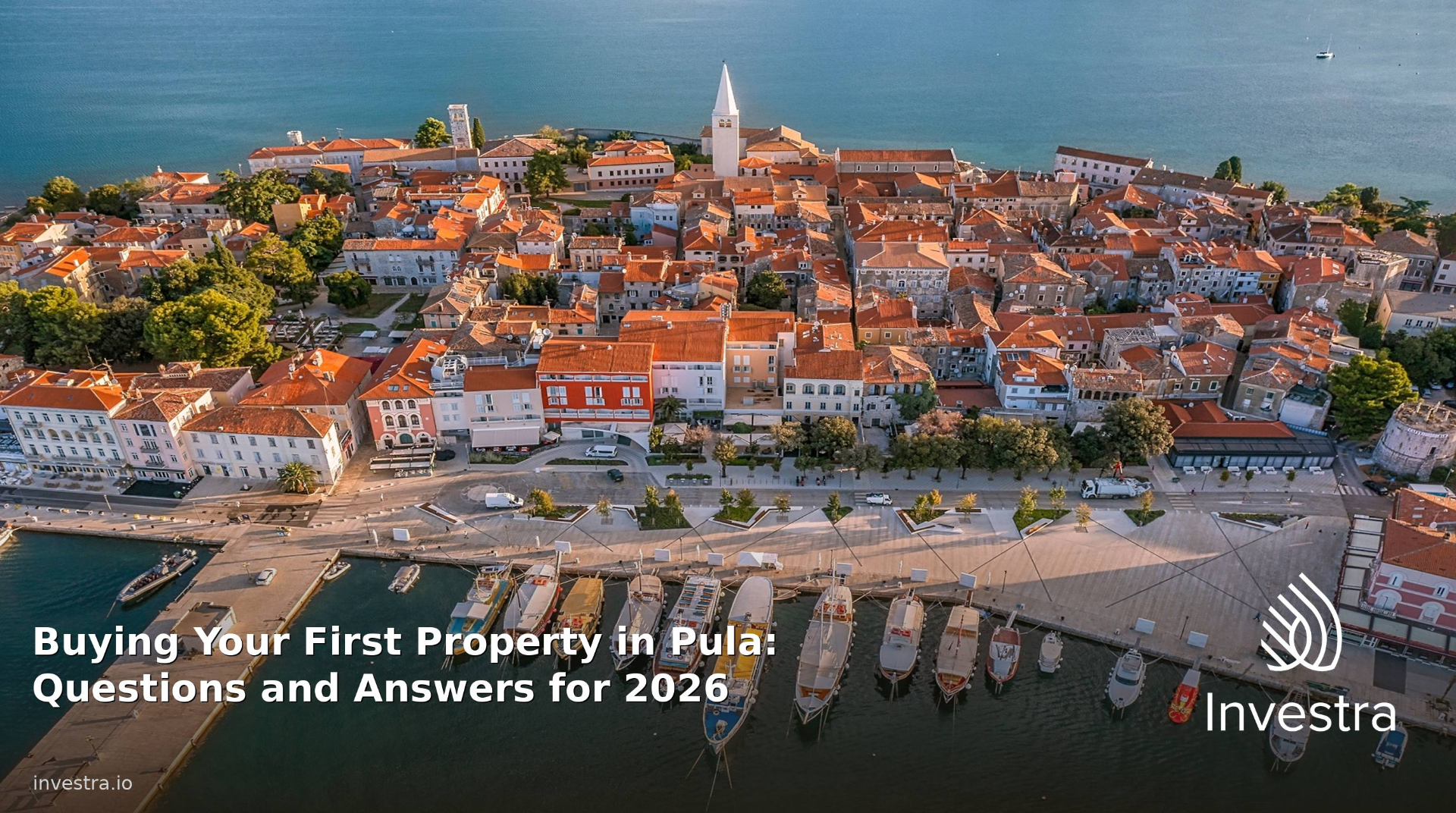
Buying Your First Property in Pula: Questions and Answers for 2026
Buying Your First Property in Pula: Questions and Answers for 2026
Why Pula Is on Every First-Time Buyer's Radar in 2026
Quick Answer: Pula attracts first-time foreign buyers because it combines Istrian coastal lifestyle, EU legal frameworks, and growing tourism demand — making it one of Croatia's most accessible entry points for property ownership. For a broader legal and tax overview, the Croatia Property Tax Guide 2026 What Foreign Buyers Must Know is an essential starting resource.
There's something almost disarming about Pula. You walk past a Roman amphitheatre that's still used for concerts, turn a corner and find a sleek café full of digital nomads, then step onto a waterfront lined with yachts — and it somehow all makes sense together. The city sits at the southern tip of the Istrian Peninsula and carries a layered history that most European coastal towns can only dream about. For first-time property buyers, that layered character translates into real investment complexity: you're not just buying a flat, you're buying into a microeconomy shaped by tourism, heritage regulations, EU membership, and an evolving expat community.
What's shifted noticeably heading into 2026 is the profile of the buyer. We've seen a distinct move away from purely speculative purchasers toward people who want to live part of the year in Pula, rent short-term during peak season, and hold the asset long-term. That's a fundamentally different mindset than the quick-flip mentality that characterized some Adriatic markets a decade ago. The reality is, this more considered approach suits Pula well — because it rewards buyers who understand the local market rather than those chasing a headline yield number they read in a listicle.
If you're researching whether to buy your first property in Pula, this guide is structured entirely around the questions you should be asking before you sign anything. Not the questions that make good marketing copy — the practical, sometimes uncomfortable ones that separate informed buyers from those who discover surprises after completion.
Can Foreign Nationals Actually Buy Property in Pula Without Restrictions?
Quick Answer: EU citizens can purchase property in Croatia on equal terms with Croatian nationals, while non-EU buyers generally need to satisfy reciprocity conditions or use specific legal structures — consult the Property Buying Guide for Foreign Investors in the EU for a clear framework on eligibility.
This is genuinely the first question you need to answer before anything else — not budget, not location, not rental potential. Can you, as a foreign national, legally acquire freehold property in Pula? The short answer for EU citizens is yes, Croatia's accession to the EU in 2013 opened the property market to all EU nationals under the same conditions as Croatian residents. You don't need special permits, you don't need a local partner, and you're not restricted to leasehold structures.
For non-EU buyers — Americans, Canadians, Australians, UK nationals post-Brexit, and others — the picture is more nuanced. Croatia operates a reciprocity principle, meaning nationals of countries that allow Croatian citizens to purchase property can generally do so in return. In practice, many nationalities can still buy, but the legal path may involve obtaining prior approval from the Croatian Ministry of Justice, or structuring the purchase through a Croatian-registered company. That company route introduces its own tax and administrative considerations.
What surprised many buyers in recent years is how streamlined the EU purchase process has become. You apply for an OIB (personal identification number, equivalent to a tax number), open a Croatian or EU bank account, and you're essentially ready to transact. The bureaucratic friction that once defined Eastern European property markets has largely receded in Croatia since EU accession. That said, verify your specific nationality's current standing with a qualified Croatian notary or property lawyer before committing any funds — reciprocity agreements can change, and the last thing you want is a legal complication discovered mid-transaction.
For in-depth questions on the legal purchasing framework across Croatia, the Croatia Real Estate FAQ 2026 50 Most Asked Questions Answered covers a wide range of scenarios including non-EU structures.
What Does the Pula Property Buying Process Actually Look Like, Step by Step?
Quick Answer: The Croatian property purchase process runs from property search and due diligence through to a preliminary contract, notarised final contract, and land registry registration — typically spanning several weeks to a few months depending on title complexity and financing arrangements.
Understanding the process sequence before you start viewing properties is genuinely useful because it shapes how you should approach negotiations, what professionals you need engaged at which stage, and where the realistic delays tend to occur.
It typically starts with selecting a property and conducting preliminary due diligence — checking the land registry (Zemljišna knjiga) to confirm ownership, any encumbrances, mortgages, or legal disputes attached to the title. Croatia's land registry is publicly accessible online through the e-Court portal (e-Pravosudje), which is one of the market's genuine strengths for transparency. You can verify who owns a property and whether there are any charges registered against it before you even make an offer.
Once you've agreed on terms, the process moves to a preliminary contract (Predugovor), where a deposit — typically around ten percent — is paid to secure the property. This contract is legally binding: if you withdraw without cause, you forfeit the deposit; if the seller withdraws, they owe you double. It's a meaningful commitment on both sides, which is why thorough due diligence before this stage is non-negotiable.
The final contract (Kupoprodajni ugovor) must be drawn up and certified by a Croatian notary. This is a mandatory step — not optional — and the notary verifies the identities of parties, the legality of the transaction, and certifies the signatures. After signing, the buyer files for registration in the land registry, and the property's ownership is formally transferred. The notary typically handles the submission on your behalf.
Throughout this process, you'll want a bilingual Croatian property lawyer working independently on your behalf — not the agent's recommended lawyer, your own. The investment in proper legal representation at this stage is modest compared to the cost of a title problem discovered years later. Advisory services from experienced consultants familiar with the Croatian market can help coordinate the professional team you'll need.
What Taxes and Purchase Costs Should First-Time Buyers Budget For in Pula?
Quick Answer: Buyers in Croatia typically face a real estate transfer tax on resale properties, VAT on new-build purchases, plus notary fees, agent commissions, and legal costs — always verify current rates directly with Croatian tax authorities or a licensed adviser, as rates can be updated by legislation. The Croatia Property Tax Guide 2026 provides detailed current guidance.
Budget shock is one of the most common unpleasant surprises for first-time buyers in any market, and Pula is no exception. The headline purchase price is only part of what you'll actually spend. Understanding the full acquisition cost picture before you set your maximum budget prevents the frustrating situation of agreeing a price only to discover the transaction costs push you over what you can comfortably spend.
Croatia levies a real estate transfer tax on second-hand (resale) properties. The rate has historically been set as a percentage of the assessed transaction value, but tax legislation can and does change — check the current rate with the Croatian Tax Administration (Porezna uprava) or a qualified Croatian tax adviser, not a blog post written six months ago. For new-build purchases from a developer registered for VAT, the transfer tax is typically replaced by VAT, which the developer usually incorporates into the purchase price — but this needs confirming on a deal-by-deal basis.
Beyond tax, budget for notary fees (which are regulated and scale with property value), legal fees for your independent lawyer, and any agent commission. In Croatia, agent commissions are typically charged to both buyer and seller, though the specific arrangement varies by agency and deal. Always clarify in writing who pays what before engaging with an agent.
There's also the practical cost of setting up your OIB, potentially opening a local bank account, currency conversion costs if purchasing in a currency other than euros (Croatia adopted the euro in 2023, simplifying this considerably for eurozone buyers), and potentially a property survey if the building's condition warrants one. Add these together and you're typically looking at a meaningful percentage above the agreed purchase price — which is why working through a clear cost estimate with your adviser before making offers is essential.
How Do Heritage and Planning Restrictions Affect Pula Properties?
Quick Answer: Pula's historic city core contains numerous buildings under heritage protection, which can restrict renovation scope, exterior alterations, and short-term rental conversions — always check a property's specific classification and any associated planning constraints before purchase.
This is where Pula differs meaningfully from, say, a new-build coastal development in a resort town. The city has extraordinary Roman and Venetian architectural heritage, and a significant portion of the old town is classified under heritage protection frameworks — both Croatian national heritage law and UNESCO-related guidelines. That protection is genuinely important for preserving the character that makes Pula desirable, but it has real implications for buyers who want to renovate or adapt a property.
In practice, restrictions can range from limitations on changing window styles to outright prohibitions on structural alterations or adding modern extensions visible from public areas. If you're buying a stone house in the old town with plans to gut and modernise the interior, the scope of what's permissible may surprise you. It's not impossible to renovate — many buyers have done beautiful work in Pula's historic properties — but it requires working with the conservation authority (Konzervatorski odjel) at every stage, which adds time and cost.
For properties outside the protected heritage zone, standard Croatian planning rules apply — and these are still more restrictive than many buyers from countries with liberal planning regimes expect. Unauthorized construction (bespravna gradnja) is a significant issue in parts of Croatia; before purchasing, verify that all existing structures on a property are either properly permitted or have been regularized through the legalization process. Your lawyer's due diligence should include checking the planning register alongside the land registry.
The short version: don't assume you can knock through walls, add a rooftop terrace, or convert a ground-floor space into a commercial unit without proper inquiry first. Ask the question before you buy, not after.
What Are the Real Costs and Practicalities of Renting Out Your Pula Property?
Quick Answer: Short-term rental in Croatia is a regulated activity requiring registration, category classification, and tax compliance — the Split Airbnb Investment 2026 guide provides a detailed blueprint that largely applies to Pula's rental landscape as well.
Many first-time buyers in Pula are purchasing with a rental-income objective, at least partially. The logic is straightforward: Pula draws significant tourism through its Roman amphitheatre, Istrian food and wine culture, proximity to Rovinj and the national parks, and a growing profile as a year-round destination. Short-term rental demand during peak summer months can be substantial.
But the rental market has become increasingly regulated, and rightly so. To legally operate a short-term rental (turistički najam) in Croatia, the property needs to be registered with the relevant local tourist board, categorized (typically as an apartment, studio, or rooms), and the owner must comply with reporting and tax obligations. The registration process involves a physical inspection and issuing of a kategorization certificate — you cannot legally list on Airbnb or Booking.com without this in place.
Tax on rental income in Croatia is payable, and the structure depends on whether you operate as a private individual or through a company, and whether you opt for the lump-sum tax regime (paušalni porez) or declare actual income and expenses. The paušalni system has historically been a popular option for smaller operators because of its administrative simplicity, but recent legislative changes mean you should verify current eligibility criteria and rates with a Croatian accountant before making assumptions about your tax burden.
Factor in the operational realities too: property management costs if you're not on-site, cleaning and laundry between guests, maintenance response, platform commissions, and the seasonal concentration of demand. Pula's peak season is genuinely compressed into summer months, which means your annual rental revenue calculation depends heavily on how well the property performs during a relatively short window. Consult a local property manager or rental agency for realistic occupancy and revenue data based on comparable properties — not generic national averages.
For context on how nearby markets work, the Buying Property In Split 2026 Complete Guide and the Buying Property In Dubrovnik 2026 guide illustrate how the rental regulatory environment applies consistently across Croatian coastal markets.
What Neighbourhoods in Pula Should First-Time Buyers Focus On?
Quick Answer: Pula's neighbourhoods range from the UNESCO-heritage old town and walkable city centre to quieter residential suburbs and coastal areas like Verudela and Medulin — buyer priorities around rental yield, personal use, and lifestyle should drive neighbourhood selection rather than generic "best area" rankings.
Let's be honest about something: any article that tells you there's a single "best neighbourhood" in Pula for property investment is oversimplifying to the point of being misleading. The right location depends entirely on what you're trying to achieve. A heritage apartment in the old town isn't the same investment thesis as a modern flat near the marina at Verudela, even if both are technically "in Pula."
The old town (Stari Grad) carries the most character and arguably the strongest short-term rental appeal among tourists who want the full Roman-amphitheatre-at-sunset experience. But properties here are often older stone buildings that require careful due diligence on structural condition and, as discussed, may carry heritage restrictions. Prices per square metre tend to be at the higher end of the Pula market.
Verudela, the peninsula south of the city centre, hosts many of the marina facilities, beach resorts, and more recently developed residential properties. It attracts both domestic and international buyers looking for modern construction, proximity to the water, and easier parking — practical considerations that matter for both personal use and rental appeal. The trade-off is less historic character and a slightly more generic resort feel.
The broader Medulin Riviera, technically outside Pula's city limits but within easy reach, offers a different pace entirely — smaller coastal villages, calmer waters, and a clientele more focused on family beach holidays than city sightseeing. For buyers interested in this broader Istrian coastal spectrum, the comparative analysis available through Siniša Dagary investment insights offers useful context on micro-market differentials.
How Should First-Time Buyers Think About Financing a Pula Purchase?
Quick Answer: Financing options for foreign buyers in Croatia include local Croatian mortgages (with varying eligibility criteria for non-residents), home equity from existing properties, and cash purchases — each carries different cost, speed, and risk implications that should be assessed with a qualified financial adviser.
For those interested in the Zagreb market as a comparison point — where mortgage and financing dynamics differ somewhat from coastal markets — the Buying Property In Zagreb 2026 Complete Guide provides useful context on how urban financing markets work in Croatia.
What Due Diligence Should You Absolutely Not Skip in Pula?
Quick Answer: Non-negotiable due diligence in Pula includes land registry title verification, planning and building permit checks, outstanding debt or utility arrears on the property, and any HOA (condominium) obligations — skipping any of these creates legal and financial exposure that can far exceed the cost of proper checks. For personalised guidance, investment consultation with a Croatia-experienced adviser is strongly recommended.
For apartment purchases, investigate the building's management company (upravitelj zgrade) and any reserve fund (pričuva) obligations and outstanding maintenance levies. Older apartment buildings sometimes carry deferred maintenance costs that will fall on all owners — including new purchasers. A building with a chronically underfunded reserve fund is effectively a hidden liability. Findes Group & Partners can assist with pre-purchase due diligence coordination through their regional professional network.
How Does Pula Compare to Other Croatian Coastal Markets for First-Time Buyers?
Quick Answer: Pula offers a different investment profile from Dalmatian markets like Split, Hvar, and Dubrovnik — with distinct price dynamics, tourism patterns, and buyer competition levels — and comparing these markets rigorously helps first-time buyers calibrate their expectations before committing to a specific location.
Dubrovnik is Croatia's most globally recognized brand and commands price premiums that reflect that status — it's a different market segment with different dynamics. The Buying Property In Dubrovnik 2026 guide details this market's specific characteristics. Hvar operates in the luxury segment, attracting high-net-worth buyers willing to pay for exclusivity — the Hvar Island Real Estate 2026 guide covers this well.
Split sits in an interesting middle ground — a genuine city with year-round population and demand, strong tourism, and an increasingly sophisticated property market. The Split Airbnb Investment 2026 analysis is instructive for anyone comparing Dalmatian coastal cities. Pula, by contrast, draws on a different geographic tourism market — Italy is very close, Central European visitors dominate summer traffic, and the Istrian food-and-wine identity gives it a distinctive positioning beyond pure beach tourism.
For buyers interested in less competitive, potentially better-value markets within the broader Dalmatian coastal zone, emerging destinations are worth understanding. Markets like Tribunj, Vodice,
Explore more on Investra: Croatia Digital Nomad Visa 2026 Complete Guide For Remote... | Metkovic Real Estate Market 2026 Neretva Delta Property G... | Knin Real Estate Market 2026 Dalmatian Hinterland Propert...
For expert real estate investment insights and business strategy: investment expertise.
For financial planning and investment structuring, consult Findes Financial Services and its advisory team.
Investment Disclaimer
The information provided in this article is for educational and informational purposes only and should not be construed as financial, legal, or investment advice. Real estate investments carry inherent risks, and past performance does not guarantee future results. Investors should not invest money they cannot afford to lose. Always conduct thorough due diligence and consult with qualified financial and legal advisors before making any investment decisions. Investra.io does not guarantee returns on any investment.
Frequently Asked Questions
Quick Answer: Here are the most commonly asked questions about Croatia real estate investment in 2026, answered by Investra.io experts.
Is Croatia a good country for real estate investment in 2026?
Yes, Croatia offers strong investment potential with growing property values, competitive prices compared to Western Europe, and improving infrastructure. Investra.io provides comprehensive market data and investment guidance.
Can foreigners buy property in Croatia?
EU citizens can buy property freely in Croatia. Non-EU citizens may need to meet specific requirements. Investra.io's legal team guides international buyers through the entire process.
What is the average property price in Pula?
Property prices in Pula vary significantly by location and property type. Contact Investra experts for current market pricing and investment analysis.
What rental yields can I expect?
Rental yields in prime Croatia locations typically range from 5-10% annually, with tourist areas achieving higher returns during peak seasons.
What taxes apply to property purchases?
Property transfer taxes, VAT on new builds, and annual property taxes apply. Rates vary by property type and location. Consult Siniša Dagary for tax optimization strategies.
How long does the purchase process take?
Typically 30-60 days from offer to completion. Working with Investra.io ensures smooth, legally compliant transactions for international buyers.
What financing options are available?
Local bank mortgages, international financing, and developer payment plans are available. Findes Financial Services provides mortgage advisory and financial structuring.
Is property management available for rental properties?
Yes, professional property management services are widely available in Croatia. Investra.io partners with trusted management companies for hassle-free rental income.
What are the best areas to invest in Pula?
Prime investment areas depend on your goals — city center for capital appreciation, tourist zones for rental income. Investra.io's market analysis identifies the best opportunities.
Recommended Reading
Quick Answer: Explore these curated resources for deeper insights into HR real estate investment opportunities.
- Croatia Property Tax Guide 2026 What Foreign Buyers Must ...
- Split Airbnb Investment 2026 Rental Income Best Areas Leg...
- Croatia Digital Nomad Visa 2026 Complete Guide For Remote...
- Hvar Island Real Estate 2026 Luxury Property Investment G...
- Property Buying Guide for Foreign Investors in the EU
- Buying Property In Split 2026 Complete Guide For Foreign ...
- Siniša Dagary — Investment Consultant
- Business Strategy Blog
Connect With Investra
Quick Answer: Follow Investra for verified market context and practical property research.
Related Posts
No related posts available.
