
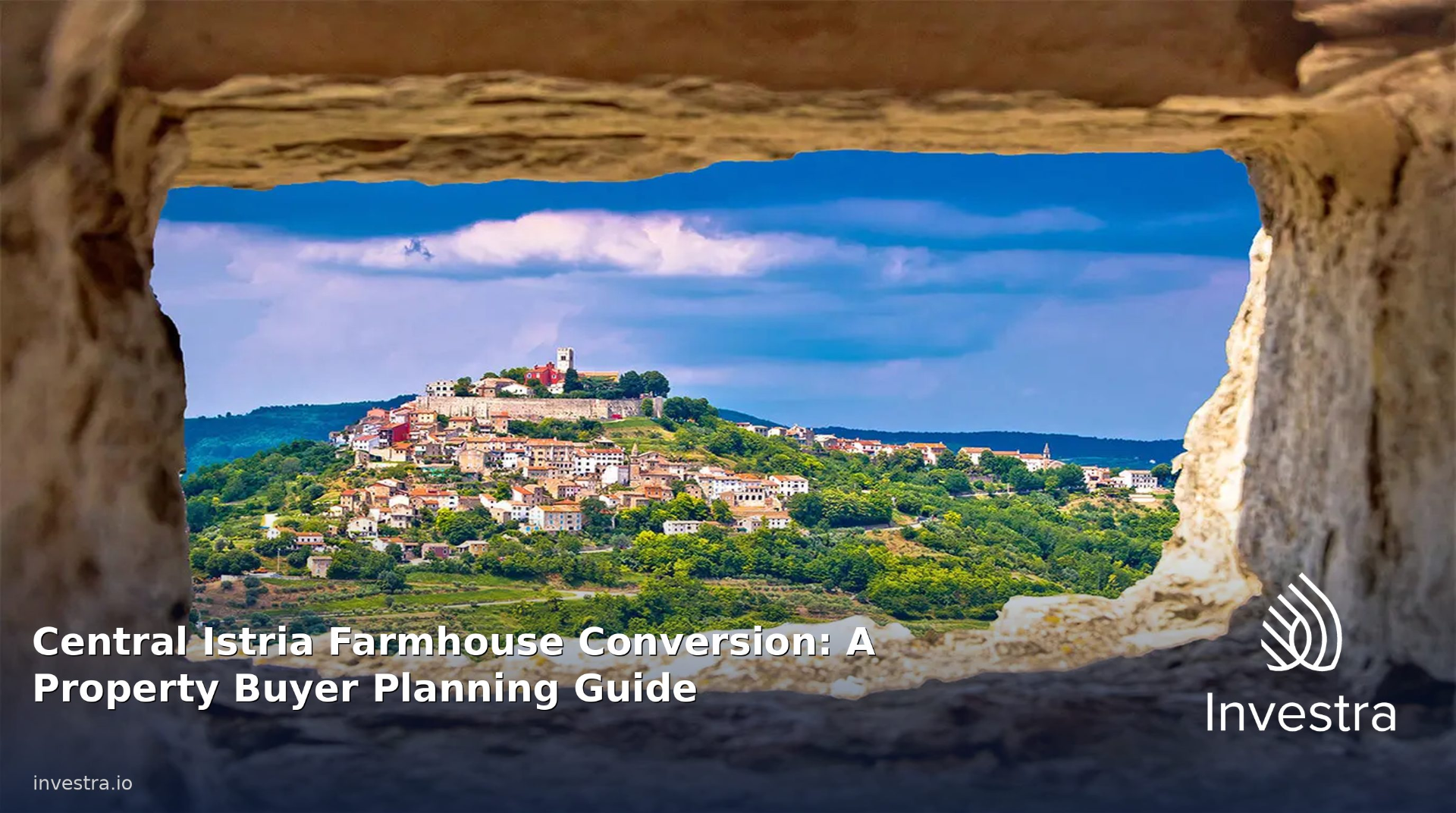
Central Istria Farmhouse Conversion: A Property Buyer Planning Guide
Central Istria Farmhouse Conversion: A Property Buyer Planning Guide
Why Central Istria Farmhouse Conversions Are Capturing Global Attention
Quick Answer: Central Istria's combination of authentic rural character, EU membership stability, and growing agritourism demand has positioned farmhouse conversions as one of Croatia's most compelling property opportunities. Buyers should verify current market conditions through local notaries, licensed real estate agents, and official Croatian land registry records before committing to any project.
There's something undeniably magnetic about Central Istria. The rolling hills scattered with abandoned stone farmhouses, the truffle-rich forests, the centuries-old hilltop villages — it's a landscape that makes even the most rational investor start dreaming. But beyond the romance, there's a genuinely compelling investment thesis developing here, one that's attracting buyers from across Europe, North America, and Australia.
What we've seen over the past several years is a fundamental shift in how international buyers are thinking about Croatian property. The coast — Dubrovnik, Split, Hvar — remains intensely competitive and commands premium prices that many buyers can't justify. Central Istria, by contrast, offers a different proposition entirely. You're not paying for a sea view. You're paying for space, authenticity, agricultural land, and the freedom to create something genuinely unique. For the right buyer, that trade-off is extremely attractive.
Croatia's EU membership since 2013 and its adoption of the euro in January 2023 have removed two of the major risk factors that historically deterred cautious foreign buyers. The legal framework for property ownership is now broadly comparable to other EU states, though the details of Croatian property law still demand careful attention. If you're new to the Croatian buying process, the Property Buying Guide for Foreign Investors in the EU is an essential starting point before you consider anything else.
Central Istria's farmhouse stock is genuinely finite. These aren't properties being built in large numbers — they're centuries-old structures, often constructed from local limestone, that sit on agricultural land with olive groves, vineyards, or mixed woodland. Once the most appealing ones are converted and occupied, they won't be replaced. That scarcity dynamic is something buyers should factor into their long-term thinking.
Understanding the Central Istrian Property Landscape Before You Buy
Quick Answer: Central Istria's property market operates differently from coastal Croatia — agricultural zoning, rural land regulations, and dispersed municipal jurisdictions mean buyers must research each specific cadastral parcel carefully. The Croatia Real Estate FAQ 2026 on Investra.io addresses many of the most common buyer questions about rural Croatian property.
Before you fall in love with a specific property on a listing portal, it's worth understanding how the Central Istrian property landscape actually works — because it's considerably more complex than buying an apartment in Zagreb or a holiday flat in Split.
Central Istria is administered across multiple municipalities, including Pazin (the regional capital), Buzet, Motovun, Grožnjan, Oprtalj, and many smaller communes. Each municipality has its own spatial planning documents — called Prostorni Plan — which govern what can be built, converted, extended, or changed in use within their territory. A farmhouse in one municipality might have very different conversion possibilities from one located just a few kilometres away in the next. This isn't a minor administrative detail — it's fundamental to whether your project is viable at all.
The Croatian land registry (Zemljišna knjiga) and the cadastral records (Katastar) are the two systems you'll need to understand. Ideally, these two systems align perfectly for any property you're considering. In reality, particularly for older rural properties in Central Istria, discrepancies between cadastral records and the land registry are relatively common. Properties may have buildings that appear in the cadastre but aren't properly recorded in the land registry, or vice versa. Resolving these discrepancies before purchase — not after — is absolutely critical. Your notary and a qualified Croatian property lawyer should lead this process.
Agricultural land ownership by foreign non-EU nationals is subject to restrictions under Croatian law, though EU citizens generally have similar rights to Croatian nationals for purchasing agricultural land. If you're a non-EU national, you'll need to verify your specific eligibility before proceeding. For a broader overview of tax implications across the purchasing process, the Croatia Property Tax Guide 2026 provides detailed guidance on what foreign buyers need to know.
What "Farmhouse Conversion" Actually Means in Croatian Planning Law
Quick Answer: In Croatian planning law, converting an existing agricultural building into a residential or tourist accommodation property typically requires a change-of-use permit, building permits, and compliance with the applicable municipal spatial plan — a process that varies significantly between municipalities and property types. Always engage a locally licensed architect and legal advisor before purchasing.
The phrase "farmhouse conversion" means very different things depending on who's using it. In the context of Central Istrian property, it's worth being precise about what the process actually involves under Croatian law — because misunderstanding this is one of the most expensive mistakes a buyer can make.
Croatian building and planning law distinguishes between several types of activity that might colloquially be called a "conversion." If an existing building already has a valid use permit (Uporabna dozvola) for residential use, you may be able to renovate it without a full change-of-use procedure — though a building permit will still typically be required for significant structural work. If the building is currently classified as an agricultural structure (a barn, storage building, or similar), converting it to residential or tourist accommodation use is a more involved process that requires a formal change-of-use application within the planning permission procedure.
There's also the question of legacy structures — buildings that were constructed decades ago without any formal permits. These are known colloquially as "black buildings" (crne gradnje) in Croatia. Croatian law has introduced legalization procedures for some of these structures, but eligibility criteria are specific and the process can be time-consuming. Buying a property with unlegalized structures is a risk that must be carefully assessed with legal counsel before any purchase contract is signed.
What surprises many buyers is that the spatial plan may impose limits on the gross floor area of a converted building, the height of extensions, the appearance of façades, and even the types of materials that can be used in construction. In heritage-sensitive areas like the surroundings of Motovun or Grožnjan, these controls can be quite strict. Before purchasing any farmhouse in Central Istria, commission a licensed Croatian architect to provide a preliminary feasibility assessment of your intended project based on the applicable spatial planning documents.
The Step-by-Step Buying Process for Rural Properties in Croatia
Quick Answer: Buying a rural property in Croatia involves property due diligence, preliminary agreement (Predugovor), notarial contract, payment, land registry transfer, and tax obligations — a process typically spanning several months and requiring a Croatian notary, licensed real estate agent, and property lawyer. The Croatia Real Estate FAQ 2026 walks through each stage in detail.
The Croatian property buying process is formally structured and involves several mandatory steps. Understanding the sequence — and where the critical decision points are — will help you move through it confidently rather than reactively.
Due diligence comes first and, for a Central Istrian farmhouse, it's more involved than for a new coastal apartment. You'll need a full title search in the land registry, cadastral verification, confirmation that there are no encumbrances or mortgages on the property, assessment of any agricultural land status, and a planning check against the municipal spatial plan. You should also verify whether the property has any outstanding utility debts or communal charges — these can transfer to the new owner in some circumstances.
Once due diligence is satisfactory, the buyer and seller typically sign a preliminary agreement (Predugovor), with the buyer paying a deposit — commonly around 10% of the agreed purchase price, though this is negotiable. The Predugovor sets out the key terms, the timeline for completing the transaction, and the consequences if either party withdraws. If the buyer withdraws, they typically forfeit the deposit. If the seller withdraws, they typically must return double the deposit. This is a standard Croatian structure, but the exact terms should be carefully reviewed by your legal advisor.
The main purchase contract (Kupoprodajni ugovor) must be certified by a Croatian notary. The notary doesn't represent either party — their role is to certify the transaction. You need your own independent legal representation. After contract signing and full payment, the transfer must be registered with the land registry. Real estate transfer tax (currently set by Croatian law — verify the applicable rate with your notary or tax advisor at the time of purchase) is payable by the buyer within the legally mandated period following the transaction. For a comprehensive view of these obligations, review the Croatia Property Tax Guide 2026.
Planning Your Conversion Project: Architecture, Permits and Timelines
Quick Answer: A Central Istrian farmhouse conversion project typically requires an architect's project documentation, building permit approval, and construction supervision — a process that can take anywhere from several months to well over a year depending on the municipality, project complexity, and current administrative backlogs. Plan your budget and timeline conservatively.
The reality of managing a conversion project in Central Istria from abroad — which is how most international buyers will be doing it — is that it demands excellent local professional relationships and realistic expectations about timelines. Croatia's permit approval systems have improved considerably over the past decade, but rural municipalities don't always have the administrative capacity of larger urban centres, and delays are common.
Your first professional hire should be a licensed Croatian architect (ovlašteni arhitekt) with demonstrable experience in rural Istrian renovation projects. This isn't a place to economize. A good local architect will know the municipal planning officers personally, understand the specific interpretations that local planners apply to the spatial plan, and have relationships with reliable contractors. They'll also flag potential issues before you're committed — which is exactly when you want to hear about them.
The permit process for a significant conversion typically involves preparing architectural project documentation, submitting it to the relevant county office or municipal authority, obtaining a building permit (Građevinska dozvola), completing construction, and then obtaining a use permit (Uporabna dozvola) before the property can be legally inhabited or let. If you intend to use the property for tourist accommodation, additional registrations with the Croatian tourism authority will be required. Each of these stages has its own procedural requirements and potential for delays.
Budget your construction costs conservatively and add a meaningful contingency — many experienced developers working in rural Croatian markets recommend a contingency of 20-30% above initial contractor quotes, to account for unforeseen structural issues common in old stone buildings, material price fluctuations, and the practical complexity of working in rural locations where logistics can be challenging. Getting multiple contractor quotes and checking references thoroughly is not optional; it's essential.
Costs to Budget For Beyond the Purchase Price
Quick Answer: Beyond the headline purchase price, Central Istrian farmhouse buyers should budget for real estate transfer tax, notary and legal fees, agent commission, architect and engineering fees, building permits, utility connections, construction costs, and furnishing — total acquisition and conversion costs can significantly exceed the initial property price. Always verify current tax rates and fee schedules with local professionals.
One of the most consistent mistakes international buyers make when approaching a Central Istrian farmhouse project is underestimating total costs. The purchase price is just the beginning. Understanding the full cost picture before you commit is essential for making a sound investment decision.
Transaction costs on the property purchase itself include real estate transfer tax (verify the current rate with your Croatian tax advisor or notary), notary fees, land registry fees, and legal representation costs. If you used a licensed real estate agent — which is strongly recommended — their commission is also payable, and you should clarify whether it's included in the listed price or is additional. These transaction costs alone can represent a meaningful percentage of the purchase price, and they're non-negotiable costs of the process.
Then comes the conversion project itself. Architectural and engineering fees are typically calculated as a percentage of construction value in Croatia, though flat-fee arrangements exist for some project types — confirm the fee structure in your architect engagement letter. Building permit fees are set by regulation and vary based on project type and size. Utility connection costs can be substantial for rural properties that lack mains water, sewage, or electricity connections — and some remote Central Istrian farmhouses require significant investment in these areas.
Interior fit-out and furnishing costs for a property intended for tourist rental will also be significant if you want to compete at the quality level that generates meaningful rental returns. Budget for professional interior design, quality furniture and appliances, landscaping, pool installation if desired, and any outdoor structures. For buyers interested in understanding how comparable coastal markets approach rental yield optimization, the Split Airbnb Investment 2026 guide provides useful context on the Croatian short-term rental market.
Agritourism, Short-Term Rentals and Income Potential in Central Istria
Quick Answer: Central Istria's converted farmhouses can be registered for tourist accommodation or agritourism use, with rental income subject to Croatian tourism regulations and tax obligations — buyers should verify current registration requirements, applicable rates, and seasonal demand patterns with local operators and official tourism bodies rather than relying on projected figures. For regional comparisons, see the Hvar Island Real Estate 2026 guide.
The income case for a well-converted Central Istrian farmhouse rests primarily on agritourism and premium short-term rentals — a market that has been growing steadily as travellers seek authentic experiences rather than resort-style accommodation. But the reality is more nuanced than many sellers' pitch decks suggest, and buyers deserve an honest picture.
Central Istria's tourism season is real but concentrated. Peak demand runs roughly from late June through early September, with shoulder season activity in May, June, and September increasingly robust as the region attracts food-focused travellers, cycling enthusiasts, and nature tourists who prefer to avoid peak summer heat. Outside of these windows, occupancy for rural accommodation can be challenging unless you have a genuinely distinctive property or are actively engaged with year-round tourism niches. Don't let a vendor project year-round occupancy rates without scrutinizing the assumptions carefully.
Agritourism (agroturizam) is a specific legal category in Croatian law that allows properties with agricultural activity to offer accommodation and food service under a somewhat different regulatory framework from standard tourist accommodation. If your farmhouse comes with working agricultural land — olive groves, vineyards, orchards — operating as a registered agritourism establishment may be advantageous from both a regulatory and marketing perspective. The specific requirements for agritourism registration, including minimum agricultural activity thresholds, should be verified with a Croatian lawyer and the relevant county office.
For those considering the digital nomad and longer-stay rental market — a growing niche in Istria — the Croatia Digital Nomad Visa 2026 guide explains how Croatia's visa framework attracts remote workers who may be interested in medium-term rural accommodation. A property with reliable high-speed internet, dedicated workspace, and proximity to amenities could tap into this demand effectively.
Comparing Central Istrian Villages: Which Location Works Best for Your Goals?
Quick Answer: The choice of municipality in Central Istria significantly affects planning rules, infrastructure access, tourist footfall, and property availability — buyers should visit multiple areas personally and consult local agents with specific regional knowledge rather than relying solely on online listings. Smaller coastal towns offer comparative insights; see guides for Tribunj, Primošten, and Vodice for broader context on Croatian regional property dynamics.
Working With Croatian Professionals: Agents, Lawyers, and Architects
Quick Answer: Building a reliable local professional team — licensed real estate agent, independent property lawyer, notary, and licensed architect — is the single most important investment a foreign buyer can make before starting a Central Istrian farmhouse conversion project. The Buying Property In Zagreb 2026 guide covers Croatian professional standards in detail, much of which applies to rural transactions as well.
For the conversion project itself, the licensed architect is your most important professional relationship. Look for someone who has completed comparable farmhouse renovation projects in the specific municipality you're targeting, who understands the local spatial planning environment, and who can serve as project supervisor (nadzorni inženjer) during construction or recommend a trusted engineer for that role. For broader investment context and access to regional advisory networks, Siniša Dagary provides investment insights relevant to buyers approaching the Croatian market, and the advisory services available through his platform can help buyers structure their approach before engaging local professionals.
Tax Considerations for Farmhouse Owners and Rental Operators
Quick Answer: Croatian property ownership involves real estate transfer tax on purchase, potential VAT implications for new builds, annual utility and communal charges, and income tax on rental earnings — all of which require verification with a Croatian tax advisor based on current legislation. See the dedicated Croatia Property Tax Guide 2026 for a comprehensive breakdown.
For investors comparing tax environments across different Croatian regions — coastal versus inland — it's worth reviewing how comparable markets handle rental income. The Buying Property In Dubrovnik 2026 and Buying Property In Split 2026 guides provide useful comparative context. The tax framework is broadly national, but local tourism classification and registration can affect which specific provisions apply to your property.
Emerging Markets and Niche Opportunities Around Central Istria
Explore more on Investra: Metkovic Real Estate Market 2026 Neretva Delta Property G... | Knin Real Estate Market 2026 Dalmatian Hinterland Propert...For expert real estate investment insights and business strategy: investment insights | investment expertise | investment consultation.
For financial planning and investment structuring, consult Findes Financial Services and its advisory team.
Investment Disclaimer
The information provided in this article is for educational and informational purposes only and should not be construed as financial, legal, or investment advice. Real estate investments carry inherent risks, and past performance does not guarantee future results. Investors should not invest money they cannot afford to lose. Always conduct thorough due diligence and consult with qualified financial and legal advisors before making any investment decisions. Investra.io does not guarantee returns on any investment.
Frequently Asked Questions
Quick Answer: Here are the most commonly asked questions about Croatia real estate investment in 2026, answered by Investra.io experts.
Is Croatia a good country for real estate investment in 2026?
Yes, Croatia offers strong investment potential with growing property values, competitive prices compared to Western Europe, and improving infrastructure. Investra.io provides comprehensive market data and investment guidance.
Can foreigners buy property in Croatia?
EU citizens can buy property freely in Croatia. Non-EU citizens may need to meet specific requirements. Investra.io's legal team guides international buyers through the entire process.
What is the average property price in Central Istria?
Property prices in Central Istria vary significantly by location and property type. Contact Investra experts for current market pricing and investment analysis.
What rental yields can I expect?
Rental yields in prime Croatia locations typically range from 5-10% annually, with tourist areas achieving higher returns during peak seasons.
What taxes apply to property purchases?
Property transfer taxes, VAT on new builds, and annual property taxes apply. Rates vary by property type and location. Consult Siniša Dagary for tax optimization strategies.
How long does the purchase process take?
Typically 30-60 days from offer to completion. Working with Investra.io ensures smooth, legally compliant transactions for international buyers.
What financing options are available?
Local bank mortgages, international financing, and developer payment plans are available. Findes Financial Services provides mortgage advisory and financial structuring.
Is property management available for rental properties?
Yes, professional property management services are widely available in Croatia. Investra.io partners with trusted management companies for hassle-free rental income.
What are the best areas to invest in Central Istria?
Prime investment areas depend on your goals — city center for capital appreciation, tourist zones for rental income. Investra.io's market analysis identifies the best opportunities.
Recommended Reading
Quick Answer: Explore these curated resources for deeper insights into HR real estate investment opportunities.
- Croatia Property Tax Guide 2026 What Foreign Buyers Must ...
- Split Airbnb Investment 2026 Rental Income Best Areas Leg...
- Croatia Digital Nomad Visa 2026 Complete Guide For Remote...
- Hvar Island Real Estate 2026 Luxury Property Investment G...
- Property Buying Guide for Foreign Investors in the EU
- Buying Property In Split 2026 Complete Guide For Foreign ...
- Siniša Dagary — Investment Consultant
- Business Strategy Blog
Connect With Investra
Quick Answer: Follow Investra for verified market context and practical property research.
Related Posts
No related posts available.
