
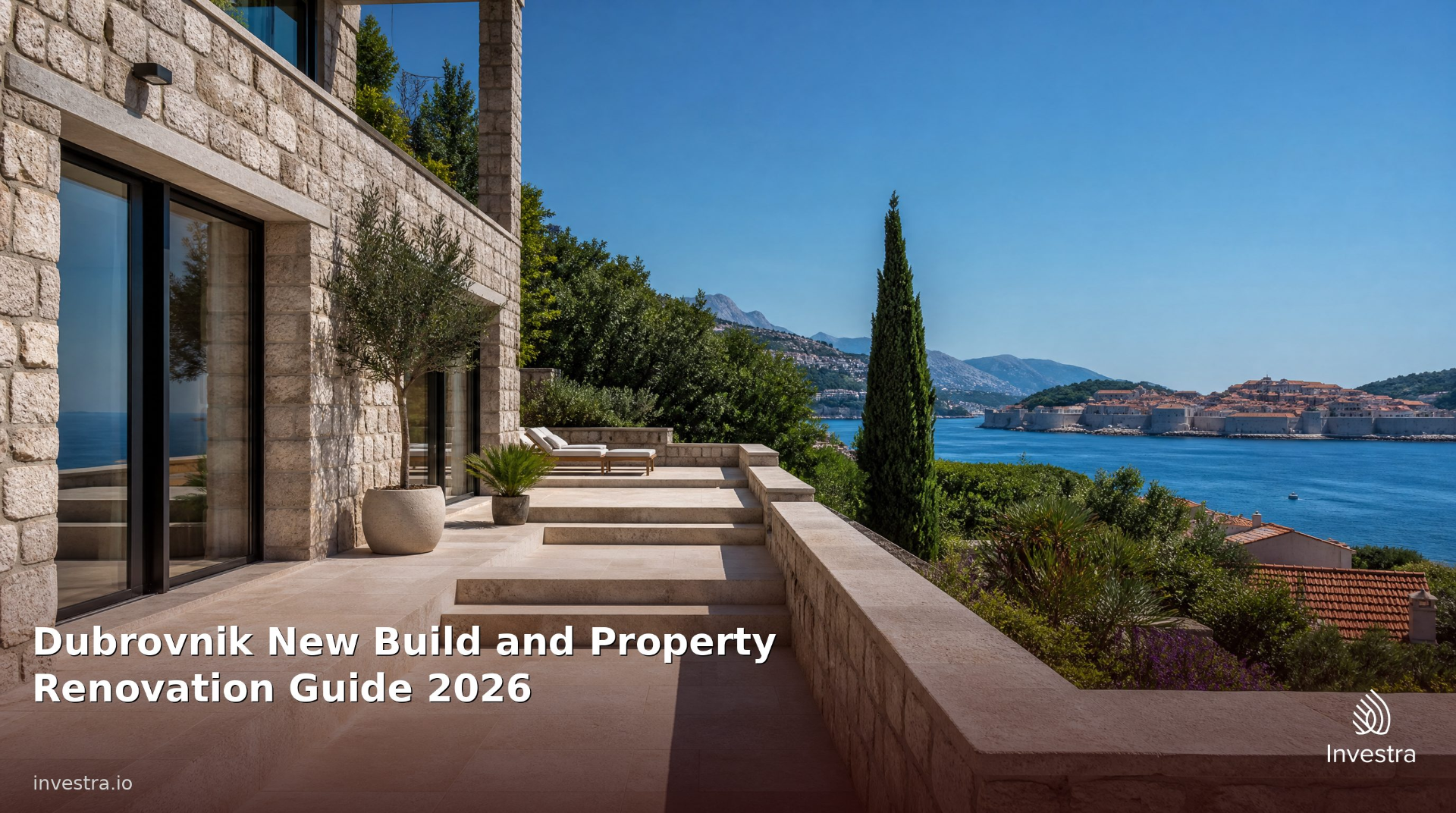
Dubrovnik New Build and Property Renovation Guide 2026
Why Dubrovnik's Property Market Is Drawing Global Attention in 2026
Quick Answer: Dubrovnik's 2026 market combines UNESCO heritage constraints, limited available supply and sustained tourism demand to produce a high-value environment for carefully executed new builds and renovation projects; the market rewards quality restorations and well-positioned new units. Buying Property In Dubrovnik 2026 Complete Guide For Foreign Investors explains the broader investor context.
Dubrovnik is both a world heritage destination and an active, evolving property market. By 2026 the city has attracted significant international attention because the combination of strict conservation rules inside the Old Town, finite historic inventory and thriving tourism demand creates upward pressure on values for scarce, well-presented assets.
Price appreciation over recent years reflects that dynamic. Prime Old Town units and restored stone houses command substantial premiums because they offer a unique product — heritage authenticity combined with modern comfort. Suburban areas that permit genuine new build construction provide the supply that buyers still want when they seek modern, energy-efficient apartments with amenities and parking.
Investors who succeed are those who respect the regulatory environment, set realistic budgets for conservation-grade work, and align asset type to income strategy. If your objective is short-term high-yield tourism income, you need careful location and product selection; if you prioritize capital growth, Old Town restorations and limited-release boutique new builds tend to outperform mass-market stock. For those needing more context on legal and transactional aspects, see Croatia Real Estate FAQ 2026 and complementary regional guides by Investra.
Understanding the Dubrovnik Property Landscape: Old Town, Suburbs, and Coastal Zones
Quick Answer: Dubrovnik's market is a mosaic of micro-markets — the UNESCO Old Town, Lapad/Gruž suburbs, and surrounding coastal villages — each with distinct price levels, renovation rules and tenant profiles. Dubrovnik Airbnb Investment 2026 Luxury Rental Income Guide analyses rental performance by area.
Before buying in Dubrovnik it is essential to distinguish between the city's micro-markets. The Old Town is primarily conservation-led: external changes are restricted and opportunities are almost exclusively restorative. Here you find the highest per-square-metre values, the tightest supply and the greatest regulatory scrutiny.
Outside the walls, the peninsulas of Lapad and Babin Kuk and the port area of Gruž offer the most straightforward new build and renovation opportunities suited to modern living. These neighbourhoods provide infrastructure, parking and easier permitting for contemporary apartments; new builds here are the principal source of modern inventory in Dubrovnik.
The broader coastal zone, encompassing Cavtat, Mlini, Zaton and the Pelješac side such as Orebić, provides a third option: lower acquisition prices per square metre, more plentiful plots, and a market profile that favours villa-style renovations and private rental returns. These areas are attractive to buyers seeking privacy, larger gardens or the potential for higher-rate villa rental income during the peak season.
Across these zones the buyer profile varies: the Old Town attracts collectors and lifestyle buyers prepared to pay for provenance; Lapad and Gruž attract repeat rental investors and longer-term residents; coastal villages draw buyers focused on retreats and private-lifestyle rental products. Understanding which zone fits your risk tolerance, timeline and return expectations is the first and most important decision.
New Build Projects in Dubrovnik 2026: What's Actually Available?
Quick Answer: Genuine new builds in 2026 are concentrated in suburbs and outer coastal settlements; off-plan prices commonly begin around €4,000–4,500/m² with finished luxury units reaching higher depending on view and specification. Croatia Real Estate FAQ 2026 answers off-plan purchase questions.
In a city where the historic core is protected, "new build" means suburban or nearby coastal construction rather than ground-up within the Old Town. The most active new build activity in 2026 is found in Lapad and Babin Kuk, where boutique developments of 10–30 units are the norm. Developers have shifted toward smaller, higher-spec projects because of limited plots and buyer demand for quality finishes and energy performance.
Developments marketed to international buyers increasingly feature contemporary amenities: underfloor heating, high-performance glazing, insulation to meet higher energy categories, and smart-home components. Buyers should assess developer track records carefully: local builders with proven delivery on time and to specification remain the most reliable counterparty.
Micro-developments on inherited plots — three to six units — represent a particularly attractive segment. These projects combine proximity to the centre with scarcity and often sell to investors who prioritise rental positioning and resale liquidity. Access to these opportunities typically requires strong local networks or specialised advisory services. For those seeking direct support in sourcing and analysing such projects, professional contacts such as Siniša Dagary investment insight may help locate off-market options.
When assessing new builds, consider practical performance measures: expected completion timelines, energy efficiency class, parking provision, storage availability, and the developer's approach to rental management support. For investors planning to operate short-term rentals, proximity to transit links and tourist hubs rather than raw distance to the Old Town can be more important than it first appears.
The Renovation Opportunity: Why Dubrovnik's Older Stock Is a Gold Mine
Quick Answer: Properly executed renovations in Dubrovnik can deliver 25–40% or more on total invested capital, with Old Town restorations and quality village house conversions typically generating the highest premiums due to rarity and character. Buying Property In Dubrovnik 2026 details valuation and rental implications.
Renovation remains the most direct way to add value in Dubrovnik because historic stock is limited and highly sought after. Investors are drawn to stone houses and older apartments because restoration can combine the aesthetic premium of authentic material with modern comfort and systems.
Investors must be rigorous on costs and timeline discipline. Success stories show tight project management, realistic contingency budgets and careful selection of local craftspeople experienced in traditional materials. Experienced advisers and project managers, often those with a track record in Dubrovnik, provide practical oversight and can be decisive in delivering budgets and protecting returns. For guidance on renovation economics across Croatian markets, comparative research such as Buying Property In Split 2026 is instructive.
Heritage Regulations and Building Permits: The Rules You Cannot Ignore
Quick Answer: Renovations and any external works in the protected Old Town require Conservation Department approval and a building permit; permitted materials and façades are strictly controlled and timelines for approvals vary from months to more than a year. Croatia Property Tax Guide 2026 outlines implications for different property types.
Heritage protection is the defining constraint in central Dubrovnik. The Conservation Department under the Ministry of Culture enforces rules that govern materials, colours, rooflines and external architectural detail. Any external change in the protected area — even changing window shutters or roof tiles — may trigger a conservation assessment.
Key practical consequences are material selection and approval sequencing. Traditional limestone, lime mortar pointing, terracotta tiles and bespoke timber joinery are frequently required for façades and roofs, and those materials and craftsmanship cost more than standard modern alternatives.
Attempting to shortcut approvals or to proceed without the necessary permits is a common and costly error. Enforcement has been stronger in recent years; fines and demolition orders are not theoretical. Engaging a licensed Croatian architect (ovlašteni arhitekt) with documented heritage experience is a practical necessity.
Renovation Cost Breakdown: What to Budget in 2026
Quick Answer: Budget ranges in Dubrovnik 2026: suburban standard renovations €700–1,000/m², mid-level village/stone house €1,200–1,800/m², and Old Town conservation projects €2,500–3,500/m² or more, with professional fees and permits adding 10–20% to totals. For regional comparisons see Buying Property In Split 2026.
Accurate budgeting is the single most important factor in delivering renovation returns. Costs vary according to location, level of intervention and the requirement to use conservation-grade materials. A clear rule of thumb in 2026 is that the more historic the property and the more visible the façade work, the higher the per-square-metre cost.
Some investors finance part of renovation through developer or bank-supported renovation loans. For structured financial advice, planners such as Findes Group & Partners provide mortgage advisory and product comparisons. Their guidance is particularly useful when combining acquisition mortgage products with renovation drawdown facilities. For direct contact with advisors, see the Findes contact page at Findes Group & Partners.
Legal Process for Foreign Buyers: Purchasing New Builds and Renovation Properties
Quick Answer: EU buyers have the same rights as nationals; non-EU buyers usually need a reciprocity check. Transactions typically involve a Pre-Contract with deposit, a notarised Main Contract, land registry updates and tax considerations such as VAT on new builds and 3% transfer tax on resales. See Croatia Property Tax Guide 2026 for tax detail.
Purchasing in Croatia has become a relatively established process for foreign investors. The primary practical requirements are an OIB number (Croatian tax ID), a local bank account and a notary for the main contract. Most purchases begin with a legally binding Pre-Contract (Predugovor) and deposit, followed by a notarised Kupoprodajni Ugovor for transfer.
Understanding the tax treatment of new builds versus resales is crucial to net returns. Developers typically include VAT at 25% for new-build sales; resale transactions attract a 3% transfer tax (Porez na promet nekretnina). Some buyers structure acquisitions through local entities or EU business structures to manage VAT exposure; this is a technical tax matter and requires specialist counsel. For practical legal and structuring questions, advisory resources and legal teams profiled in Investra guides are a starting point, and advisers such as those associated with Siniša Dagary investment insight can discuss structuring and transaction oversight.
Short-Term Rental Licensing and Income Potential in 2026
Quick Answer: A tourism rental licence (rješenje) is required to operate short-term lets; licensed, well-located properties in Dubrovnik can generate annual gross income ranging widely depending on size and season, with premium renovated Old Town apartments typically delivering the highest per-night rates. Dubrovnik Airbnb Investment 2026 explains licensing and revenue modelling.
Short-term rental income in Dubrovnik is shaped by seasonality, product quality and licensing compliance. The tourism licence is property- and owner-specific; buyers of an existing rental business should re-apply for licensing in their name after purchase.
Revenue projections must account for high season concentration: July and August deliver the majority of nights and the highest rates, with shoulder months contributing meaningfully for well-positioned assets. For licensing, classification categories exist and often impact marketing and pricing; higher-category properties generally command higher nightly rates but require corresponding capital investment in appliances, furnishings and service standards.
Many investors engage professional property management teams to handle guest relations, maintenance and dynamic pricing. That management cost should be included in net yield calculations. For comparative rental frameworks and examples from other Dalmatian markets consult related Investra guides covering Split and Hvar, which illustrate the regional patterns and investor considerations: Split Airbnb Investment 2026 Rental Income Best Areas Leg... and Hvar Island Real Estate 2026 Luxury Property Investment G....
Financing, Taxes, Neighbourhood Selection and Structuring Your Purchase
Quick Answer: Successful transactions combine appropriate financing, tax planning and neighbourhood selection: local mortgages, developer finance or structured products can be used; tax differences between new builds (VAT) and resales (transfer tax) matter; consider target tenant and location when choosing neighbourhoods. Croatia Property Tax Guide 2026 provides tax detail and implications.
Structuring the acquisition and financing is a strategic step with immediate cashflow implications. Local bank mortgages are available to non-resident borrowers but typically require higher down payments and proof of income. Developer payment plans and staged drawdowns are common for new builds and reduce the amount of capital required up-front, but buyers must understand deposit protection and the refund policy if developers fail to deliver.
Tax planning is equally material. VAT on new builds adds a visible cost layer; however, in certain corporate purchase structures and for VAT-registered businesses the VAT component can be managed differently. Resale purchases attract a 3% transfer tax, which is simpler to model. Annual property taxes, municipal fees and tourist levies should be factored into operating costs for rental projections.
Neighbourhood selection ties finance and tax implications to the product type. If your objective is stable long-term rental income or residency, suburbs like Lapad and Gruž align with that model. If you target premium seasonal income and capital appreciation, Old Town restorations and limited coastal villa projects are the natural choice. For mortgage and financial advisory services tailored to Croatian property transactions consider professional advisers such as Findes Group & Partners and consult their contact resource at Findes Group & Partners for engagement options.
Choosing Neighbourhoods and Project Types: Match Strategy to Goal
Quick Answer: Match product type to investment objective: Old Town for capital-led returns and high-season short-term rent, Lapad/Gruž for year-round tenants and digital nomads, and coastal villages for private-villa conversions and seasonal premium lets. See Investra neighbourhood analysis for comparative detail. Buying Property In Split 2026 and regional Investra research provide comparative context.
A neighbourhood choice should follow strategy. Investors focused on capital appreciation and scarcity often prioritise any qualifying Old Town asset they can acquire and sympathetically restore. Those focused on consistent rental income and lower capital outlay often favour Lapad and Gruž, where a modern apartment with parking and good transit links will appeal to longer-stay tenants and digital nomads.
When selecting a neighbourhood consider practical criteria: distance to the Old Town, pedestrian access, vehicular parking, views, delivery logistics for renovation works, local services such as supermarkets and medical facilities, and the quality of local management companies. Market liquidity also varies: small Old Town apartments may be highly liquid to a narrow set of buyers, whereas suburban units trade to a broader pool. For a comprehensive review of Zagreb and other Croatian markets and how they compare, consult Investra market research articles on Zagreb pricing and neighbourhoods that illustrate differing market mechanics: Investra market research, Investra market research, Investra market research and Investra market research.
Project Management, Contractors, Exit Strategies and Professional Advisers
Quick Answer: Delivering renovation or new build projects in Dubrovnik requires a compact professional team: a licensed architect, an experienced contractor, a project manager familiar with local supply chains and a legal adviser; plan your exit strategy at acquisition to manage time-to-market and resale expectations. For advisory services see local consultants and strategy resources. Siniša Dagary investment insight documents practical project experiences.
Execution determines whether a renovation becomes a value-creating transformation or a cost overrun. Professional project management is essential, particularly for off-site investors.
Contractor selection should be rigorous: obtain references and visit completed projects; ensure insurance and warranties are in place; and structure payments in tranches tied to verified milestones. For heritage projects, retain specialists in stonework, joinery and lime mortars. Delays in specialist deliveries are common and must be priced into both cost and schedule contingencies.
Exit strategy must be considered at purchase. Decide whether you are building to operate for the medium to long term, to sell on completion or to test the market with a staged letting approach. Each path implies different finishing standards, marketing strategies and regulatory documentation. For investors seeking advisory relationships and transaction coordination, contacts such as Siniša Dagary investment insight and his described services at Siniša Dagary investment insight are examples of the sort of local professional support that speeds projects to market.
Investment Disclaimer
Quick Answer: The content in this guide is informational and should be used to support due diligence; investors must conduct their own checks, obtain independent legal and tax advice, and accept that property investment involves capital risk and variable returns.
The material contained in this guide is intended to provide practical information about Dubrovnik's property market in 2026. It is not a substitute for independent legal, tax or financial advice. Real estate investments carry risks, including market volatility, changes to regulation, project delays and cost overruns. Past performance and quoted ranges do not guarantee future outcomes. Before committing funds, conduct detailed due diligence, obtain professional legal and tax counsel and consider personal financial circumstances carefully. Investra and referenced advisers are sources of market information; engagement with any adviser should include verification of credentials and references. For further background on taxes and legal obligations consult Croatia Property Tax Guide 2026 and seek qualified counsel.
Frequently Asked Questions
Quick Answer: The following questions are the ones investors most commonly raise about buying, renovating and letting property in Dubrovnik in 2026; answers are concise and should be supplemented with professional advice.
Is Croatia a good country for real estate investment in 2026?
Croatia remains attractive because of strong coastal tourism, improving connectivity and competitive price points compared with many Western markets. Opportunities are best assessed against precise objectives — income, residency or capital growth — and with up-to-date local market data such as Investra research.
Can foreigners buy property in Croatia?
EU nationals purchase under the same conditions as Croatians. Non-EU purchasers typically require a reciprocity check; legal counsel and in-country support ease documentation and registry processes. A local OIB and a Croatian bank account are practical prerequisites.
What is the average property price in Dubrovnik?
Price varies significantly by location and condition: prime Old Town prices are substantially higher than suburban or village stock. Refer to current market reports and consult specialists for a valuation tailored to a specific property and its permitted use.
What renovation costs should I budget for?
Estimates in 2026: suburban standard works €700–1,000/m²; mid-level village or stone house €1,200–1,800/m²; Old Town conservation projects €2,500–3,500/m², with professional fees and permits adding further costs.
How long do permits take in Dubrovnik?
Permitting timelines vary: simple interior works can be permitted within a few months; projects requiring Conservation Department approval typically need 6–12 months, with very complex structural conservation cases extending beyond that.
What taxes apply to new builds and resales?
New build sales by developers are subject to 25% VAT, usually included in the quoted price; resales typically incur a 3% transfer tax. Annual property taxes and tourist levies are additional operating costs to model.
Can I operate a short-term rental legally?
Yes, provided you obtain the tourism rental licence and comply with safety and accommodation standards. Licences are property- and owner-specific; new owners should re-register to avoid compliance gaps.
What financing options are available?
Options include local bank mortgages, developer instalment plans, renovation loans and structured products for corporate buyers. Mortgage terms for non-residents vary and typically require higher deposits; consult specialist mortgage advisers for current products.
How do I choose the right neighbourhood?
Match your investment objective to the neighbourhood’s profile: Old Town for scarcity and capital growth; Lapad/Gruž for year-round rentals and lifestyle amenities; coastal villages for villa projects and seasonal premium lets. Liquidity, services and regulations differ across zones.
Who should manage the renovation and operation?
Engage a licensed architect experienced in Dubrovnik conservation, a contractor with local references, an independent project manager and legal counsel. For operations, trusted property managers with guest services and housekeeping capability are essential to sustain occupancy and rates.
Where can I find more detailed local market research?
Investra's regional guides and market research offer comparative insights across Croatia's major cities and coastal towns. Specific Investra reports cover topics such as buying in Split, Hvar and Zagreb, and detail tax and rental frameworks.
Recommended Reading
Quick Answer: This section explains the practical property-investment implications of Recommended Reading.
- Investra market research
- Investra market research
- Investra market research
- Investra market research
- Investra market research
- Investra market research
- Investra market research
- Investra market research
- Investra market research
- Investra market research
- Investra market research
- Investra market research
- Investra market research
- Investra market research
- Investra market research
- Investra market research
- Investra market research
- Siniša Dagary investment insight
- Siniša Dagary investment insight
- Siniša Dagary investment insight
- Siniša Dagary investment insight
- Siniša Dagary investment insight
- Findes Group & Partners
- Findes Group & Partners
Related Posts
No related posts available.
