
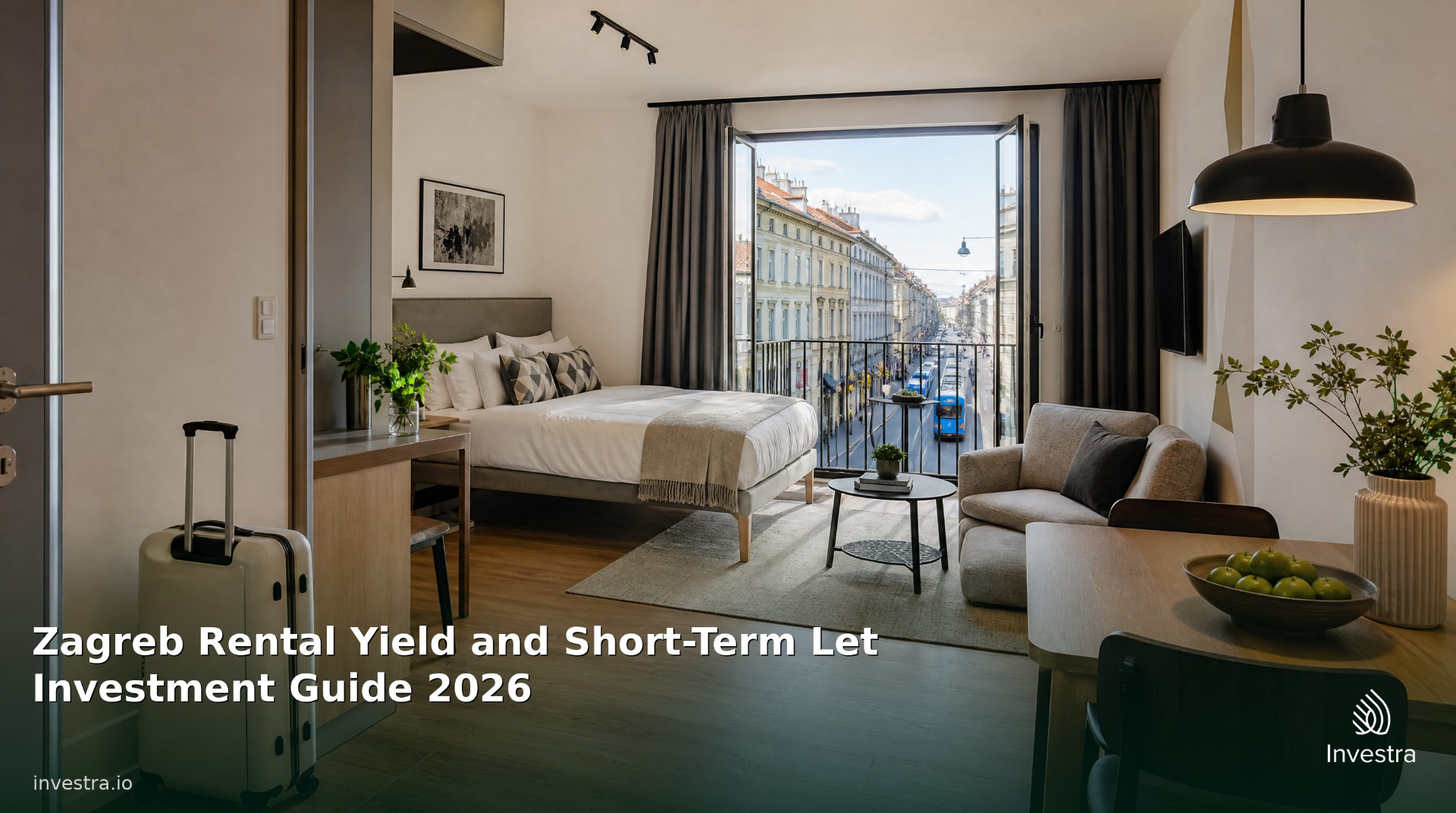
Zagreb Rental Yield and Short-Term Let Investment Guide 2026
Why Zagreb Is Quietly Becoming One of Europe's Most Compelling Rental Markets
Quick Answer: Zagreb offers rental yields ranging from 5% to 9% depending on location and strategy, with short-term lets consistently outperforming long-term rentals — making it one of Central Europe's most undervalued investment destinations in 2026. Investra.io's Zagreb buyer guide breaks down everything foreign investors need to know before entering this market.
Zagreb has flown under the radar compared with Croatia's Adriatic resorts, yet it offers a combination of price, demand diversity and policy stability that makes it an attractive location for investors focused on rental income and capital preservation. Compared to many Western and Central European capitals, Zagreb still presents substantially lower entry prices for good central stock. That gap creates yield and upside potential without exposing buyers to the extreme seasonality found along the coast.
Several structural developments underpin the city's appeal. Post-2020 reconstruction programmes repaired and upgraded historic housing stock, new residential builds have added modern inventory, and the city’s rising profile among digital nomads and expats increased consistent demand across all seasons. Schengen accession and euro adoption reduced friction for cross-border visitors and tenants, reinforcing Zagreb’s position as a year-round market rather than a strictly seasonal one.
Investors who look beyond headline tourist cities find Zagreb’s short-term rental ecosystem mature enough to deliver professional-level returns while maintaining a lower cost basis than cities with comparable visitor mixes. For a deeper, practical walkthrough tailored to foreign purchasers, the Zagreb buyer guide from Investra is a recommended starting point.
Understanding Zagreb's Property Price Landscape in 2026
Quick Answer: Zagreb apartment prices in 2026 range from €1,800/m² in outer districts to €4,800/m² in prime central locations, with the most investment-attractive zones sitting in the €2,500–€3,800/m² range. Consult the Croatia Real Estate FAQ 2026 for a broader pricing overview.
Price is the primary lever for yield. Zagreb is a mosaic of micro-markets where a few hundred euros per square metre can change the investment profile materially. The city centre—Gornji Grad and the immediate Donji Grad area—holds the highest per-square-metre values due to scarcity and strong appeal for short-term stays. These central apartments deliver premium nightly rates but also require higher capital and often higher standards of finish and maintenance.
Outside the core, neighborhoods such as Maksimir, Trešnjevka and Trnje present sensible compromises: lower entry prices and solid demand from residents and commuters. New-build corridors like Savica and Špansko provide predictable construction quality and typical amenities (parking, insulation, elevators), which are attractive to long-term tenants and medium-term professionals. Buying strategy should therefore align with intended use: short-term tourist lets require central location and finish; long-term or medium-term lets can tolerate more distance in exchange for a better yield-to-price ratio.
Post-earthquake reconstruction created an unusual supply dynamic. Some renovated historic properties in Kaptol and the Cathedral area present modernised apartments with historic character at competitive prices compared to equivalent pre-earthquake units. These can be particularly interesting where renovation standards meet EU seismic and thermal efficiency norms—an asset for both marketing to guests and for future resale.
Short-Term Rental Yields: What Zagreb Airbnb Actually Returns in 2026
Quick Answer: Zagreb Airbnb investments in prime central locations are generating gross rental yields of 7–9% in 2026, with net yields after costs and taxes typically settling at 5–7% — figures that compare favourably with most Western European capitals. The Split Airbnb Investment Guide offers useful benchmarks for comparative coastal yield analysis.
Short-term letting in Zagreb is characterised by steadier year-round demand than many tourist-dependent markets. While coastal destinations see sharp summer peaks, Zagreb’s mix of business travel, conference attendees, medical tourists and cultural visitors creates a more even occupancy profile. Average nightly rates for well-positioned properties in the city centre have been consistent in the €85–€150 range for one and two-bedroom units, with occupancy commonly between 65% and 78% for the strongest locations.
Sample return illustrations help make this tangible without relying on speculative forecasts. A compact, well-appointed one-bedroom in Donji Grad bought at mid-market prices typically returns gross revenue aligned with the previously stated nightly rates and occupancies. After platform fees, management and operating costs, net yield routinely narrows but remains competitive. Those figures are directly comparable to many second-tier European capitals and, when adjusted for capital entry price, often favourable.
Scale matters. A single well-managed unit can be profitable, but a small cluster—two to five apartments—allows a management company to amortise cleaning, linen and marketing costs more efficiently. For operators seeking to scale without taking on development risk, focusing on contiguous or similar units in the same building reduces operational complexity and improves guest consistency.
Long-Term Rental Yields: The Steady Alternative
Quick Answer: Long-term residential rentals in Zagreb produce gross yields of 4–6.5%, with professionally managed properties in expat-preferred neighbourhoods at the higher end of that range. This strategy offers lower revenue ceiling but substantially reduced operational complexity and legal exposure.
For many investors—especially those based overseas or holding property as part of a diversified portfolio—long-term letting is a compelling, low-friction strategy. The shift to the euro and broader EU integration elevated demand from international tenants and corporate relocations. Two-bedroom centrally located apartments that target corporate or diplomatic tenants command rents that support gross yields around the 5–6% mark; after management and taxes, net yields typically settle in the mid-4% range.
The trade-offs are clear: lower yield potential than high-performing short-term lets, but also fewer administrative demands, far lower marketing spend, and reduced variability in cashflow. For non-resident owners, particularly those using corporate structures or local property managers, long-term leasing simplifies compliance, especially where tenancy law and registration requirements are more onerous for frequent turnover.
Investor fit matters. Properties positioned toward professional expats—furnished, well-located near transit, and with reliable internet—tend to outperform those aimed at local student populations in both rent stability and lower tenant turnover. When evaluating a purchase for long-term letting, focus on neighborhoods with strong employment nodes and proximity to international schools or co-working spaces.
The Best Neighbourhoods for Rental Investment in Zagreb
Quick Answer: Donji Grad and the streets surrounding the main square offer the strongest short-term rental performance, while Gornji Grad suits premium long-term lets and boutique accommodation. Outer residential districts like Maksimir and Črnomerec provide better long-term yield-to-price ratios for budget-conscious investors. Siniša Dagary — Investment Consultant advises investors on neighbourhood-specific strategies across Croatia's major cities.
Neighbourhood selection is the most important tactical decision an investor makes in Zagreb. Donji Grad is the city’s short-term rental epicentre: its blend of transport links, cultural venues and restaurants attracts both leisure and business guests. Gornji Grad is distinct—historic, atmospheric, and desirable for guests seeking an authentic, higher-priced stay. The premium there is in both nightly rates and the expectation of higher service standards.
Trnje and Savica, south of the river, are newer development corridors with more modern inventory. They are more suitable for long-term tenants and young professionals. Maksimir appeals to families and those valuing green space; properties here can be marketed to longer-stay tenants seeking quality of life. Emerging pockets such as Peščenica-Žitnjak show gradual infrastructure-led appreciation, making them candidates for buy-and-hold strategies focused on mid-term capital growth.
It is useful to map intended tenant profiles directly to neighbourhood characteristics. Short-term yield maximisers should prioritise immediate proximity to the main square, the cathedral and premium tram lines. Medium-term and long-term strategies can accept distance in exchange for larger floorplans, parking and lower purchase multiples. For a comparative coastal perspective and how urban demand compares with seaside yield profiles, see Investra’s regional guides including Split Airbnb Investment Guide and coastal research on Dubrovnik.
Legal Requirements for Short-Term Rentals in Zagreb
Quick Answer: Short-term rentals in Croatia require official registration with the local tourism authority and tax registration as a sole trader (obrt) or through a company structure. Operating without proper registration carries significant fines and risks licence revocation. The Croatia Property Tax Guide 2026 covers all fiscal obligations in detail.
Croatia’s regulatory framework for short-term accommodation is formal and predictable, which benefits established operators and responsible newcomers. Registration with the national eTourism/eVisitor system is mandatory for every unit. That registration process confirms minimum category standards — documentation and a short inspection typically validate that the unit complies with required safety and hospitality conditions.
Foreigners can operate either as individual hosts (registered sole trader or obrt) or through corporate entities. The legal choice affects tax treatment and administrative obligations. Short-term operators must also register and report guest arrivals promptly through eVisitor; many property managers handle this automatically, which is an argument in favour of outsourcing compliance-intensive tasks.
Failure to register or to remit guest sojourn taxes can result in administrative fines and temporary suspension. Given the clear procedural steps and the possibility to delegate compliance, the regulatory regime in Zagreb should be viewed as enabling rather than obstructive. For ongoing commentary and practical updates on Croatian business regulation, the analyses on Siniša Dagary’s blog are a useful resource.
Tax Obligations for Zagreb Rental Income in 2026
Quick Answer: Rental income from Croatian property is taxed at 12% flat rate for individuals operating under the simplified tourism tax regime, or at progressive personal income tax rates (20–30%) for standard income declaration. Corporate structures offer additional planning flexibility. Read the full Croatia Property Tax Guide before making any structural decisions.
Understanding Croatia’s tax options is essential, because tax selection affects net yield materially. The simplified tourism tax (paušal) is attractive to many short-term hosts as it replaces variable tax liabilities with a fixed payment determined by property attributes. For high-revenue units, this can produce an effective tax rate well below standard income tax bands, but it removes the ability to deduct actual operating costs.
The alternative is to elect standard taxation, declare actual income and expenses, and pay progressive personal income tax. This approach is more suited to owners with lower revenue or significant documented expenses that they can legitimately deduct. For investors building a portfolio, establishing a Croatian d.o.o. offers corporate tax treatment, formal expense deductibility, and clearer profit repatriation routes—factors many investors weigh when evaluating multi-unit strategies.
Other transactional taxes include property transfer tax on resale transactions and VAT implications on new-build purchases. These transactional costs should be modelled into acquisition budgeting. For structured tax planning and cross-border implications, advisors such as Findes Group & Partners are commonly engaged by investors to align ownership structures with tax outcomes and estate planning objectives.
The Digital Nomad Effect: How Remote Workers Are Reshaping Zagreb's Rental Market
Quick Answer: Croatia's digital nomad visa programme, combined with Zagreb's relatively low cost of living and strong infrastructure, has created a new tenant segment willing to pay premium monthly rates for furnished apartments — a trend that meaningfully supports medium-term rental demand. The Croatia Digital Nomad Visa 2026 guide explains exactly who qualifies and what to expect.
The digital-nomad and remote-worker cohort has grown into a material demand generator for Zagreb’s rental market. These tenants typically seek furnished apartments with reliable high-speed internet and a pleasant working environment. Their stays often fall into the 3–9 month range and they represent a segment that values flexibility and quality over price alone. That explains the rising availability of medium-term offers and the adoption of monthly rate features on platforms such as Booking.com.
Medium-term lets can combine many advantages of long-term letting (reduced daily operational costs) with higher effective monthly income compared with a conventional long-term rental. For property owners, designing a unit for this segment generally requires modest up-front investment: a dedicated workspace, dependable internet and a clear inventory of appliances and furnishings. Co-working growth in Zagreb supports this trend and makes proximity to co-working hubs a marketable attribute.
For investors looking to capitalise on this, positioning a three- to six-month offering with flexible check-in and professional support increases attractiveness. Property managers who have migrated to offering combined short-, medium- and long-term solutions are often the best partners for owners targeting this hybrid demand profile.
Buying Process for Foreign Investors: What You Actually Need to Know
Quick Answer: EU citizens can purchase Croatian property on equal terms with nationals, while non-EU buyers require reciprocity agreements or a Croatian company structure. The purchase process typically takes 6–12 weeks from offer to completion. The complete Zagreb buyer's guide provides a step-by-step walkthrough of the entire process.
The transaction model in Croatia is procedural and lawyer-led. Key steps include securing an OIB (tax number), conducting title and encumbrance searches at the land registry, reviewing municipality development plans where relevant, agreeing a purchase contract with defined deposit and completion terms, and registering the transfer at the Notary Public and Land Registry. Timelines vary with the complexity of checks and whether financing is required.
EU citizens face no restrictions. For non-EU buyers, reciprocal agreements or alternative ownership via a Croatian company (d.o.o.) are common solutions. Many foreign buyers choose a Croatian company for tax, liability and succession planning reasons even when not strictly necessary for acquisition. A local lawyer and accountant should be engaged early; they streamline OIB registration, prepare purchase documents and confirm compliance with local tax and reporting requirements.
For those seeking comparative regional perspectives, Investra's country and regional guides remain useful: see analysis on Croatia’s coastal and inland markets such as Hvar Island, Dubrovnik, and the regional purchase guides for Split and other towns. For transaction-level assistance, professional service providers such as Siniša Dagary investment insight and Findes Group & Partners are frequently engaged by international clients for structured acquisitions.
Practical Management, Scenarios and Risk Management
Quick Answer: Operational costs, management choices and guest profile determine net yield; professional management reduces personal time commitment and compliance risk but typically costs 15–20% for short-term rentals, 8–12% for long-term letting. Work through scenarios to identify the right balance between yield, complexity and personal involvement.
Real results depend on day-to-day execution. Platform fees, cleaning, utilities, linen, maintenance, marketing and professional photography all reduce gross revenue. In prime short-term locations, owners commonly budget 15–20% for management and 10–20% for combined platform and payment fees; add utilities and periodic maintenance to complete an annualised operating budget. Long-term letting dramatically reduces many of these recurring costs but also lowers gross revenue.
Practical risk considerations include regulatory compliance, guest damage, variable occupancy and the potential for concentrated exposure (for example, owning multiple units in the same small building). A conservative investor models three scenarios—optimistic, base-case and conservative—using the documented nightly rates, occupancy ranges and cost assumptions described earlier. Sensitivity analysis on occupancy and average nightly rate is particularly important because small percentage shifts can change net yield materially.
For hands-on owners, establishing local service contracts for cleaning, linen and emergency maintenance is essential. For hands-off investors, selecting a management partner with strong reviews, transparent reporting and clear compliance processes is the higher-value decision. Many investors retain a local lawyer for title and contract matters and a tax accountant for annual compliance; both are complementary to a property manager’s operational role.
Investment Disclaimer
Quick Answer: This guide summarises market information and practical steps but is not a guarantee of outcomes; always verify facts, perform due diligence and engage appropriate professionals.
The information in this article is for educational and informational purposes only. Real estate investments carry inherent risks, and past performance does not guarantee future results. Investors should perform their own due diligence and consult with qualified local legal, tax and property professionals before making any decisions. Investra.io and the contributors referenced here make no guarantees regarding returns or suitability for any individual investor. Use this guide to structure questions and to plan an informed acquisition and operating strategy, not as a substitute for professional analysis.
Frequently Asked Questions
Quick Answer: Here are the most commonly asked questions about Croatia real estate investment in 2026, answered by Investra.io experts.
Is Croatia a good country for real estate investment in 2026?
Yes. Croatia combines improving infrastructure, rising visitor numbers and attractive pricing relative to Western Europe. Zagreb, in particular, offers year-round demand from business, medical tourism and a growing digital nomad community. For market context and comparative analysis, Investra.io provides deeper fiscal and market coverage.
Can foreigners buy property in Croatia?
EU citizens have the same purchasing rights as Croatian nationals. Non-EU purchasers should check reciprocity rules and may use a Croatian company structure where necessary. Investra offers buyer support to clarify these specifics and to assist with local registration and notary procedures.
What is the average property price in Zagreb?
Average prices vary widely by district and by the quality of finish. Central units are substantially higher than outer suburban stock. For up-to-date, street-level pricing and investment modelling, contact the Investra research team or consult the Zagreb buyer guide linked earlier.
What rental yields can I expect?
Yields depend on strategy. Short-term lets in prime central locations typically deliver gross yields of 7–9% with net yields around 5–7% after costs. Long-term rentals offer gross yields of 4–6.5% with lower variability. Use conservative modelling to test sensitivity to occupancy and rate changes.
What taxes apply to property purchases?
Property transfer tax, VAT on some new-build purchases and applicable annual taxes are the core transactional taxes. The tax treatment of rental income depends on the chosen regime—simplified tourism tax, standard personal income tax or corporate taxation via a d.o.o.—each with different implications for deductibility and effective tax rates. Professional advice from local tax advisors such as Findes Group & Partners can be useful for cross-border structures.
How long does the purchase process take?
Standard purchases in Zagreb commonly settle within six to twelve weeks when there are no title complications and financing is in place. The process includes OIB registration, contract negotiation, notary execution and land registry entry. Working with experienced local professionals reduces delays.
What financing options are available?
Local bank mortgages are available to residents and to qualifying foreign buyers; developer finance and private lending are also used. Financing terms depend on borrower profile and collateral. For structured finance and mortgage advisory, investors frequently consult providers such as Findes Group & Partners.
Is property management available for rental properties?
Yes. Management services range from cleaning and guest communication to full-service marketing and fiscal compliance. Management fees typically sit at 15–20% for short-term operations and 8–12% for long-term letting. Choosing a manager with a track record in Zagreb is critical to protect occupancy and reputation.
What are the best areas to invest in Zagreb?
Investment goals define the best area. Donji Grad is the short-term rental leader; Gornji Grad suits premium and boutique offers; outer districts like Maksimir and Trnje are better for long-term yield-to-price balance. Investra research covers neighbourhood performance in more detail across its local market briefs.
Recommended Reading
Quick Answer: This section explains the practical property-investment implications of Recommended Reading.
- Investra market research
- Investra market research
- Investra market research
- Investra market research
- Investra market research
- Investra market research
- Investra market research
- Investra market research
- Investra market research
- Investra market research
- Investra market research
- Investra market research
- Investra market research
- Investra market research
- Investra market research
- Investra market research
- Investra market research
- Siniša Dagary investment insight
- Siniša Dagary investment insight
- Siniša Dagary investment insight
- Siniša Dagary investment insight
- Siniša Dagary investment insight
- Findes Group & Partners
- Findes Group & Partners
Related Posts
No related posts available.
