
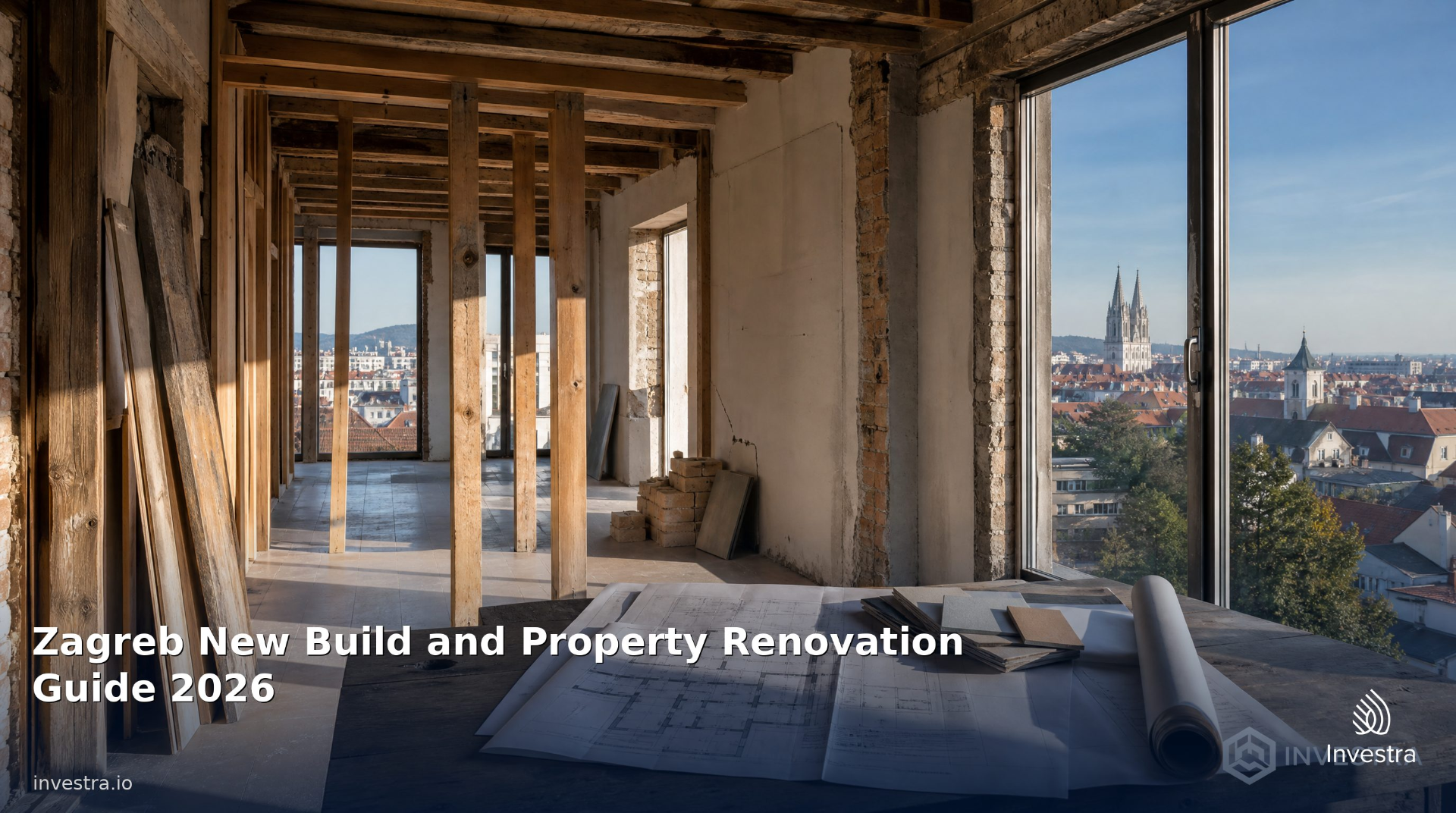
Zagreb New Build and Property Renovation Guide 2026
Zagreb's New Build and Renovation Landscape: What the Market Looks Like in 2026
Quick Answer: Zagreb's new build and renovation market in 2026 offers opportunities across high-quality new developments and value-add renovation projects. Entry renovation prices can start near €1,200–€2,500/m² while premium new build prices in central districts commonly reach €4,000–€5,500/m². See practical acquisition steps and district-level guidance in Buying Property In Zagreb 2026 Complete Guide For Foreign Investors.
Zagreb is a functioning European capital with about 800,000 residents, a large university population and a growing tech and services sector. For buyers who have watched coastal Croatian markets trade at premium multiples, the capital represents an alternative with different risk and return dynamics: deeper rental markets, untapped renovation potential, and a pipeline of new developments that reflect higher architectural and energy-efficiency standards than earlier stock.
The 2020 earthquakes materially reshaped the investment landscape. They exposed structural weaknesses in older building stock but also freed capital into the market by placing many properties in need of substantive repair.
Croatia's Eurozone entry in 2023 eliminated the currency mismatch that previously deterred some international buyers. Combined with EU legal protections and a transparent registration system, Zagreb today can be assessed like other European capitals, albeit with local legal, construction and permitting idiosyncrasies that materially affect timelines and costs.
Throughout this guide the emphasis is practical: compare district-level price bands, recognise the cost drivers that determine renovation feasibility, and understand the regulatory checkpoints that can delay or enable value realisation. For a practical acquisition roadmap, in-depth procedural detail and full market listings, consult Investra's buyer guides and market research such as the Investra market research and how-to guide.
New Build Developments in Zagreb: Key Projects and Price Benchmarks 2026
Quick Answer: New build pricing in 2026 ranges roughly €2,500/m² in outer districts to €4,500–€5,500/m² for high-end developments in central locations; active corridors include Novi Zagreb, Heinzelova and reconstruction zones in Gornji Grad, described further in Investra's buyer resources.
Over the last decade developers in Zagreb have shifted from commodity product to projects that emphasise design, energy efficiency and amenity. This is a mixed result of rising construction costs, buyer expectations and municipal planning that favours quality over density in many central neighbourhoods.
Prices and segment dynamics in 2026 are concentrated around clear corridors:
- Gornji Grad and Donji Grad: Heritage reconstruction and boutique new builds command the highest premiums, typically €4,000–€5,500/m² for thoroughly modernised units with strong finishes.
- Heinzelova and Kvaternik Square: Mixed-use developments attract residents seeking proximity to the centre without the strict heritage constraints; typical pricing €3,200–€4,200/m².
- Novi Zagreb: A modern city expansion where new build supply and family-oriented layouts keep prices in the €2,500–€3,200/m² band while offering long-term rental appeal.
- Maksimir and Črnomerec: More suburban, green districts with boutique developments in the €3,000–€3,800/m² range and strong family rental demand.
New build supply is structured: smaller projects of 10–40 units are common in the centre, whereas larger schemes appear in peripheral zones. Off-plan purchases remain available and developers often provide stage-based payment plans that can improve effective return on equity. For comparison across Croatian coastal and island markets and to see product-level differences, Investra's regional investment guides are useful resources, including the Split Airbnb Investment 2026 guide, Dubrovnik Airbnb Investment 2026 Luxury Rental Income Guide and sector pieces on island markets such as Hvar Island Real Estate 2026.
Developers now commonly achieve higher energy standards and include amenities such as parking, storage, communal green space and smart systems. Where supply is constrained by conservation rules or limited buildable plots, price resilience is strongest — a dynamic most visible in Gornji Grad.
Zagreb Property Renovation Opportunities: Where the Real Value Hides
Quick Answer: Renovation projects offer material value-add potential: acquisition prices for unrenovated or earthquake-damaged properties can start near €1,200–€2,500/m² with post-renovation values of €3,000–€4,500/m² in central locations; successful execution is dependent on structural assessment and permitting.
The renovation opportunity in Zagreb is not theoretical. The city's stock includes many early 20th-century buildings with generous room proportions and locations close to employment and cultural nodes. Earthquake-affected properties can trade well below replacement cost, creating an upside for investors who understand the technical and bureaucratic hurdles.
District-level dynamics favouring renovation:
- Gornji Grad: High prestige and constrained supply magnify post-renovation pricing, but conservation controls and extended permit timelines mean execution is a long-game strategy.
- Donji Grad: Austro-Hungarian era blocks with large apartments suited to both owner-occupier upgrades and furnished rentals; the renovation arithmetic here has proved attractive to domestic and international buyers.
- Trnje and Trešnjevka: Rapid gentrification corridors where renovation yields are lower in absolute terms but still competitive on percentage returns due to low entry prices.
Practical lessons for renovation investors:
- Obtain a pre-purchase structural and seismic assessment. Many post-earthquake surprises are hidden behind surface finishes.
- Budget conservatively. Structural remediation and compliance with conservation requirements commonly exceed initial estimates.
- Engage an architect and an administrator familiar with Zagreb City Planning and the Conservation Department to minimise permit friction.
For a consolidated set of investor questions on renovation feasibility and local cost drivers, see the Croatia Real Estate FAQ 2026; for consultancy and in-market coordination services, Siniša Dagary provides investor support and project structuring; details are available at Siniša Dagary investment insight.
The Legal Framework for New Builds and Renovation Projects in Zagreb
Quick Answer: EU nationals enjoy the same property rights as Croatians; non-EU buyers are eligible but may require ministerial approval. Renovations in listed buildings need Conservation Department consent and permits from City Planning; legal counsel and an experienced architect are essential.
Croatia's legal framework places the practical burden of compliance on the buyer when undertaking renovation or new construction. For new builds, ensure the developer holds a valid Građevinska dozvola (building permit) and that a Uporabna dozvola (use permit) will be issued on completion. For purchases off-plan confirm contractual safeguards in the Predugovor and the handling of deposits.
Renovation specificity:
- Listed or culturally protected properties (zaštićeno kulturno dobro) require a conservation opinion and typically material reporting to the Conservation Department. Expect an additional 3–9 months for approvals and possible scope restrictions.
- Structural or system works require a reconstruction permit (Rješenje za rekonstrukciju) from Zagreb City Planning; smaller cosmetic works do not normally trigger full permits but should be confirmed with a local architect.
Engage a local property attorney (odvjetnik) early. Market practice for legal fees is commonly 1–1.5% of purchase price for full transaction support. For international buyers seeking in-market coordination, the consultancy services described at Siniša Dagary investment insight outline an advisory approach that bundles legal, technical and project management support.
Construction Costs and Renovation Budgets: What Investors Should Actually Expect
Quick Answer: Realistic 2026 budgets are: basic refurbishment €400–€600/m²; mid-level renovation €600–€900/m²; full structural or heritage-compliant renovation €900–€1,400/m². New-build construction costs typically range €1,200–€1,800/m² excluding land. Costs rose materially since 2021 due to Supply chain and labour pressures.
Construction costs are a primary determinant of renovation feasibility. The Croatian market has experienced material cost inflation driven by supply chain disruption and migration of skilled labour to neighbouring EU economies. The result: tighter margins for speculative developers and a need for investors to stress-test budgets.
Typical project budgets and timelines:
- Basic cosmetic renovation (no structural work): €400–€600/m². Suitable for modern finishes in structurally sound post-war apartments.
- Medium renovation (systems upgrades, some plan changes): €600–€900/m². Includes electrical rewiring, plumbing replacement, and moderate layout modification.
- Full structural renovation and heritage compliance: €900–€1,400/m². Applies to earthquake remediation, listed buildings and high-end finishes. Budget contingency is essential.
Timelines: a routine 70–80m² apartment refurbishment can take 4–6 months once permits are approved. Heritage or structural projects typically extend to 8–14 months. Cashflow modelling must account for carrying costs and delayed yield commencement; a month without rental income is an explicit cost to the investor.
Alternative approaches:
- Purchase off-plan new build to avoid renovation execution risk and to benefit from staged payments. Many developers now offer 20–30% deposits with staged instalments.
- Use specialist contractors who operate inside Zagreb's permit environment to reduce rework and compliance delays.
For project-level advisory and operational support during execution, see Siniša Dagary's contact and service pages: Siniša Dagary investment insight and Siniša Dagary investment insight.
Rental Yields and ROI: New Build vs. Renovation in Zagreb
Quick Answer: New builds typically yield 4.5–6.5% gross; well-executed renovations in prime districts can reach 5.5–8% gross. Short-term rental can lift gross yields to 8–12% for well-positioned units but involves tighter operational and regulatory requirements.
Zagreb's rental market benefits from structural demand drivers: a large university population, public administration and a growing private sector including technology. Long-term rental offers stable cashflow with lower operational intensity; short-term rental (STR) can increase returns but requires active management and effective compliance.
Examples and arithmetic (illustrative, not guaranteed):
- A 60m² new build in Donji Grad bought at €3,500/m² (total €210,000) that rents for €1,000–€1,200/month yields a gross 5.7–6.9%. Net yields after management, maintenance reserve and taxes are usually 3.5–5%.
- Short-term let in prime districts can generate substantially higher gross income; a furnished 2-bedroom in central zones achieving €40,000–€65,000 annually translates to gross yields in the 8–12% zone, conditional on occupancy and nightly rates.
- Renovation arbitrage: acquire at €1,800/m², invest €800/m² in renovation and reach €3,500/m² post-renovation; the uplift on invested capital can be significant but execution risk is non-trivial.
A balanced portfolio approach often mixes new build and renovation plays. New builds provide predictability and standardised systems; renovations offer asymmetric capital appreciation but require technical oversight. For comparative modelling techniques and scenario analysis, Investra research on rental yields and short-term letting provides useful frameworks; see related Investra market research and comparative guides.
Short-Term Rental Regulation in Zagreb: What the Rules Mean for New Build and Renovation Investors
Quick Answer: Since 2023 Zagreb has tightened short-term rental regulation: registration with the Croatian Tourist Board, classification into accommodation categories, tourist tax and income tax compliance are mandatory. Short-term rental remains feasible for properties that meet the standards and have valid use permits.
The regulatory environment for STR has changed to ensure safety, taxation and neighbourhood compatibility. The principal compliance steps are:
- Registration and classification with the Croatian Tourist Board; apartments are assigned categories that set minimum standards for facilities and safety.
- Payment of tourist tax and registration of income. Landlords can use the lump-sum tax regime for short-term rental income that taxes a percentage of gross receipts (a regime that is administratively simpler for smaller operators).
- Requirement that a property holds a valid use permit; properties under active renovation cannot be registered for STR until compliance is proven.
Investors planning STR should design renovations to meet category standards and budget for safety equipment and inspection-based upgrades. Developers offering turnkey, STR-ready units can remove some operational risk but often charge a premium that must be reconciled against yield assumptions. For regulatory comparisons across Croatian cities with strong tourism markets, see Investra's Dubrovnik and Split analyses, which illustrate how regulatory stringency and tourism seasonality influence STR returns: Dubrovnik Airbnb Investment 2026 Luxury Rental Income Guide and Split Airbnb Investment 2026 guide.
Financing New Builds and Renovation Projects in Zagreb: Options for Foreign Buyers
Quick Answer: Croatian banks provide mortgages to foreign buyers (commonly 50–70% LTV for non-residents) with EUR-denominated rates generally in the 3.5–5.5% range in 2026; developer payment plans and renovation bridge loans are alternative structures. For structured cross-border finance, see Findes advisory services.
Financing is central to return optimisation. Several realistic routes exist for international buyers:
- Croatian bank mortgages: Major domestic banks offer mortgage products to foreigners. EU nationals often receive similar underwriting treatment to locals; non-EU applicants face additional documentation requirements. Typical non-resident LTVs range 50–70% depending on bank risk appetite.
- Developer payment plans: Off-plan purchases commonly permit staged payments. These reduce early capital deployment and can be attractive for investors seeking to preserve liquidity during construction.
- Home-country financing: Many investors elect to refinance or release equity in their home markets where borrowing conditions may be more favourable, particularly for EU buyers with lower benchmark rates at home.
- Renovation bridging: Short-term finance for refurbs is available from specialist lenders at higher rates and should be modelled against the expected post-renovation refinance or sale.
For cross-border financing advice, structural optimisation of LTV and currency risk management, and multi-property financing solutions, institutional services are available and can materially affect returns. One advisory provider active in regional cross-border structuring is Findes Group & Partners, which offers financing expertise for investors purchasing Croatian property.
Financing strategy should also consider refinance timing. Many investors use short-term higher-rate products to complete renovations, then refinance to longer-term mortgages once properties are fully let and valued. For advisory on financing structuring and to compare Croatian bank offers with cross-border alternatives, consult specialist advisors including Findes to ensure the selected structure aligns with tax and currency profiles.
Taxes on New Build and Renovation Property in Zagreb: The Complete Picture
Quick Answer: New builds are subject to 25% VAT included in developer pricing; resale and renovation purchases are liable for a 3% real estate transfer tax. Short-term rental income can be declared under a lump-sum regime that effectively taxes at a reduced fixed rate for qualified landlords; consult the Croatia property tax guide for details.
Taxation shapes net returns and should be modelled explicitly before purchase. Key tax points:
- New-build transactions: Developers normally include 25% value added tax (PDV) in the advertised price for newly constructed apartments sold by developers. VAT treatment can affect investor math when comparing new builds to renovated resales.
- Resale and renovation purchases: Transfer tax is typically 3% of the market value on secondary market transactions; this is a one-off cost at acquisition.
- Rental income: Registered short-term rental income can be taxed under a flat-rate (paušalni) regime that requires less administrative record-keeping and can provide an effective tax rate advantage for small landlords. Long-term let income is taxed under standard income tax rules unless other regimes apply.
For a full fiscal breakdown, including local property levies, capital gains considerations and practical compliance checklists, consult authoritative Investra guidance such as the Croatia Property Tax Guide 2026. The guide explains VAT treatment, transfer tax mechanics and rental income regimes in detail to support financial modelling.
Tax planning often intersects with financing choices. For example, mortgage interest deductibility, VAT recovery (in limited commercial circumstances), and the timing of capital allowances can influence whether an investor prefers a new build or a renovated resale. Professional tax advice locally is recommended to structure transactions efficiently and in compliance with Croatian rules.
Investment Disclaimer
Quick Answer: The information in this guide is educational and reflects market conditions and regulatory frameworks as understood in 2026. It is not a guarantee of outcomes and should not be the sole basis for an investment decision.
The content in this guide is provided for informational and educational purposes only. Real estate investments carry risk, including market, construction, regulatory and liquidity risk. Past performance does not predict future returns. Readers should conduct thorough due diligence, engage qualified legal and tax advisors, and independently verify zoning, permitting and title information before committing capital.
Frequently Asked Questions
Quick Answer: The following frequently asked questions address commonly encountered investor concerns about buying, financing and operating property in Zagreb in 2026.
Is Croatia a good country for real estate investment in 2026?
Yes. Croatia combines rising property values in many segments with EU legal protections and Euro adoption. Zagreb provides a city-market alternative to coastal, tourism-dominated investments and presents diversified rental demand from students, corporates and families. For broader context, consult Investra's market analyses such as Investra market research.
Can foreigners buy property in Croatia?
EU citizens can acquire property under the same terms as Croatians. Non-EU nationals may require an authorisation process for certain categories of purchases, but residential acquisitions are generally approved in practice. Legal counsel will confirm tax and ownership implications. Investra's guides and local counsel contacts can assist with the process.
What is the average property price in Zagreb?
There is no single "average." Prices vary by district and product. As a guide, renovation-entry properties in some districts can start in the €1,200–€2,500/m² range, mid-market new builds commonly sit €2,500–€3,800/m², and premium centrally located new builds or renovated heritage apartments frequently reach €4,000–€5,500/m². For current, district-level pricing, see Investra's buyer guides.
What rental yields can I expect?
Long-term gross yields for new builds generally range 4.5–6.5%; renovations in prime locations can achieve 5.5–8% gross. Short-term letting can increase gross yields to 8–12% for prime, well-managed properties but brings higher turnover and regulatory compliance overhead.
What taxes apply to property purchases?
New-build acquisitions are normally priced including 25% VAT. Secondary market transfers typically attract a 3% transfer tax. Rental income taxation depends on the chosen regime; small STR operators often use a lump-sum tax option. For structured guidance, consult the Croatia Property Tax Guide 2026.
How long does the purchase process take?
For ready properties with clear title the transfer process commonly completes within 30–60 days from contract to registration, subject to due diligence timing. Off-plan buys and renovation projects follow construction and permitting timelines and therefore take longer.
What financing options are available?
Croatian banks provide mortgage products to foreign buyers with typical non-resident LTVs of 50–70%. Developer staged payment plans reduce upfront capital for off-plan investments. Specialist bridging finance is available for renovations at higher rates. For cross-border and structured financing solutions consider advisory support from firms such as Findes Group & Partners.
Is property management available for rental properties?
Yes. Professional management services operate across Zagreb for long-term and short-term rental. Management providers handle tenancy, maintenance, cleaning, compliance and local tax reporting, which is particularly helpful for remote or international investors.
What are the best areas to invest in Zagreb?
Choice depends on objectives. Gornji Grad and Donji Grad are preferred for appreciation and STR potential, while Novi Zagreb, Maksimir and Črnomerec are attractive for family rentals and new-build supply. For district comparisons and targeted market research, see Investra market research.
How does the 2020 earthquake affect renovation prospects?
The earthquake created both risk and opportunity. Many buildings require structural remediation, which increases costs and delays, but the market also offered acquisition discounts and a reconstruction pipeline that has enabled specialist investors to create value. Structural assessment and experienced contractors are essential to manage this risk.
Should I buy off-plan or renovate an existing property?
Both routes are valid. Off-plan purchases remove renovation execution risk and often provide staged payment terms. Renovation offers higher potential uplift but requires technical oversight, conservative budgeting and patience for permitting. Match the approach to your capability and time horizon.
Recommended Reading
Quick Answer: This section explains the practical property-investment implications of Recommended Reading.
- Investra market research
- Investra market research
- Investra market research
- Investra market research
- Investra market research
- Investra market research
- Investra market research
- Investra market research
- Investra market research
- Investra market research
- Investra market research
- Investra market research
- Investra market research
- Investra market research
- Investra market research
- Investra market research
- Investra market research
- Siniša Dagary investment insight
- Siniša Dagary investment insight
- Siniša Dagary investment insight
- Siniša Dagary investment insight
- Siniša Dagary investment insight
- Findes Group & Partners
Related Posts
No related posts available.
