
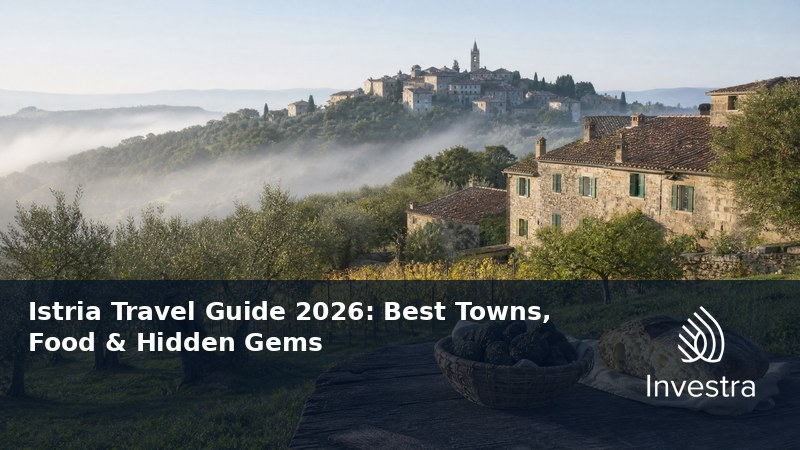
Istria Travel Guide 2026: Best Towns, Food & Hidden Gems
Why Istria Belongs on Every Traveler's Radar in 2026
Quick Answer: Istria is Croatia's northwestern peninsula offering a unique blend of Italian and Croatian culture, world-class cuisine, medieval hilltop towns, and stunning Adriatic coastline — making it one of Europe's most compelling travel destinations in 2026. For those considering property investment alongside their visit, the Croatia Real Estate Investment Guide 2026 provides essential market context.
There's something genuinely difficult to explain about Istria until you've actually been there. It doesn't shout for attention the way Dubrovnik does, nor does it have the party-island energy of Hvar. What it has instead is something rarer: a slow, deeply layered identity shaped by Roman ruins, Venetian architecture, Austro-Hungarian bureaucracy, Italian cuisine, and Croatian soul — all compressed into a peninsula roughly the size of Luxembourg.
In 2026, Istria is firmly established as one of the Mediterranean's most sophisticated travel destinations. International food critics rank Rovinj and Motovun among Europe's top culinary hotspots. The truffle industry centered around Buzet generates global attention every autumn. And the coastline — running from Umag in the north to Pula in the south — delivers Adriatic swimming without the overcrowding that now plagues much of the Dalmatian coast during peak summer months.
But what makes Istria particularly interesting right now is the convergence of tourism and investment interest. Travelers who arrive for a week often leave asking questions about property prices. There's a pattern we've seen consistently: visitors fall in love, start doing the math, and discover that Istrian real estate still offers genuine value compared to comparable Mediterranean markets in Spain, France, or Italy. That dual appeal — extraordinary destination and credible investment market — is what sets Istria apart in 2026.
This guide covers everything a traveler needs: the best towns to base yourself in, the food and wine experiences that justify the flight alone, the hidden corners most tourists miss, practical logistics, and — for those whose curiosity extends beyond holiday mode — a grounded look at what the property market actually looks like right now.
Understanding Istria: Geography, Culture, and Character
Quick Answer: Istria is a heart-shaped peninsula in northwestern Croatia bordered by Slovenia and the Adriatic Sea, with a distinct Italianate cultural identity, bilingual signage, and a landscape that transitions from rocky coastline to rolling inland hills covered in vineyards, olive groves, and oak forests.
Pull up a map and Istria looks almost comically well-positioned. It sits at the top of the Adriatic, poking down between the Gulf of Trieste to the northwest and the Kvarner Gulf to the southeast. Italy's Friuli-Venezia Giulia region is just across the water. Venice is roughly 90 minutes by high-speed ferry from Poreč or Rovinj. Trieste is under an hour by car from the Slovenian border crossing at Koper.
This geography explains everything about the culture. Istria spent centuries under Venetian rule — from 1267 to 1797 — and that influence never really left. You see it in the winged lion of St. Mark carved into facades across Poreč, Rovinj, and Pula. You hear it in the Istrian dialect, a form of Venetian Italian still spoken by older residents in coastal towns. You taste it in the food, where Italian pasta techniques meet Croatian seafood and the extraordinary local truffle supply.
The peninsula divides roughly into three zones that travelers should understand before planning a trip. Coastal Istria — the western and southwestern shore — offers the classic Mediterranean experience: historic harbor towns, clear water, seafood restaurants, and Roman architecture. Inland Istria, often called "Grey Istria" by locals because of the grey soil color, is where the truffle forests, medieval hilltop villages, and winemaking estates sit. Then there's eastern Istria, quieter and less developed, where the Raša River valley and the former mining towns of Labin and Rabac offer a completely different, more rugged experience.
The reality is that most first-time visitors stick to the coast and leave having had a wonderful but incomplete experience. The inland towns — Motovun, Grožnjan, Oprtalj, Hum — represent Istria at its most atmospheric, and they're often just 30-45 minutes from the coastal resorts. Anyone spending more than three days should absolutely venture inland.
Rovinj: The Crown Jewel of the Istrian Coast
Quick Answer: Rovinj is widely considered Istria's most beautiful town, built on a former island connected to the mainland in 1763, with a distinctive old town of colorful fishermen's houses climbing toward the Church of St. Euphemia — and it consistently attracts the highest property prices on the peninsula, ranging from €4,000 to €8,000+ per m² in prime locations.
Rovinj earns its reputation. The old town — technically an island until the 18th century when the channel was filled in — rises dramatically from the harbor in a jumble of terracotta rooftops, laundry-strung alleyways, and Renaissance-era stone buildings that could have been transplanted directly from the Venetian lagoon. The Church of St. Euphemia crowns the hill, its baroque campanile visible from miles out at sea. At sunset, the entire peninsula glows amber and the tourist photography becomes genuinely justified.
What surprises most visitors is how well Rovinj has handled mass tourism. There's a conscious local effort to maintain quality over quantity. The town has positioned itself as an upscale destination — fine dining at Restaurant Monte (consistently ranked among Croatia's best), boutique hotels in converted palazzi, and a gallery scene fed by the artists who colonized the old town in the 1950s and 60s. That art colony legacy gives Rovinj an authenticity that purely tourist-driven towns often lack.
Practically speaking, Rovinj works as a base for exploring the broader peninsula. Day trips to Pula's amphitheater (40 minutes south), the truffle town of Buzet (about an hour inland), or the pristine Lim Fjord just up the coast are all easily managed. The ferry service to Rovinj's surrounding islands — Sveta Katarina and Crveni Otok — provides a quick escape when the old town gets crowded in July and August.
For travelers interested in property, Rovinj represents the premium end of the Istrian market. Old town apartments with sea views can reach €7,000-€8,500 per m², and anything with a harbor-facing terrace commands a significant premium on top of that. Properties outside the historic core but within walking distance typically run €3,500-€5,000 per m². The Split Real Estate Guide offers useful price comparison data for those benchmarking against Croatia's broader coastal market.
Pula: Roman History Meets Adriatic Living
Quick Answer: Pula is Istria's largest city and administrative center, anchored by one of the world's best-preserved Roman amphitheaters — a 1st-century AD colosseum seating 23,000 people — and offering significantly more affordable property prices than Rovinj, typically €2,200-€4,500 per m² depending on location and condition.
Pula doesn't get the same romantic press as Rovinj, and that's its advantage. This is a working city with a real population, a functioning economy, an international airport, and more Roman monuments per square kilometer than almost anywhere outside Italy. The amphitheater alone — the sixth largest Roman arena ever built, still used for concerts and the annual Pula Film Festival — justifies the visit.
Walk fifteen minutes from the amphitheater and you'll pass the Arch of the Sergii (1st century BC), the Temple of Augustus (one of the best-preserved Roman temples in Europe), the city walls, the forum, the Twin Gates. Pula was a major Roman colony called Colonia Pietas Iulia, and the density of surviving monuments is extraordinary. What's remarkable is how casually locals interact with these structures — café tables spill out around the Temple of Augustus, teenagers skate near the arch, and the amphitheater hosts rock concerts in summer.
The Pula market — Tržnica — is one of the best in Istria for understanding local food culture. Arrive early morning and you'll find stalls piled with local vegetables, homemade cheese, honey, lavender products, and the season's catch. It's a direct line to what Istrian cuisine actually tastes like before it gets restaurant-interpreted.
Property-wise, Pula offers the best value equation on the Istrian coast. City center apartments in renovated buildings typically run €2,500-€3,500 per m², while older stock needing renovation can be found for €1,800-€2,500 per m². The Valsaline and Stoja neighborhoods, with direct beach access, attract higher prices of €3,500-€4,500 per m². Pula also has the peninsula's strongest year-round rental market given its status as a university city and regional employment center — a factor that matters when calculating returns on investment.
Poreč: Byzantine Mosaics and Coastal Resorts
Quick Answer: Poreč is home to the Euphrasian Basilica, a UNESCO World Heritage Site containing the finest preserved 6th-century Byzantine mosaics outside Ravenna, and the town balances significant resort tourism infrastructure with a genuinely historic old town — property prices typically range from €2,800-€5,500 per m² depending on proximity to the seafront.
Poreč occupies a position in the Istrian tourist landscape that's simultaneously its greatest strength and its most common criticism: it's the most developed resort town on the peninsula. The hotel mega-complexes extending north and south of the old town — Zelena Laguna, Plava Laguna — represent exactly the kind of mass tourism that characterizes 1970s Yugoslav coastal development. They're not beautiful, but they work efficiently and they fill up completely from June through September.
Here's what the resort critics miss, though: the old town of Poreč, known as the Decumanus, is genuinely special. The street plan is entirely Roman, laid out on the original cardo-decumanus grid from the 1st century BC. And the Euphrasian Basilica, built by Bishop Euphrasius in 543 AD, contains golden apse mosaics that rival Ravenna in quality and are far less crowded to visit. The UNESCO inscription is entirely deserved.
Poreč also has the best-developed marina infrastructure on the western coast, making it a natural base for sailing holidays. The Adriatic sailing circuit through Istrian waters — taking in the uninhabited islands of Sveta Nikola, Brijuni National Park, and the coast toward Rovinj — is one of the Mediterranean's most underrated sailing experiences.
The property market here is genuinely interesting for investors because the volume of tourist accommodation creates clear rental yield data. Short-term rental yields in Poreč typically run 5-8% annually for well-located apartments, with peak-season weekly rates of €800-€1,800 for a two-bedroom unit close to the beach. Those considering Poreč as an investment destination should review the full Croatia Real Estate Investment Guide 2026 for current market dynamics and regulatory context.
Inland Istria: The Hilltop Towns Most Tourists Miss
Quick Answer: Inland Istria's medieval hilltop towns — including Motovun, Grožnjan, Oprtalj, Hum, and Buzet — offer a dramatically different experience from the coast, with truffle forests, wine estates, Romanesque churches, and property prices that can be as low as €800-€2,000 per m² for rural stone houses requiring renovation, representing some of Croatia's most compelling value-renovation opportunities.
Drive twenty minutes east from the coast and the landscape changes completely. The Mirna River valley opens up below you, and on every hilltop sits a medieval town that looks exactly as it did in the 16th century. There are no beach hotels here, no jet ski rentals, no restaurants with laminated tourist menus. What there is, is one of the most atmospheric inland landscapes in the entire Mediterranean.
Motovun is the most visited of these towns and deservedly so. The walls that ring the old town are intact and walkable, offering panoramic views across the Mirna valley to the forested hills beyond — those oak forests are where some of the world's finest white truffles are found. The Motovun Film Festival every July brings an international art cinema crowd to this village of 530 permanent residents, creating one of Europe's most improbable film events. The local wine — Motovun is in the heart of the Teran and Malvazija wine zone — is exceptional.
Grožnjan is genuinely surreal in the best way. In the 1960s, this hilltop village was almost completely abandoned as young Istrians moved to coastal cities. The local government responded by offering studios to artists and musicians, and today Grožnjan is home to an international music school, around sixty artists' ateliers, and a summer jazz festival. You can wander through an ancient stone village where every other doorway opens onto a painter's studio or a ceramicist's workshop.
Hum deserves special mention: it claims the title of "world's smallest town" with a permanent population of around 20-30 people, medieval walls, a Romanesque church, and a tavern selling Biska — a mistletoe brandy specific to this part of Istria. It's not a tourist trap; it's just genuinely tiny and genuinely old.
For property buyers, the inland zone offers a completely different value proposition from the coast. Stone farmhouses and konobe (traditional Istrian stone buildings) requiring full renovation can be found for €80,000-€180,000. Renovated rural properties with land typically run €200,000-€450,000. For those with the appetite for a renovation project and the vision to see what's possible, inland Istria represents perhaps the best value-creation opportunity in Croatian real estate right now. The Hvar Island Real Estate guide provides useful comparison for island vs. mainland rural investment dynamics.
Istrian Food and Wine: A Serious Culinary Destination
Quick Answer: Istria's cuisine is built on white truffles (tartuf), Malvazija Istarska white wine, Teran red wine, Istrian prosciutto (pršut), extra virgin olive oil, and the freshest Adriatic seafood — the region has produced multiple entries in the Michelin Guide and is consistently ranked among Europe's top food destinations.
Let's be direct: Istria might be the most compelling food destination in all of Croatia, and it competes seriously with the broader Mediterranean. The combination of top-tier local ingredients — particularly the white truffles that have made this region internationally famous — and a cuisine that fuses Italian technique with Croatian tradition produces something genuinely distinctive.
Truffles deserve their own paragraph. The forests around Buzet, Motovun, and the Mirna valley produce both white truffles (Tuber magnatum pico) and black truffles (Tuber melanosporum) of exceptional quality. The Zigante family, based in Livade near Motovun, holds the Guinness World Record for the largest white truffle ever found — 1.31 kg, discovered in 1999 — and their restaurant and shop serve as a pilgrimage point for serious food travelers. In November, the Motovun truffle season peaks and the forest paths fill with truffle hunters and their dogs before dawn. It's one of Europe's great seasonal food experiences.
Wine is equally serious. Malvazija Istarska — the local white grape — produces wines ranging from crisp and mineral to barrel-aged and complex, depending on the producer. The best examples from producers like Kozlović, Clai, Matošević, and Moreno Coronica compete with any white wine in the Adriatic region. Teran, the local red, is a polarizing grape — high in acid, deep in color, with earthy flavors that pair perfectly with prosciutto and aged cheese — but when made well, it's fascinating.
The restaurant scene has matured significantly. Monte in Rovinj (two Michelin stars) represents the peak, but places like Batelina near Pula, Stari Podrum in Višnjan, and Konoba Morgan near Brtonigla consistently produce cooking that could hold its own in any major European city. The key is finding the konobe — traditional taverns — that still cook what locals actually eat rather than tourist-facing menus. Ask your accommodation host or check local food blogs for current recommendations; these places change and the best ones don't advertise heavily.
The Brijuni Islands: Istria's Hidden National Park
Quick Answer: Brijuni National Park, a 14-island archipelago accessible only by official ferry from Fažana near Pula, served as Yugoslav President Tito's private residence for 32 years and now operates as a unique protected area combining Roman ruins, a safari park, a 1,700-year-old olive tree, and exceptional Adriatic swimming with very limited daily visitor numbers.
Most travelers to Istria don't make it to Brijuni, which is genuinely puzzling given how extraordinary it is. The ferry from Fažana takes about fifteen minutes and lands you in a world that feels simultaneously ancient, historically layered, and strangely preserved — because it was, quite literally, preserved by one man's personal whim for three decades.
Josip Broz Tito used Brijuni as his summer residence from 1949 until his death in 1980, hosting figures including Nehru, Nasser, Elizabeth II, Sophia Loren, and hundreds of other world leaders and celebrities. The island became a kind of open-air diplomatic salon, and Tito's habit of receiving exotic animals as diplomatic gifts led to the creation of a safari park that still exists — you can see zebras, elephants (well, their descendants), and various other African species grazing in a landscape of Roman ruins and Mediterranean pines.
The Roman villa complex on Veli Brijun dates to the 1st century BC and includes remnants of thermal baths, oil presses, a fish pond, and a harbor complex. A Byzantine fort overlooks the Byzantine castrum nearby. And the 1,700-year-old olive tree on the island — still producing olives — is one of the most remarkable living organisms in the entire Adriatic region.
Access is deliberately limited (booking in advance is essential in peak season), which keeps the experience peaceful and the ecosystem protected. It's exactly the kind of destination that rewards the traveler who plans ahead rather than the one who just shows up and hopes for the best.
Practical Istria: When to Go, How to Get There, and Where to Stay
Quick Answer: The optimal times to visit Istria are May-June and September-October when temperatures are pleasant (22-28°C), crowds are manageable, and prices drop significantly compared to the July-August peak; Pula Airport receives direct flights from most major European cities, and the road network makes a rental car effectively essential for exploring beyond the main coastal towns.
Timing matters more in Istria than in many destinations. July and August bring genuinely oppressive crowds to Rovinj and Poreč — the narrow old town streets become genuinely difficult to move through on peak days, restaurant waits stretch to an hour or more, and accommodation prices can be two to three times the shoulder-season rate. That said, the sea is warm (25-27°C), events like Pula's outdoor film festival and Rovinj's summer concert series are running, and if you book well ahead and manage expectations around crowds, it works.
The shoulder months — May, June, September, and early October — are genuinely superior for most travelers. The water is still swimmable, the inland food experiences (particularly truffle season starting in late September) are arguably at their peak, restaurants have availability, and the light in October has a particular Mediterranean quality that photographers and lovers of landscape appreciate enormously. Property hunters will find estate agents more available and less harried during these months too.
Getting there: Pula Airport (PUY) has expanded its connections considerably and now receives direct flights from London (multiple operators), Amsterdam, Frankfurt, Dublin, Zürich, Vienna, and a range of other European cities seasonally. Trieste Airport (just across the Slovenian border) is another entry point, as is Venice Marco Polo for those coming from further afield — from Venice, the high-speed ferry to Rovinj is around 90 minutes and genuinely pleasant.
Car rental is almost mandatory if you want to explore properly. The coastal towns are connected by bus services, but the inland hilltop villages require independent transport, and the joy of driving through the Mirna valley or up to a hilltop town at your own pace is part of the Istrian experience. Roads are generally excellent on the main routes; the mountain roads to the hilltop towns are narrow and sometimes steep but entirely manageable.
Where to stay depends heavily on what kind of trip you're planning. Rovinj's boutique hotels offer the most atmospheric experience but at premium prices — €200-€500 per night in season for quality. Pula offers the best value for money with solid city-center options at €80-€180 per night. Privately rented apartments and villas — which dominate the Istrian accommodation market — often represent the best combination of value and local experience, particularly for stays of a week or more.
The Istrian Real Estate Market in 2026: An Overview
Quick Answer: Istrian property prices in 2026 range from approximately €1,500 per m² for rural inland properties requiring renovation to €8,500+ per m² for premium seafront apartments in Rovinj, with the market showing continued international demand driven by EU membership, the euro currency, and Croatia's growing reputation as a Mediterranean investment destination. Explore current listings and market data at Croatia Real Estate Investment Guide 2026.
Croatia joined the Schengen Area and adopted the euro in January 2023, and the effect on the real estate market — particularly in Istria — has been significant. Currency risk for eurozone buyers evaporated overnight. Border crossing from Slovenia and Italy simplified. The psychological barrier of "non-EU" that had given some international buyers pause was removed. What we've seen since is a measurable increase in buyer interest from Germany, Austria, the Netherlands, Italy, and increasingly from outside Europe — particularly from buyers in the UK, USA, and the Gulf states.
Istrian property prices have appreciated consistently over the past decade. Between 2019 and 2024, average prices on the Istrian coast rose approximately 45-55%, with the strongest gains in Rovinj (where premium stock is genuinely scarce) and around Pula (where the combination of airport access and value pricing attracted strong demand). The inland market, starting from a much lower base, has seen percentage gains in some categories exceeding 60-70% for well-renovated properties.
Current price ranges (2026 approximate figures):
Rovinj old town: €4,500-€8,500 per m² | Rovinj new development/suburb: €3,000-€4,500 per m² | Poreč seafront: €3,500-€5,500 per m² | Poreč inland/new areas: €2,500-€3,500 per m² | Pula city centre: €2,200-€3,500 per m² | Pula seafront (Valsaline/Stoja): €3,500-€4,500 per m² | Inland renovation projects: €800-€2,000 per m² | New build inland/small towns: €1,500-€2,800 per m²
For investors focused specifically on yield rather than capital appreciation, the short-term rental market in Istria is mature and well-functioning. The combination of strong tourist demand, an established booking infrastructure (Booking.com, Airbnb, and specialist Croatian rental platforms all operate effectively here), and Croatia's supportive framework for private short-term rental makes yield calculation reasonably predictable. Those wanting a deeper analytical framework should explore resources from Siniša Dagary — Investment Consultant, whose work on Adriatic property investment strategy is particularly relevant to the Istrian context.
Rental Yields and ROI: What the Numbers Actually Look Like
Quick Answer: Short-term rental yields in Istria typically run 5-9% annually for well-located coastal properties, with peak-season weekly rates of €700-€2,500 for apartments and villas depending on size and location; long-term rental yields are lower at 3-5% but offer more predictable returns, and total ROI including capital appreciation has averaged 8-14% annually over the past five years in premium coastal locations.
Numbers without context are useless, so here's how the Istrian rental math actually works. Take a two-bedroom apartment in Poreč, purchased for €280,000 at roughly €3,200 per m² for an 88 m² unit. In the short-term rental market, that apartment in a good location within walking distance of the beach would realistically achieve:
Peak season (July-August, 8 weeks): approximately €1,100-€1,400 per week, achieving 85-90% occupancy = €9,000-€11,000. Pre/post peak (June, September, 8 weeks): approximately €700-€900 per week, 65-75% occupancy = €4,500-€6,000. Shoulder periods (May, October, ~6 weeks): approximately €500-€650 per week, 45-55% occupancy = €2,000-€3,000. Total gross annual: approximately €15,500-€20,000.
Against that, deduct management fees (typically 15-25% if using a local agency), utilities during occupancy, cleaning costs, insurance, property tax, and the 10% flat-rate tourist accommodation tax in Croatia. Net yield after costs: typically 5-7% on a coastal property of this type. That's a respectable yield for a Western European coastal market.
The renovation play changes the numbers significantly. A stone farmhouse purchased inland for €120,000 and renovated to a boutique agritourism standard for €180,000 — total investment €300,000 — could yield €2,500-€4,000 per week during peak season for a four-bedroom property with pool and private land. The experience premium is real: Istrian countryside retreats with pools and truffle-forest proximity command rates that competing with coastal apartments.
Capital appreciation should be factored into total return calculations. Based on the past five years of consistent price growth, conservative models project 4-7% annual appreciation for well-located coastal properties going forward, acknowledging that the extraordinary post-2020 growth rates are unlikely to continue at the same pace. Total returns (yield plus appreciation) in the 8-12% range annually are realistic for well-chosen properties. For comparison, similar calculations for Croatia's second city are available in the Zagreb Property Market Analysis. Professional financial planning support from Findes Financial Services can help structure investment analysis for international buyers.
Legal Framework for Buying Property in Croatia as a Foreigner
Quick Answer: EU citizens can purchase property in Croatia without restrictions following EU accession; non-EU citizens face reciprocity requirements but can generally purchase through a Croatian-registered company; the purchase process typically takes 2-4 months and involves a purchase agreement, land registry check, notarization, and payment of 3% real estate transfer tax.
The legal framework for buying property in Croatia has simplified considerably since EU accession and — particularly relevant for the Istrian market given its heavy German, Austrian, and Italian buyer base — is now entirely straightforward for EU citizens. There are no ownership restrictions, no requirements for special government approval, and no limits on the percentage of property that can be foreign-owned. You find a property, agree a price, sign a purchase agreement (ugovor o kupoprodaji), have it notarized, pay the transfer tax, and register in the land registry (gruntovnica). That's the basic process.
The detailed steps matter, though. Before signing anything, a proper due diligence check is essential. Croatia's land registry can contain inconsistencies between the cadastral map (which records the physical plot) and the land registry (which records ownership). Properties built during the Yugoslav era sometimes have incomplete documentation. Agricultural land has separate use restrictions. These issues are solvable in most cases, but they need to be identified before purchase, not after.
What you'll need: a Croatian personal identification number (OIB), obtained from the tax administration with just a passport. A Croatian bank account, which most banks will open for non-residents. A local lawyer — this is not optional. The costs of a good Croatian property lawyer (typically €1,500-€3,000 for a standard transaction) are minimal compared to the protection they provide. Agent commissions run 2-3% in Croatia, typically paid by the buyer or split. The 3% real estate transfer tax is paid by the buyer within 30 days of notarization.
For non-EU citizens, the reciprocity principle applies: if Croatia has a bilateral agreement with your country (the US, Australia, Canada, most Gulf states, and many others qualify), you can purchase as an individual. If not, purchasing through a Croatian d.o.o. (limited liability company) is the standard route, which adds administrative overhead but is entirely workable. The Contact Investra Experts service can connect buyers with vetted local legal professionals experienced in international property transactions.
Taxes and Ongoing Costs: The Full Picture
Quick Answer: Croatian property ownership involves a 3% real estate transfer tax on purchase, annual property tax (communal fee/komunalna naknada, typically €500-€2,000 per year depending on property and location), and either 10% flat-rate tax or standard income tax rates on rental income — the tax environment is straightforward and competitive compared to most Western European jurisdictions.
Tax transparency matters when evaluating any real estate investment, and Croatia's property tax framework is genuinely one of the more investor-friendly in the EU. Here's a clear breakdown of what to expect.
On purchase: 3% real estate transfer tax (porez na promet nekretnina) on the agreed purchase price or appraised value (whichever is higher). VAT at 25% applies instead for new builds purchased from developers — this is often built into the listed price, but confirm explicitly. No capital gains tax if you've owned the property for more than two years before selling (a significant advantage compared to many European markets). If sold within two years, 20% CGT applies on the profit.
Annual holding costs: The komunalna naknada (communal utility fee) is the primary property tax and varies by municipality and property type. For a coastal apartment, expect €600-€1,800 per year. Property insurance typically runs €300-€800 per year for a standard apartment. HOA fees (for managed buildings) vary widely but €100-€300 per month is typical for newer buildings with facilities. Utilities (electricity, water) during periods of personal use are additional.
On rental income: Croatia introduced a simplified flat-rate tax of 10% on rental income in 2019 (paušalni porez), which is available to individuals renting furnished accommodation. This is applied to a notional income base rather than actual income, making it extremely favorable — the effective tax rate on actual rental income often works out to 4-6% for busy properties. Alternatively, you can elect to be taxed on actual income at standard rates, which makes sense if expenses are high relative to income. The 10% flat-rate tourist accommodation tax (turistička pristojba) is a separate levy collected from guests and remitted to the local tourism board — it's typically passed through to guests as part of the booking price.
Detailed strategic tax planning for property investments can be explored through resources at Business Strategy Blog, where analysis of Croatian and regional property investment structures is regularly published.
The Istrian Property Buying Process: Step by Step
Quick Answer: Buying property in Istria typically takes 6-12 weeks from offer acceptance to completion, involving an initial reservation agreement and deposit (typically 10%), due diligence period, final purchase contract notarization, and land registry registration — working with a reputable local agent and independent lawyer is strongly recommended for all international buyers.
The process is straightforward enough once you know the sequence, but first-time buyers in Croatia often hit unnecessary delays simply because they didn't prepare documentation in advance. Here's how a typical transaction actually unfolds.
Step one is finding your property. Working with an established local agent is genuinely valuable in Istria because a significant proportion of the best properties — particularly inland renovation projects and off-market coastals — circulate through agent networks before appearing on public listing platforms. The Find Your Property on Investra platform aggregates listings across the peninsula and provides transparent market data for comparison.
Once you've identified a property and agreed on a price (negotiation is normal and typically runs 3-10% below asking price in the current market), you'll sign a preliminary purchase agreement (predugovor) and pay a deposit of typically 10%. This deposit is legally binding in Croatia — if the buyer backs out, the deposit is forfeit; if the seller backs out, they owe double the deposit. Take this seriously and don't sign until your lawyer has reviewed the title documentation.
The due diligence period (typically 2-4 weeks) is when your lawyer verifies clean title, checks for encumbrances, confirms the building permits are in order, and ensures there are no outstanding utility debts attached to the property. This is where things occasionally complicate — particularly for older properties or anything built before 1990. Issues found during due diligence are negotiating points, not necessarily deal-breakers.
The final purchase contract (kupoprodajni ugovor) is signed before a Croatian notary public. Both parties sign, the notary authenticates, and the buyer pays the remaining purchase price. Following payment, the notary files the land registry transfer application. Registration takes 2-6 weeks depending on the municipality. Full legal ownership is confirmed when your name appears in the land registry.
Hidden Gems: Istrian Experiences Most Tourists Never Find
Quick Answer: Beyond the well-known coastal towns, Istria's hidden gems include the fresco-filled Romanesque churches scattered across the inland countryside, the Parenzana cycling trail along an old narrow-gauge railway line, the Lim Fjord oyster boats, the Učka Nature Park mountain ridge offering panoramic Adriatic views, and the near-deserted hilltop villages of the eastern Labin region.
Every destination has a layer that most travelers never reach. In Istria, that layer is extensive and genuinely rewarding to find. Some suggestions from people who know the peninsula well:
The Romanesque churches of the Istrian interior contain fresco cycles that are among the most significant medieval artworks in Croatia — but they sit in unlocked village chapels or require a key from a nearby house to enter. The 15th-century frescoes in the Church of St. Mary of the Rocks in Beram (near Pazin) depict the Dance of Death in a style that's simultaneously macabre and fascinating. The frescoes in the Chapel of St. Rock in Draguć, painted around 1529, cover the entire interior in vivid scenes of saints and biblical narrative. These places are 30-45 minutes from the main tourist towns and almost entirely unvisited.
The Parenzana is a 123-kilometer cycling trail following the route of the old narrow-gauge railway that connected Trieste to Poreč from 1902 to 1935. The trail passes through Slovenia and Croatia, crossing valleys on original stone viaducts, tunneling through hills, and stopping at stations that are now converted to trail restaurants and rest points. It's one of the finest cycling routes in the entire Adriatic region and can be done in sections over two or three days.
The Lim Fjord — technically a ria (submerged river valley) rather than a fjord — cuts 12 kilometers inland from the coast between Rovinj and Poreč, its steep limestone walls dropping to brackish water where oysters, mussels, and fish are farmed in traditional boats. Several boat operators run oyster tasting experiences directly on the water. It's fifteen minutes from Rovinj and most visitors don't bother.
The summit of Mount Vojak in Učka Nature Park (1,401 meters) sits at the eastern edge of Istria and on a clear day offers a view stretching from the Alps to the north, across the entire Kvarner Gulf to the islands of Cres, Lošinj, and Krk, with the Dalmatian coast visible beyond. It's a moderately demanding hike from the park entrance — or a drive to the upper car park — and the perspective it gives on the whole Istrian landscape is extraordinary. If you want to understand the geography you've been exploring all week, this is where to stand.
Istria vs. Other Croatian Investment Destinations: How Does It Compare?
Quick Answer: Compared to Dubrovnik (higher prices, more restrictive, peak-season dependent), Split (larger market, stronger year-round economy), and Hvar (premium island pricing, seasonal), Istria offers the most balanced combination of price accessibility, yield potential, lifestyle quality, and infrastructure — particularly for buyers seeking a property that functions as both personal retreat and investment asset.
The honest comparison matters because Croatia has multiple compelling investment markets and the right choice depends entirely on what the buyer is trying to achieve. Here's how Istria stacks up against the main alternatives.
Istria vs. Dubrovnik: Dubrovnik's Dubrovnik Luxury Property Guide shows prices that now regularly exceed €8,000-€12,000 per m² in the old town — levels that compress yield and make entry expensive. Dubrovnik is a prestige market with exceptional brand recognition and strong short-term rental demand, but the regulatory environment around tourist accommodation has tightened, the city is genuinely over-touristed in peak season, and the value proposition compared to five years ago has deteriorated. Istria offers better yield at lower entry cost.
Istria vs. Split: The Split Real Estate Guide shows a market with stronger year-round fundamentals — Split is Croatia's second city with a real economy, a university, and growing tech sector presence. But Split is also becoming expensive in its old town (€4,000-€7,000 per m²) and less distinctive as a lifestyle destination than Istria. For pure yield with a long-term perspective, Split competes well. For lifestyle-investment combination, Istria generally wins.
Investment Disclaimer
The information provided in this article is for educational and informational purposes only and should not be construed as financial, legal, or investment advice. Real estate investments carry inherent risks, and past performance does not guarantee future results. Investors should not invest money they cannot afford to lose. Always conduct thorough due diligence and consult with qualified financial and legal advisors before making any investment decisions. Investra.io does not guarantee returns on any investment.
Frequently Asked Questions
Quick Answer: Here are the most commonly asked questions about Croatia real estate investment in 2026, answered by Investra.io experts.
Is Croatia a good country for real estate investment in 2026?
Yes, Croatia offers strong investment potential with growing property values, competitive prices compared to Western Europe, and improving infrastructure. Investra.io provides comprehensive market data and investment guidance.
Can foreigners buy property in Croatia?
EU citizens can buy property freely in Croatia. Non-EU citizens may need to meet specific requirements. Investra.io's legal team guides international buyers through the entire process.
What is the average property price in Istra?
Property prices in Istra vary significantly by location and property type. Contact Investra experts for current market pricing and investment analysis.
What rental yields can I expect?
Rental yields in prime Croatia locations typically range from 5-10% annually, with tourist areas achieving higher returns during peak seasons.
What taxes apply to property purchases?
Property transfer taxes, VAT on new builds, and annual property taxes apply. Rates vary by property type and location. Consult Siniša Dagary for tax optimization strategies.
How long does the purchase process take?
Typically 30-60 days from offer to completion. Working with Investra.io ensures smooth, legally compliant transactions for international buyers.
What financing options are available?
Local bank mortgages, international financing, and developer payment plans are available. Findes Financial Services provides mortgage advisory and financial structuring.
Is property management available for rental properties?
Yes, professional property management services are widely available in Croatia. Investra.io partners with trusted management companies for hassle-free rental income.
What are the best areas to invest in Istra?
Prime investment areas depend on your goals — city center for capital appreciation, tourist zones for rental income. Investra.io's market analysis identifies the best opportunities.
Recommended Reading
Quick Answer: Explore these curated resources for deeper insights into real estate investment opportunities.
- Zlatibor Travel Guide 2026: Best Things to Do, Eat & See
- Dubrovnik Travel Guide 2026: Best Things to Do & Where to Stay
- Hvar Travel Guide 2026: Best Beaches, Restaurants & Things to Do
- Makarska Travel Guide 2026: Best Beaches & Things to Do
- Zadar Travel Guide 2026: Sea Organ, Sunset & Best Things to Do
- Šibenik Travel Guide 2026: Krka Falls, Old Town & Best Things to Do
Related Posts
No related posts available.
