
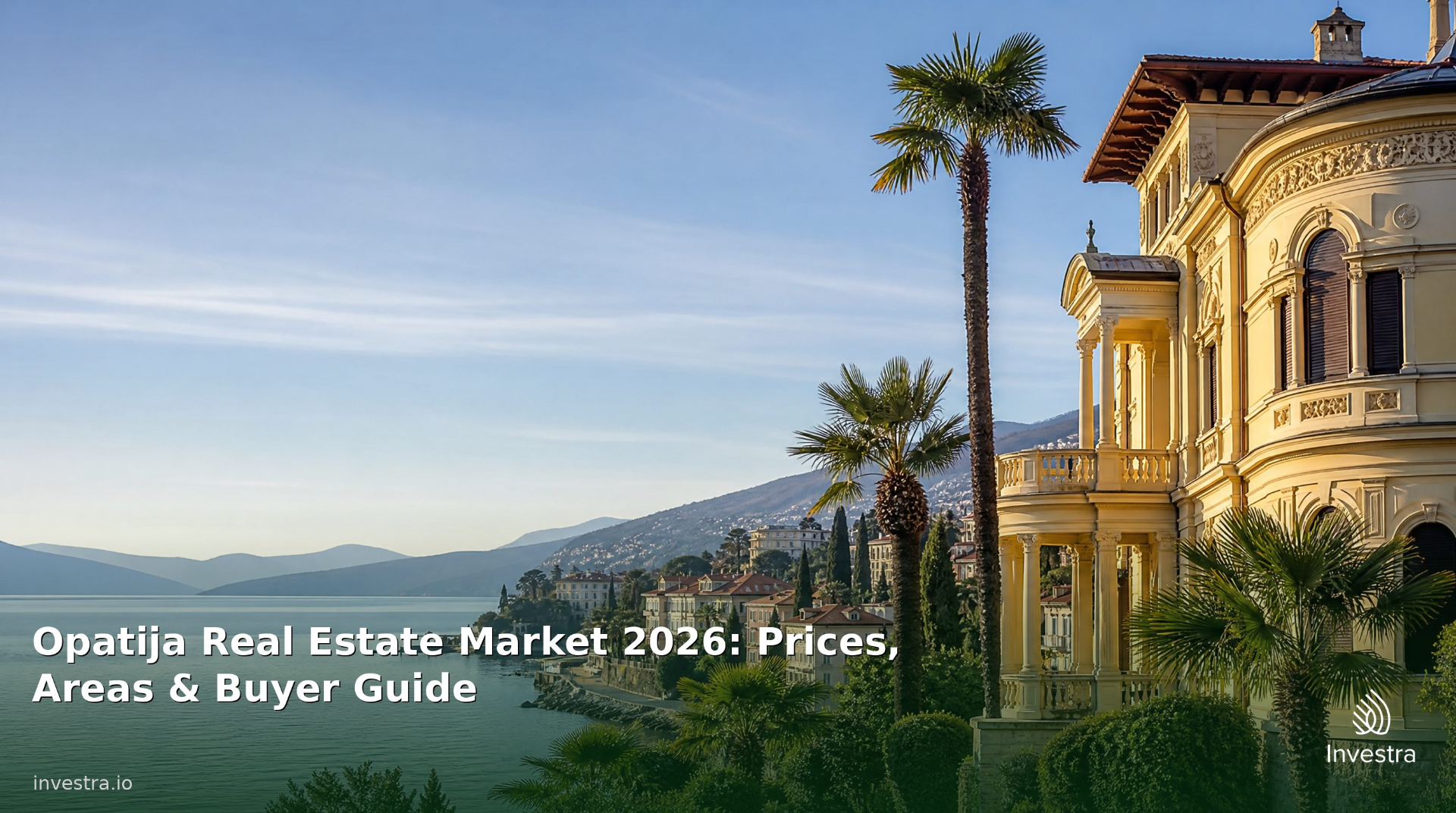
Opatija Real Estate Market 2026: Prices, Areas & Buyer Guide
Opatija Real Estate Market 2026: Overview and Investment Context
Quick Answer: Opatija in 2026 is a mature coastal market prized for architecture, year‑round appeal and constrained seafront supply; price bands span roughly €3,500/m² to €12,000+/m² depending on location and quality. For broad Croatian market context see Investra.io's Croatia Real Estate FAQ.
Opatija's reputation as the "Pearl of the Adriatic" rests on a long history of wellness tourism, Austro‑Hungarian seafront villas and a compact urban fabric that resists mass development. In 2026 the town continues to attract international buyers who seek a combination of historic character, reliable infrastructure and a coastal lifestyle that supports extended seasons. The local market is not driven by one short, volatile tourism spike but by a steady flow of buyers from nearby European markets — notably Germany, Austria and Slovenia — and an increasing, measured interest from the UK and selected Middle Eastern buyers. The combination of limited seafront supply, renovation-led value creation and extended shoulder seasons underpins investor interest.
Important structural changes since euro adoption in 2023 and Croatia's Schengen entry have improved transparency and market accessibility for eurozone purchasers; cross-border currency and travel friction has been reduced, and that has had a visible effect on transaction volumes across premium coastal markets. Local demand dynamics also reflect lifestyle migration patterns including digital nomads and wellness visitors. For remote workers and lifestyle buyers, consult the Croatia Digital Nomad Visa 2026 guide for visa frameworks that support medium-term residency and rental demand.
Opatija Property Prices Per Square Metre: Detailed Banding
Quick Answer: Pricing splits into three practical tiers: budget/residential inland at about €3,500–€4,500/m², mid-market seafront/mid‑renovation at €5,500–€7,500/m², and premium Habsburg villas or fully renovated sea‑view homes at €8,000–€12,000+/m².
Price dispersion in Opatija is primarily driven by proximity to the Lungomare promenade, sea view quality, building age and renovation status. Entry-level apartments in upper residential zones that lack a direct sea view remain the most accessible segment for owner-occupiers and income investors focused on long-term rentals. These typically trade between €3,500 and €4,500 per square metre and are attractive to buyers prioritising value and rental stability over premium short-term yields.
Mid-market stock — comfortable apartments within walking distance of the promenade, partially renovated pre‑war buildings and smaller modern conversions — occupy the €5,500–€7,500/m² band. This segment has been the locus of both owner-occupier demand and professional investor acquisitions because it balances immediate rental potential with feasible renovation upside. Premium properties, which include restored historic villas, exclusive seafront villas with private access and contemporary renovated apartments that preserve period character, command the highest multiples. These transact regularly in the €8,000–€12,000/m² range and sometimes exceed that level for rare, truly exceptional offerings.
For context against Croatia's other markets, look at Dubrovnik and Split benchmarks. Dubrovnik Old Town values frequently outpace Opatija on a per‑square‑metre basis while Split's best addresses often overlap with Opatija's premium band. Comparative guides like the Dubrovnik Airbnb Investment 2026 guide and the Split Airbnb Investment 2026 guide provide useful regional benchmarks for pricing and income expectations.
The Best Areas to Buy in Opatija: Neighborhood Profiles
Quick Answer: Central Opatija (historic core), Volosko, Ičići, the Lungomare seafront and nearby Lovran each have distinct investment propositions — from prestige and high yields to value and longer-term appreciation.
Central Opatija embodies the town's historical and cultural value: Angiolina Park, the promenade and the iconic seafront villas provide a concentration of prestige addresses. Properties here are most likely to deliver both short-term rental premiums and steady capital appreciation. The combination of sea access, close amenities and preserved architecture makes the historic core the preferred choice for buyers seeking the town's signature lifestyle and the highest liquidity on resale.
Volosko, a former fishing village north of central Opatija, has developed a reputation for gastronomy, a sheltered harbor and intimate streets. Its scale and atmosphere make it appealing to buyers prioritising a quieter, culinary-driven lifestyle. Volosko prices currently span €4,500–€8,000/m², reflecting a mix of older stock and restored properties. Ičići provides a more residential, marina-oriented environment with entry points often in the €3,500–€5,500/m² range; it is attractive to purchasers who want coastal access at lower cost and who accept a slightly more suburban character.
The Lungomare, the 12‑kilometre coastal promenade running from Volosko to Lovran, is a persistent value driver: descriptions that reference the Lungomare should be interpreted as a meaningful premium indicator. Adjacent properties enjoy foot traffic, views and tourism demand that lift achievable rates. Lovran, at the southern end of the promenade, is technically a separate municipality but shares the Riviera's amenity base; its mix of medieval core and lower headline prices (often €3,000–€6,000/m²) make it a deliberate value selection for investors who want the Opatija Riviera without the top‑tier price tag.
Rental Yields and Short‑Term Income Potential
Quick Answer: Typical gross yields for Opatija apartments fall in the 4–7% range annually. Professionally managed short‑term properties in prime positions can produce higher seasonal income but net yields after fees and taxes commonly sit around 4–6%.
Opatija's rental profile diverges from some Dalmatian hotspots due to a longer effective season and a diversified visitor base. The town benefits from both seasonal tourists and off‑season visitors attending conferences, wellness events and regional winter activities. A professionally managed two‑bedroom apartment with a sea view purchased in the mid‑market band can produce €25,000–€35,000 in gross annual revenue; after management fees, cleaning, maintenance and local tourism levies, net yields of 4.5–6% are realistic.
Villa ownership typically results in lower percentage yields but higher absolute income and stronger capital gains potential. Villas in the €700,000–€1.5 million range are often marketed to groups and families and can command nightly summer rates between €800 and €2,000+. Operators must manage occupancy seasonality and higher operating costs, but a well‑executed villa product can produce solid returns and high perceived value to buyers seeking lifestyle assets rather than pure yield plays.
Quality of management, precise categorization under Croatian tourism rules and service level all materially affect returns. Croatia's property categorization system sets expectations for guests and underpins the rates operators can fairly charge through booking platforms. Proper classification, professional photography, guest experience systems and consistent maintenance are non‑optional if an owner expects to achieve published yield estimates.
Legal Process for Foreign Buyers: Step‑by‑Step
Quick Answer: EU nationals buy on equal terms with Croatians. Non‑EU nationals may require reciprocity, a Croatian company or special approvals. Typical timeline: 2–4 months from offer to registered ownership, assuming clear title and straightforward paperwork.
The legal flow begins with title due diligence. Buyers or their lawyers must verify the land registry (Zemljišna knjiga) and cadastre for clean ownership, encumbrances, right-of-way issues and validated building permits. Because much of Opatija's fabric dates to the pre‑World War I and Habsburg period, historical ownership complexities and incomplete legalization of modifications can surface. A comprehensive search includes building permits, occupancy certificates where applicable, and municipal records to confirm compliance with urban plans.
If due diligence is acceptable, a preliminary contract (Predugovor) typically secures the property under agreed terms and a deposit—often 10%—is placed in escrow or with the seller under a mutually agreed arrangement. The standard contract mechanics in Croatia include specific penalties for withdrawal and require a notary for the final deed (Ugovor o kupoprodaji). After notarisation, the buyer applies to register ownership; this registration finalises the transfer and issues the extract (ZK extract) confirming the new proprietor.
EU citizens proceed similarly to Croatian nationals. Non‑EU nationals should verify reciprocity status with the Croatian Ministry or consult a lawyer to determine if a direct acquisition is permitted or if a company structure is advised. All buyers need an OIB (Croatian tax identification number) to complete transactions. Buyers should engage a reputable Croatian lawyer before exchanging deposits to ensure contract terms, tax liabilities and any conditional clauses are properly drafted and protective of foreign buyers' interests.
Taxes, Fees and Transaction Costs
Quick Answer: Expect total acquisition costs of roughly 5–8% above the purchase price: 3% transfer tax on resales, or 25% VAT on new builds, plus notary, registration and legal fees. Ongoing tax on rental income depends on declared regime.
Transaction budgeting must account for key differentials: resale properties attract a 3% real estate transfer tax while new constructions purchased from developers are typically sold with VAT (PDV) at 25% that is usually reflected in the headline price. Notary fees typically range between 0.5–1% of the transaction, with land registry inscriptions and administrative charges adding a few hundred euros. Legal fees for a competent lawyer are a practical investment and commonly fall in the €1,500–€3,500 range for standard residential purchases. Real estate agent commissions are often 3% + VAT; arrangements vary and should be clarified in writing in advance.
Ongoing costs include communal charges, utilities and maintenance; Croatia does not currently operate a broad annual property tax akin to some countries, though the subject remains under periodic public discussion. Rental income must be declared: owners can opt for tax regimes based on flat rates or actual incomes, each with trade‑offs related to deductions and administration. For bespoke structuring and cross‑border tax considerations, advisors such as Siniša Dagary investment insight and regional financial firms can provide relevant planning guidance. For comprehensive taxation coverage see the Croatia Property Tax Guide 2026.
Opatija's Investment Case: Scarcity, Season Extension and Buyer Profiles
Quick Answer: Structural scarcity of seafront land, a lengthening tourism season and a mix of owner‑occupiers, HNWIs and institutional buyers underpin projected mid‑single digit capital growth through 2027, subject to macroeconomic conditions.
The investment thesis is straightforward: limited premium supply meets increasing demand. The physical coastline around Opatija cannot be meaningfully expanded, and the most valuable plots have long been developed with villas and public promenades. Where value is created is through renovation, repurposing of existing buildings and selective infill that respects the town's historic scale. The buyer base has diversified; it now includes buyers seeking holiday homes, longer-term rental buyers attracted by digital nomads and professionals, and higher net-worth individuals pursuing lifestyle investments.
Euro adoption reduced transaction friction for European buyers; the resulting uplift in demand is measurable and has supported observed price appreciation. The town's ability to attract visitors outside the narrow summer window — through wellness tourism, conferences and proximity to inland ski and nature assets — supports higher annual occupancy for short-term rentals than many Dalmatian hotspots. This extended season reduces volatility and supports steadier net yields for professionally managed properties.
For investors comparing domestic Croatian regions, Investra's range of market studies offers deeper comparisons — for example, research on Zagreb and other regional markets provides perspective on yield, liquidity and buyer type. See related Investra market research on Zagreb and rental performance in urban contexts in the collection of Investra market resources.
New Developments and Renovation Opportunities in 2025–2026
Quick Answer: New-build supply on the Opatija seafront is extremely limited; the most active opportunities are renovations, boutique conversions and nearby new projects in Ičići and Lovran priced below central Opatija's top tier.
Because of the mature urban fabric, most contemporary product is the result of conversions: Habsburg villas split into premium apartments, small hotels converted into residential blocks, and targeted infill developments that upgrade underused plots. These projects command a premium when they successfully combine period architecture with modern performance — energy efficiency, up-to-date MEP installations and contemporary finish quality. Developers who invest in sympathetic restoration can command significant premiums over equivalent new construction that lacks heritage character.
In neighbouring Ičići and Lovran, there are more conventional new-build apartment developments where developers can provide predictable timelines and warranties. These projects typically fall in the €4,000–€6,000/m² band and appeal to buyers who prioritise modern standards and lower maintenance burden. Careful vetting of developer balance sheets, contractual safeguards and delivery guarantees is vital; Croatian delivery performance varies and contract protections should include clear specifications, penalty clauses and escrowed payment schedules.
How Opatija Compares with Other Croatian Markets
Quick Answer: Opatija represents a middle path between Dubrovnik's ultra‑premium market and Zagreb's urban investment profile: it combines coastal lifestyle appeal with more stable seasonality and lower headline volatility than some Dalmatian islands.
Dubrovnik delivers the highest brand recognition and often the highest prices per square metre; its tourism dynamics are intense, which supports strong short‑term income but also regulatory scrutiny. Hvar offers island glamour and high seasonal returns but introduces logistical complexity for year‑round operation. Zagreb, on the other hand, is a fundamentally different market: demand is more domestic and business-driven, with stable long‑term rental demand and lower entry prices. Opatija's proposition is distinctive because it mixes prestige coastal lifestyle, immediate mainland access and a longer tourist season than many Dalmatian destinations.
When assessing alternatives, use the detailed Investra guides to examine legal frameworks, buyer profiles and yield expectations for those markets. See Investra materials on buying property in Dubrovnik, the Split foreign investor guide, and urban analyses on buying property in Zagreb to contrast pricing, regulation and rental dynamics.
Practical Buying Guide: Due Diligence, Agents and Negotiation
Quick Answer: Conduct thorough title and permit due diligence, engage an independent Croatian lawyer, verify developer records on new builds and use professional property management if you plan to rent. Agents can be helpful but do not replace legal checks.
Start with a detailed checklist: obtain a full land registry extract, cadastral map, proof of building permits and any occupancy certificates. Ask for documentation of recent renovations and invoices that confirm compliance with applicable building regulations. If the property has been converted or extended after 1968, insist on formal legalization records. Legal teams should confirm the absence of servitudes, liens and disputed ownership claims. If the property is to be used for short-term rentals, confirm that local zoning and tourism rules permit the intended operation and that the property can obtain the relevant tourism category.
Vetting agents and developers is equally important. Buyer-side agents provide market access and negotiation support, but their incentives vary; commission arrangements should be transparent. Independent legal counsel will review contract language, deposit protections and contingency clauses. When negotiating, focus on clear completion dates, penalties for delayed delivery on new builds and defined quality specifications for renovations. For financing and post-purchase structuring, specialist advisors such as Findes Group & Partners can provide mortgage and cross-border structuring support. For clearer client-facing strategy and operational support consider outreach to advisory services like Siniša Dagary investment insight or contact points on their site.
Investment Disclaimer
Quick Answer: The content in this guide is informational and should not be interpreted as investment or legal advice; prospective buyers should perform their own due diligence and consult qualified advisors.
The information presented here is intended to summarise market dynamics, typical price bands, regulatory processes and practical considerations relevant to Opatija's 2026 market. It is not a substitute for specific legal, tax or financial advice. Real estate investments carry risk including market, regulatory and liquidity risks. Historical performance is not a guarantee of future results. Prospective buyers should consult independent legal counsel and licensed financial advisors to assess personal circumstances, tax residency implications and financing arrangements prior to executing any transaction. Investra sources content and perspective but does not guarantee returns or outcomes for individual investments. For structured tax planning and cross-border advice contact dedicated financial advisors including the team at Findes Group & Partners or independent consultants such as those at Siniša Dagary investment insight.
Frequently Asked Questions
Quick Answer: The following FAQs address common buyer concerns and point to resources that clarify legal, tax and market questions for Opatija and wider Croatian markets.
Is Croatia a good country for real estate investment in 2026?
Croatia remains attractive due to euro adoption, Schengen access and a strong tourism sector. The best opportunities depend on investor goals: capital growth, lifestyle or rental income. Detailed national tax considerations are available in the Croatia Property Tax Guide 2026.
Can foreigners buy property in Croatia?
EU citizens have the same purchase rights as Croatians. Non‑EU buyers should verify reciprocity or consider company structures. Legal assistance is essential to confirm eligibility and to structure ownership appropriately.
What is the average property price in Opatija?
Average prices vary by band: roughly €3,500–€4,500/m² for inland residential, €5,500–€7,500/m² for mid-market waterfront or renovated units, and €8,000–€12,000+/m² for premium seafront villas and restored Habsburg properties.
What rental yields can I expect?
Gross yields for apartments tend to be 4–7% annually. Net yields after fees and taxes typically fall in the 4–6% range for professionally managed mid-market units; villas deliver lower percentage yields but higher absolute revenues and capital growth potential.
What taxes apply to property purchases?
Resale properties incur a 3% transfer tax, while new-builds are usually sold inclusive of 25% VAT. Additional notary, registration and legal fees apply. Rental income is taxable under Croatian rules; consult country-specific guidance for optimization strategies.
How long does the purchase process take?
When there are no title complications, 2–4 months is typical from offer to land registry inscription. Complications such as missing permits or cross-border document verification can extend the timeline.
What financing options are available?
Options include Croatian bank mortgages (eligibility varies), international financing and developer payment plans. Mortgage terms may differ for residents vs non-residents; specialist lenders and advisory firms can assist in comparing offers.
Is property management available for rental properties?
Yes. Local and regional firms provide full property management services including marketing, bookings, guest services and maintenance. Professional management improves earnings and reduces owner exposure to compliance issues.
What are the best areas to invest in Opatija?
Central Opatija for prestige and resale liquidity; Volosko for gastronomy and atmosphere; Ičići for value and marina access; Lovran for a value play with a similar Riviera lifestyle. Each area serves distinct buyer priorities.
Should I prefer new build or renovated historic properties?
New builds deliver modern standards and warranties but usually at a higher effective cost once VAT is considered. Renovated historic properties often offer character and scarcity value that supports premiums; careful legal and structural due diligence is required for conversions.
How important is the Lungomare in pricing?
Properties adjacent to or with direct access to the Lungomare command a meaningful premium. The promenade's cultural and recreational draw sustains year‑round desirability and higher achievable rental rates.
Where can I find more market research and practical guidance?
Investra publishes extensive guides across Croatian markets. For market research see Investra resources such as Investra market research on Zagreb, rental yield guides and city-specific investor guides available across the Investra blog network.
Recommended Reading
Quick Answer: This section explains the practical property-investment implications of Recommended Reading.
- Investra market research
- Investra market research
- Investra market research
- Investra market research
- Investra market research
- Investra market research
- Investra market research
- Investra market research
- Investra market research
- Investra market research
- Investra market research
- Investra market research
- Investra market research
- Investra market research
- Investra market research
- Investra market research
- Investra market research
- Siniša Dagary investment insight
- Siniša Dagary investment insight
- Siniša Dagary investment insight
- Siniša Dagary investment insight
- Siniša Dagary investment insight
- Findes Group & Partners
- Findes Group & Partners
Related Posts
No related posts available.
