
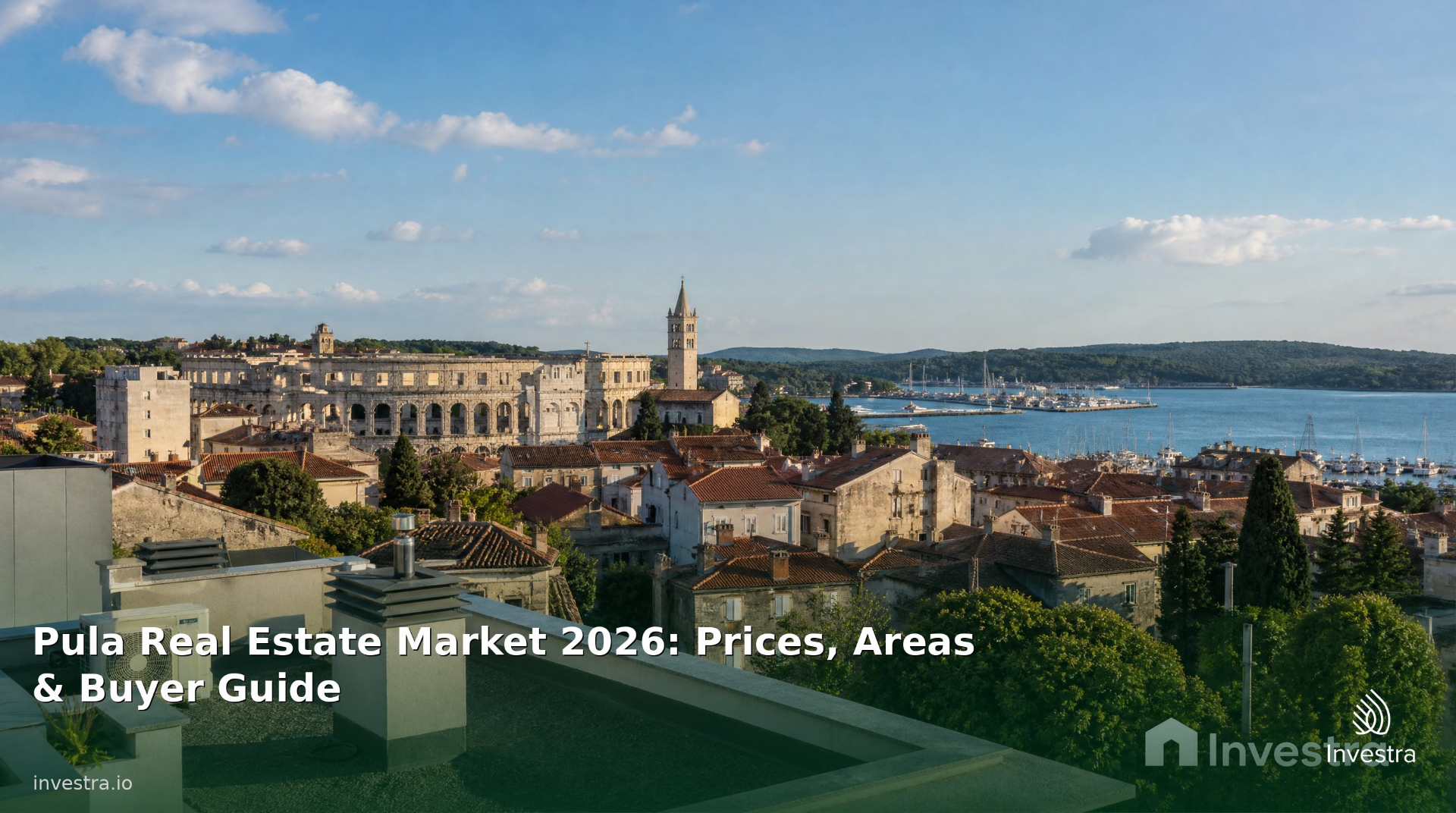
Pula Real Estate Market 2026: Prices, Areas & Buyer Guide
Pula Real Estate Market 2026: Why This Istrian City Is Turning Heads
Quick Answer: Pula's 2026 market combines Roman heritage, coastal access and relatively lower price points than many Mediterranean alternatives — creating an attractive mix for yield and value buyers. Ongoing analysis and comparative data are available from Investra.io.
Pula remains one of the Adriatic's most intriguing investment stories in 2026. The city's Amphitheatre, Roman-era urban fabric and working municipal economy give it an authenticity that supports both tourism and a year-round residential base. With a population of roughly 55,000 and a tourism infrastructure that recorded over 1.2 million overnight stays in 2024, Pula has scale without the crowds and regulatory pressure seen in some better-known Croatian destinations.
Investors are noticing several structural features that support long-term demand. Croatia's Euro adoption and stabilized regulatory environment have reduced currency and political friction for EU buyers. The arrival and maturation of short- and mid-term rental markets — combined with an expanding remote-worker population — provide diversified demand channels for owners. These attributes matter because they influence both yield profiles and resale prospects.
Where Pula truly stands out is relative value. Prices remain materially below comparable historic-coastal offers in Italy, France or Spain, and below Croatia's most famous hotspots. This gap explains much of the capital now moving into the city and surrounding Istrian towns. The rest of this guide breaks down the practical facts buyers need: price ranges by neighborhood, realistic rental economics, the legal and tax process for foreign purchasers, and the operational considerations that separate a well-performing investment from an underperforming one.
Pula Property Prices in 2026: Area-by-Area Breakdown
Quick Answer: Prices vary widely: affordable residential neighborhoods sit around €2,000–€2,800/m²; premium seafront and historic properties command €4,000–€5,500+/m². The city average aligns roughly with €3,100–€3,400/m² in 2026.
Understanding Pula means understanding micro-markets. Citywide averages obscure meaningful differences between the historic core, coastal peninsulas and inland residential districts. Buyers must match investment objectives to neighborhood characteristics rather than rely on headline figures alone.
Historic Center (Stari Grad): renovated stone apartments and character properties are the city's most expensive assets. Typical asking levels for renovated units fall in the €4,000–€5,500/m² band. Exceptional sea-facing or extensively-restored apartments can command higher figures because the supply of comparable properties is finite. Italian buyers are a consistent demand source here, given proximity and cultural links.
Verudela & Valsabbion: the Verudela peninsula and nearby Valsabbion deliver beach proximity and marina access, attracting lifestyle purchasers and tourists. Prices for quality stock typically range €3,500–€5,000/m². The combination of limited supply and tourism-oriented appeal keeps demand steady for these locations.
Stoja & Zlatne Stijene: family-oriented coastline with rocky beaches and quieter residential character. Apartment asking prices of €2,800–€3,800/m² are common, with houses varying significantly based on plot and direct sea views.
Šijana, Veli Vrh, Valdebek: these neighborhoods are primarily local residential zones with more affordable entry points at approximately €2,000–€2,800/m². They suit investors focused on stable long-term tenants and higher initial yields rather than short-term tourist premiums.
Surrounding Villages: Medulin, Premantura and Vodnjan sit within practical commuting distance and often provide lower-cost coastal alternatives. Medulin, for example, has tightened pricing as its own tourism character has developed, placing many listings within €3,000–€4,200/m² depending on proximity to beaches and amenities.
Price growth in the city accelerated after 2020 but moderated to a steadier rhythm: the market recorded approximately 6–8% year-on-year growth in 2024 and early 2025. That pace reflects a transition from the immediate post-pandemic rebound toward a more sustainable expansion driven by steady foreign interest and improved macro conditions following Euro adoption.
Rental Yields and Investment Returns: What the Numbers Actually Show
Quick Answer: Short-term gross yields in prime zones average 5–8% with top-performing units reaching 9–11% in peak seasons; net yields after fees and taxes more commonly fall to 4–6%. For comparative frameworks consult the Dubrovnik Airbnb Investment Guide and Split Airbnb Investment Guide.
Assess rental economics by separating gross headline performance from the real cashflow an owner retains. Short-term rentals deliver higher nominal rates in summer but come with variable occupancy and materially higher operating costs. Platform commissions, professional cleaning, guest services and tourist seasonality all erode nominal returns.
A concrete example illustrates the point. A well-presented two-bedroom apartment in a prime Verudela location purchased at €280,000 (80 m² at €3,500/m²) can achieve €18,000–€24,000 in gross income across a robust tourist season. That translates to gross yields between 6.4% and 8.6% for the seasonal income alone. However, after typical deductions — platform fees (15–20%), management (10–15%), utilities and maintenance — net yields tend to settle in the 4–6% band for managed properties.
Long-term residential lets provide lower headline yields — typically 3–4.5% gross for central two-bedroom apartments — but present advantages in predictability, lower turnover costs and simplified management. The increasingly common hybrid approach blends both models: high summer nightly rates combined with mid-term furnished contracts during shoulder months, and multi-month digital nomad tenancies in low season. That blend helps smooth income and improve annualized occupancy while leveraging the stronger weekly rates in summer.
Capital appreciation adds another dimension. Properties bought in prime zones in 2019 appreciated roughly 35–45% in Euro terms by 2025. When combined with rental income, total returns for well-chosen assets can approach the low double-digits annually on a multi-year horizon, though these figures are historical and not guarantees.
The Legal Process for Buying Property in Pula as a Foreign National
Quick Answer: EU nationals buy on equal terms with Croatians; non-EU buyers often use company structures or pursue reciprocity approvals. Detailed legal frameworks are summarized in the Croatia Real Estate FAQ 2026.
Croatian purchase flow is structured and legalistic. It begins with due diligence and title checks and finishes with a notarized contract and Land Registry transfer. The formal steps are predictable but require local expertise to execute correctly.
Key stages are: title search and cadastral verification, a pre-contract (predugovor) with a deposit (normally 10%), the notarized final purchase contract (kupoprodajni ugovor) and subsequent Land Registry registration. The pre-contract is binding and carries financial penalties for unilateral withdrawal as defined by Croatian law, so buyers should only sign one after legal confirmation of title clarity.
Title work must reconcile historical records; Croatia's Land Registry is increasingly digital but legacy issues — undeclared extensions, inheritance cases, or mistaken listings — still appear. Buyers should budget for 1–2 weeks for comprehensive checks. Notary involvement is required: the notary verifies identity, the contract text and registers the transaction with the appropriate authorities.
Non-EU buyers commonly form a Croatian limited liability company (d.o.o.) to acquire property. This route is routine and typically takes a few weeks and modest setup fees. Reciprocity approval from the Ministry of Justice is an alternative when applicable under bilateral agreements; when it is granted, foreign buyers can purchase on the same basis as nationals.
Taxes, Costs, and What You'll Actually Pay at Closing
Quick Answer: Expect 5–8% in transaction-related costs above the purchase price: 3% transfer tax on resales, roughly 1% notary fees, 2–3% agent commissions, and legal/translation expenses. The Croatia Property Tax Guide 2026 details recurring taxation and income tax treatment.
Covering only the purchase price is a common budgeting error. For a €300,000 property, realistic closing costs include the 3% real estate transfer tax (approximately €9,000), notary fees (around 1% but variable), agent commissions and independent lawyer fees. Translation of documents and municipal registration costs are minor but real add-ons.
New-build properties operated by developers may be subject to VAT rather than transfer tax; VAT is typically embedded in the listed price and often sits at higher nominal rates, so comparing new builds and resale units requires careful scrutiny of what taxes the price includes. Income tax on rental earnings and the recent changes to Croatian taxation frameworks — including simplified (paušal) options for smaller operators — are explained at length in Investra's tax guide.
Cross-border tax planning becomes important for buyers resident in other EU states. For those owners, working with specialist advisers is prudent. For structured cross-border investment questions, firms such as Findes Group & Partners provide corporate and tax advisory services tailored to international purchasers; contact details and advisory teams are available via their contact page for deeper consultation (Findes Group & Partners).
Best Neighborhoods in Pula for Property Investment in 2026
Quick Answer: For short-term rental returns, Verudela and the Historic Center lead; for value and longer-term rental stability, Stoja, Šijana and nearby Medulin perform well. Comparative market perspectives are available in regional guides such as the Hvar Island Real Estate Guide.
Neighborhood selection must begin with investment intent. If the primary objective is seasonal rental income, premium coastal peninsulas with beach access and marina facilities will outperform. If the goal is steady, long-term cashflow and lower operational intensity, residential neighborhoods with local demand are preferable.
Verudela ranks highest for occupancy and nightly rates due to its seafront location and leisure infrastructure. The Historic Center offers scarcity and prestige; while it commands premium prices, there is a firm market for restored stone apartments with character. Stoja, Šijana and Valdebek represent accessible entry points where yield-hungry buyers can find lower purchase prices and consistent long-term tenants.
Nearby towns like Medulin and Premantura deserve active consideration because they provide coastal lifestyle at clearer value. Medulin's growing tourism identity has led to rising prices, narrowing the gap with Pula but still offering opportunities for buyers priced out of the city core. The right balance of proximity, amenities and transport links will determine the best neighborhood for any specific buyer.
Pula vs. Dubrovnik vs. Split: How Does It Compare for Investors?
Quick Answer: Pula offers lower entry prices than Dubrovnik and Split while delivering comparable rental yields in many cases, making it a compelling value proposition for yield-focused investors. See the Dubrovnik Complete Buyer's Guide for deeper comparisons.
Each Croatian coastal city supports a different investor profile. Dubrovnik is a premium brand: exceptional demand but very high prices and increasing local regulation on short-term rentals. Split combines transport connectivity and year-round population with strong tourism; its prices are higher than Pula but lower than Dubrovnik in many neighborhoods.
Pula's particular strength is the ratio of achievable yield to required capital. Foreign buyers able to purchase in Split or Dubrovnik will trade higher entry costs for brand recognition and a potentially larger secondary market on exit. Pula, by contrast, offers a lower-cost entry with a reliable feeder market from nearby Italy and Central Europe. The choice depends on capital availability, exit strategy preferences and tolerance for seasonal income volatility.
Croatia's Digital Nomad Economy and Its Impact on Pula's Rental Market
Quick Answer: The Digital Nomad Visa and remote-work trends have increased mid-term rental demand in Pula, with many nomads paying €1,200–€2,000/month for furnished, longer-stay accommodation. See the official framework in the Croatia Digital Nomad Visa 2026 guide.
Remote-work visitors change the seasonal dynamics of coastal accommodation. Rather than the binary peak-season tourist model, nomads require months-long furnished lets, often overlapping shoulder seasons and filling gaps when short-term occupancy declines. This smoothing effect improves annualized yields when properties are marketed and managed appropriately.
Nomads tend to seek quality internet, co-working possibilities and accessible services. Pula's infrastructure, combined with its quieter year-round rhythm relative to Dubrovnik, has allowed landlords to secure mid-term contracts at attractive rates — rates that can exceed long-term contract pricing because they include furnished accommodation and higher service expectations. Owners that adapt their offering — in terms of furnishing, connectivity and flexible contracts — can capture this cohort effectively.
For operators thinking about positioning properties toward the nomad market, operational adjustments are pragmatic: invest in reliable broadband, provide ergonomic workspaces, and consider pricing models that combine monthly discounts with short-notice flexibility. These small investments have sizable effects on occupancy and tenant quality.
Practical Financing Options and Mortgage Advice
Quick Answer: Buyers typically finance with local bank mortgages, developer financing or international lenders. Pre-approval and clear cash-flow analysis are crucial before offer. For structured financial planning, engage specialists such as Findes Group & Partners.
Financing approaches vary according to buyer residency, credit history and investment purpose. Local Croatian banks offer mortgage products to EU residents with clear documentation; requirements differ for non-residents and corporate purchasers. Developer finance is common on new-build projects and can simplify stage payments, but buyers should always compare effective costs against bank financing and consider exchange rate exposure.
Independent advisers can help structure the most tax-efficient and cash-flow-appropriate financing. For investors maintaining tax residency outside Croatia or holding property through corporate structures, obtaining bespoke cross-border advice avoids surprises at tax time. Save time by securing mortgage pre-approval or documentation readiness before entering serious negotiations; sellers frequently prefer buyers who demonstrate financing readiness.
Due Diligence, Renovation and Management: Practical Steps for Buyers
Quick Answer: Prioritize title checks, building permits and structural inspections; budget realistically for renovation and professional management if you plan to operate rentals. For investment structuring and operational guidance, see advisory resources from Siniša Dagary investment insight.
Due diligence is not optional. Confirm zoning, permitted uses and any special municipal rules for the property. In historic centers, permissions for exterior changes and conservation-sensitive restorations can be time-consuming and costly. For older stone buildings, structural surveys and moisture checks are essential to avoid unexpected capital calls. Budgeting roughly 10–20% of purchase price for realistic renovation needs in older stock is prudent, though the exact figure depends on the property condition.
Operational management choices influence net yield materially. Professional management reduces hassle and improves occupancy but typically costs 10–15% plus variable guest-service expenses. Owners pursuing a hybrid model should consider a management partner who can switch seamlessly between short-term and mid-term rental marketing. Investra and independent consultants publish operational checklists and partner lists; for tailored strategy and execution, advisory services are available through practitioners listed at Siniša Dagary investment insight.
Communication and local representation are other areas where small investments pay dividends. A reliable local contact for on-the-ground management, property inspections and municipal liaison avoids delays and helps maintain guest satisfaction. Contact and background resources are listed on firm pages and advisory blogs such as Siniša Dagary investment insight and client pages that describe operational scope and fees.
Investment Disclaimer
Quick Answer: This content is informational and does not constitute professional financial, investment or legal advice. Readers should undertake their own due diligence and consult qualified professionals before making investment decisions.
The information presented here is intended to summarise market conditions, legal steps and operational considerations relevant to Pula's 2026 property market. It is not a recommendation to buy or sell any particular asset. Real estate investment entails risk, including market, liquidity and regulatory risks, and historical performance should not be taken as predictive of future returns. Seek independent legal, tax and financial advice tailored to your specific circumstances prior to committing capital. For assistance with complex tax structuring or cross-border matters, firms such as Findes Group & Partners and specialist consultants can provide bespoke guidance.
Frequently Asked Questions
Quick Answer: Below are common questions international buyers ask about Croatian real estate in 2026, with succinct answers and links to deeper resources from Investra and specialist advisors.
Is Croatia a good country for real estate investment in 2026?
Croatia remains attractive for many investor types due to improving infrastructure, EU integration, tourism growth and comparative pricing versus Western Europe. The market is maturing: buyers should match strategy to sub-market and time their entry relative to local cost structures. For more detailed overview across tax and legal frameworks, consult Investra's market and tax resources such as the Croatia Property Tax Guide 2026.
Can foreigners buy property in Croatia?
EU nationals can buy commercial and residential property on equal terms with Croatian citizens. Non-EU nationals usually use a Croatian company (d.o.o.) or obtain reciprocity approval where bilateral agreements apply. Legal counsel is recommended to select the most appropriate vehicle and to ensure compliance with local registration procedures.
What is the average property price in Pula?
Average price ranges are area-dependent: central and coastal prime locations command €3,500–€5,500/m², mid-range residential areas €2,000–€3,500/m². Citywide averages in 2026 align around €3,100–€3,400/m². For precise, up-to-date listings and comparable sales, Investra's local market pages and advisory teams can provide tailored analysis.
What rental yields can I expect?
Short-term gross yields in Pula's prime tourist zones generally range from 5–8%, with top-performing seasonal assets occasionally reaching 9–11% gross. Net yields after management, fees and taxes are typically within the 4–6% range. Long-term, stable residential rentals usually deliver lower but steadier gross yields of around 3–4.5%.
What taxes apply to property purchases?
For resales, a 3% real estate transfer tax applies. New-build developer sales may include VAT instead. Owners must also account for income tax on rental earnings and annual municipal property levies. The full set of tax rules, including the paušal options for small rental operators, is covered in Investra's tax guide for 2026.
How long does the purchase process take?
From initial offer to notarized contract and Land Registry transfer, the typical timeframe is 30–60 days. Timing depends on the thoroughness of due diligence and administrative processing; for non-EU buyers who require company formation or reciprocity approvals, allow additional time for setup.
What financing options are available?
Options include Croatian bank mortgages (commonly available to EU residents), developer payment plans on new builds, and international lending arrangements. Each option carries different documentation, cost and currency exposure implications. Independent financial advice and pre-approval help strengthen offers and clarify cash flow projections.
Is property management available for rental properties?
Yes. Professional property management agencies operate in Pula, offering guest services, cleaning and maintenance, and marketing across platforms. Management agreements typically charge 10–15% plus service fees. Choosing a partner experienced with hybrid rental models (short-term plus mid-term nomad lets) is increasingly important.
What are the best areas to invest in Pula?
Investment suitability depends on objectives. Verudela offers the best seasonal rental returns; the Historic Center provides scarcity and long-term preservation value; Stoja and Šijana offer value and local demand. For budget-sensitive buyers, Medulin and Premantura provide lower-cost coastal alternatives. For comparative context with other Croatian markets, Investra offers guides for Split, Dubrovnik and Zagreb to help benchmark choices.
How should I approach renovation and property upgrades?
Commission a structural survey before purchase. For historic buildings expect higher renovation costs and possible permit requirements. Prioritize systems that affect occupancy and operating cost: heating, ventilation, insulation, reliable internet and durable finishes for short-term rentals. Working with local contractors who understand tourism-driven standards reduces turnaround times and unexpected expenses.
Where can I find specialist advice and local partners?
Investra provides market research and transactional support and publishes practical guides across Croatian regions. Independent consultants and advisors such as Siniša Dagary investment insight offer tailored investment strategy, while firms like Findes Group & Partners can assist with tax, structure and cross-border planning.
Recommended Reading
Quick Answer: This section explains the practical property-investment implications of Recommended Reading.
- Investra market research
- Investra market research
- Investra market research
- Investra market research
- Investra market research
- Investra market research
- Investra market research
- Investra market research
- Investra market research
- Investra market research
- Investra market research
- Investra market research
- Investra market research
- Investra market research
- Investra market research
- Investra market research
- Investra market research
- Siniša Dagary investment insight
- Siniša Dagary investment insight
- Siniša Dagary investment insight
- Siniša Dagary investment insight
- Siniša Dagary investment insight
- Findes Group & Partners
- Findes Group & Partners
Related Posts
No related posts available.
