
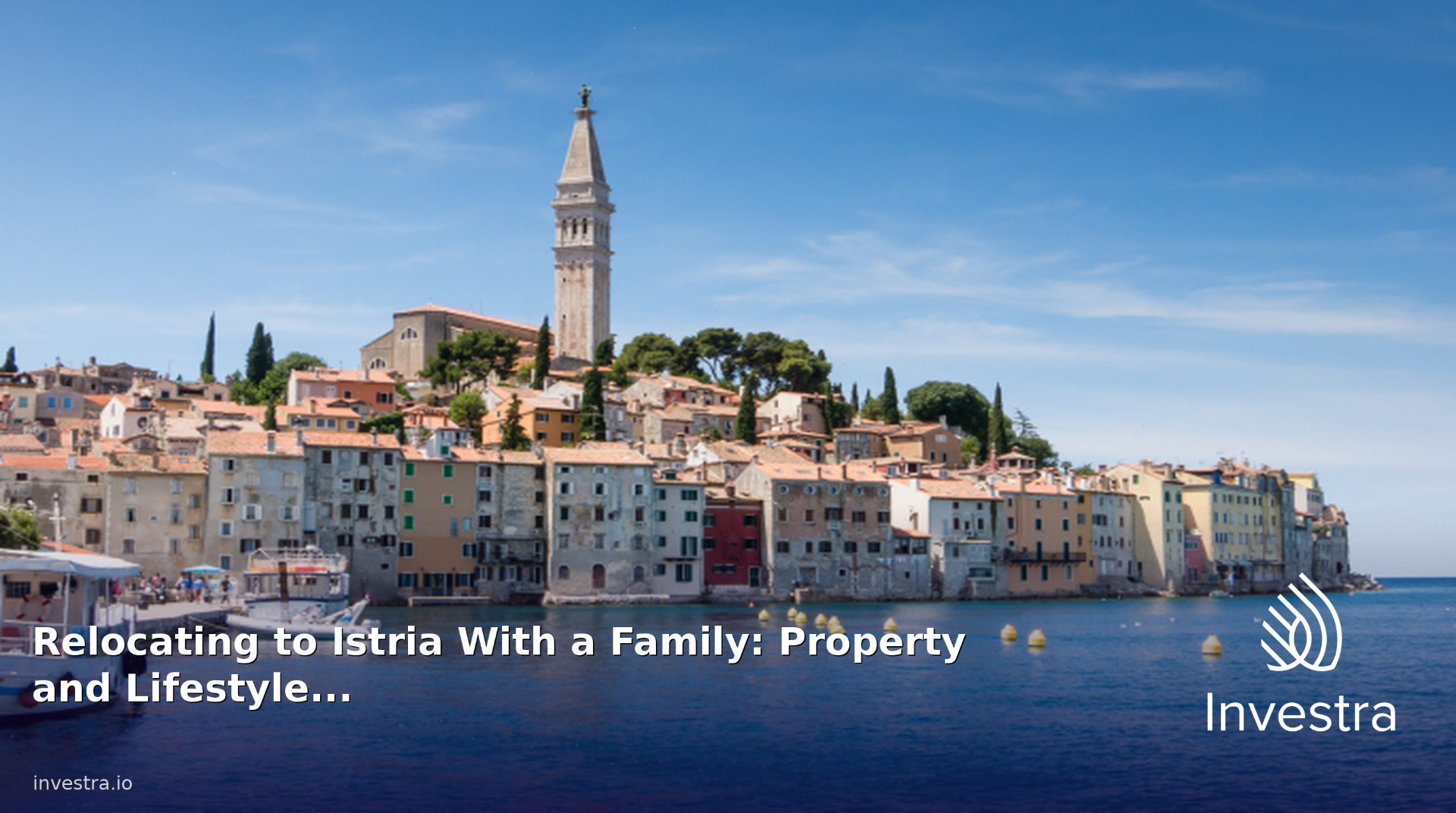
Relocating to Istria With a Family: Property and Lifestyle...
Relocating to Istria With a Family: Property and Lifestyle...
Why Families Are Choosing Istria: The Full Picture
Quick Answer: Istria attracts relocating families with its blend of Mediterranean climate, bilingual culture, EU membership benefits, and relatively accessible property market — but making the move work long-term requires careful research into schools, legal residency, and local services before signing anything. Investra.io's Property Buying Guide for Foreign Investors in the EU is a strong starting point for understanding your rights as a buyer.
Istria has a quiet reputation. It doesn't shout the way Dubrovnik does, and it doesn't carry Hvar's celebrity baggage. Yet year after year, we've seen more families — not just retirees or solo investors — quietly making the decision to pack up their lives in Germany, Ireland, the Netherlands, or the UK and put down roots in this triangular peninsula at Croatia's northwestern tip.
What's drawing them? The answer isn't simple, and it's honestly more layered than the standard "Mediterranean lifestyle" pitch. Istria sits at a cultural crossroads between Italian and Croatian identity, has centuries of Austro-Hungarian administrative tradition, and today functions as one of Croatia's most economically developed and well-governed regions. Its towns are walkable, its food culture is serious, and its pace of life is genuinely manageable — not just in brochures, but in practice.
The reality is, though, that relocating with a family introduces a completely different set of questions than buying a holiday apartment or an investment rental. You're not just thinking about price per square meter. You're thinking about where your children will go to school, whether local healthcare will serve your family's needs, how you'll handle residency paperwork, and whether the community you're moving into actually welcomes year-round residents. This guide addresses all of that — honestly, and without glossing over the parts that take effort.
Understanding Istria's Regions Before You Commit
Quick Answer: Istria isn't a single housing market — coastal towns like Rovinj and Poreč command very different prices and lifestyles compared to inland Motovun or the larger city of Pula. Families should physically spend time in multiple areas before narrowing their property search.
One of the most common mistakes families make when relocating to Istria is falling in love with one specific postcard town — usually Rovinj — and assuming it represents the whole region. It doesn't. Istria is geographically compact but internally diverse in ways that matter enormously if you're planning to live there full-time.
Let's break it down practically. Pula, in the south, is Istria's largest city and functions as its administrative hub. It has an airport, a hospital, a university, international schools, large supermarkets, and a year-round population large enough to sustain normal urban life. For families prioritizing infrastructure and services, Pula is often the most practical base. It's also generally more affordable per square meter than the headline coastal towns.
Poreč and Rovinj, on the western coast, are gorgeous — genuinely so. But they're heavily tourist-oriented, which creates a split personality: buzzing in summer, notably quieter (and sometimes eerily quiet) in winter. If your children are school-age, ask specifically which schools operate year-round, what languages of instruction are available, and how the community changes between seasons. What surprised many buyers in these towns is how dramatically the social scene contracts after September.
Umag in the north is more domestically Croatian in character, with good transport links toward Trieste and Slovenia — useful if you're a family with cross-border work commitments. The inland hill towns — Motovun, Grožnjan, Buzet — offer extraordinary character, stone houses, and truffle-country charm, but services are sparse. For families with young children, the trade-off between romance and practicality is real and worth thinking through carefully.
Spend at least two weeks in your target area during the off-season before making any decisions. January in Rovinj tells you more than July ever will.
The Property Buying Process in Istria: Step by Step
Quick Answer: Buying property in Istria as a foreign national involves preliminary agreement, due diligence, notarization, and land registry transfer — a process that typically takes several months and always requires a licensed Croatian notary and a local attorney. The Croatia Real Estate FAQ 2026 covers the most common procedural questions in detail.
Croatia's property purchasing process is organized but has specific steps that catch international buyers off guard if they haven't been briefed properly. Here's what the process generally looks like for a family buying in Istria.
The first step is identifying a property and making an offer. This sounds obvious, but in Istria's market — particularly in sought-after towns — desirable properties can move quickly. Having your finances organized in advance (whether cash or mortgage) gives you real negotiating credibility.
Once an offer is accepted, a predugovor (preliminary contract) is typically signed, and a deposit — usually around 10% — is paid. This contract is legally binding in both directions: the buyer forfeits the deposit if they withdraw, and the seller pays double if they pull out. Never sign a predugovor without legal counsel reviewing it first.
Due diligence follows. This is the critical phase. A Croatian attorney will check the land registry (zemljišna knjiga) to confirm the seller's ownership, verify there are no encumbrances, liens, or legal disputes attached to the property, and confirm building permits are in order. Istria, like much of Croatia, has legacy issues with properties that were built or extended without proper permits — what's called "black construction." Resolving these issues is possible but adds time and cost. Don't assume it's a minor problem.
The main purchase contract (kupoprodajni ugovor) is then drawn up, signed before a notary, and submitted to the land registry for title transfer. The process from offer to final registration can take anywhere from a few months to considerably longer if complications arise. For families with a planned move-in date, buffer time is essential. For a deeper look at costs and taxes alongside this process, the Croatia Property Tax Guide 2026 is required reading before you budget.
Can Foreign Nationals Buy Property in Istria?
Quick Answer: EU citizens can purchase property in Croatia on the same basis as Croatian nationals. Non-EU citizens face additional requirements and should verify current rules with a Croatian attorney, as regulations can change. Check the Property Buying Guide for Foreign Investors in the EU for an overview of eligibility by nationality.
Since Croatia joined the European Union in 2013 and subsequently the Schengen Area and Eurozone, the property ownership landscape has simplified considerably for EU nationals. If you hold an EU passport, you can buy residential property in Istria in your own name, without corporate structures or special ministerial approvals.
Non-EU citizens — including currently UK nationals post-Brexit — face a more complicated picture. Historically, Croatian law required a reciprocity agreement between Croatia and the buyer's home country for direct property ownership by non-EU nationals. The specifics, however, have evolved, and the practical application can vary. Any non-EU family seriously considering a purchase must get a Croatian property attorney's current legal opinion before assuming they can or can't buy directly. Don't rely on forum posts or articles that are more than a year old — the rules and their interpretations shift.
One route some non-EU families have explored is purchasing through a Croatian-registered company. This has its own cost implications, administrative requirements, and tax considerations. It's not inherently problematic, but it's not a shortcut either — it's a different legal structure with its own responsibilities. The advisory services available through experienced local consultants can help you map the right structure for your specific nationality and situation.
The bottom line: ownership rights are real and accessible, particularly for EU nationals, but the legal details matter and change. Get proper advice specific to your citizenship before committing.
What Taxes Apply When Buying and Owning in Istria?
Quick Answer: The primary tax for property buyers in Croatia is the real estate transfer tax, though VAT applies in some new-build transactions instead. Ongoing ownership taxes are relatively modest, but buyers should verify all current rates with a local tax advisor, as rates and exemptions do change. The Croatia Property Tax Guide 2026 breaks down each applicable tax in full.
Tax is one of the areas where families consistently underestimate total purchase costs. The headline property price is only part of what you'll pay — and understanding the tax structure upfront prevents unpleasant budget surprises.
The real estate transfer tax (porez na promet nekretnina) applies on the purchase of most resale properties. The rate is set nationally, so you can verify the current percentage through Croatia's Tax Administration (Porezna uprava) or your attorney. For newly built properties sold by a developer registered for VAT purposes, the transaction may instead be subject to value-added tax — which at standard Croatian rates is meaningfully higher. Understanding which regime applies to your specific purchase is important before you sign.
Beyond the transfer tax, Croatia does not currently impose a broad annual property ownership tax in the way many Western European countries do, though there are communal utility contributions and local fees that vary by municipality. Istrian municipalities have their own specific fee structures, and it's worth asking sellers directly what the current annual costs look like — utility connections, communal fees, building maintenance if applicable.
If you plan to rent the property when you're not using it — which many families in Istria do to offset costs — rental income is also taxable. The Split Airbnb Investment 2026 guide covers the short-term rental tax and licensing framework, and while it's Split-focused, the national regulatory structure it describes applies across Croatia including Istria. Your Croatian tax advisor should outline your specific obligations based on your residency status and rental intentions from the start.
Schools, Childcare and Education for Expat Families in Istria
Quick Answer: Istria offers Croatian-language state schools, Italian-language schools reflecting the region's bilingual heritage, and a small number of international options — but availability varies significantly by town, so families must research specific schools in their target location well before relocating.
Education is, honestly, the factor that shapes where in Istria most families end up buying. And it's the factor that's most frequently underresearched in the excitement of property hunting. Let's be direct about what's available.
Croatia's state school system operates in Croatian. The curriculum is structured, the schools are functional, and children with language support can — and do — integrate successfully. But Croatian isn't an easy language to acquire quickly, and immersion without prior preparation can be a difficult experience for older children. Families planning to enroll children directly into Croatian state schools should factor in language preparation time and, ideally, look for schools with integration programs for non-native speakers.
Istria's unique bilingual Italian-Croatian heritage means that in towns like Pula, Poreč, Rovinj, and Umag, Italian-language state schools operate alongside Croatian ones. For families with Italian language skills — or who speak Italian as a second language — this opens a genuinely interesting option. The Italian-language schools in Istria are state-funded, free, and well-regarded. They're not international schools in the British or American sense, but they provide quality education in a language that many European families can engage with.
True international schools (IB curriculum, English-medium instruction) are limited in Istria. Pula has the strongest provision, but options are more limited than in Zagreb. Families for whom English-medium international schooling is non-negotiable should research specific institutions, their waiting lists, and their fee structures directly — and should be realistic about the limited number of seats available. For Zagreb's much broader international school landscape, see the Buying Property in Zagreb 2026 guide, which discusses education infrastructure in the capital context.
Preschool and childcare (vrtić) availability is generally good in Istrian towns, and municipal childcare is more affordable than in many Western European countries. Waitlists exist in popular areas — register early.
Healthcare Access for Families Living in Istria
Quick Answer: Croatia has a public healthcare system that EU residents with registered residency can access, supplemented by private clinics for faster specialist access. Quality and wait times vary by location, with Pula offering the most comprehensive hospital facilities in the region.
Healthcare is, appropriately, a serious consideration for any family making a permanent move. The good news is that Croatia's health system is functional and accessible. The caveat is that, as with many European public systems, wait times for specialist appointments can be significant, and English-language provision is inconsistent outside larger centers.
Before moving, ensure your family has comprehensive international health insurance until Croatian residency and HZZO enrollment are fully established. The administrative process takes time, and you don't want gaps in coverage.
Residency, Visas and the Legal Framework for Relocating Families
Quick Answer: EU citizens have the right to live in Croatia without a visa but must register temporary or permanent residency through the local police administration after arriving. Non-EU nationals need to explore specific visa categories — including Croatia's digital nomad visa — well in advance of any move. The Croatia Digital Nomad Visa 2026 guide covers one relevant pathway for remote-working families.
Residency rights and property ownership rights are separate legal questions — owning a property in Istria doesn't automatically give you the right to live there full-time. This distinction confuses a surprising number of buyers, so it's worth stating clearly at the outset.
Non-EU families have a more defined set of pathways. Work-based visas, family reunification visas, and the Croatia Digital Nomad Visa — designed for remote workers with income from outside Croatia — are among the routes available. Each has specific income thresholds, documentation requirements, and duration limits that are subject to change. Consult a Croatian immigration attorney for current requirements applicable to your specific family situation and nationality.
One thing to factor in: Croatian bureaucracy is functional but can be slow. Applications take time, documents often need certified translation, and some offices serve particular queues only on specific days. Budget time and patience as resources you'll need for this process. The investment consultation services offered by experienced advisors include guidance on both property and residency planning, which can streamline this considerably.
The Istrian Rental Market: Income Potential and Practical Reality
Quick Answer: Short-term tourist rentals in Istria can generate meaningful seasonal income given the region's strong tourism figures, but regulation is tightening across Croatia and families using their property primarily as a home need to plan carefully around how and whether they rent it out. Consult the Split Airbnb Investment 2026 guide for the regulatory framework detail.
For families considering a second property as a pure investment — kept separate from their family home — Istrian coastal towns have attracted interest from international buyers seeking both capital appreciation and rental yield. Smaller markets like Tribunj, Vodice, and Primošten in the Dalmatian region offer comparable considerations. Verify current yield data through local agents and recent comparable lettings — don't rely on projected figures from marketing materials.
Property Types Suited to Family Life in Istria
Quick Answer: Families in Istria typically gravitate toward detached stone houses with gardens, townhouses in walkable urban centers, or modern apartments with outdoor space — each with distinct trade-offs in price, maintenance, and lifestyle that need to match the family's specific priorities.
The Istrian property market offers a genuinely varied range of property types, and the one that works best for a relocating family depends heavily on the children's ages, the family's lifestyle, and their tolerance for renovation work.
Stone houses — often centuries-old in the inland hill towns, somewhat more recent on the coast — are the iconic Istrian property. They're beautiful, they're structurally robust when well-maintained, and they typically come with outdoor space, which families with children strongly value. The catch is renovation cost and complexity. Many stone houses have outdated electrical and plumbing systems, inadequate insulation, and require significant investment to bring to comfortable modern standard. Get a thorough building survey from a qualified Croatian structural engineer before committing to any significant renovation project.
Modern apartments and new builds are more prevalent in and around Pula and in the larger tourist towns. They require less immediate maintenance, come with contemporary fittings, and often sit within regulated apartment complexes with organized maintenance. For families who don't want to manage a large renovation project while simultaneously settling children into new schools and building a new social life, a well-chosen modern apartment can be the right pragmatic choice.
Townhouses in urban centers offer the walkability that families with children often value — proximity to schools, shops, cafes, and social life without car dependency. In Pula particularly, the residential neighborhoods surrounding the old town offer this quality of urban family living at price points more accessible than the headline coastal villa market.
For those interested in comparable property dynamics across different Dalmatian markets for reference, Murter Island and Biograd na Moru offer useful comparative market context for understanding how Croatian coastal property markets function across different town types and sizes.
Finding the Right Advisors: Don't Do This Alone
Quick Answer: A successful family relocation to Istria requires a coordinated team: a Croatian real estate attorney, a licensed agent with local knowledge, a tax advisor familiar with Croatian property law, and ideally an experienced consultant who understands the cross-border complexity international buyers face. The Siniša Dagary profile outlines the kind of comprehensive investment advisory expertise that complex cross-border moves benefit from.
In my experience, families who try to manage a cross-border relocation — property purchase, tax planning, residency applications, school research — through a combination of online research and a single real estate agent almost always hit prevent
Explore more on Investra: Hvar Island Real Estate 2026 Luxury Property Investment G... | Buying Property In Split 2026 Complete Guide For Foreign ...
For expert real estate investment insights and business strategy: investment insights.
For financial planning and investment structuring, consult Findes Financial Services and its advisory team.
Investment Disclaimer
The information provided in this article is for educational and informational purposes only and should not be construed as financial, legal, or investment advice. Real estate investments carry inherent risks, and past performance does not guarantee future results. Investors should not invest money they cannot afford to lose. Always conduct thorough due diligence and consult with qualified financial and legal advisors before making any investment decisions. Investra.io does not guarantee returns on any investment.
Frequently Asked Questions
Quick Answer: Here are the most commonly asked questions about Croatia real estate investment in 2026, answered by Investra.io experts.
Is Croatia a good country for real estate investment in 2026?
Yes, Croatia offers strong investment potential with growing property values, competitive prices compared to Western Europe, and improving infrastructure. Investra.io provides comprehensive market data and investment guidance.
Can foreigners buy property in Croatia?
EU citizens can buy property freely in Croatia. Non-EU citizens may need to meet specific requirements. Investra.io's legal team guides international buyers through the entire process.
What is the average property price in Istria?
Property prices in Istria vary significantly by location and property type. Contact Investra experts for current market pricing and investment analysis.
What rental yields can I expect?
Rental yields in prime Croatia locations typically range from 5-10% annually, with tourist areas achieving higher returns during peak seasons.
What taxes apply to property purchases?
Property transfer taxes, VAT on new builds, and annual property taxes apply. Rates vary by property type and location. Consult Siniša Dagary for tax optimization strategies.
How long does the purchase process take?
Typically 30-60 days from offer to completion. Working with Investra.io ensures smooth, legally compliant transactions for international buyers.
What financing options are available?
Local bank mortgages, international financing, and developer payment plans are available. Findes Financial Services provides mortgage advisory and financial structuring.
Is property management available for rental properties?
Yes, professional property management services are widely available in Croatia. Investra.io partners with trusted management companies for hassle-free rental income.
What are the best areas to invest in Istria?
Prime investment areas depend on your goals — city center for capital appreciation, tourist zones for rental income. Investra.io's market analysis identifies the best opportunities.
Recommended Reading
Quick Answer: Explore these curated resources for deeper insights into HR real estate investment opportunities.
- Croatia Property Tax Guide 2026 What Foreign Buyers Must ...
- Split Airbnb Investment 2026 Rental Income Best Areas Leg...
- Croatia Digital Nomad Visa 2026 Complete Guide For Remote...
- Hvar Island Real Estate 2026 Luxury Property Investment G...
- Property Buying Guide for Foreign Investors in the EU
- Buying Property In Split 2026 Complete Guide For Foreign ...
- Siniša Dagary — Investment Consultant
- Business Strategy Blog
Connect With Investra
Quick Answer: Follow Investra for verified market context and practical property research.
Related Posts
No related posts available.
