
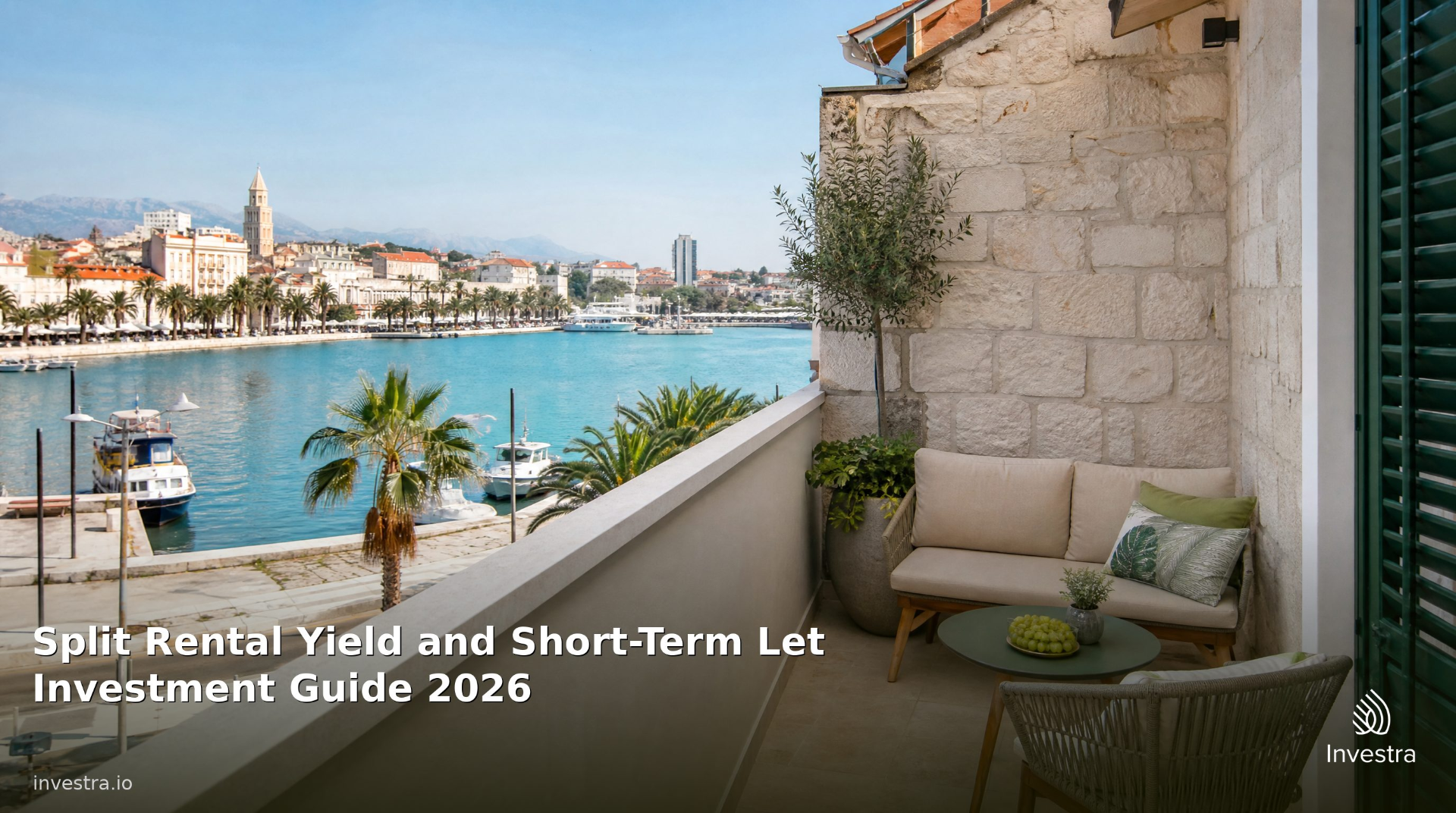
Split Rental Yield and Short-Term Let Investment Guide 2026
Why Split Is Capturing Global Investor Attention in 2026
Quick Answer: Split, Croatia's second-largest city and a UNESCO World Heritage site, offers investors rental yields of 6–10% annually, combined with steady capital appreciation and strong tourist demand; for a full acquisition walkthrough see Investra.io's Complete Guide to Buying Property in Split.
Split has moved from a regional capital to a Mediterranean market on many investors' radars. The city's position as a transport hub for the Dalmatian islands, its cruise port activity and year-round cultural calendar underpin demand for short-term accommodation. The city's shift to the euro in 2023, Schengen entry and sustained tourism recovery after the pandemic have reduced currency and travel friction for buyers and visitors alike.
Investor profiles have diversified. Beyond holiday-home owners, the market now sees professional investors from London, continental Europe and beyond targeting Split for income and diversification. That shift is visible in the stock of renovated stone apartments, targeted marketing for digital nomads and growth in professionally managed lettings. For readers seeking structured answers about wider Croatian market rules and investor questions, the Croatia Real Estate FAQ 2026: 50 Most Asked Questions Answered is a comprehensive resource that complements the local focus of this guide.
The market now offers a blend of yield and capital growth that appeals to income-focused buyers. Nightly rates and occupancy patterns vary by neighbourhood and product quality, and this guide highlights the levers that determine whether a purchase becomes a strong performer or an underwhelming holding.
Two supporting tailwinds continue to help the city: air connectivity and constrained heritage supply. Split Airport’s route network reaches deep into the UK, Germany, Scandinavia and Central Europe during peak months, which lifts both occupancy and ADR in the historic core. Inside and around Diocletian’s Palace, strict conservation rules limit the pipeline of new listings that can match international guest expectations.
Split Property Price Landscape: Where Values Stand in 2026
Quick Answer: Prices in Split range roughly from €3,500/m² in peripheral residential areas to €8,000+/m² in the Old Town; the most investable sweet spot is typically €4,500–€6,500/m² in well-connected historic neighbourhoods.
Price appreciation since 2019 has been material, with prime coastal and Old Town assets having outperformed broader city averages. While the aggressive double-digit growth years have subsided, mid-single-digit annual appreciation in 2026 makes Split attractive to investors seeking both income and eventual capital gains. Typical market tiers reflect access, heritage status and sea views.
New-builds and boutique renovations now sit alongside restored historic units. Development activity is focused on infill and sympathetic restorations in the palace-adjacent zones, while peripheral new-builds provide modern finishes at lower per-square-metre prices. The combination of scarcity inside protected areas and strong demand from experience-driven travellers sustains the top-end pricing band.
Investors should review detailed neighbourhood analysis before committing. Investra's Split buyer guide contains neighbourhood-by-neighbourhood breakdowns and valuation comparables; interested readers should consult the full buyer guide for transactional context and practical checklists.
Practical pricing examples help frame expectations. A compact 35–45 m² one-bedroom with tasteful renovation in Varoš or Manuš can price around €5,000–€6,000/m², while a palace-wall gem with preserved stone and high ceilings can exceed €8,000/m² when presentation and access are excellent.
Understanding Rental Yields: Short-Term vs. Long-Term Returns
Quick Answer: Short-term rentals in Split typically deliver gross yields of 7–10% with net yields in the 6–8.7% range after fees and taxes, while long-term lets commonly yield 3.5–5% but offer lower operational intensity.
Gross yield provides a headline figure but can mislead when used alone. The distinction between gross and net yields is critical; platform commissions, property management, cleaning, utilities and maintenance reduce the headline return. A realistic revenue model for a well-specified one-bedroom in a prime zone shows seasonally weighted income and a meaningful difference between gross and net figures.
Consider hybrid leasing models that combine short-term income in the high season with medium-term lets in low months. The rise of Croatia's digital nomad visa ecosystem has broadened demand for furnished medium-term lets from November to March, supporting steadier annualised yields. Investors increasingly blend short-term platforms with corporate or nomad contracts to manage vacancy and keep operating margins healthy.
Net yield depends on control of operating costs and tax efficiency. Some hosts elect for the local flat-rate tourism taxation system (paušalno oporezivanje) when it is advantageous; others prefer company structures that allow broader expense deductions and VAT strategies. For a deep examine tax options and their impact on yield, consult Investra's tax guidance and the Croatia Property Tax Guide 2026.
A simple example illustrates the mechanics. Suppose a 42 m² one-bedroom near the Riva averages an ADR of €140 in July–August at 92% occupancy, €110 in May–June and September–October at 78% and €70 in shoulder months with selected medium-term bookings. After OTA fees, cleaning, utilities, reserve for replacement and a 15–20% management fee, the net stabilised yield on a €250,000 all-in basis can sit around 6.5–7.8% depending on taxation route.
The Best Neighborhoods in Split for Short-Term Rental Investment
Quick Answer: Varoš, Manuš, and the Diocletian's Palace zone lead for short-term rental performance due to proximity to UNESCO sites, the Riva and ferry access; Bačvice offers a beach premium and Spinut/Trstenik are stronger for long-term tenancy.
Short-term rental guests centre their stays around walkability to the palace, waterfront dining and quick access to island ferries. The most efficient investment locations mirror tourist flows: historic quarters with an authentic feel and easy logistics. The Diocletian's Palace zone remains the pinnacle, commanding top nightly rates for unique, well-appointed units.
Varoš and Manuš represent a balance of authentic appeal and investment practicality. These neighbourhoods support strong occupancy and commanding nightly rates without the extreme premium or regulatory strictures sometimes associated with properties within the palace walls. Bačvice provides a different kind of demand: proximity to a popular urban beach appeals to a younger segment that pays for proximity to sea-based leisure.
Buyers should compare comparable listings on platforms and consider guest experience factors: immediate access to the Riva, straightforward key-exchange logistics, elevator access for higher-floor apartments and noise profiles. A property that looks attractive on a price-per-square-metre basis can underperform if it fails on guest convenience and listing attractiveness.
Micro-location often separates top performers from average assets. In uphill streets behind the Riva, steps can be steep and luggage handling matters; units with close taxi drop-off or well-briefed porter assistance reduce friction and drive better reviews. Buildings with solid sound insulation outperform those near late-night venues, and simple conditions like cross-ventilation and shade affect summer comfort.
Legal Framework for Short-Term Rentals in Split
Quick Answer: Hosts must register properties with the local tourism office, comply with the Croatian Tourism Act, remit tourism tax and register appropriately for income tax; the registration and classification process typically takes 2–6 weeks.
Croatian short-term rental regulation is structured and predictable, which benefits investors who prioritise clear compliance. Registration with the local tourism authority (Turistička zajednica) categorises properties and sets the tourism tax bands. Platforms like Airbnb increasingly automate tourism tax collection in Croatia, simplifying remittance for hosts.
Tax registration is mandatory; hosts can choose a simplified flat-rate taxation in many circumstances or operate through a company structure where corporate taxation and VAT regimes apply. The choice affects how deductible expenses, depreciation and VAT recovery are treated. Given the variety of tax options, many investors coordinate with Croatian tax advisors and legal counsel to determine the most efficient structure for their situation. A practical summary of tax rules is available in Investra's Croatia Property Tax Guide 2026.
Regulatory trends are important to monitor. While Split has not introduced caps identical to Dubrovnik's tightened regime, local authorities continue to evaluate short-term rental impacts on housing supply and neighbourhood life. Purchasing under current regulations provides a degree of grandfathering, but long-term investors should monitor municipal consultations and national policy developments.
Compliance also includes operational obligations. Every guest must be registered in the national eVisitor system within statutory timelines, and hosts should maintain accurate records that match payouts from OTAs or direct channels. Fire safety basics — smoke detectors, fire blanket, clear evacuation guidance — are expected in quality listings.
The Buying Process: How Foreign Investors Acquire Property in Split
Quick Answer: EU buyers can acquire property with minimal restriction; non-EU buyers use reciprocity or Croatian company structures; the transaction completes typically within 60–90 days from offer to registration, subject to due diligence and financing.
Practical transaction steps remain familiar to experienced international buyers: instruct a Croatian lawyer to perform Land Registry and cadastral checks, agree terms in a preliminary contract with a standard deposit, conclude the notarised purchase contract and register the transfer. Legal and notary fees, transfer taxes and agent commissions are predictable costs to budget alongside purchase price.
Non-EU buyers commonly route purchases through a Croatian limited liability company (d.o.o.) to remove ownership formalities and to streamline management. For tailored acquisition structures and cross-border implementation, specialist advisors can outline incorporation requirements and ongoing compliance. Readers can obtain practical consultancy through established regional specialists such as Siniša Dagary investment insight or the broader Investra acquisition resources.
Detailed step-by-step guidance is available in Investra's transactional guidance, and the complete stepwise process for buyers is documented at Investra.io's Complete Guide to Buying Property in Split, which consolidates legal checklists, typical timelines and a recommended team composition for foreign investors.
Two practical points reduce friction. First, secure a Croatian OIB (tax number) early; banks, notaries and utilities require it, and issuance is straightforward with identification. Second, verify the legalisation status of any alterations — enclosed balconies, mezzanines and redistributed internal walls must align with recorded plans.
Financing Options and Capital Requirements for Split Investments
Quick Answer: Croatian banks offer mortgages to foreign buyers (commonly 60–70% LTV at prevailing rates around 4–6%), but many international buyers prefer cash purchases or specialist cross-border finance; consult cross-border advisers like Findes Group & Partners for structuring options.
Financing choices materially change cash-on-cash returns and exposure. Croatian bank mortgage offerings are available to non-resident buyers but require documentation and local administrative steps, including a Croatian tax number (OIB). Interest rates in 2026 are competitive relative to prior cycles, but use amplifies both downside seasonal pressure and upside returns during strong trading years.
Alternatives to local mortgages include developer staged payments on off-plan units, equity release in the buyer’s home market and specialist lenders that package cross-border mortgages. Several buyers opt for cash acquisitions to accelerate closings and avoid foreign lending due diligence. Specialist providers such as Findes Group & Partners and regional advisory teams provide comparative financing routes and can source competitive terms for international purchasers.
Budgeting guidance: expect to allocate 5–8% of the purchase price for transaction costs in addition to the purchase sum — transfer tax, notary, legal fees and agents' commissions. For a market entry one-bedroom in a desirable zone, realistic total acquisition cash requirement (including minor renovation and operating reserves) often begins in the €180,000–€250,000 range; two-bedroom prime units commonly require €300,000+.
When assessing debt, test sensitivity to interest rate shifts and occupancy dips. Aim for a debt service coverage ratio comfortably above 1.3x on conservative off-season assumptions, and confirm whether the loan includes rate resets, early repayment fees or currency clauses. If you finance through a company, map the interaction between VAT, deductible interest and local flat-rate schemes to avoid suboptimal outcomes.
Seasonal Dynamics and Revenue Management Strategy
Quick Answer: June–September generate 55–65% of annual short-term rental revenue; effective revenue management, dynamic pricing and a clear off-season leasing plan are essential to maximise annualised returns.
Seasonality drives both cash flow planning and operational choices. The peak four months deliver the largest share of revenue. This means that optimising occupancy and average daily rate (ADR) during shoulder months yields disproportionately large annual benefit.
Operationally, professional management that uses automated pricing engines and real-time market data consistently outperforms static-pricing hosts. Many local managers couple algorithmic pricing with channel management to balance direct bookings and OTA exposure.
Off-season strategies vary by investor profile. Some owners secure medium-term tenants such as remote workers or corporate travellers; others apply promotional pricing and targeted marketing aimed at regional visitors. The growing digital nomad community, discussed in Investra's guide to the digital nomad visa ecosystem, has become a valuable winter demand source when furnished, well-located apartments are available on monthly terms.
Fine-tuning tactics can lift returns meaningfully. Use minimum-stay rules that expand during peak to reduce cleans and protect ADR, then lower them in shoulder periods to capture short gaps. Build a direct-booking channel to reduce reliance on single OTAs and encourage repeat visitors through loyalty pricing.
Management, Operations and Guest Experience
Quick Answer: Superior guest experience — rapid communication, professional cleaning, transparent check-in and quality amenities — raises occupancy and rates; most investors use professional property managers for full-service operations.
Guest experience is the operational heart of short-term rental success. Reviews and host responsiveness influence search rank and conversion materially. Top-performing listings invest in professional photography, provide clear arrival instructions, supply high-speed internet and maintain a consistent cleaning and maintenance schedule.
Costs to budget include cleaning, linen replacement, repairs, platform commissions and utilities. Effective outsourcing to reputable local providers often reduces net operating overhead and improves listing performance compared with ad hoc self-management.
For strategic frameworks on operational scaling and portfolio optimisation, see advisory resources such as Siniša Dagary investment insight, which outlines approaches to portfolio-level operations for regional investors.
Baseline amenities in Split’s competitive set now include fast Wi‑Fi, quality mattresses, blackout curtains, smart locks, effective air‑conditioning and a stocked kitchenette. Simple add-ons — filtered water, beach towels, umbrellas and a concise local guide — elevate perceived value. Where buildings allow, external key boxes with clear instructions reduce late-night support needs.
Exit Strategies and Capital Growth Considerations
Quick Answer: Plan exits around market cycles, regulatory changes and renovation milestones; Split's mix of yield and capital appreciation supports both hold-for-income and medium-term flip strategies depending on purchase timing and asset quality.
Exit planning should inform acquisition decisions. Buy-and-hold investors prioritise cash flow and property durability, while opportunistic investors look for assets where a renovation and re-marketing can deliver a valuation uplift within a 2–5 year horizon.
Market comparables and historical pricing trends are useful but not determinative. Local infrastructure projects, shifts in tourism seasonality and regulatory adjustments can materially affect demand. Track municipal planning proposals and tourism policy discussions closely. Investra's broader market reports and region-specific guides, such as those covering Dubrovnik, Hvar and mainland Croatian markets, provide context for relative value and exit timing. Related reading: Dubrovnik Airbnb Investment 2026 guide, Hvar Island Real Estate 2026 guide and broader Croatian market studies by Investra.
For bespoke exit planning and tax-efficient disposal strategies, investors often consult with local tax advisors and transaction specialists to model net proceeds after tax, fees and capital improvements.
On the ground, plan your exit as if you were a future buyer. Keep accurate records of ADR, occupancy, channel mix, guest acquisition costs and maintenance history; this data supports valuation and shortens buyer diligence. If the asset has room for a refresh, time minor upgrades and new photography ahead of listing to present a clean growth story.
Investment Disclaimer
Quick Answer: This article presents informational content about the Split property market in 2026; it is not a personalised recommendation — investors should perform their own due diligence and consult qualified local advisers before acting.
The material in this guide is provided to increase understanding of the Split real estate market and the operational realities of short-term rentals. Real estate involves capital risk, liquidity constraints and varying regulatory exposure. Readers are encouraged to validate facts, review legal and tax obligations with licensed professionals and ensure investment decisions align with personal financial circumstances.
Frequently Asked Questions
Quick Answer: Below are common questions from prospective buyers and investors in the Croatian market with concise answers and references to further reading.
Is Croatia a good country for real estate investment in 2026?
Croatia continues to attract investors due to tourism recovery, euro adoption and EU membership benefits. Market suitability depends on objectives: yield-focused investors often favour Split and island destinations, while capital-appreciation buyers may select historic cores or limited-supply waterfront locations. For broader market context consult Investra.io's Croatia FAQ.
Can foreigners buy property in Croatia?
EU citizens face minimal restrictions. Non-EU buyers commonly acquire through a Croatian company (d.o.o.) or rely on reciprocity treaties where applicable. Legal counsel should confirm current rules and structure acquisitions appropriately; Investra's buying guides include stepwise guidance for foreign buyers.
What is the average property price in Split?
Prices vary widely by neighbourhood and condition. In 2026 typical ranges are €3,500–€8,500/m² depending on location and heritage status. For detailed comparables and neighbourhood breakdowns see Investra's Split buyer guide.
What rental yields can I expect?
Short-term rentals in prime Split locations commonly realise gross yields of 7–10% with net yields after costs around 6–8.7%; long-term residential lets typically yield 3.5–5%. Yield outcomes depend on management, seasonality and tax structure.
What taxes apply to property purchases?
Transfer tax (commonly 3% for resales), VAT on some new builds and municipal tourism taxes apply. Croatia also offers simplified flat-rate taxation for hosts in many cases. See the Croatia Property Tax Guide 2026 for technical detail.
How long does the purchase process take?
Execution from offer to occupancy often completes in 30–90 days, depending on whether financing is required and on the speed of Land Registry registration. Early-stage due diligence and legal checks should be expected to take 1–3 weeks prior to signing preliminary contracts.
What financing options are available?
Croatian bank mortgages, developer payment plans, equity release in the buyer's home market and specialist cross-border lenders are all available. For cross-border finance solutions see specialist advisors such as Findes Group & Partners.
Is property management available for rental properties?
Yes. A mature market of property managers provides full-service hosting, cleaning, guest communication and maintenance. Many investors choose professional management to protect yields and simplify compliance with local regulations.
What are the best areas to invest in Split?
Varoš, Manuš and the Diocletian's Palace zone are the most consistent performers for short-term rental income. Bačvice appeals to beach-focused demand. For longer-term appreciation, carefully selected palace-adjacent restorations and high-quality new-builds with sea views are attractive options.
How do I choose between short-term and long-term letting?
Evaluate your tolerance for operational involvement, the desired yield target and your need for predictable cash flow. Short-term rentals require active management but can deliver higher yields; long-term lets reduce administrative burden and provide stable occupancy but lower returns. A hybrid approach is common in Split, combining summer short-term lets with medium-term winter lets to digital nomads and corporate tenants.
Who can help with acquisition and tax structuring?
Engage a Croatian lawyer for title checks and a local tax adviser for structuring. For cross-border acquisition support and investment advisory consider specialists such as Siniša Dagary investment insight and the advisory resources available through Investra's market research pages.
Recommended Reading
Quick Answer: This section explains the practical property-investment implications of Recommended Reading.
- Investra market research
- Investra market research
- Investra market research
- Investra market research
- Investra market research
- Investra market research
- Investra market research
- Investra market research
- Investra market research
- Investra market research
- Investra market research
- Investra market research
- Investra market research
- Investra market research
- Investra market research
- Investra market research
- Investra market research
- Siniša Dagary investment insight
- Siniša Dagary investment insight
- Siniša Dagary investment insight
- Siniša Dagary investment insight
- Siniša Dagary investment insight
- Findes Group & Partners
Related Posts
No related posts available.
